
What you’ll learn in this article…
- Curating three or four top publications and one monitoring tool delivers roughly 80 percent of your trend intelligence.
- Organizations like PRSA, IABC, and NCA offer conferences, research, and peer networks that sharpen competitive awareness.
- Free tools such as Google Trends and Talkwalker Alerts provide real-time monitoring without straining your budget.
- A master's in communications builds the research and analytical framework needed to separate lasting shifts from short-lived hype.
Platform algorithms shift quarterly, generative AI rewrites content workflows in months, and audience behavior data from two years ago is already outdated. For communications professionals, the pace of change has become a career variable in itself, not just background noise.
Most practitioners recognize the problem. They know they should be tracking what is happening in media relations, internal communications, social strategy, or brand journalism. What they lack is a repeatable system for doing it without spending hours each week sifting through noise.
Three practical approaches address that gap directly: curating a lean stack of publications, newsletters, and podcasts; plugging into professional associations that publish primary research; and using digital monitoring tools to catch signals in real time. Together, they form a sustainable routine, not a one-time audit.
Why Staying Informed on Communication Trends Matters for Your Career
The communication field is undergoing a fundamental transformation as artificial intelligence reshapes how messages are created, distributed, and measured.
The Accelerating Pace of Change
According to Gallup, half of U.S. workers already used AI on the job in 2025, and 41% of organizations had integrated it into their operations.1 The 2026 Stanford AI Index Report projects that 53% of the global population will adopt generative AI tools within three years.2 For communication professionals, this velocity means the tools, platforms, and skills that define the field are shifting faster than any single degree or certification can cover. Staying informed isn't simply about keeping up; it's about protecting your career relevance.
Where to Find Reliable, Actionable Trend Data
Tuning out the noise requires turning to sources that combine rigor with practitioner focus. Start with these:
- Bureau of Labor Statistics (BLS.gov): Occupational outlook reports for communication roles go beyond employment projections to highlight emerging tools and skill demands. They give you a long-view context for which trends have staying power.
- Professional associations: Annual surveys from PRSA (Public Relations Society of America) and IABC (International Association of Business Communicators) track AI adoption, platform usage, and shifting priorities directly from the practitioners shaping the field.
- LinkedIn Workforce Reports and Learning Hub: Real-time data on the fastest-growing skills shows what employers are hiring for right now. This is a direct line to the competencies that can accelerate your next career move.
- University curriculum updates: When top programs like Northwestern and USC add courses or tools, they're responding to employer demand. Monitoring their curriculum changes can signal where the industry is headed before it becomes obvious.
Turning Insight into Career Advantage
Staying informed positions you as a strategic thinker rather than a reactive executor. When you can anticipate shifts, like the rise of AI-powered analytics or the decline of a once-dominant social platform, you can proactively build the skills that your organization will need, advocate for new tools, and shape messaging strategy around emerging channels. This kind of foresight is what separates managers from directors and keeps your earning potential on an upward trajectory. It also helps you evaluate whether pursuing advanced education, such as careers with a masters in communication, aligns with where the industry is heading.
1. Curate Industry Publications, Newsletters, and Podcasts
Curating your media diet means hand-picking a short list of publications, newsletters, and podcasts that reliably deliver news and analysis in the communication subfields you care about most. Rather than skimming every headline that crosses your feed, you build a focused reading stack, evaluate each source for quality, and rotate selections so your perspective stays fresh.
Recommended Sources by Subfield
The landscape of communication media is broad, so organizing by specialty helps you zero in on what matters for your role.
- PR and Corporate Comms: PR Daily publishes multiple times per day and excels at speed, surfacing breaking stories within hours. PRWeek offers deeper, reported features with strong sourcing from named practitioners and agency leaders. Spin Sucks, Gini Dietrich's long-running newsletter and blog, blends opinion with research-backed analysis, making it especially useful for strategic thinkers who want context alongside the headlines.
- Digital Marketing and Brand-Side Comms: Marketing Dive delivers concise, data-rich briefings almost daily, covering ad tech shifts, platform policy changes, and campaign case studies. The Drum provides international breadth, with correspondents in London, New York, and Singapore reporting on creative strategy and brand performance. Campaign rounds out the trio with award-caliber long-form features and trend forecasts.
- Internal Communications: Ragan Communications runs a dedicated internal-comms channel with practitioner-written articles, webinar recaps, and survey data on employee engagement. CommsWeek, Ragan's annual virtual event series, compiles on-demand sessions that function almost like a mini-course throughout the year.
- Crisis Communications: Crisis Response Journal covers incident management, reputation recovery, and organizational resilience. It publishes less frequently than daily outlets, but its sourcing draws on firsthand accounts from crisis teams, giving it a depth most trade sites cannot match. For a closer look at how these principles apply in higher education, see this examination of campus crisis communication best practices.
Evaluating Each Source
Before adding anything to your rotation, weigh three dimensions. Speed of coverage tells you how quickly a source reports breaking developments. Depth of analysis reveals whether you are getting surface-level summaries or expert commentary grounded in data. Credibility and sourcing indicate whether the outlet names its sources, cites research, and discloses potential conflicts of interest. PR Daily scores high on speed; Spin Sucks and Crisis Response Journal score higher on depth. PRWeek and Marketing Dive tend to balance all three dimensions well. Deloitte's 2026 Technology, Media and Telecommunications Industry Outlook notes that the pace of change across media and telecom continues to accelerate, which makes speed-versus-depth trade-offs even more important to understand when selecting your sources.1
How to Avoid Information Overload
Start with three or four sources, ideally one from your primary subfield, one from an adjacent area, and one broader industry outlet. That mix keeps you grounded in your specialty while exposing you to ideas you might otherwise miss. If you work in social media marketing or management, for example, pairing a digital marketing outlet with a crisis comms journal can surface risks you would not catch otherwise. Set a quarterly reminder to swap one source out for something new. Rotating prevents echo-chamber thinking and introduces you to emerging voices. If a publication consistently fails on any of the three evaluation dimensions, drop it and backfill from the list above.
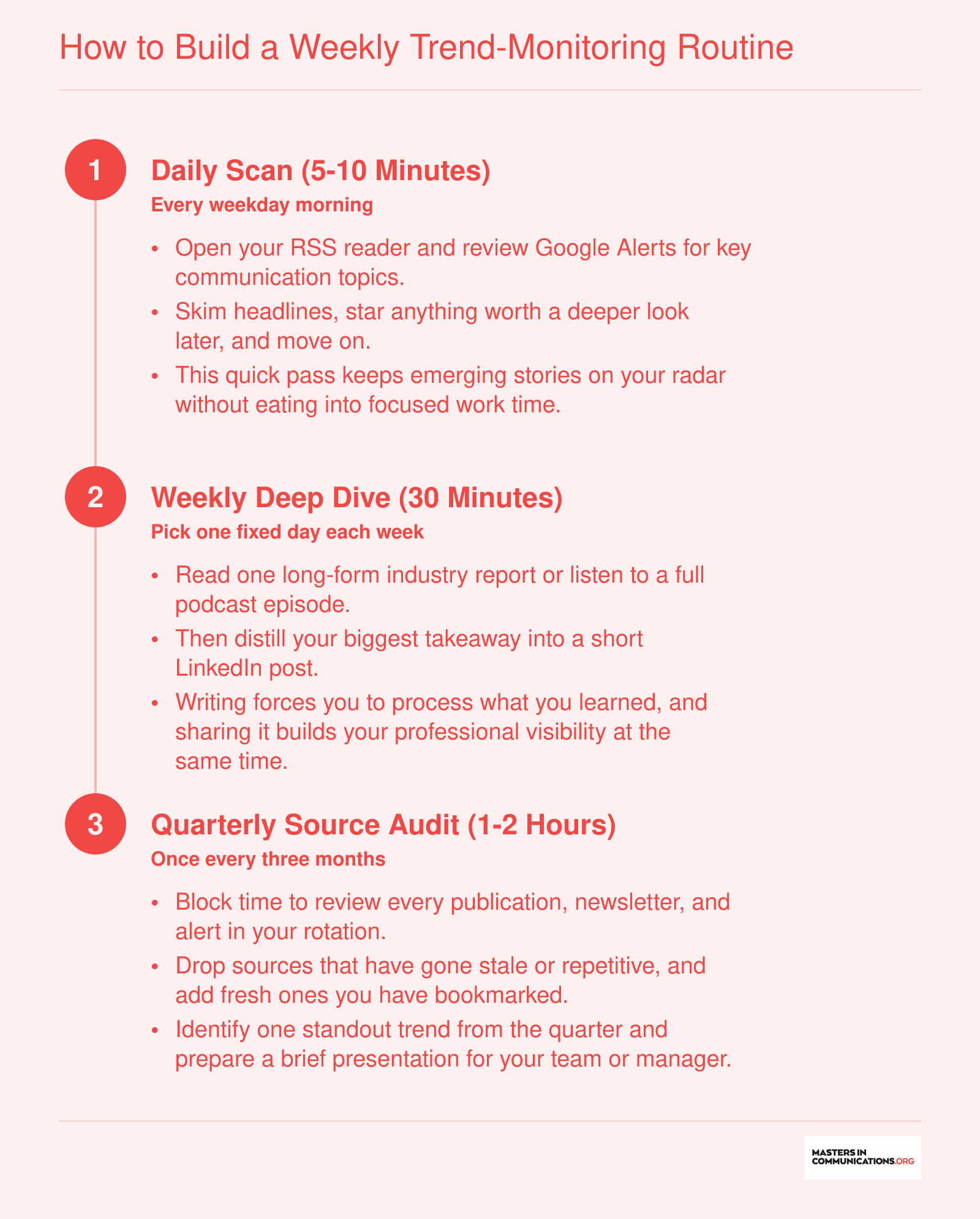
This approach turns trend monitoring from a firehose into a manageable, even enjoyable, part of your weekly routine, something the infographic later in this article maps out step by step.
Questions to Ask Yourself
2. Join Professional Associations and Attend Events
What professional associations are worth your time, and your money, if you want to stay informed on communication trends? The answer lies in a handful of organizations that combine peer networking, formal learning, and proprietary research into a single membership. For communicators who treat trend awareness as a career advantage, these memberships do the heavy lifting of curation and credentialing.
The Major Players and What They Offer
- PRSA (Public Relations Society of America): With regular individual dues of $273 per year and a one-time $65 initiation fee, PRSA provides access to live and on-demand webinars, an extensive job center, and local chapter events.1 Its flagship ICON conference, held each fall, brings thousands of practitioners together for keynotes and breakout sessions. Graduate students can join for just $73 annually, making it an early-career bargain.1
- IABC (International Association of Business Communicators): IABC opens doors across industries with a globally minded community. Annual professional membership runs about $325, while students pay roughly $50. Members gain research reports, a career center, and discounted registration for the summer World Conference, one of the sector's most diverse gatherings. Local chapters often add monthly programming, from digital ethics panels to measurement bootcamps.
- NCA (National Communication Association): More academically focused but still vital for trend tracking, NCA supports scholars and practitioners alike. Dues typically range from $100 to $200, depending on membership level. The November convention is a hub for emerging theory and research, with hundreds of sessions on everything from crisis communication to media psychology. Even if you never submit a paper, attending can surface ideas years before they hit the mainstream.
- Arthur W. Page Society: This invitation-only group serves senior-level communication executives. While it doesn't publish public dues, its gatherings, including the Spring Seminar and Annual Conference, consistently set the agenda for reputation management, ESG communication, and C-suite influence. If you qualify, access to Page's thought leadership alone can justify membership.
Digital and Virtual Engagement
Not everyone can travel to a conference. Fortunately, all four associations now maintain strong digital footprints. PRSA's online learning platform hosts certificate programs and on-demand tutorials. IABC regularly streams World Conference sessions and curates lively LinkedIn group discussions. NCA offers virtual preconferences and a searchable archive of its journals. For an even lighter touch, LinkedIn groups like PRSA's National Group and IABC's member community let you tap into real-time conversations without leaving your desk. If you're weighing whether a masters in public relations aligns with your goals, the networking at these events can help clarify your path.
How Association Research Becomes Trend Intelligence
One underappreciated benefit is the steady flow of proprietary research. PRSA's annual member survey charts practitioner sentiment and budget priorities. At IABC events, data from the Edelman Trust Barometer often anchors talks on shifting public expectations. NCA journals publish meta-analyses that forecast where the profession is heading. By synthesizing these reports, members can anticipate industry pivots rather than just react to them.
3. Use Digital Tools for Real-Time Trend Monitoring
Every monitoring stack involves a tradeoff between breadth and budget: free tools cast a wide net but require manual filtering, while enterprise platforms surface insights faster at a cost that can run into thousands per month. The right mix depends on whether you are a solo practitioner tracking your beat or a team owner responsible for client reporting. Below is a practical map of the landscape, plus how to verify current pricing before you commit.
Free and Low-Cost Tools for Individuals
If you are building a personal trend radar, start with these:
- Google Alerts: Free keyword alerts delivered by email. Best for tracking brand mentions, competitor coverage, or niche topics.
- Google Trends: Free search-interest data. Useful for spotting rising queries and seasonal patterns in audience curiosity.
- Feedly: RSS aggregation with a free tier; Feedly Pro paid plans typically start around $8/month and add AI-assisted filtering. Ideal for curating dozens of industry blogs in one reader.
- Inoreader: Another solid RSS option with a free tier and paid upgrades for advanced search and monitoring rules.
- Exploding Topics: Identifies emerging topics before they peak. Offers a free newsletter alongside paid Pro access.
- SparkToro: Audience research tool with limited free searches per month and paid plans for deeper data on where your audience pays attention.
Enterprise Platforms for Teams
When monitoring becomes a team function, the conversation shifts to media intelligence suites:
- Meltwater, Cision, and Brandwatch: Full-service media monitoring and social listening platforms. Pricing is custom and typically starts in the several-hundred-to-several-thousand-dollar-per-month range. Request a demo to get current quotes tied to your use case.
- BuzzSumo: Content discovery and influencer identification, with mid-tier paid plans that are more accessible than the enterprise suites.
How to Verify Current Pricing and Features
Vendor pricing pages change frequently, and the figures above are starting points, not commitments. Before subscribing:
- Check the tool's official website for the latest tier structure and free trial terms.
- Cross-reference user reviews on G2, Capterra, or TrustRadius, filtering by category (social listening, media monitoring) and looking for verified pricing notes in recent reviews.
- Read updated tool roundups from sources like Social Media Examiner, Moz, or HubSpot, which refresh their comparisons for the current year.
- Ask your professional association. PRSA and similar groups often publish member tool recommendations and occasionally negotiate discounts.
A layered approach (one RSS reader, one alerting tool, one listening platform when budget allows) usually beats trying to do everything inside a single suite. Professionals who combine real-time monitoring with a deeper understanding of communication and mass media are better equipped to distinguish fleeting buzz from meaningful shifts in audience behavior.
Did you know that 37% of communications professionals already use generative AI in their daily work, according to Cision's 2025 State of the Media report? That means more than one in three practitioners have integrated AI tools in just a few short years, underscoring how fast the field now moves.
How to Build a Weekly Trend-Monitoring Routine
Ad hoc scrolling feels productive, but it rarely builds lasting expertise. A structured routine does. When you commit to a repeatable schedule, small daily investments compound into deep, actionable knowledge over weeks and months. The best part: the entire system below demands fewer than two hours per week.
Evaluating Trends: Separating Lasting Shifts From Short-Lived Hype
Not every headline-grabbing platform or tactic will move the needle for your organization. Communications professionals who race to adopt every new tool risk exhausting budgets, fragmenting their audience, and eroding credibility with leadership. The challenge is not staying informed; it is knowing which trends deserve strategic investment and which are better watched from a distance.
A Four-Question Framework for Trend Evaluation
Before you recommend any new communication tactic, run it through this simple filter:
- Is adoption growing across multiple industries, or just one? Cross-sector growth signals broad utility. A trend confined to a single vertical may solve a niche problem that does not translate to your context.
- Are established organizations investing real budget in it? When Fortune 500 companies, major nonprofits, or government agencies allocate resources, they have tested the hypothesis. Early-stage experimentation by startups is not the same as institutional commitment.
- Does it solve a structural problem, or exploit a novelty window? Lasting trends address persistent challenges: audience fragmentation, declining organic reach, trust erosion, information overload. Hype-driven tactics capitalize on temporary attention gaps.
- Is there credible data supporting its effectiveness, or only anecdotes? Look for third-party research, longitudinal studies, or published case studies with methodology. Testimonials and influencer endorsements are not evidence.
Case Study: Short-Form Video vs. Clubhouse Audio Rooms
Consider short-form video. By 2024, platforms like TikTok, Instagram Reels, and YouTube Shorts had demonstrated multi-year audience growth across entertainment, retail, education, healthcare, and public sector communications. Organizations invested in production teams, analytics suites, and content calendars. The trend solved a structural problem: capturing attention in a mobile-first, scroll-heavy environment. Understanding mass media effects helps explain why these platforms gained traction so quickly. Meta, Google, and LinkedIn all built competing features, signaling sustained platform commitment. By 2026, short-form video is a core channel, not an experiment.
Now compare that trajectory to Clubhouse audio rooms in early 2021. Adoption spiked quickly but remained concentrated in tech and media circles. Few traditional organizations built audio strategies. The platform addressed no persistent problem that existing podcast infrastructure did not already solve. Within 18 months, user activity had collapsed, and competing features from Twitter and Facebook saw minimal uptake.
The 90-Day Rule
When you flag a promising trend, track it for 90 days before making a formal recommendation. Monitor adoption patterns, watch for credible ROI data, and assess whether the tactic fits your organizational capacity. This pause reduces reactive pivots and positions you as a strategic advisor, not a trend chaser. Professionals looking to sharpen this kind of judgment may benefit from online masters in communication and leadership programs that blend theory with real-world application. Leadership values communication professionals who can distinguish between noise and signal, and who know when to say no.
Key Communication Trends to Watch Right Now
Five forces are reshaping communications work in 2026, and each one is moving at a different speed. Knowing which trends are mature versus accelerating helps you decide where to invest your attention and which skills to build first.
AI in PR and Marketing Workflows (Accelerating)
Generative AI has moved from experiment to infrastructure. Cision's Inside PR 2026 report pegs AI adoption among PR professionals at 91%, with 73% using it for idea generation and 68% for writing.1 On the marketing side, Jasper's State of AI Marketing 2026 finds the same 91% adoption rate, and 65% of marketing teams now have designated AI roles. This trend is past the early-adopter phase; the competitive question is no longer whether to use AI but how to govern it.
Short-Form Video Dominance (Mature, Still Growing)
Video is now the default content format, with 91% of marketers using it according to HubSpot's State of Marketing 2026.3 Consumer behavior reinforces the shift: 67% of consumers discover brands through social media and AI-powered feeds, where short-form vertical video dominates the surface area.4 Treat this as mature infrastructure, not an emerging bet.
Internal Communications as Strategy (Accelerating)
Internal comms has graduated from newsletters and all-hands logistics to a strategic function tied to retention, change management, and culture. Employee advocacy programs, where staff amplify company messaging on their own channels, generate roughly 2x the engagement of brand-owned posts.4 Understanding marketing and communication strategy is increasingly essential for anyone managing these cross-functional efforts. Expect budget and headcount in this area to keep climbing through 2027.
Data Privacy Reshaping Targeting (Accelerating)
GDPR, expanding US state-level privacy laws, and the deprecation of third-party cookies are forcing communicators to rebuild audience strategies around first-party data and consent-based engagement. This is less a single trend than a permanent constraint reshaping every adjacent practice, from email to programmatic advertising.
Employee Advocacy and Personal Branding (Early-to-Accelerating)
Companies are increasingly treating employee voices as a primary distribution channel rather than a nice-to-have. With 77% of companies adopting or actively exploring AI tools to scale content, pairing AI-assisted drafting with authentic employee distribution is becoming a standard playbook.5 This trend is still early enough that building expertise now offers real career leverage.
How a Master's in Communications Prepares You to Lead Through Change
Effective trend monitoring isn't just about collecting information. It's about building the interpretive framework to separate signal from noise. A master's in communications provides that framework, training you to analyze patterns through research methods, media theory, and strategic planning rather than simply reacting to the latest platform update.
Structured Analytical Frameworks
Graduate programs ground you in qualitative and quantitative research methodologies that turn anecdotal observation into evidence-based insight. Courses in communication theory, from agenda-setting to cultivation analysis, help you understand why certain messages gain traction. Strategic communication planning teaches you to map trends to organizational goals, ensuring that your monitoring efforts feed into actionable strategy instead of becoming a passive newsfeed scroll. You learn to ask not just "What's trending?" but "Why now, and for whom?"
Coursework That Matches Industry Needs
Today's master's curricula directly address the trends discussed earlier in this article. Many programs now include dedicated courses in communication data analytics, covering social listening tools, sentiment analysis, and audience segmentation. With AI reshaping content creation and media consumption, coursework in AI ethics and algorithmic communication has become increasingly common. Similarly, crisis communication simulations prepare you to navigate real-time reputation threats, exactly the kind of high-stakes scenario where trend awareness must translate into rapid, principled response.
Building the Muscle to Lead
The real value of a graduate degree lies in the habit of critical analysis it instills. Rather than chasing every viral moment, you develop the ability to identify tectonic shifts in audience behavior, regulatory environments, or platform economics. This analytical muscle makes your trend monitoring productive: you become the person who connects a privacy regulation update to a need for new messaging frameworks, or who spots an emerging platform demographic shift before competitors do. That's the difference between reacting and communicating change to employees effectively.
Programs featured on mastersincommunications.org offer a range of specializations, from digital media strategy to public relations, that embed this trend-awareness DNA into every course. Explore 2026 Master's in Communication Programs to find one that aligns with the communication challenges you want to solve.
Frequently Asked Questions About Staying Current in Communications
Staying on top of communication trends can feel overwhelming, but a few practical habits go a long way. Below are answers to the questions working professionals ask most often about keeping their skills and knowledge current.
- What is one way to stay informed about industry trends?
- Subscribe to a curated industry newsletter that lands in your inbox on a set schedule. Publications like PR Daily, Ragan Communications, and the Harvard Business Review communications digest distill the most important developments into short, scannable updates. A single high-quality newsletter can keep you aware of shifts in audience behavior, emerging platforms, and regulatory changes without requiring hours of browsing each week.
- What tools can I use to monitor communication trends for free?
- Google Alerts lets you track specific keywords and delivers relevant articles straight to your email. Google Trends shows search interest over time so you can spot rising topics early. Social listening through free tiers of tools like Talkwalker Alerts or BuzzSumo's content discovery feature also helps. Combining two or three of these tools gives you a lightweight, no-cost monitoring system you can check in minutes.
- What professional associations help communicators stay current?
- The International Association of Business Communicators (IABC), the Public Relations Society of America (PRSA), and the National Communication Association (NCA) all offer webinars, conferences, research reports, and peer networks. Membership typically includes access to trend briefings and continuing education resources. Joining even one association connects you with practitioners who are actively testing new strategies, which can be just as valuable as the published research.
- How do you evaluate whether a communication trend is worth following?
- Ask three questions: Does it align with your audience's actual behavior? Is there credible data supporting its effectiveness? And can you pilot it without a major resource commitment? Trends that satisfy all three are usually worth exploring. If a trend relies mostly on anecdotal hype or a single platform's promotional claims, give it time before investing. Tracking outcomes from a small test is the safest way to separate a lasting shift from a passing fad.
- How much time per week should I spend on trend monitoring?
- Most professionals find that 60 to 90 minutes per week is enough to stay well informed. Break that into short daily sessions (scanning a newsletter or checking alerts) and one longer block for deeper reading or a podcast episode. The key is consistency rather than volume. Spending a focused 15 minutes each morning is more productive than a sporadic two-hour binge once a month.
- What are the latest trends in communication for 2025 and 2026?
- AI-assisted content creation and personalization continue to reshape workflows, while short-form video remains dominant on social platforms. Ethical communication and transparency have become competitive differentiators, especially as audiences grow more skeptical of misinformation. Internal communications professionals are investing in employee experience platforms, and data storytelling skills are increasingly expected across roles. Accessibility in digital content is also moving from a nice-to-have to a compliance requirement in many industries.