

What you’ll learn in this article…
- Tuition across the ten ranked no-GRE programs ranges from roughly $8,200 to nearly $31,500 in total.
- Only 15% of psychology master's programs required the GRE by 2022 to 2023, reflecting a broader graduate admissions shift.
- Specializations span strategic communication, digital media, public relations, journalism, and more across 2026 programs.
- Graduates of no-GRE programs land the same roles and salary bands as those from GRE-required programs.
More than half of ranked graduate communication programs now waive standardized testing requirements, a shift that accelerated sharply after 2020 and has not reversed. That change is real, but the terminology around it is loose: programs that call themselves "no GRE" can mean anything from a permanent, unconditional policy to a waiver available only to applicants who meet a GPA threshold or have several years of work experience.
The ten programs ranked here are accredited, fully or primarily online, and have confirmed no-GRE policies for the 2026 admissions cycle. They range from UNC Chapel Hill's cohort-based M.A. in Digital Communication to Pace University's M.A. in Communications and Digital Media, with tuition spread wide enough that residency status and financial aid strategy matter as much as the admissions checklist.
The practical tension for most applicants is not the GRE itself but what replaces it: a stronger statement of purpose, documented work experience, or a minimum GPA, typically 3.0. Skipping the test does not simplify the application so much as redirect where the effort goes.
Best Online No-GRE Master's in Communications Programs for 2026
We verified GRE policies for the 2026 admissions cycle wherever possible, drawing on published admissions pages and direct program materials. Because graduate testing requirements can shift between catalog years, we recommend confirming the latest policy with each school's admissions office before you apply. All graduation rates listed below are institution-wide figures reported to the federal government; they reflect the broader university, not any single program. Program-level earnings data are not yet available for these specific degrees, so we include institution-wide median earnings where reported by the College Scorecard.
- Academic quality and graduation rates
- Tuition and net price affordability
- Program flexibility for working adults
- Relevance of concentrations offered
- Institutional reputation and accreditation
- Internal program database
- College Scorecard graduate earnings — collegescorecard.ed.gov
- NCES-IPEDS federal institutional data — nces.ed.gov
- Independent program research
University of North Carolina at Chapel Hill
#1Chapel Hill, NC · $12,000/yr
Best for: Mid-career professionals seeking leadership roles
UNC-Chapel Hill's Hussman School of Journalism and Media runs a tightly curated online M.A. in Digital Communication built for mid-career professionals with at least three years of experience. Cohorts are capped at 20 students and draw seasoned communicators from news, government, corporate, and nonprofit sectors nationwide. The curriculum emphasizes data-driven strategy, visual literacy, and multimedia storytelling, with two required on-campus intensives designed for high-impact networking. Schools offering this program have a graduation rate of 91.2%, and institution-wide median earnings ten years after enrollment reach $72,200.
- No GRE required or accepted for admission
- 30 credit hours completed over 2.5 years part-time
- Cohort-based with classes capped at 20 students
- Two required on-campus immersion experiences
- Thesis project integrating real-world campaigns
- Asynchronous coursework with optional live sessions
- Minimum 3.0 GPA and 3 years professional experience
- Alumni network exceeding 17,000 graduates
Rutgers University
#2New Brunswick, NJ · $24,000/yr (net price)
Best for: Professionals wanting deep concentration options
Rutgers offers one of the most flexible no-GRE communications master's programs in the country through its Master of Communication and Media, which spans six concentrations including Digital Media, Public Relations, Health Communication, and Strategic Leadership. Students can attend fully online, on campus, or in a hybrid mix, with live evening sessions running weeknights from 6 to 9 p.m. to accommodate full-time workers. More than 60% of MCM students work while studying, and 86% finish within 24 months. Schools offering this program have an institution-wide graduation rate of 83.6%, with median earnings of $74,479 ten years after enrollment.
- No GRE required across all six concentrations
- 36 credit hours, completable in 24 months or less
- Synchronous and asynchronous online course options
- Rolling admissions with a fall start each year
- Six specializations: Digital Media, PR, Health, and more
- Evening classes designed for working professionals
- 1,800-plus alumni network across media industries
- On-campus, online, or hybrid attendance each semester
University of Minnesota-Twin Cities
#3Minneapolis, MN · $17,000/yr
Best for: Agency-side communicators in the Midwest
The University of Minnesota's Professional M.A. in Strategic Communication is a hybrid program rooted in the Twin Cities advertising and PR community. Courses meet Tuesday and Thursday evenings in small cohorts of roughly 20 students, blending synchronous online sessions with select in-person components. Faculty drawn from Minneapolis-St. Paul agencies help students move beyond tactical execution into strategic planning, culminating in a capstone campaign for a real organization. The university reports an institution-wide graduation rate of 85.3% and median earnings of $69,020 ten years out.
- GRE not required; test-optional policy in effect
- 30 credit hours over a two-year hybrid schedule
- Cohorts of 20 with completion rates above 90%
- Capstone campaign project for a real organization
- Rolling admissions with fall and spring starts
- Faculty from Twin Cities agencies and corporations
- Evening classes compatible with full-time employment
- Scholarships available for admitted students
Florida State University
#4Tallahassee, FL · $11,000/yr
Florida State University delivers two distinct online pathways for communication-minded professionals. The fully online M.S. in Organizational Management and Communication blends behavioral analysis with leadership training across 33 credit hours, while the hybrid Communication Science and Disorders M.S. prepares future speech-language pathologists through 61 credits of clinical coursework. Neither track requires the GRE. FSU's institution-wide graduation rate stands at 85.6%, with median earnings of $61,675 a decade after enrollment.
- No GRE or entrance exam required
- 33 credits, completable in approximately two years
- Fully online with asynchronous coursework
- Capstone portfolio showcasing applied work products
- Three start terms: fall, spring, and summer
- Cohort-based structure for peer accountability
- 3.0 GPA minimum with preferred professional experience
- Same faculty who teach FSU's on-campus doctoral program
- Hybrid format: online classes with local clinical placements
- 61 total credit hours including supervised practicum
- ASHA-accredited program for SLP licensure
- Part-time schedule designed for working adults
- Clinical sites at Florida schools, hospitals, and clinics
- Addresses the national speech-language pathologist shortage
Drexel University
#5Philadelphia, PA · $39,000/yr (net price)
Drexel's M.S. in Strategic and Digital Communication lets you choose between a Strategic Communication track and a Digital and Social Media Communication track, each completable fully online. The program stands out for its required six-month internship (waivable for experienced professionals) and the freedom to pull electives from across the university, enabling highly customized study plans. Drexel's Philadelphia roots connect online students to a vibrant Mid-Atlantic media and corporate communications market. The institution-wide graduation rate is 78.2%, and median earnings reach $84,648 ten years after enrollment.
- No GRE required; recommended only for lower GPAs
- 45 credit hours, completable in about two years part-time
- Required six-month internship (waiver for experienced pros)
- Four quarterly start dates per year
- Cross-university elective choices for custom study plans
- Evening class scheduling for working professionals
- Same no-GRE, test-optional admissions policy
- Fully online completion available
- Covers social media strategy, analytics, and campaign design
- Optional graduate co-op for on-campus students
- Faculty advisor assigned to each student
- Rolling admissions with multiple annual deadlines
Stony Brook University
#6Stony Brook, NY · $19,000/yr
Stony Brook University's M.S. in Journalism merges traditional reporting skills with a solutions-journalism philosophy and modern multimedia production. The ACEJMC-accredited hybrid program offers evening and synchronous online classes, making it workable for professionals in the New York City and Long Island media market. No prior journalism background is needed, and GRE scores are optional. The university's institution-wide graduation rate is 75.6%, and median earnings hit $74,502 ten years after enrollment.
- GRE is test-optional; most applicants do not submit scores
- 33 credit hours, completable in about 1.5 years
- ACEJMC-accredited with solutions journalism emphasis
- Hybrid format: evening and synchronous online sessions
- Access to two-story newsroom and podcasting studio
- Capstone master's project required
- No prior journalism background necessary
- Full-time and part-time enrollment options
San Jose State University
#7San Jose, CA · $14,000/yr
San Jose State University's online M.S. in Speech-Language Pathology is a 66-unit, clinically intensive program designed for students who can complete fieldwork at California-based sites. Academic coursework is fully online in small cohorts, while clinical placements take place at local schools, hospitals, and community clinics. No GRE is required, and the program meets ASHA certification and California licensure standards. Note that state authorization rules may limit availability for out-of-state students. SJSU's institution-wide graduation rate is 69.2%, with median earnings of $78,988 ten years out.
- No GRE required for admission
- 66 total units with online academic coursework
- Clinical practicum at California-based local sites
- CAA-accredited and meets ASHA certification requirements
- Small cohort-based learning model
- Fall and spring admission cycles
- 3.0 GPA minimum with two-step application process
- State authorization required for out-of-state applicants
Lipscomb University
#8Nashville, TN · $25,000/yr
Lipscomb University, a Nashville-based Christian institution, offers hybrid graduate programs in Public Relations and Advertising, each requiring 36 credit hours and completable in about one year. Neither program requires the GRE. The curriculum incorporates an ethics-driven perspective on strategic communication, with ties to Nashville's media, entertainment, and nonprofit sectors. A 15-hour graduate certificate option lets students test the waters before committing to the full degree. Lipscomb's institution-wide graduation rate is 72.2%, and median earnings are $55,541 ten years after enrollment.
- No GRE required for admission
- 36 credit hours in a hybrid on-campus and online format
- Completable in approximately one year
- Covers campaign management, crisis communication, and social media
- Optional thesis track available
- Experiential learning with applied research opportunities
- No entrance exam or GRE required
- 36 credit hours, hybrid delivery
- Focus on traditional and digital media advertising
- Ethics-driven approach to advertising practice
- 15-hour graduate certificate pathway available
- Designed for working professionals and career changers
West Virginia University
#9Morgantown, WV · $16,000/yr
West Virginia University's online M.A. in Communication Studies with a Corporate and Organizational Communication concentration is a cohort-based, 30-credit program that most students finish in two years. No GRE or GMAT is required, and no prerequisite coursework in communication is needed. The curriculum is taught by the same faculty who lead WVU's on-campus Ph.D. program, and students complete a capstone case study project with direct professional application. WVU's institution-wide graduation rate is 64.7%, with median earnings of $55,939 ten years out. The university also offers an online M.S. in Speech-Language Pathology for students pursuing clinical careers.
- No GRE or GMAT required
- 30 credit hours, completable in two years online
- Fully asynchronous coursework in a cohort model
- Capstone case study with real-world application
- No undergraduate communication prerequisites needed
- Financial aid available for online students
- Full-time online program, seven to ten semesters
- 400 supervised clinical hours required
- Optional on-campus activities available
- 3.0 GPA must be maintained throughout
- Designed for current SLP assistants or similar backgrounds
- Part-time and full-time enrollment options
Pace University
#10New York, NY · $30,000 – $35,000/yr
Pace University's fully online M.A. in Communications and Digital Media blends video production, media law, corporate communications, and social networking into a 36-credit curriculum. Students choose between an internship and a thesis track, with optional concentrations in Digital Filmmaking and Media Production or Social Media and Public Relations. No GRE or GMAT is required. Faculty bring real-world experience from documentary filmmaking, journalism, and public relations, and alumni work at outlets such as NBC Sports, HBO, and A+E Networks. Pace's institution-wide graduation rate is 60%, with median earnings of $70,378 ten years after enrollment.
- No GRE or GMAT required for admission
- 36 credit hours, completable in as little as 1.5 years
- 100% online coursework with no campus visits required
- Choose internship track or thesis track
- Two optional concentrations: filmmaking or social media/PR
- Hands-on assignments with real-world clients
- 3.0 GPA minimum; military benefits accepted
- Alumni network includes NBC Sports, HBO, and A+E Networks
How We Ranked These No-GRE Communications Programs
Alphabetical lists vs. outcome-driven rankings: one tells you a program exists, the other tells you whether attending it is worth your time and money. Many competitor sites publish communications program roundups that amount to little more than sorted school names with no explanation of why one program appears before another. This ranking takes a different approach.
What Goes Into the Score
Each program is evaluated across four dimensions: tuition and net price, graduation rates, program-level earnings outcomes drawn from the College Scorecard, and accreditation status. Cost matters because a communications master's should open doors, not permanently dent your finances. Graduation rates signal whether students who enroll actually finish, a reliable proxy for program quality and institutional support. Earnings data grounds the ranking in real careers with a masters in communication rather than reputation alone.
Accreditation status serves as a baseline filter. Programs that lack recognized regional or programmatic accreditation are excluded regardless of how they score on other measures, because a degree from an unaccredited institution can create problems when it comes to employer recognition and future academic transfers.
The No-GRE Filter and Editorial Verification
The no-GRE requirement functions as a ranking weight, not a hard automatic pass. Schools that clearly eliminate the GRE receive a boost in the scoring process, but that weighting alone does not guarantee every program on this list is test-free at the time you apply. An editorial verification layer was added specifically to cross-check admission pages, because policies shift. If a program has moved to GRE-optional or reinstated the requirement since publication, the ranking note will reflect that nuance. For a deeper look at the formulas and data sources behind every score, see our full Rankings Methodology.
When Program Data Is Unavailable
Communications programs are sometimes too small or too new to appear in program-specific federal datasets. In those cases, institution-wide metrics for graduation rates and net price are used as stand-ins. This is standard practice across higher-education research because it preserves comparability rather than simply dropping programs with thin data. Where institution-level figures substitute for program-level figures, the program profiles say so plainly.
No GRE Required Vs. GRE Optional Vs. GRE Waiver: What's the Difference?
When you browse admissions pages, the language around standardized testing can be a tangle of terms. Most programs fall into one of three clear categories that affect whether you need to sit for the GRE at all. Knowing the difference lets you zero in on programs where your application will be most competitive without unnecessary test prep.
No GRE Required: Scores Not Considered
These programs have removed the GRE from the admissions process entirely. They do not ask for scores, and even if you submit them, the admissions committee will not review them. The decision is final: your GRE performance plays no role. For example, the online Master of Arts in Digital Communication at the University of North Carolina at Chapel Hill explicitly states that GRE scores are neither required nor considered.2 Admissions instead focus on your academic record, personal statement, and professional experience, often requiring a bachelor's degree with a 3.0 GPA or higher and three or more years of relevant work.2
GRE Optional: Submitting Scores Is Up to You
In an optional policy, the choice is entirely yours. You may submit scores if you think they strengthen your profile, but an application without scores receives full consideration. This flexibility can work in different ways: if your undergraduate GPA is lower than a program's typical average or you have less professional experience, a strong GRE result can add a persuasive data point. Conversely, if your credentials are already solid, skipping the test saves time and money. A typical optional statement might read: "Scores are not required but may be submitted to demonstrate verbal or quantitative readiness." Although no specific online communications program in our current research is documented as purely GRE-optional, many universities nationwide have moved to this model, so it is worth asking the admissions office directly if a program's site is unclear.
GRE Waiver: Meeting Specific Conditions
A waiver differs from an optional policy because a test score is technically required unless you formally qualify for an exemption. Programs set precise eligibility thresholds: common criteria include a minimum undergraduate GPA (often 3.5 or above), substantial professional experience (such as five or more years in a communication role), or holding a prior graduate degree. If you meet the stated conditions, you request the waiver and the GRE requirement disappears. If you do not, you must submit scores. For instance, a program might waive the GRE for applicants with a 3.5 GPA and at least five years of management-level communication experience, but a recent graduate with a 3.2 GPA would still need to test. Because waiver rules vary widely, always confirm the exact criteria with the program before you apply. If you are weighing whether a communication management masters might suit your career goals, several of those programs also offer waiver pathways.
The Hidden Advantage in Optional and Waiver Policies
A nuance many applicants miss: in both GRE-optional and GRE-waiver contexts, strong scores can still set you apart. If a program accepts scores even when they are not required, outstanding results may improve your chances, especially when a scholarship or assistantship is at stake. If your application is otherwise average, a high GRE score can be the tiebreaker. This does not mean you must take the test, but it is a strategic consideration. Weigh the time and cost of preparation against the potential boost, and if you decide to submit, aim for a score that exceeds the program's typical threshold.
Related Articles
Cost and ROI Comparison Across No-GRE Online Communications Programs
Tuition for a no-GRE online communications master's can range from roughly $8,200 to nearly $31,500, depending on residency status and institution. That spread matters: borrowing $15,000 at a 6.5% fixed rate translates to about $170 per month on a standard 10-year repayment plan, while a $50,000 balance pushes that figure above $565 per month. The table below, sorted by in-state tuition (ascending), lets you compare sticker prices, net price after aid, median institutional debt at graduation, and institution-level median earnings 10 years after enrollment. Program-level post-graduation earnings are not yet available for these programs, so the earnings column reflects each university's overall median. Note the ROI ratio spread: UNC Chapel Hill and San Jose State deliver more than five times median earnings relative to median debt, while Columbus State's higher debt load compresses that ratio to about 1.7.
| University | In-State Tuition | Out-of-State Tuition | Net Price (After Aid) | Median Debt at Graduation | Median Earnings (10 Yr, Institution) | ROI Ratio (Earnings / Debt) |
|---|---|---|---|---|---|---|
| Columbus State University | $8,268 | $10,140 | $13,115 | $26,000 | $44,544 | 1.71 |
| Lamar University | $8,642 | $16,022 | $9,366 | $21,250 | $49,652 | 2.34 |
| Southeastern Louisiana University | $8,830 | $21,308 | $13,154 | $22,113 | $46,482 | 2.10 |
| San Jose State University | $9,934 | $20,014 | $13,760 | $15,000 | $78,988 | 5.27 |
| Florida State University | $10,553 | $26,707 | $11,297 | $18,000 | $61,675 | 3.43 |
| West Virginia University | $11,412 | $29,538 | $15,634 | $22,500 | $55,939 | 2.49 |
| University of Southern Indiana | $11,667 | $21,948 | $12,923 | $20,105 | $47,605 | 2.37 |
| The University of Tennessee, Martin | $11,916 | $12,978 | $10,701 | $21,024 | $44,213 | 2.10 |
| University of Florida | $12,737 | $30,130 | $6,541 | $15,000 | $71,588 | 4.77 |
| University of North Carolina at Chapel Hill | $12,751 | $31,408 | $11,655 | $14,000 | $72,200 | 5.16 |
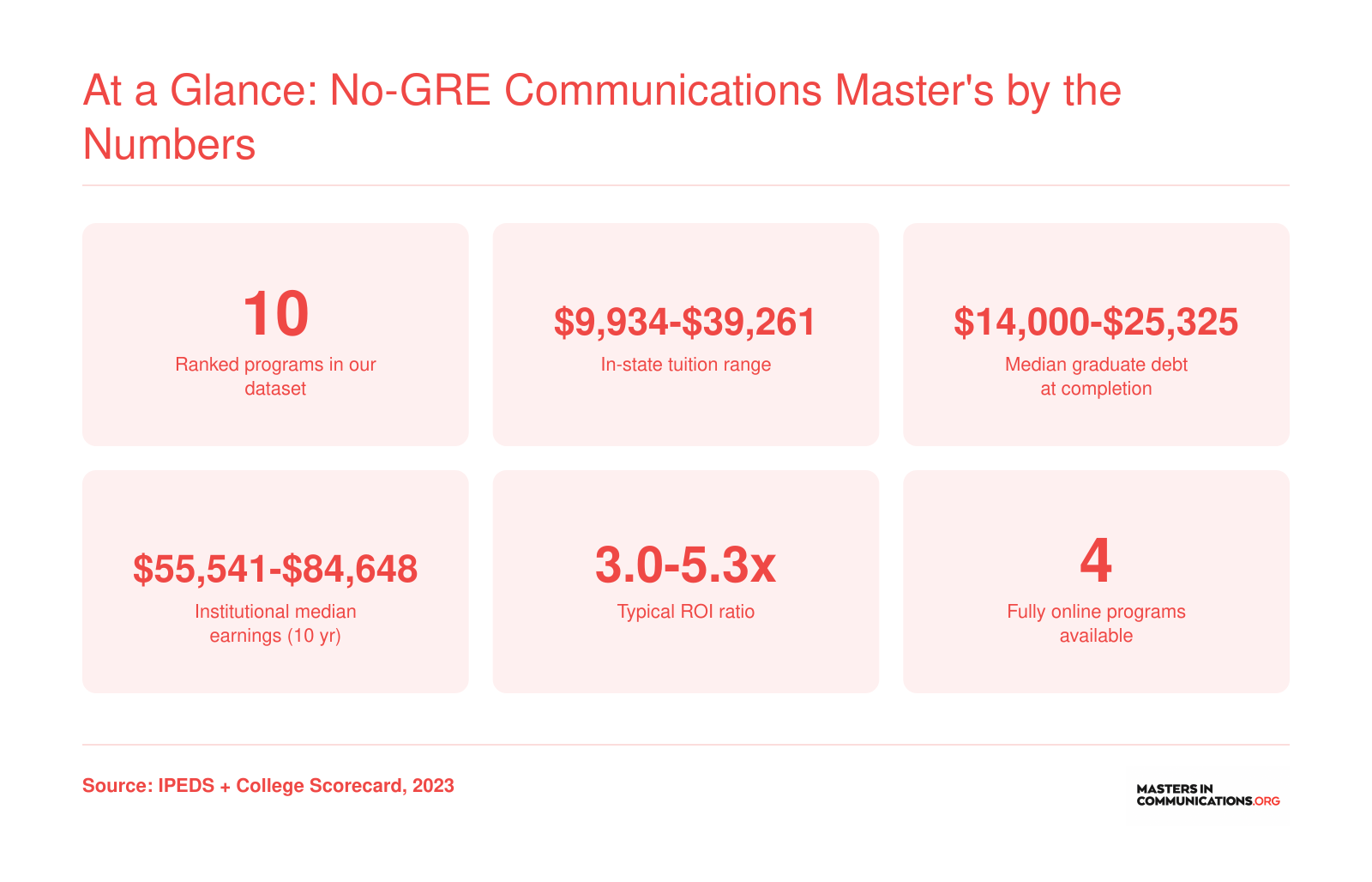
At a Glance: No-GRE Communications Master's by the Numbers
Before you dive into individual program profiles, here is a quick snapshot of the landscape across the ten no-GRE communications master's programs ranked for 2026. These aggregate figures can help you benchmark cost, debt, and earning potential as you narrow your shortlist.
Admissions Requirements Beyond the GRE
Dropping the GRE doesn't mean dropping standards: it shifts the weight onto your GPA, professional track record, and written materials. Understanding what admissions committees actually evaluate, and where the bar sits, helps you build an application that stands out.
The Baseline Academic and Professional Criteria
Most no-GRE communications programs anchor their review around a small set of consistent requirements:
- Minimum GPA: Typically 2.75 to 3.0 on a 4.0 scale. Thomas Edison State sets the floor at 2.75, while Drexel and the University of Delaware's MA in Strategic Communication both expect a 3.0.1
- Letters of recommendation: Two to three are standard. Baylor's MA in Communication, for instance, asks for three.2
- Personal statement: Nearly universal. Programs use it to assess your goals, fit, and writing ability in one document.
- Resume: Expected at virtually every program, with three to five years of relevant work experience strengthening your candidacy.
- Writing sample or portfolio: Often optional for general communication tracks, but commonly required for journalism and strategic communication concentrations where published clips, campaign work, or content samples demonstrate practitioner skill.
When 'No GRE' Still Means a GRE
Read the fine print carefully. Some programs market themselves as no-GRE but actually use GPA or work experience as the waiver trigger. If your undergraduate GPA falls below the stated minimum, or you have fewer than five to six years of professional experience, you may still be asked to submit a test score to demonstrate readiness.1 Applicants in this position should ask admissions directly before assuming a waiver applies.
What a Competitive Applicant Looks Like
While minimums sit at 2.75 to 3.0, admitted students at well-regarded programs typically present undergraduate GPAs in the 3.3 to 3.7 range, three or more years of relevant work in marketing, PR, modern journalism, internal communications, or adjacent fields, and a personal statement that connects past experience to specific program offerings. For journalism and strategic communication tracks, a tight portfolio of three to five professional pieces (published work, campaign samples, or polished writing) often matters more than another tenth of a GPA point.
Questions to Ask Yourself
Specializations Available in No-GRE Online Communications Programs
A generalist communications degree and a tightly focused specialization lead to very different career trajectories, so the concentration you choose matters as much as the school you choose. Fortunately, no-GRE online programs in 2026 offer a surprisingly wide menu of options.
The Most Common Concentrations
Strategic communication dominates the landscape. Programs at the University of Minnesota-Twin Cities, SUNY Oswego, Central Connecticut State University, Drexel University, and Avila University all center their curricula on strategy-driven messaging, campaign management, and audience analytics. If you want a versatile credential that translates across industries, this is the path most programs pave.
Digital media is the second most prevalent focus. Rutgers University's 36-credit Master of Communication and Media includes a digital media concentration1, while UNC-Chapel Hill's entire 30-credit M.A. is built around digital communication.2 Texas State University offers a dedicated M.A. in Digital Media Communication (also 36 credits)3, and Pace University layers digital filmmaking and media production into its MA communication management curriculum through its MA in Communications and Digital Media.4
Public relations appears as a standalone degree at Lipscomb University, where a 36-credit M.A. in Public Relations can be completed in roughly one year. Several strategic communication programs also weave PR coursework into their elective tracks, but Lipscomb is one of the few no-GRE options treating it as a full degree.
Journalism Without the GRE
If you are specifically searching for a journalism master's that does not require the GRE, Stony Brook University's M.S. in Journalism (33 credits, ACEJMC-accredited) lists the exam as test-optional. The program emphasizes solutions journalism and provides access to a broadcast studio, podcasting lab, and a two-story newsroom. Evening class scheduling makes it workable for professionals who cannot step away from a day job.
Harder-to-Find Specializations
Health communication, crisis communication, organizational communication, and sports communication appear far less frequently. Rutgers lists six total concentration options within its Master of Communication and Media, offering more niche pathways than most competitors.1 If one of these narrower fields is your goal, compare Rutgers' concentration catalog carefully against broader strategic communication programs that may touch the topic only through an elective or two. Exploring online master's in global communication programs can also open doors for professionals interested in cross-cultural or international media work.
Practical Experience by Specialization
Capstone and applied-learning requirements shift depending on your chosen focus. Texas State requires a professional project with an oral defense and offers an internship component.3 Pace University lets students choose between a thesis and an internship track.4 UNC-Chapel Hill concludes with a final thesis project2, while Avila University builds a portfolio through a capstone partnered with a real-world client. Sam Houston State University wraps its 30-credit program with an accelerated capstone. The takeaway: nearly every no-GRE program demands some form of culminating applied work, but the format ranges from traditional research to client-facing deliverables. Match the capstone style to the kind of portfolio evidence your target employers actually want to see.
Career Outcomes: What Can You Do With a No-GRE Communications Master's?
What jobs do graduates of no-GRE communications master's programs actually land, and what do those jobs pay? The short answer: the same roles, at the same salary bands, as graduates of programs that still require the test. Admissions policy has no bearing on what your diploma signals to an employer.
Common Job Titles for Graduates
Graduates of online no-GRE communications master's programs typically move into roles like:
- Communications director: Oversees internal and external messaging strategy for an organization, often reporting to the C-suite.
- Public relations manager: Leads media relations, crisis response, and brand reputation work for agencies, corporations, or nonprofits.
- Digital content strategist: Plans editorial calendars, owned-media campaigns, and SEO-driven storytelling across web and social channels.
- Media relations specialist: Builds press lists, pitches journalists, and manages spokesperson preparation for executive interviews.
Depending on the concentration you choose (strategic communication, digital media, public interest, journalism), you may also be competitive for roles like brand manager, social media director, corporate affairs lead, or newsroom editor.
What the Salary Data Says
The Bureau of Labor Statistics tracks the occupations these degrees feed into. As of 2024, the national median annual wage for public relations specialists was $69,780, with projected job growth of about 5% through 2034.1 Media and communication workers nationally posted a median of $70,300.3 At the management tier, where most master's holders eventually land, public relations and fundraising managers earned a national median of $132,870, also with 5% projected growth.2 These are national figures across all education levels, not state-specific or program-specific medians, but they sketch the realistic earnings arc from early career into management.
Program-level earnings data from many of the schools featured here, including Georgetown, Columbia, Drexel, UNC Chapel Hill, and Rutgers, shows alumni reporting strong mid-career income roughly a decade after entering the workforce, consistent with the BLS managerial bands above. That outcome alignment is the practical answer to anyone worried that skipping the GRE signals a weaker program. Employers hire on portfolios, internships, and demonstrated writing and strategy skills, not on standardized test scores you took before enrollment.
Employment, Not Just Enrollment
One useful gut-check: at the strongest no-GRE programs on this list, the large majority of graduates are working (not continuing in further graduate study) within a year of finishing. Specific employment-share figures vary by program and reporting year, and not every school publishes them, but the pattern across reputable accredited programs is consistent. A communications master's is a terminal professional degree for most students, and graduates head straight into the job market.
According to the American Psychological Association, by the 2022-2023 academic year, only 15% of master’s programs in psychology required the GRE. This steep drop mirrors a wider trend in graduate admissions, with communication programs increasingly adopting no-GRE policies.
Frequently Asked Questions About No-GRE Communications Programs
Dropping the GRE from your application checklist can feel almost too easy, so it is natural to wonder whether the degree still carries weight. Below are the questions prospective students ask most often, answered with current data from the programs profiled on mastersincommunications.org.
- What is the difference between no GRE required and GRE optional for graduate programs?
- A "no GRE required" program has permanently removed the exam from its admissions criteria; you cannot submit a score even if you wanted to. A "GRE optional" program lets you choose whether to include scores. Some schools also offer GRE waivers, which excuse the exam only after you meet specific conditions such as a minimum GPA or relevant work experience. The practical takeaway: confirm each school's exact policy before you apply.
- Is a master's in communications worth it without a GRE requirement?
- Yes. A no-GRE master's in communications is held to the same accreditation standards as any GRE-requiring program. Graduates typically qualify for senior roles in public relations, corporate communications, digital media, and related fields. The programs featured in our 2026 ranking report median alumni earnings that compare favorably with national averages for the occupation, and employers evaluate candidates on the degree itself, relevant specialization, professional experience, and institutional reputation, not on whether a standardized test was part of admission.
- How much does an online master's in communications cost without GRE?
- Tuition for the no-GRE programs in our 2026 list ranges roughly from about $12,000 to over $75,000 for the full degree, depending on residency status, credit requirements, and institutional type. Public universities at in-state rates tend to cluster at the lower end, while private institutions often sit higher. Many schools also charge technology or distance-learning fees, so compare total cost of attendance rather than per-credit rates alone.
- Can you get a journalism master's degree without taking the GRE?
- Absolutely. Several accredited journalism and mass communications programs have dropped the GRE. Some of these hold ACEJMC accreditation, the profession-focused accrediting body for journalism and mass communications at the master's level. St. Bonaventure University, for example, offers an ACEJMC-accredited online program that does not require the GRE. Check each program's specialization tracks to confirm a journalism concentration is available.
- Are no-GRE online master's in communications programs accredited?
- They can be, and the strongest ones are. ACEJMC accredits master's-level journalism and mass communications programs based on program quality and professional standards, with no distinction based on GRE policy. Regional institutional accreditation (through bodies such as the Higher Learning Commission or Middle States) applies as well. Always verify both institutional and, where applicable, programmatic accreditation before enrolling.
- What are the admissions requirements for no-GRE online master's in communication programs?
- Without the GRE, programs shift their evaluation to other indicators. Common requirements include a bachelor's degree from an accredited institution, a minimum undergraduate GPA (often 3.0), a professional resume or CV, a statement of purpose, two or three letters of recommendation, and sometimes a writing sample or portfolio. Several programs also weigh relevant work experience heavily, which benefits mid-career applicants.
- Do employers view no-GRE master's degrees differently?
- No. Hiring managers in communications fields assess candidates based on the degree earned, the institution's reputation, relevant specializations, and professional experience. Whether the GRE was part of the admissions process is not reflected on a transcript or diploma, and employers do not distinguish between the two paths. Focus your energy on building a strong portfolio and choosing an accredited, well-regarded program rather than worrying about how you were admitted.
More Online No-GRE Communications Programs to Consider
Beyond our top 10, these accredited programs offer flexible, no-GRE pathways to a communications master's. Browse the directory below and verify current policies directly with each school before applying.
Nova Southeastern University
State University of New York at Oswego
Central Connecticut State University
Sam Houston State University
Avila University
Ohio University
University of Southern Indiana
Southeastern Louisiana University
Lasell University
Commonwealth University of Pennsylvania
Columbus State University
Columbia University in the City of New York
University of Northern Colorado
The University of Tennessee-Martin
Lamar University
How Long Does It Take to Complete an Online Communications Master's Without GRE?
An online master's in communications without a GRE requirement can be completed much faster than most working professionals expect, with accelerated paths taking as little as 12 months.1
Typical Completion Timelines
Most no-GRE online communications master's programs offer multiple pacing options. An accelerated track can be finished in 12 to 18 months for students who commit full-time and take courses year-round.1 The standard full-time path usually spans about two years, aligning with traditional academic calendars. Part-time students balancing careers and family typically complete the degree in three to four years, though many programs allow up to five to eight years if you need extra flexibility.
Factors That Influence Your Timeline
The total number of credits required is a major determinant , programs typically demand 30 to 36 credits.1 Transfer credits from previous graduate work can shorten your path significantly.3 Capstone or thesis requirements also play a role: a thesis track may extend your timeline by several months, sometimes pushing completion to 30 months. Summer enrollment is often optional, but taking courses during summer sessions can accelerate your progress even on a part-time schedule.3
Program Structure Matters
Some online programs use a fixed cohort model, where you progress through a set sequence of courses with the same group. While this builds community, it reduces flexibility. Others offer asynchronous, self-paced formats that let you move faster when your schedule allows. Online masters in marketing communications programs, for instance, often provide both cohort and self-paced tracks, so it's worth comparing structures across specializations. Look for programs that do not require summer enrollment to finish in fewer semesters if you prefer to concentrate courses during fall and spring.
Questions to Ask Programs
When evaluating timelines, ask directly: 'What is the average time to degree for part-time students?' and 'Does the program require summer enrollment to graduate in fewer semesters?' These answers will help you map out a realistic plan without surprises. If you are weighing a research-focused path, communications doctorate programs have distinct timelines worth understanding before committing to a master's thesis track.
Explore More
- Best Online Faith-Based Masters in Communication
- Best Online Master's in Communication Disorders
- Best Online Master's in Communication Management
- Best Online Master's in Communication Studies
- Best Online Master's in Global Communication
- Best Online Master's in Health Communication
- Best Online Master's in Journalism
- Best Online Master's in Marketing
- Best Online Master's in Mass Communication
- Best Online Master's in Media Communication
- Best Online Master's in Organizational Communication
- Best Online Master's in Public Relations
- Best Online Master's in Social Media Marketing
- Best Online Master's in Sports Communication
- Best Online Master's in Strategic Communication
- Best Online Master's in Technical Communication
- Best Online MBA in Marketing
- Best Online PhD in Communication Programs by State
- Online Communication Programs Are Expanding
- Online Master's in Political Communication
- Online vs. Hybrid Master's in Communication