
What you’ll learn in this article…
- U.S. employees lose roughly 2.8 hours per week to conflict, costing organizations about one full workday per person each month.
- Setting explicit role ownership, deliverables, and deadlines eliminates the single most common trigger of preventable workplace disputes.
- Channel mismatch (sending the wrong message type through email, chat, or video) ranks among the top causes of avoidable team friction.
- Remote teams face higher conflict rates, with 70 percent of distributed workers reporting occasional friction that demands targeted prevention strategies.
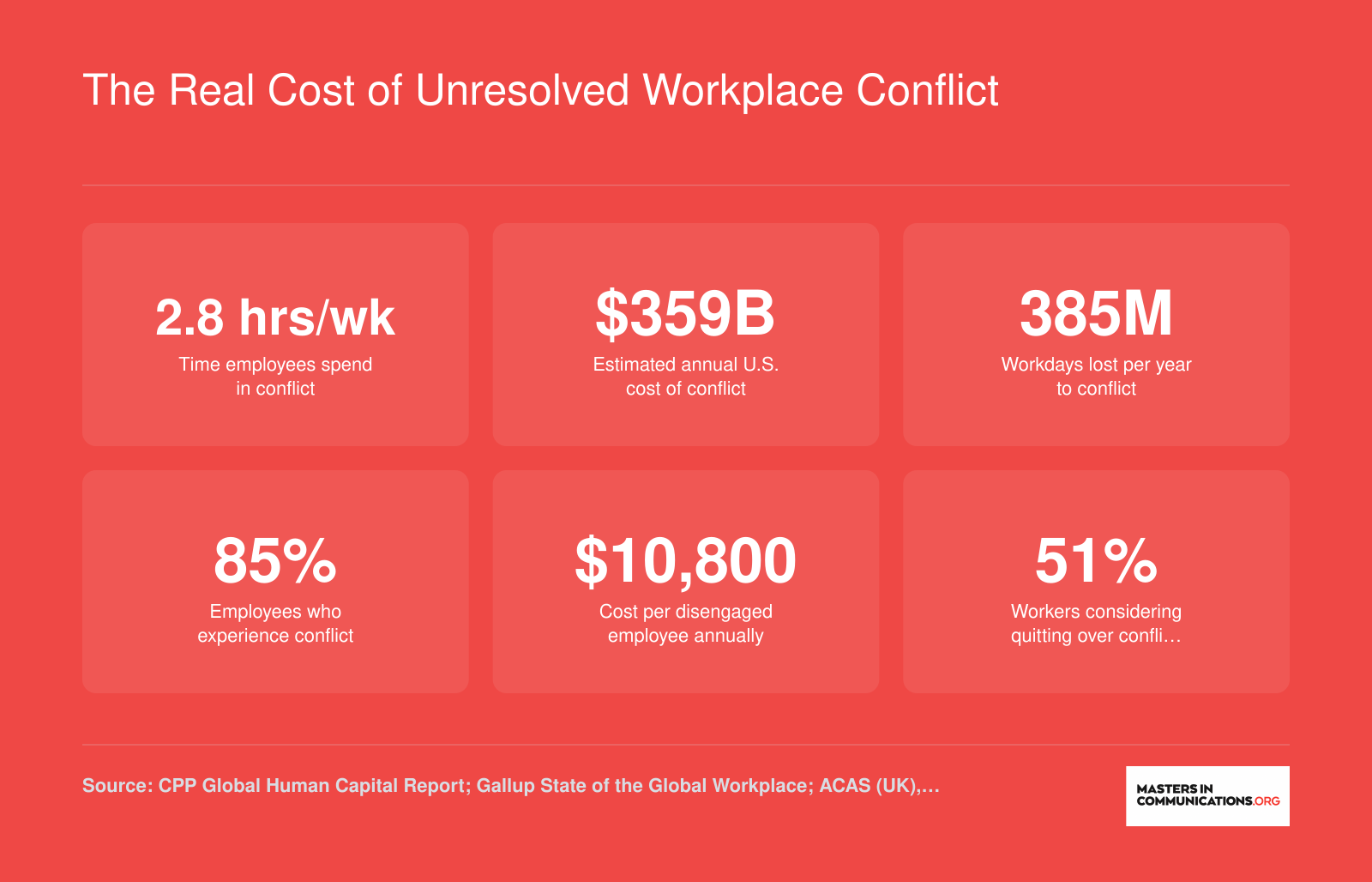
How can better communication actually prevent workplace conflict before it starts? Research from CPP's Global Human Capital Report puts a number on the problem: U.S. employees spend an average of 2.8 hours per week dealing with conflict, and the majority of those situations trace back to miscommunication, not bad intentions or incompatible personalities.
That distinction matters. When conflict is framed as a people problem, the instinct is to manage individuals. When it is framed as a communication design problem, teams can address the structures and habits that let misunderstandings compound into full disputes. Three areas consistently account for the most preventable friction: unclear expectations, underdeveloped listening skills, and poor channel selection.
Those root causes are also, notably, within reach of anyone in an organization, not just HR or senior leadership. Managers, individual contributors, and people operations professionals each have specific leverage points, and the most durable conflict-prevention cultures are built when all three groups act on them together.
Why Workplace Conflict Happens: Common Communication Breakdowns
Most workplace conflict stems not from incompatible goals or personality clashes, but from gaps in how information moves between people. Understanding where communication breaks down gives teams a concrete starting point for prevention, rather than treating every flare-up as a unique crisis.
Five Root Causes of Communication Breakdown
Clear patterns emerge when you audit the moments before conflict ignites:
- Unclear expectations: A manager asks for a "quick draft" without specifying format, timeline, or level of polish. One team member spends 30 minutes on bullet points; another invests six hours in slide design. Neither is wrong, but both feel the other missed the mark, and resentment builds before anyone names the real problem: the brief was vague.
- Tone misreads in written messages: Email and chat strip out vocal inflection and facial cues. A terse "Got it" can read as dismissive or curt when the sender simply meant efficient. Over days and weeks, these micro-misreads accumulate into assumptions about respect or engagement. Practicing good communication etiquette helps teams establish shared norms for digital tone.
- Power dynamics that silence feedback: Junior employees may hesitate to ask clarifying questions for fear of appearing unprepared. Senior leaders may assume their instructions are self-evident. The resulting information vacuum creates errors that later trigger blame cycles.
- Assumptions about shared context: A product manager references "the Q3 roadmap shift" in passing, unaware that two colleagues joined after that pivot. Those teammates nod along, make decisions based on outdated mental models, and only surface the mismatch when work has already diverged.
- Cultural and generational communication norms: What one colleague views as candid feedback, another experiences as blunt criticism. Preferences around directness, formality, response time, and meeting structure vary widely, and unspoken norms become points of friction when teams don't surface and align on them.
When Disagreement Becomes Dysfunction
Not all tension signals a problem. Healthy disagreement surfaces competing ideas, stress-tests assumptions, and often leads to better decisions. The hallmark: participants remain focused on the problem, not the person. Harmful conflict, by contrast, erodes trust. Colleagues question motives, attribute bad faith, or withdraw engagement entirely. The shift from productive to destructive happens when communication patterns amplify personal friction rather than resolve substantive questions. Research on how stress affects communication shows that elevated tension narrows listening capacity and makes misinterpretation far more likely.
How Small Breakdowns Compound
Consider this scenario: A vague project brief leads two team members to pursue parallel tracks without realizing it. By the time they compare notes in a review meeting, each has invested a week of effort. Rather than naming the unclear brief as the culprit, both feel the other ignored obvious priorities. The frustration spills into side conversations, erodes collaboration on the next project, and eventually requires HR mediation. A single ambiguous paragraph, left unaddressed, cascaded into team-wide dysfunction because no one intervened at the first sign of misalignment.
The Real Cost of Unresolved Workplace Conflict
Most guides on preventing workplace conflict skip the numbers entirely. That is a mistake, because the data makes one thing unmistakable: unresolved conflict is not just uncomfortable, it is expensive. Every statistic below represents a preventable loss, not an inevitability. Stronger communication practices can reclaim these hours, dollars, and people.
Questions to Ask Yourself
Strategy 1: Set Clear Expectations and Communication Norms
Ambiguity in roles, deliverables, and deadlines is the single most common trigger of workplace conflict, and also the most preventable. When team members lack clarity about who owns which tasks, what good work looks like, or when contributions are due, misunderstandings multiply. The resulting friction often masquerades as personality clashes or departmental turf wars, but the root cause is structural: people simply do not know what is expected of them or others.
Write Down Role Clarity
Verbal agreements fade and selective memory thrives in fast-moving workplaces. Counter this by creating written role clarity documents for every position and project team. A RACI matrix (Responsible, Accountable, Consulted, Informed) provides a proven framework for mapping who does what. For each task or deliverable, assign one person as Responsible (does the work), one as Accountable (owns the outcome), and identify who must be Consulted (provides input) or Informed (receives updates). This simple grid eliminates the most common conflict scenario: two people believing they own the same decision, or no one stepping forward because accountability was never assigned.
Establish Communication Norms at Project Kickoff
Every new project or team should begin with a kickoff checklist that defines communication cadence and channel preferences. Rather than leaving these choices implicit, document answers to practical questions: How often will the team meet? What belongs in email versus instant messaging? What response time is expected? A brief communication norms agreement might read: "Respond to Slack messages within four hours during work hours; use email for non-urgent items and project documentation; flag anything blocking your work immediately in the team channel; reserve video calls for complex discussions requiring back-and-forth." When everyone operates from the same playbook, the chance of someone feeling ignored or overwhelmed drops sharply. Understanding communication etiquette also reinforces these norms by helping team members recognize the social expectations behind each channel.
Teach Communication Norms During Onboarding
New hires absorb cultural cues quickly, but they cannot read minds. Onboarding protocols should explicitly teach how your organization communicates. Cover preferred tools, tone expectations (formal or casual), escalation paths when problems arise, and feedback norms. The interest-based relational approach, a conflict prevention framework rooted in organizational psychology, emphasizes prioritizing good relationships alongside task completion. One of its six core guidelines is making communication about issues, not personalities.1 Embedding that principle during onboarding helps employees separate behavior from identity when tensions arise, reducing the likelihood that disagreements harden into interpersonal conflict. Developing effective listening skills is another critical onboarding priority, because active listening prevents the miscommunication that so often escalates into disputes.
By investing time upfront to codify expectations and norms, teams eliminate the friction born from guesswork. Clarity does not guarantee harmony, but it removes the most fertile ground for preventable workplace conflict.
Strategy 2: Build Active Listening and Empathy Skills
Workplace listening training has shifted in the last few years from soft-skills add-on to a measurable performance discipline, with organizations now tracking listening behaviors the same way they track meeting efficiency or response times. That shift matters because most workplace conflict does not start with disagreement: it starts with one person feeling unheard, then escalating to prove their point.
What Active Listening Actually Means at Work
Forget the therapy-office image of nodding silently. Active listening at work is a set of small, repeatable micro-skills you can practice in any meeting or one-on-one:
- Paraphrase before responding: Restate the other person's point in your own words so they can confirm or correct it.
- Ask a clarifying question first: Before you agree, disagree, or offer a solution, ask one question that probes what they actually mean.
- Acknowledge, then counter: Name the validity of their point before you introduce yours. This is not capitulation, it is sequencing.
- Hold your reply for two seconds: A short pause signals you are processing, not waiting for your turn to talk.
Scripts You Can Use Tomorrow
Having a few phrases ready prevents you from improvising under pressure. Try these:
- "Let me make sure I understand what you're saying. You're concerned that the timeline shifts the QA window, is that right?"
- "I can see why that's frustrating. Here's what I was thinking, and I want to know where it breaks down for you."
- "Before I respond, can you tell me more about what happened from your side?"
- "I hear that this feels like a recurring pattern. Can we name what specifically keeps coming up?"
These scripts work because they slow the exchange down and force both parties to operate from the same facts.
Nonverbal Signals That Quietly Start Fights
Crossed arms in a conference room, a sigh during a status update, checking Slack while a teammate is presenting on video: these read as dismissal even when you mean nothing by them. Mastering the art of body language in professional settings takes deliberate practice. On camera, keep your video on, your eyes on the lens during key moments, and close other tabs that pull your attention. In person, keep an open posture and put your phone face down.
Empathy Is a Skill, Not a Personality Trait
This is the part most people get wrong. Empathy can be taught, measured, and improved. Structured communication training, including role-play exercises and feedback loops, has been shown to reduce conflict incidents and improve team cohesion scores. If you want to strengthen this foundation, learning how to become a better communicator is a practical starting point. If your team treats listening as a fixed trait ("she's just a people person"), you will never invest in the practice that actually moves the needle.
According to the CPP Global Human Capital Report on Workplace Conflict, U.S. employees spend an average of 2.8 hours per week dealing with conflict. Across an organization, that adds up to roughly one full day per employee each month lost to disagreements, misunderstandings, and interpersonal friction rather than productive work.
Strategy 3: Choose the Right Communication Channel
Slack's own internal communication research identifies four primary workplace channels (email, chat, video, in-person) and finds that channel-message mismatch is one of the most common triggers of avoidable workplace conflict.1 A non-urgent policy update fired off in Slack at 9 p.m. reads as an emergency. A delicate performance concern delivered over email reads as cold. The medium shapes the meaning before the words land.
Match the Channel to the Message
Use this as a working framework, drawn from current internal communication guidance:
- Email: Best for non-urgent, formal, referenceable messages, customer retention notes, and B2B exchanges where a written record matters.2
- Chat (Slack, Teams): Best for quick informal updates, status pings, and lightweight coordination that does not need to be archived or escalated.1
- Video conferencing: Best for synchronous, complex collaborative work where tone, screen sharing, and real-time back-and-forth prevent misreads.1
- In-person: Best for sensitive or formal information, performance conversations, and deep collaboration where body language carries half the meaning.1
- SMS: Reserve for urgent, time-sensitive alerts where high engagement is essential (a system outage, a schedule change in the next hour).3
Do Your Own Channel Research
If you want to pressure-test these defaults for your specific industry or role, a few sources are worth your time. The BLS Occupational Outlook Handbook (bls.gov/ooh) lets you filter occupations by typical work setting, which is useful for understanding how remote-heavy versus in-person roles structure their communication. Professional association sites, including the National Association of Colleges and Employers, publish recurring employer surveys on channel preferences and perceived effectiveness. University career services and alumni platforms can often share aggregate data on how graduates in communication-heavy fields rate channel use in their first jobs. If you are considering formal study in this area, online masters in organizational communication programs often cover channel strategy as part of their core curriculum. And Google Scholar or JSTOR will surface peer-reviewed studies on channel effectiveness if you search terms like "employer perception of communication medium" or "synchronous versus asynchronous team performance." Staying current on latest trends in communication will also help you adapt your channel choices as new tools emerge.
The rule underneath all of it: pick the channel the message deserves, not the channel that is fastest for you to send.
Conflict Prevention for Remote and Hybrid Teams
Distributed work has reshaped the geography of workplace conflict, and the friction points look nothing like the ones managers trained for a decade ago. Recent data shows that 70% of remote workers report occasional conflict and 10% experience it daily, while hybrid teams fare worse: 48.7% report frequent conflict and 20.5% deal with it every single day.1 Miscommunication in distributed teams has risen by roughly 40% since the shift to remote work accelerated in 2020.2
The Triggers That Live in the Gaps
Four patterns drive most remote and hybrid conflict, and each one traces back to a communication breakdown rather than a personality problem.
- Async communication gaps: A message sent at 4 p.m. that goes unanswered until the next morning can read as dismissal when it was really just dinner. Without shared norms, silence gets interpreted.
- Time-zone friction: Teammates in different time zones end up carrying uneven meeting burdens, with one group always taking the early call or the late one.
- Missing informal relationship-building: The hallway chat that used to defuse tension has no remote equivalent unless you build one. Trust is a conflict trigger for 79.5% of hybrid workers and 60% of remote workers.1
- Always-on culture: Constant pings blur the workday boundary, breeding quiet resentment that surfaces weeks later in unrelated disagreements.
Prevention Tactics That Actually Work
Start by documenting async norms in writing. Specify expected response windows by channel: chat within four working hours, email within one business day, anything tagged urgent gets a phone call. When expectations live in a shared document rather than in someone's head, role clarity improves, which matters because role ambiguity triggers conflict for 80% of remote workers and 69.2% of hybrid ones.1 Professionals exploring a masters in global communication often study these exact cross-cultural coordination challenges in depth.
Schedule intentional social check-ins: reserve the first ten minutes of a weekly team meeting for non-work conversation, and rotate meeting times so the same people are not always inconvenienced.
The Proximity Bias Problem
Watch for proximity bias, the tendency for in-office employees to make decisions in hallways, at lunch, or in impromptu huddles that exclude remote teammates. Even unintentional exclusion erodes trust quickly. The fix is procedural: if a decision involves the team, it happens in a channel everyone can see, or it gets summarized there within the hour.
Role-Specific Tips: Managers, HR, and Individual Contributors
Preventing workplace conflict is a shared responsibility, but each role carries distinct leverage points. Managers shape team culture through daily behavior, HR builds the infrastructure that makes prevention sustainable, and individual contributors own the clarity and self-awareness that keep small tensions from escalating. The table below breaks down specific actions, pitfalls, and quick wins for each role.
| Role | Top Prevention Actions | Common Mistakes | Quick Win |
|---|---|---|---|
| Manager | Model communication norms visibly (e.g., paraphrase before responding, invite dissent in meetings). Intervene at the first sign of tension rather than waiting for a formal complaint. Create psychological safety by normalizing questions and admitting your own errors openly. | Assuming silence means agreement. Avoiding early, candid conversations because they feel uncomfortable. Defaulting to email for sensitive feedback instead of speaking directly. | Open your next team meeting by asking each person to share one concern or obstacle they are facing, then respond without judgment. |
| HR Professional | Build proactive systems: recurring communication skills training, anonymous pulse surveys, and clearly publicized reporting channels. Analyze trends in survey data and exit interviews to identify friction patterns before they become crises. | Operating in reactive mode only, stepping in after conflict has already damaged relationships. Treating training as a one-time event rather than an ongoing practice. Relying solely on formal grievance processes that employees hesitate to use. | Launch a quarterly two-question pulse survey asking employees to rate team communication quality and psychological safety, then share aggregated results transparently. |
| Individual Contributor | Own your communication clarity: state needs and expectations directly rather than hinting. Raise concerns with a colleague or manager before frustration builds. Practice self-awareness about your personal triggers so you can pause before reacting emotionally. | Venting to peers instead of addressing the source of tension. Assuming intent behind ambiguous messages (especially in chat or email). Waiting until a performance review to surface ongoing friction. | Before sending a message that feels charged, reread it aloud and ask yourself whether the tone would land well if you received it from someone else. |
How to Measure Whether Your Conflict Prevention Efforts Are Working
Conflict prevention can feel abstract until you put numbers behind it. Without measurement, you're left guessing whether your new norms, listening practices, and channel choices are actually reducing friction or just adding meetings to people's calendars. The good news: a handful of well-chosen indicators can turn prevention from a vague aspiration into a trackable initiative your team revisits every quarter.
Five KPIs Worth Tracking
- Psychological safety pulse scores: The share of employees who respond favorably (typically 4 or 5 on a 5-point scale) to questions about speaking up and raising concerns. Organizational psychology research generally treats 75 to 80 percent favorable as a healthy benchmark, 60 to 75 percent as a watch zone, and anything below 60 percent as high-risk territory that warrants intervention.1
- HR complaint and mediation frequency: Track the rolling 90-day count of formal complaints, informal grievances, and mediation requests. You're looking for direction of travel, not absolute numbers.
- Voluntary turnover rate: Especially among high performers and within specific teams. A spike in one department often points to an unresolved interpersonal or managerial issue.
- Exit interview themes: Code responses for mentions of communication breakdowns, manager conflict, or feeling unheard. Three mentions in a quarter is a pattern, not a coincidence.
- Meeting effectiveness ratings: A single post-meeting question asking whether decisions were clear and disagreements addressed productively.
Sample Pulse Questions to Use This Week
Good pulse questions are short, specific, and scored on a consistent 1-to-5 agreement scale. A few to borrow:
- I feel comfortable raising concerns with my manager without fear of negative consequences.
- When disagreements happen on my team, we address them directly and respectfully.
- I understand what is expected of me and how my work connects to my teammates' work.
SHRM recommends keeping pulse surveys to roughly 3 to 15 questions, with about two open-ended prompts to capture context the numeric scores miss.2
Cadence: Quarterly Beats Annually
A traditional annual engagement survey is too slow to catch conflict before it metastasizes. A more responsive rhythm looks like this:
- Full engagement survey every 12 to 18 months (Gallup suggests roughly every 6 months for its Q12 instrument).3
- Team pulse surveys of 5 to 10 questions quarterly.4
- Micro-pulses of 1 to 3 questions monthly, or after major changes.
- Manager one-on-ones weekly or biweekly, which act as your most frequent qualitative signal.
For benchmarking team health alongside safety scores, Gallup's Q12 data suggests top-performing teams average between 4.3 and 4.6, with 4.0 as the floor for a team you'd consider healthy.3 If you want to deepen the communication skills that underpin these scores, exploring a masters in organizational communication can give you the frameworks to design and interpret these instruments at a strategic level. Track your numbers against those reference points, share the trends openly, and your conflict prevention work stops being a soft skill and starts behaving like any other operational priority.
Frequently Asked Questions About Preventing Workplace Conflict
These are some of the most common questions professionals ask about preventing and managing workplace conflict. Each answer connects back to strategies covered earlier in this article, so you can put them into practice right away.
- What are the main causes of communication conflict at work?
- The most common causes include unclear expectations, inconsistent messaging from leadership, over-reliance on text-based channels where tone is easily misread, and cultural or generational differences in communication styles. As outlined in the section on common communication breakdowns, even small misunderstandings can escalate when teams lack shared norms for how and when to communicate.
- How can better communication prevent workplace conflict?
- Stronger communication reduces conflict by closing the gap between what people intend and what others perceive. When teams practice active listening, confirm understanding before acting, and choose channels suited to the message's complexity, misinterpretations drop significantly. The strategies in this article, from setting clear norms to building empathy skills, give teams a practical framework for heading off disputes before they take root.
- What is the difference between healthy disagreement and harmful workplace conflict?
- Healthy disagreement focuses on ideas, stays respectful, and moves a team toward better decisions. Harmful conflict becomes personal, erodes trust, and stalls productivity. The key distinction is psychological safety: when people feel safe challenging ideas without fear of retaliation, disagreement fuels innovation. When that safety is absent, even minor friction can spiral into lasting resentment and disengagement.
- How do you prevent conflict in remote or hybrid teams?
- Remote and hybrid teams face unique risks because they lose nonverbal cues and spontaneous check-ins. As discussed in the section on conflict prevention for distributed teams, leaders should establish explicit communication norms, schedule regular video touchpoints, and default to richer channels (video or phone) for sensitive topics. Documenting decisions in shared spaces also prevents the "I never saw that message" disputes that plague async workflows.
- What are 10 ways to resolve conflict in the workplace?
- Effective approaches include: (1) address issues early before they escalate, (2) use "I" statements instead of accusations, (3) listen to understand rather than to reply, (4) clarify the facts before assuming intent, (5) involve a neutral mediator when needed, (6) focus on interests rather than positions, (7) set ground rules for difficult conversations, (8) follow up in writing to confirm agreements, (9) revisit unresolved tensions on a set timeline, and (10) invest in ongoing communication skills training.
- How do you measure whether conflict prevention strategies are working?
- Track both quantitative and qualitative indicators. As covered in the measurement section above, useful metrics include employee engagement scores, turnover rates, the volume of HR complaints, and pulse survey data on psychological safety. Pair those numbers with qualitative signals like manager observations and exit interview themes. Consistent improvement across multiple indicators over two or three quarters suggests your strategies are gaining traction.