
What you’ll learn in this article…
- Neural coupling research shows a listener's brain mirrors the storyteller's, making narrative the most persuasive communication format.
- Frameworks like the Hero's Journey and Pixar's story spine give any professional a repeatable structure for compelling narratives.
- A five-step mastery process, from audience analysis through iteration, turns storytelling from innate talent into a trainable skill.
- Graduate communication programs formalize storytelling techniques across channels, accelerating career advancement in leadership and strategic roles.
Why does a data-heavy pitch with better numbers often lose to a simpler pitch wrapped in a story? Because stories activate empathy, memory, and decision-making circuits in ways that bullet points never will. A VP listening to two proposals may forget your ROI projections by Tuesday, but she will remember the story you told about a customer who almost walked away, then didn't, because of what your team built. That difference in recall is a competitive edge, and it is available to anyone willing to learn.
Storytelling is not an innate gift reserved for a charismatic few. It is a professional skill with teachable frameworks, repeatable techniques, and measurable outcomes. You can master it the same way you learned to write a business case or run a regression. The sections ahead walk through the neuroscience behind narrative persuasion, proven structures like the Hero's Journey and the Story Spine, channel-specific techniques for everything from keynotes to data reports, and the mistakes even skilled communicators make when they confuse information with impact.
What Is the Art of Storytelling?
The art of storytelling is the deliberate structuring of information into a narrative arc that includes a relatable protagonist, a conflict or tension that creates stakes, and a resolution that delivers a clear takeaway. Unlike simply being articulate or charismatic, storytelling transforms data points, abstract concepts, and forgettable facts into memorable experiences that move people to think, feel, and act differently.
This definition matters because the phrase "art of storytelling" is often misunderstood as a soft skill reserved for novelists or TED speakers. In reality, it is a technical competency with measurable impact across leadership, marketing, sales, internal communications, and change management.
The Core Elements of Effective Storytelling
Every compelling story, whether delivered in a boardroom or a brand campaign, shares five structural components:
- A relatable protagonist: The audience must see themselves, their customer, or their organization in the character navigating the story. In a product pitch, the protagonist is often the customer facing a problem your solution resolves.
- Stakes and tension: Without conflict or challenge, there is no story. The protagonist must face a credible obstacle, risk, or choice that creates uncertainty and emotional investment.
- Sensory detail: Concrete, vivid language activates the brain's sensory cortex. Compare "our platform improved efficiency" to "teams cut approval cycles from three weeks to two days, freeing Friday afternoons for strategic work."
- Emotional throughline: Data informs, but emotion persuades. The best business stories pair metrics with human impact, whether that's relief, pride, frustration, or hope.
- A clear takeaway: Every story should answer the implicit question, "So what?" The resolution should deliver a lesson, decision point, or call to action that the audience can apply immediately.
Why Storytelling Is a Professional Competency
In 2026, storytelling has become non-negotiable in knowledge work. Leaders use narrative to communicate vision and align distributed teams. Marketers build brand loyalty by framing products within customer transformation arcs. Sales professionals close deals by positioning solutions as the turning point in a client's struggle. Internal communicators drive adoption of new systems by replacing change-management memos with stories of early adopters who overcame the same friction their colleagues now face.
Of course, storytelling does not operate in a vacuum. Pairing narrative skill with effective listening skills helps you understand the concerns your audience brings to the table, making every story you tell more targeted and persuasive. Professionals looking to communicate more effectively in the workplace will find that even basic narrative structure elevates everyday emails, presentations, and team stand-ups.
Storytelling is not embellishment. It is the architecture that makes information stick, decisions feel urgent, and collaboration feel possible.
Why Storytelling Matters: The Neuroscience Behind Narrative Persuasion
In 2010, Uri Hasson and his team at Princeton published research in PNAS that fundamentally changed how we understand communication: when you tell a story, your listener's brain activity begins to mirror your own.1 This phenomenon, called neural coupling, explains why some messages stick while others disappear the moment they're heard.
Neural Coupling: When Brains Synchronize
Hasson's original experiment used fMRI scanning to observe what happens in the brain during storytelling. Researchers recorded a speaker telling an unrehearsed story about her high school prom, then played that recording to listeners while scanning their brain activity. The results were striking: brain activity in the listener's auditory cortex synchronized with the speaker's brain activity during the original telling.1 But coupling didn't stop at auditory processing. Regions involved in language comprehension, emotion, and even high-level interpretation showed the same synchronization. When communication succeeded, the speaker's brain patterns appeared in the listener's brain seconds later, sometimes even earlier, suggesting listeners were anticipating where the story would go.
Hasson later described this in a 2016 TED talk and expanded the theory in a 2012 review in Trends in Cognitive Sciences, arguing that brain-to-brain coupling is a general mechanism for creating shared understanding.23 For professionals, the implication is clear: storytelling is not just rhetorical technique but a biological process that creates alignment between speaker and audience in ways that bullet points and data tables cannot.
Oxytocin, Character, and Cooperation
Paul Zak's research at Claremont Graduate University adds a biochemical layer to the story. Zak's experiments demonstrated that character-driven narratives trigger the release of oxytocin, a neuropeptide associated with trust, empathy, and social bonding. In one study, participants watched a short video about a father and his terminally ill son. Blood samples taken before and after showed significant oxytocin increases, and those increases correlated with participants' willingness to donate money to a related charity. The more oxytocin released, the more generous the behavior. Zak's conclusion: stories with emotional arcs and relatable characters chemically prime audiences to trust the storyteller and act on the message.
Narrative Transportation and Reduced Resistance
Melanie Green and Timothy Brock introduced narrative transportation theory to explain why stories bypass skepticism. When listeners are absorbed, or "transported," into a narrative, their critical faculties temporarily disengage. Green and Brock's experiments showed that transported readers were less likely to counter-argue and more likely to adopt story-consistent beliefs, even when the story contradicted their prior attitudes. For communicators, this means a well-constructed story can overcome resistance that direct argument cannot. Anyone working to become a knowledgeable and engaging public speaker should consider these findings essential reading.
The Memory Advantage: 22 Times More Memorable
Stanford professor Chip Heath conducted research showing that stories are remembered 22 times more effectively than facts presented in isolation. In classroom experiments, only 5 percent of listeners recalled individual statistics from a presentation, but 63 percent remembered the stories those statistics were embedded in. The multiplier effect is dramatic: wrapping data in narrative makes it exponentially more likely to stick.
Together, these findings establish storytelling not as a soft skill but as a hard-wired advantage. Neural coupling creates shared understanding, oxytocin builds trust, transportation lowers resistance, and memory consolidation ensures your message endures long after the conversation ends.
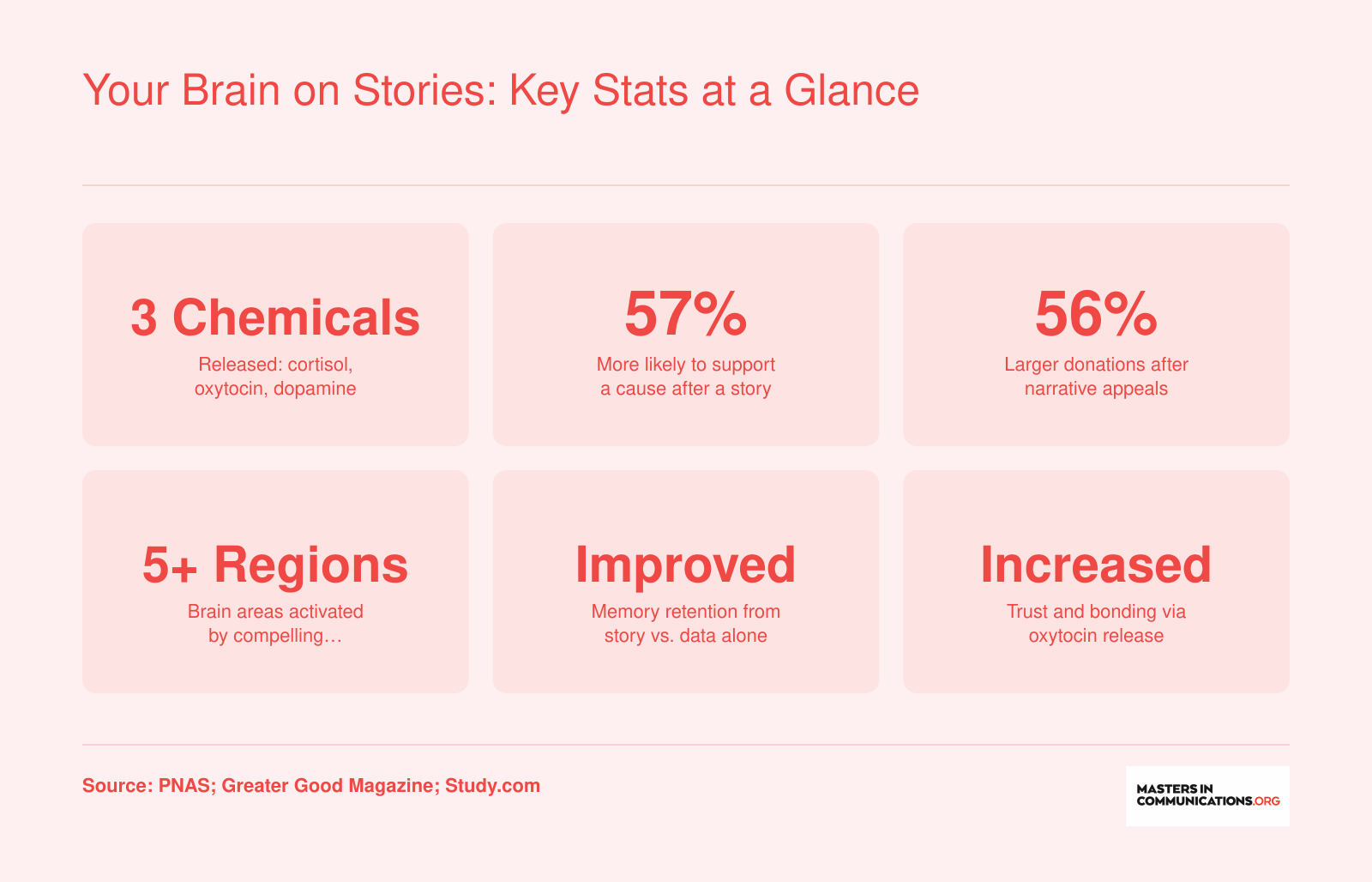
Your Brain on Stories: Key Stats at a Glance
Stories do more than hold attention: they reshape brain chemistry and drive measurable behavior change. The stats below highlight why narrative persuasion is so powerful, drawing on neuroscience and behavioral research.
Proven Story Frameworks Every Professional Should Know
Every memorable story you have ever heard runs on a framework, whether the teller knew it or not. The frameworks below have shaped blockbuster films, viral keynotes, billion-dollar sales decks, and bedtime stories alike. Learning even one of them turns storytelling from a mysterious gift into a repeatable skill you can deploy on demand.
Five Frameworks at a Glance
Each of these structures solves a different problem. Some excel at emotional transformation, others at fast persuasion, and others at making complex ideas feel inevitable. Match the framework to the moment, not the other way around.
- Three-Act Structure: Setup, confrontation, resolution. Three acts. Traced back to Aristotle and modernized by screenwriter Syd Field.1 Best for feature-length narratives, case studies, and conference talks with clear escalation and payoff. Difficulty: intermediate.
- Hero's Journey: Departure, initiation, return, expanded across 12 stages. Developed by mythologist Joseph Campbell.1 Best for transformation arcs, founder stories, and brand narratives where a protagonist is changed by the experience. Difficulty: advanced.
- Story Spine: Eight beats that flow from "Once upon a time" through "Every day," "Until one day," "Because of that," "Until finally," and "And ever since then." Created by improv teacher Kenn Adams.2 Best for team meetings, oral storytelling, and quick brainstorming where cause-and-effect needs to feel inevitable. Difficulty: beginner.
- Pixar Storytelling Formula: The Story Spine adapted by former Pixar artist Emma Coats, who also published the studio's famous 22 Rules of Storytelling.2 Eight beats anchored by a strict causal chain. Best for short pitches, product narratives, and story workshops that need to feel human and linear. Difficulty: beginner to intermediate.
- I-You-Point: Three parts. Open with your credibility or experience (I), pivot to the audience's stake (You), then deliver the core message (Point).3 A staple business-presentation framework built on audience-centered messaging. Best for sales decks, executive updates, and persuasive talks under 10 minutes. Difficulty: beginner.
Where to Start, Where to Grow
If you are new to structured storytelling, begin with the Story Spine or I-You-Point. Both give you a fill-in-the-blank scaffold you can apply this afternoon, and both force the discipline that separates a story from a list of facts: causality and audience focus.
Once you are comfortable shaping narratives on the fly, graduate to the Hero's Journey. It is the most demanding of the five because it asks you to track internal transformation alongside external events, but it is also the framework behind the stories audiences remember for decades. And because storytelling is as much about delivery as structure, pairing these frameworks with the art of body language will help your narrative land with even greater impact.
Questions to Ask Yourself
How to Master the Art of Storytelling: A Step-By-Step Process
Mastering storytelling is not a matter of innate talent. It is a repeatable process that translates professional insight into narrative power. The five steps below transform raw experience into stories that move audiences to action.
Step 1: Audience Analysis
Before you draft a single sentence, know who sits on the other side of the table. Effective storytelling begins with empathy, not exposition. Ask yourself three questions:
- What problem keeps this audience awake at night? Align your story with their pressure points, not yours.
- What beliefs or assumptions do they hold that might resist my message? Anticipate objections and address them within the narrative arc.
- What outcome do I want them to feel or do when the story ends? Clarity on desired action sharpens every word.
A product manager pitching a new feature to a skeptical engineering team will tell a different story than one presenting to executive stakeholders. The raw material may be identical, but the framing, pacing, and emotional emphasis shift based on who listens.
Step 2: Mine Your Material
Great stories live in the details you already own. Build a personal story bank by committing to a ten-minute weekly journaling habit. Capture:
- Client conversations where you noticed a shift in tone or energy.
- Moments when a process failed and you learned something unexpected.
- Small observations that reveal larger truths about your industry, team, or customers.
Write without editing. The goal is volume and specificity. Over six months, you will accumulate dozens of raw narratives ready to be shaped for the right context. This habit transforms vague recollection into concrete sensory detail.
Step 3: Draft with a Framework
Select one of the frameworks discussed earlier and slot your material into its structure. The Story Spine works especially well for first drafts:
- Once upon a time, our customer support team received the same feature request every week.
- Every day, we logged it and moved on.
- But one day, a client called in tears, explaining how the missing feature cost her a major contract.
- Because of that, we escalated the request to product leadership.
- Because of that, the feature went into the next sprint.
- Until finally, we shipped it, and support tickets on that issue dropped to zero.
- And ever since, we listen for patterns in frustrated voices, not just ticket volume.
The framework prevents meandering and ensures every beat advances the narrative.
Step 4: Edit for Emotion and Economy
Cut ruthlessly. Every sentence must serve the emotional arc or clarify the stakes. Replace abstractions with sensory details. Instead of writing "The client was upset," show the moment: "Her voice cracked on the word 'contract.'" That shift from telling to showing immerses the listener in the experience.
Strip away qualifying phrases, hedges, and corporate jargon. If a detail does not heighten tension, deepen character, or illuminate the lesson, delete it.
Step 5: Practice Delivery and Iterate
Rehearsal is not optional. Read your story aloud three times. Record yourself and listen for pacing, vocal energy, and clarity. Staying current on latest trends in communication can also sharpen your awareness of what resonates with modern audiences. Then deploy the three-audiences test: share the story with three different people and note where they lean in, where their attention drifts, and what questions they ask afterward.
Revise based on those signals. Storytelling mastery comes from iteration, not inspiration. Each telling sharpens the narrative until it lands with precision every time.
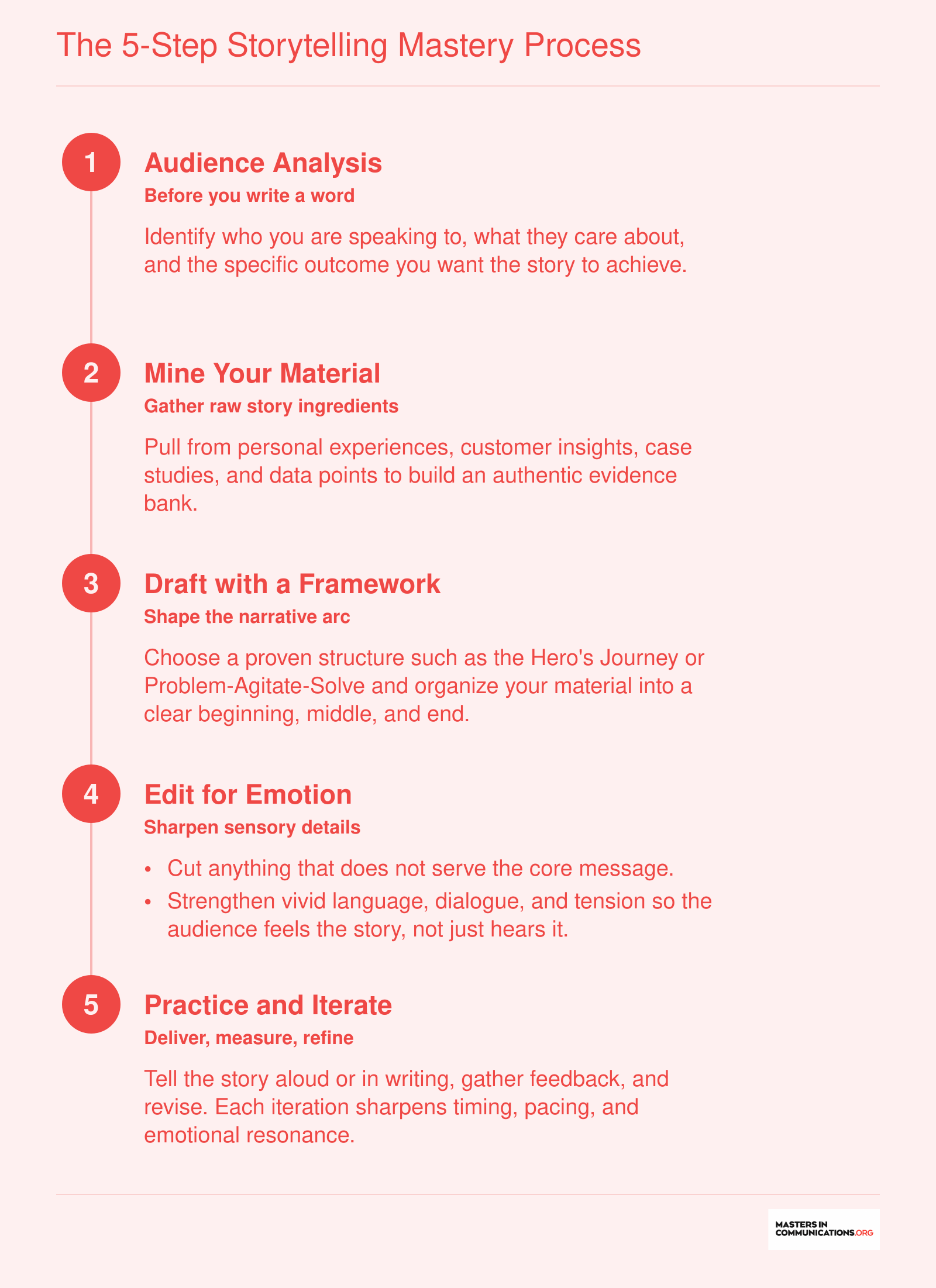
The 5-Step Storytelling Mastery Process
Turning raw ideas into compelling narratives is a repeatable craft, not a mysterious gift. Follow these five steps in order, cycling back as needed, until storytelling becomes second nature.
Storytelling Techniques for Different Professional Channels
A story that lands brilliantly in a keynote can fall completely flat in a data report, while a micro-narrative built for LinkedIn would feel thin and underdeveloped stretched across a 45-minute presentation. The channel shapes the story, not the other way around. Learning to adapt your narrative instincts to the format in front of you is what separates a competent communicator from one who consistently moves people to action.
Presentations and Keynotes
Live presentations reward a full narrative arc. Open with a personal anecdote that plants a question in the audience's mind, something unresolved that they will want answered. Structure your slide deck around a three-act shape: the world as it was, the disruption or challenge, and the new reality you are proposing. Then close with a callback to your opening story. That callback signals that the journey is complete and gives the audience a satisfying moment of closure. It also makes the central message far more memorable than any summary slide ever could.
Email and Written Communication
Written communication demands a different kind of discipline. Readers do not give email the same attention they give a speaker standing in front of them, so you cannot afford a slow build. Lead with the conflict or the central question, not the background context. Keep the narrative arc to three or four sentences at most, and trust a single vivid image or detail to carry the emotional weight of the whole message. Practicing communication etiquette can also help you strike the right tone, ensuring your story feels appropriate for the channel. The goal is to create enough tension in the first two sentences that the reader feels compelled to keep going.
Social Media and Short-Form Video
On LinkedIn and in short-form video, the first line is the entire audition. If it does not stop the scroll, nothing else matters. Compress your arc into a micro-story format: situation, unexpected twist, lesson learned. A useful self-check before posting is what practitioners sometimes call the scroll-stop test: does your opening line create enough curiosity or surprise that a distracted person would pause? If the honest answer is no, rewrite the first sentence before anything else.
Data Reports and Decks
Numbers rarely move people on their own. When you frame a data report as a character's journey, the figures come alive. Instead of opening with a chart, try something like: our customer was struggling with X, then we discovered Y, and the result was Z. The data becomes evidence in a story rather than the story itself, and that shift in framing makes your conclusions far easier for stakeholders to absorb and act on.
A Note on Ethical Storytelling
None of these techniques justify fabrication or manipulation. Do not invent details to heighten drama, do not manufacture false stakes to create urgency, and always treat the real people who appear in your stories with genuine respect. Audiences are perceptive, and a story that feels engineered or exploitative erodes the trust you built with every previous story you told. Craft matters, but integrity is what makes craft sustainable.
Common Storytelling Mistakes and How to Fix Them
The line between a story that captivates and one that fizzles often rests on a handful of small but critical choices. Even seasoned communicators can sabotage their own narratives by leaning on habits that feel safe but weaken the connection with listeners. These four mistakes show up everywhere, from boardrooms to client calls, and each comes with a straightforward fix.
Burying the Hook
Most stories fail in the first ten seconds, not from a lack of substance but because the opening buries the most gripping element under layers of context. Think of the difference between starting with "I want to walk you through the background of our new initiative," versus "Three weeks ago, we were losing two major accounts every single day." The first is polite throat-clearing; the second yanks attention by naming a conflict. Before you share any story, cut the preamble and lead with the moment of tension, the surprising result, or the question that keeps you up at night.
Making Yourself the Hero
Business stories often center on the teller's own cleverness or perseverance, but persuasion hinges on making the audience the protagonist. When you say, "I built a tool that streamlined our reporting," the listener is a spectator. Reframe it as, "You know how every Monday you face a mountain of scattered data? Here is the system that gives you the story behind the numbers in one click." This shift moves the audience from passive observer to active hero, with you cast as the helpful guide. Audiences lean in when they see themselves in the struggle and the solution.
No Stakes, No Interest
If nothing is at risk, there is no reason to care. This plagues business narratives where proposed changes sound optional rather than urgent. Mundane anecdotes gain traction by highlighting what is at stake. Instead of, "We updated the onboarding checklist," try, "New hires were drowning in mismatched instructions, and two had already walked out the door within their first month." That tiny injection of potential loss (talent, revenue, reputation) transforms a procedural note into a story with high emotional stakes. Even in low-stakes situations, surface a fear, a frustration, or a real downside that the listener can feel.
Overloading with Detail
Too many characters, subplots, and data points choke the narrative arc. Listeners cannot track three protagonists, two timelines, and a half-dozen supporting numbers. The fix is the one-protagonist, one-conflict rule: build your story around a single person or entity facing a single central challenge. If tangents tempt you, file them away as separate anecdotes. The clearest business stories follow a clean path: protagonist encounters obstacle, takes action, achieves resolution. Stick to that skeleton and let the details serve the spine. If you want to sharpen this skill across all your professional interactions, explore how to be a great communicator for additional techniques.
The Pre-Delivery Checklist
Before you share any story draft, run it through these questions: - Does the opening line create immediate curiosity or tension? - Is the audience clearly the protagonist of the story? - Are the stakes explicit and emotionally tangible? - Have I removed any detail that does not directly serve the main arc? - Can I summarize the whole story in one sentence: [Protagonist] must [goal] or else [consequence]?
How to Measure Your Storytelling Impact
How do you prove a story actually worked, beyond the gut feeling that the room leaned in? Storytelling can feel maddeningly subjective, but there are concrete proxies that tell you whether your narrative is landing, persuading, and spreading. Measurement matters because without it, you can't iterate, defend the time investment to a skeptical boss, or distinguish a story that resonates from one that simply feels good to tell.
Digital Engagement Signals
For anything published online, a handful of quantitative indicators do most of the heavy lifting: time on page, scroll depth, social shares, click-through rates, conversion rates, and repeat visits.1 Narrative-driven content typically outperforms feature lists on dwell time and shareability because readers are tracking a character or tension to its resolution, not scanning for specs. If your story-led blog post holds attention for two minutes while your product-feature post bounces at twenty seconds, that gap is your evidence. Email reply rates and the substance of comments (are people adding their own stories, or just clicking "like"?) round out the picture.
Behavioral and Business Metrics
The sharpest test is conversion. Run an A/B test between a story-led landing page and a feature-led one, or pit a narrative email subject line against a benefit-driven one. In B2B contexts, storytelling reportedly influences roughly 72% of buying decisions, which is why account-based marketing teams increasingly lead with customer narratives rather than capability decks.2 Track which version moves prospects to the next stage, not just which gets opened.
Qualitative Feedback Loops
Numbers miss the most telling signal: did your audience retell your story to someone else? The "retell test" is brutal and honest. If a colleague paraphrases your pitch to their boss a week later, you wrote something durable. Supplement this with post-presentation surveys asking what listeners remember (brand-association and recall studies are a staple of this research), structured peer feedback, and customer interviews probing why a particular story stuck.1
Learn from Documented Campaigns
Study the brands that have published their results. Dove's Real Beauty work, Airbnb's host-story campaigns, and Charity:Water's donor narratives are well-documented examples where measurable lifts in brand affinity, conversion, and repeat giving have been tied directly to narrative choices.2 Understanding how communication and mass media shape audience behavior can help you reverse-engineer what these campaigns measured and apply the same scoreboard to your own work.
How a Communications Degree Strengthens Your Storytelling Skills
If you've worked through the frameworks, practiced the techniques, and started measuring your impact, you've already discovered that professional storytelling is a learned skill, not just a natural gift. The next question is whether to continue your self-study or formalize your training through a communications degree. For professionals serious about making storytelling a competitive advantage, structured education offers a direct path to mastery.
Coursework That Builds Storytelling Foundations
Communications programs teach the exact building blocks you need to craft persuasive narratives in professional contexts. Core courses in rhetoric and persuasion unpack the psychology behind why stories move audiences to action, while audience analysis classes train you to identify and adapt your message to different stakeholder groups. Media production courses give you hands-on practice shaping stories across video, audio, and digital platforms. Public relations writing and organizational communication coursework emphasize clarity, structure, and strategic messaging, the same skills that separate effective storytellers from those who simply relay information. Digital content strategy classes connect narrative theory to real-world channels like email campaigns, social media, and web content, ensuring your stories reach the right people at the right time.
The Career ROI of Formal Communication Training
Professionals with communication degrees consistently move into careers with a masters in communication where storytelling is a daily requirement. Marketing managers craft brand narratives that differentiate products in crowded markets. Public relations specialists translate complex corporate events into compelling press releases and executive statements. Corporate communication directors shape internal messaging that aligns thousands of employees around strategic goals. Training and development professionals design learning experiences that stick because they're anchored in narrative. Content strategists build editorial calendars that turn fragmented blog posts into cohesive story arcs. These roles don't just benefit from storytelling skills; they demand them.
Making Storytelling a Career Advantage
If you've read this far, you're serious about mastering the art of storytelling. A communications degree is the structured path to transforming this skill into a career differentiator. Whether you're weighing the investment, it helps to understand both the drawbacks and reasons not to study a Master's in Communication alongside the benefits. You'll graduate with a portfolio of work, a network of professionals who share your commitment to strategic communication, and a credential that signals to employers that your storytelling ability is grounded in both theory and practice. For those seeking flexible options, an online communications degree can deliver the same rigorous curriculum on your schedule. The frameworks you've learned in this guide become second nature when you've spent two years applying them under faculty guidance, receiving feedback, and refining your approach across dozens of projects. That's the difference between knowing how to tell a good story and building a career on the strength of your narrative skills.
Frequently Asked Questions About Storytelling
Whether you are just exploring the art of storytelling or actively working to sharpen your narrative skills, these answers address the questions professionals ask most often. Each response draws on widely accepted communication best practices and current industry guidance.
- How do you master the art of storytelling?
- Start by studying proven frameworks such as the Hero's Journey or the Problem, Agitation, Solution model. Then practice deliberately: draft short narratives, record yourself, and solicit honest feedback. Focus on clarity, emotional engagement, and audience relevance. Consistent repetition, combined with coursework or coaching, accelerates growth. Because storytelling is a recognized trainable communication competency, virtually anyone willing to put in focused effort can reach a high level of proficiency.
- Why is storytelling important in communication?
- Stories activate multiple areas of the brain simultaneously, making messages more memorable and persuasive than raw data alone. In professional settings, storytelling helps you simplify complex ideas, build trust, and motivate action. Whether you are pitching a product, leading a team meeting, or presenting quarterly results, narrative structure gives your audience a reason to care and a framework for remembering your key points.
- What are the key elements of effective storytelling?
- Communication researchers generally identify seven core elements: a relatable character, a clear setting, a compelling conflict, rising tension, a turning point, a resolution, and a takeaway message. The most impactful stories are also coherent, emotionally engaging, easy to imagine, and authentically credible. Missing even one of these qualities can weaken audience connection and reduce the persuasive power of your narrative.
- What storytelling frameworks should professionals know?
- Three frameworks stand out for workplace use. The Hero's Journey maps a character through challenge and transformation. The Problem, Agitation, Solution (PAS) model is ideal for sales and negotiation. The Pixar Pitch ("Once upon a time... Every day... Until one day...") works well for concise presentations. Choosing the right framework depends on your purpose and audience, the two factors experts recommend as every story's starting point.
- How does storytelling improve professional communication?
- Storytelling transforms abstract concepts into concrete experiences, which helps audiences process and retain information. In business contexts such as selling, negotiation, and leadership, narrative techniques increase engagement and make data more actionable. Professionals who weave stories into presentations, proposals, and even emails consistently report stronger audience responses, because stories create emotional resonance that bullet points alone cannot achieve.
- Can storytelling be learned, or is it an innate talent?
- Storytelling is a learnable skill, not a fixed trait. While some people may have a natural flair for performance, the structural and strategic dimensions of narrative, such as framing, pacing, and audience analysis, are taught in communication programs worldwide. Current industry guidance treats storytelling as a core trainable competency on par with data literacy and public speaking. Deliberate practice is the single biggest predictor of improvement.
- How long does it take to get good at storytelling?
- There is no universal timeline, but most professionals notice meaningful improvement within a few months of consistent practice. A practical benchmark is crafting and delivering one to three minute professional narratives regularly, then refining them based on audience feedback. Formal coursework or a communications degree can compress the learning curve by providing structured feedback, peer collaboration, and exposure to evidence-based storytelling techniques.
- What is the difference between storytelling and public speaking?
- Public speaking is the broader skill of presenting information to an audience, while storytelling is a specific technique used within that skill. You can deliver a public speech built entirely on statistics or logical arguments without ever telling a story. Storytelling adds narrative arc, characters, and emotional stakes to your message. The most effective communicators combine both: strong delivery mechanics from public speaking and compelling structure from storytelling.