
What you’ll learn in this article…
- All ranked programs are regionally accredited public institutions with tuition often under $500 per credit hour.
- BLS data shows communication managers can earn significantly more than writers or media specialists at the national level.
- MA degrees emphasize theory and rhetorical analysis, while MS programs lean toward data driven and strategic communication tracks.
- Most programs require a bachelor's degree but accept applicants from any undergraduate major, not just communication.
Employers increasingly treat a master's in communication as a baseline credential for senior roles in public relations, corporate communications, digital marketing, and media strategy. Among the programs in our 2026 rankings, total tuition ranges from roughly $5,700 at Eastern New Mexico University to just over $17,400 at the University of Florida, with credit-hour costs spanning about $310 to $484. That spread matters: the degree can pay for itself quickly or become a financial drag depending on format, pace, and whether you secure in-state rates.
Most programs now offer asynchronous coursework designed for working professionals, though hybrid options requiring periodic campus visits remain common at several California State and Florida institutions. Whether you prioritize affordability, specialization in global communications, or flexible scheduling, the right program is out there.
The Best Online Master's in Communication Programs for 2026
The programs below were selected for their combination of affordability, flexible online delivery, strong institutional outcomes, and direct relevance to communication careers. Every school on the list is regionally accredited, and most offer fully online or hybrid formats built around working professionals' schedules. Graduation rates listed are institution-wide figures and may not reflect the specific communication program. Program-level median earnings are not yet available for most of these degrees, so we have included institution-wide earnings where applicable to give you a general sense of each school's return on investment.
- Tuition affordability and net price
- Institution-wide graduation rates
- Online delivery flexibility
- Program concentration variety
- Post-graduation earnings potential
- Independent program research
- Internal program database
- NCES-IPEDS federal institutional data — nces.ed.gov
- College Scorecard graduate earnings — collegescorecard.ed.gov
University of Florida
#1Gainesville, FL · ~$7,000/yr (est.)
Best for: Aspiring advocates and social-change communicators
The University of Florida's College of Journalism and Communications houses one of the broadest online communication master's suites in the country, with six distinct concentrations all delivered under a single M.A. in Mass Communication umbrella. The interdisciplinary Public Interest Communication track is one of the first graduate programs dedicated entirely to evidence-based advocacy and social-change campaigns, while the Public Relations concentration carries CEPR certification eligibility. UF pairs an institution-wide graduation rate of 91.1% with a net price of $6,541, and the university's advisory board of industry leaders keeps coursework tightly aligned with current hiring trends across nonprofits, government, and corporate communications.
- Total tuition approximately $17,441 for 36 credits
- $484 per credit, completable in as few as 16 months
- 100% asynchronous online with recorded lectures and live office hours
- Capstone project replaces thesis requirement
- Three annual start dates: fall, spring, and summer
- Interdisciplinary curriculum blending systems thinking and strategic planning
- Careers in advocacy, government, and socially responsible corporations
- Total tuition approximately $21,087 for 36 credits at $586 per credit
- First online PR program offering CEPR certification preparation
- Core courses in strategic writing, campaign management, and ethics
- Career paths include crisis management, media relations, and brand strategy
- 100% online via recorded lectures with fall, spring, and summer starts
- Financial aid and College of Journalism scholarships available
- Total tuition approximately $29,367 for 36 credits at $815 per credit
- Completable in 16 months with synchronous and asynchronous options
- Advisory council of industry experts shapes curriculum
- Capstone course included in the 10-course sequence
- Prepares for brand manager, content strategist, and social media director roles
- Three start dates per year with financial aid available
- 36 credits with 12 elective credits for customization
- Asynchronous classes with recorded lectures for flexible viewing
- Culture core emphasizes intercultural communication competencies
- Messaging core covers ethics and public affairs
- Graduate certificate option available for shorter credential path
- Capstone project in global strategic communication required
- 36 credit hours completable in under two years
- Asynchronous online delivery taught by industry professionals
- 33 hours of coursework plus a three-credit capstone course
- Designed for professionals in government, campaigns, and policy
- Full-time pacing with fall, spring, and summer enrollment windows
- Blends political theory with applied media strategy
Florida International University
#2Miami, FL · ~$9,000/yr (est.)
Best for: Globally minded PR and crisis professionals
Florida International University leverages Miami's position as a bilingual, globally connected media hub to shape its M.S. in Mass Communication with a Global Strategic Communications focus. The program offers both a Management Track and a Creative Track, each completable in roughly one year through six accelerated eight-week terms. FIU's Fulbright-scholar faculty and emphasis on international case studies appeal to professionals targeting cross-border PR, crisis management, or multinational corporate communications. The institution-wide graduation rate sits at 74.4%, and the fully online tracks list total tuition at approximately $25,000 for 30 credits.
- $25,000 total tuition for 30 credits across six eight-week terms
- Fully online format completable in approximately one year
- Covers reputation management, branding, and crisis communication
- GRE waiver available for qualified working professionals
- Fall and spring start dates with a $30 application fee
- Capstone project required; financial aid and scholarships available
- $25,000 total tuition for 30 credits, no entrance exam required
- Dual focus on digital strategy and creative content development
- Prepares graduates for PR manager, media strategist, and executive roles
- International perspective with South Florida and Latin American case studies
- GRE waiver for applicants with professional experience
- Cohort pacing allows completion within one calendar year
Eastern New Mexico University
#3Portales, NM · $5,000/yr
Best for: Budget-focused career changers seeking flexibility
Eastern New Mexico University consistently ranks among the most affordable online communication master's options in the nation, with tuition at roughly $310.50 per credit and out-of-state tuition waivers that keep costs low for distance learners everywhere. The M.A. in Communication offers three concentrations, including a relatively uncommon Media Literacy and Criticism track suited to students pursuing academic or policy careers. While the institution-wide graduation rate of 45.1% is modest, ENMU's small class sizes and close faculty mentorship deliver a personalized experience that larger programs rarely match. Students choose between a thesis or non-thesis capstone pathway across 24 to 30 credit hours.
- Approximately $310.50 per credit with free graduate application
- 100% online coursework or hybrid option for hands-on learning
- 30 credits (non-thesis) or 24 credits plus thesis defense
- Scholarships and graduate assistantships available
- Prepares for PR, journalism, and media relations careers
- Fall, spring, and summer start dates for maximum flexibility
- Fully online delivery designed for working professionals
- Emphasizes critical analysis of media systems and public advocacy
- Thesis or capstone pathway for scholarly or applied focus
- $310.50 per credit with out-of-state tuition waivers
- Recorded lectures via Panopto with advising by email and phone
- Prepares students for doctoral programs or media policy roles
- 30 credit hours with fall, spring, or summer entry
- Thesis or capstone option with hands-on media experience
- Financial aid and scholarship support available
- Flexible scheduling accommodates full-time employment
- Small cohort learning with accessible faculty
- Builds skills in reporting, editing, and multimedia storytelling
University of Central Florida
#4Orlando, FL · $10,000/yr
UCF's communication programs span both a hybrid M.A. in Communication and a fully online English M.A. with a Technical Communication concentration, making it a strong pick for professionals in Central Florida's booming tech, defense, and tourism sectors. The M.A. in Communication covers corporate, crisis, health, intercultural, and strategic communication while also preparing students for doctoral study. The online Technical Communication track, priced at about $369.65 per credit for 33 hours, targets UX writing, documentation, and content strategy roles. UCF's institution-wide graduation rate is 78%, and the net price sits at $10,411.
- Customizable curriculum across corporate, crisis, and health communication
- Evening courses and part-time pacing for working professionals
- Internship and research opportunities with nationally recognized faculty
- Prepares graduates for doctoral programs at leading universities
- Fall start with financial aid and scholarships available
- Requires statement of purpose, CV, and two recommendation letters
- $369.65 per credit for 33 hours, fully online delivery
- Completable in two years with thesis or capstone option
- Career paths include technical writer, UX consultant, and content strategist
- Spring and fall start dates with part-time enrollment available
- Award-winning interdisciplinary faculty
- Ideal for professionals in software, engineering, or defense industries
San Jose State University
#5San Jose, CA · $14,000/yr
San José State University's online M.S. in Speech-Language Pathology is a clinically focused 66-unit program that blends rigorous coursework with supervised practicum placements across California communities. The small-cohort format and no-GRE admissions policy make it accessible for career changers, though this is a clinical communication disorders degree rather than a strategic communication program. SJSU's institution-wide median earnings ten years after enrollment reach $78,988, the highest among all schools on this list, and the net price is $13,760. Graduates meet both ASHA certification and California licensure requirements.
- 66-unit program with online academics and in-person clinical practicum
- No GRE required; 3.0 GPA minimum for admission
- Small cohort-based learning with personalized mentorship
- Fieldwork arranged at local California schools, clinics, and hospitals
- Meets ASHA certification and California state licensure standards
- Fall and spring admission cycles with two-step application process
Florida State University
#6Tallahassee, FL · $11,000/yr
Florida State University offers two distinct online-friendly communication pathways: a hybrid M.S. in Communication Science and Disorders designed to address Florida's speech-language pathologist shortage, and a fully online M.S. in Organizational Management and Communication that blends behavior analysis with leadership strategy. The organizational program requires 33 credits, no GRE, and three start terms per year, making it one of the more accessible options for mid-career professionals. FSU's 85.6% institution-wide graduation rate and strong distance-learning infrastructure reinforce its appeal for students spread across the state and beyond.
- 61-credit hybrid program with online classes and Florida-based clinical placements
- Part-time pacing designed for working professionals
- ASHA-accredited with practicum at schools, hospitals, and clinics
- Addresses statewide SLP workforce shortage
- Enrollment specialist support for distance learners
- Clinical sites throughout Florida communities
- 33 credits, fully online, completable in about two years
- No GRE required; three annual start dates
- Capstone portfolio replaces traditional thesis
- Behavior analysis and communication leadership focus
- Designed for professionals in government, education, and nonprofits
- 3.0 GPA minimum with three letters of recommendation
University of North Carolina at Chapel Hill
#7Chapel Hill, NC · $12,000/yr
UNC Chapel Hill's Hussman School of Journalism and Media delivers a cohort-based M.A. in Digital Communication that blends rigorous media theory with project-driven, hands-on learning. Capped at roughly 20 students per cohort, the part-time program spans about 2.5 years and includes a thesis alongside nine sequential courses. Two required on-campus immersions in Chapel Hill foster peer connections and regional employer networking. UNC's 91.2% institution-wide graduation rate and access to its 17,000-plus alumni network give graduates a strong career launchpad in digital media, advertising, and public relations leadership.
- 30 credits over approximately 2.5 years, part-time pacing
- Cohort capped at 20 students for focused faculty mentorship
- Two required on-campus experiences at Chapel Hill
- Thesis project required alongside nine sequential courses
- GRE not required; three years of professional experience expected
- Asynchronous delivery with optional synchronous sessions
- Access to 17,000-plus Hussman School alumni for networking
University of West Florida
#8Pensacola, FL · $5,000 – $10,000/yr
The University of West Florida's M.A. in Strategic Communication and Leadership stands out for its stackable certificate model: students earn three embedded credentials (Executive Communication, Social Media for PR and Advertising, and Health Leadership Communication) on the way to the full degree. Coursework centers on real client projects and roundtable discussions, building portfolios that translate directly into workplace value. No undergraduate communication degree is required, and UWF offers express admission for eligible alumni. The 33-credit program has a net price of $9,364 and an institution-wide graduation rate of 58.8%.
- 33 credits with three stackable professional certificates included
- No prerequisite communication coursework required
- Hands-on projects with actual regional clients build portfolio
- Concentrations in executive, social media/PR, and health communication
- Capstone project required; no GRE needed
- Express admission pathway available for UWF graduates
- Covers ethical leadership, diversity, teamwork, and message design
California State University-Monterey Bay
#9Seaside, CA · ~$14,000/yr (est.)
California State University, Monterey Bay's hybrid M.S. in Speech-Language Pathology prepares students to serve California's diverse communities through evidence-based clinical practice and community partnerships. The program starts each summer in a cohort format with coursework delivered in hybrid mode and practicum placements arranged at local sites. CSUMB's institution-wide net price of $13,663 and median graduate debt of $12,750 make it one of the lower-debt options on this list. This is a clinical communication disorders program rather than a strategic communication degree, so it is best suited for students pursuing SLP licensure.
- Hybrid delivery with summer cohort start
- Evidence-based curriculum with community partnership practicum
- Prepares for ASHA certification and California licensure
- Emphasis on innovative technologies and interdisciplinary practice
- Cohort-based format with advising and program update resources
- Serves local California communities through clinical placements
California State University-San Marcos
#10San Marcos, CA · $10,000/yr (net price)
California State University, San Marcos rounds out the list with a hybrid M.S. in Speech-Language Pathology spanning 76 units over three years. Online asynchronous coursework pairs with weekly synchronous evening sessions and intensive summer clinical rotations, followed by full-time clinical placements in the final year. Students complete a minimum of 400 supervised hours to meet ASHA certification and California licensure requirements. CSUSM's institution-wide net price is $10,229, and the program's cohort structure across eight consecutive semesters provides clear pacing for working students transitioning into clinical practice.
- 76-unit program completed in three years across eight semesters
- Online asynchronous content with weekly synchronous evening classes
- Summer clinical rotations and full-time final-year placements
- Minimum 400 supervised clinical hours for licensure readiness
- Meets ASHA certification and California state licensure requirements
- Cohort-based with fall-only admissions
How We Ranked These Online Communication Master's Programs
A ranking is only as useful as the logic behind it, so here is a transparent look at how we built the list you see on this page.
An Affordability-First Approach
Our model is weighted heavily toward what you will actually pay. Rather than leading with brand prestige or selectivity, we prioritize net price and financial aid metrics. The reasoning is straightforward: for working professionals investing in career advancement, return on investment matters more than name recognition. Programs that deliver strong outcomes at a lower out-of-pocket cost rise to the top. For a deeper dive into the formulas and weights, see our full Rankings Methodology.
Data Sources We Used
Three primary federal datasets power the rankings:
- IPEDS tuition data: Published tuition and fee figures reported directly by institutions to the federal government.
- College Scorecard program-level data: Where available, this includes earnings outcomes and debt levels for graduates of specific communication programs, giving you a clearer picture of what alumni actually earn after completing their degree.
- Institution-wide graduation rates: Completion rates drawn from IPEDS, reflecting the overall track record of each university in helping enrolled students finish their programs.
These sources are publicly available and updated on a regular federal reporting cycle, which keeps our comparisons grounded in verifiable numbers rather than self-reported marketing claims.
What the Rankings Cannot Tell You
No model is perfect, and ours has a few limitations worth noting. Graduation rates reflect the entire institution, not just the online communication program, so a large university's overall completion rate may not mirror the experience of its graduate communication students specifically. Net price figures are sector-conditional averages, meaning they represent a broad middle ground rather than a personalized quote for every student. And not every program has full coverage in the College Scorecard yet; some newer or smaller programs simply do not have enough graduates in the federal earnings tracking window to produce reliable salary or debt figures. Where that data is unavailable, we note it rather than guess.
Transparency about these gaps is part of our commitment to giving you information you can trust. If you are exploring how a communication degree translates into the job market, our guide to careers with a masters in communication offers useful context. If a program's outcomes data is limited, that does not necessarily mean the program is weak. It may just mean the numbers have not caught up yet.
Questions to Ask Yourself
Explore By State
- Alabama
- Alaska
- Arizona
- Arkansas
- California
- Colorado
- Connecticut
- Delaware
- Florida
- Georgia
- Hawaii
- Idaho
- Illinois
- Indiana
- Iowa
- Kansas
- Kentucky
- Louisiana
- Maine
- Maryland
- Massachusetts
- Michigan
- Minnesota
- Mississippi
- Missouri
- Montana
- Nebraska
- Nevada
- New Hampshire
- New Jersey
- New Mexico
- New York
- North Carolina
- North Dakota
- Ohio
- Oklahoma
- Oregon
- Pennsylvania
- Rhode Island
- South Carolina
- South Dakota
- Tennessee
- Texas
- Utah
- Vermont
- Virginia
- Washington
- Washington DC
- West Virginia
- Wisconsin
- Wyoming
Online Communication Master's Tuition and Cost Comparison
Every school on this list is a public institution, which means tuition varies depending on whether you qualify for in-state rates. The net price shown below is an institution-level average reported to the federal government; your actual out-of-pocket cost will depend on financial aid, employer tuition benefits, and the specific credit-hour rate your graduate program charges. Programs are sorted from lowest to highest net price so you can quickly spot the most affordable options.
| School | State | In-State Tuition | Out-of-State Tuition | Avg. Net Price | Sector |
|---|---|---|---|---|---|
| Eastern New Mexico University | NM | $5,706 | $7,480 | $4,904 | Public |
| University of Florida | FL | $12,737 | $30,130 | $6,541 | Public |
| Marshall University | WV | $9,510 | $22,192 | $7,502 | Public |
| Murray State University | KY | $10,683 | $10,683 | $9,096 | Public |
| Florida International University | FL | $11,334 | $24,439 | $9,288 | Public |
| University of West Florida | FL | $9,062 | $24,894 | $9,364 | Public |
| Austin Peay State University | TN | $10,518 | $15,702 | $9,735 | Public |
| Morehead State University | KY | $10,512 | $10,512 | $9,793 | Public |
| California State University, San Marcos | CA | $9,606 | $19,686 | $10,229 | Public |
| University of Central Florida | FL | $8,872 | $28,657 | $10,411 | Public |
| University of Houston, Downtown | TX | $10,029 | $16,509 | $10,542 | Public |
| The University of Tennessee, Martin | TN | $11,916 | $12,978 | $10,701 | Public |
| University of North Carolina at Greensboro | NC | $8,614 | $23,329 | $10,965 | Public |
| Western Kentucky University | KY | $12,140 | $18,340 | $10,990 | Public |
| Florida State University | FL | $10,553 | $26,707 | $11,297 | Public |
Related Articles
Salary and Career Outcomes After an Online Communication Master's
A communication master's can lead to two distinct salary trajectories: one anchored in specialized writing or media production roles, the other rising into management and strategy positions. The online degree you choose doesn't just influence what you learn, it shapes your earning potential for years to come. While program-specific salary data isn't yet available for most online communication master's programs, the overall earnings outcomes at top-ranked universities offer a compelling preview.
Earnings Snapshot: What Graduates Can Expect
Looking at the median earnings of former students 10 years after entry, a broad but telling metric, the institutions featured in this guide report strong figures. The University of Illinois Urbana-Champaign leads with alumni earning a median of $81,054. San Jose State University follows at $78,988, and Purdue University graduates see a median of $72,424. These numbers reflect all degree holders from each school, not just communication grads, but they signal the kinds of earning environments these institutions cultivate.
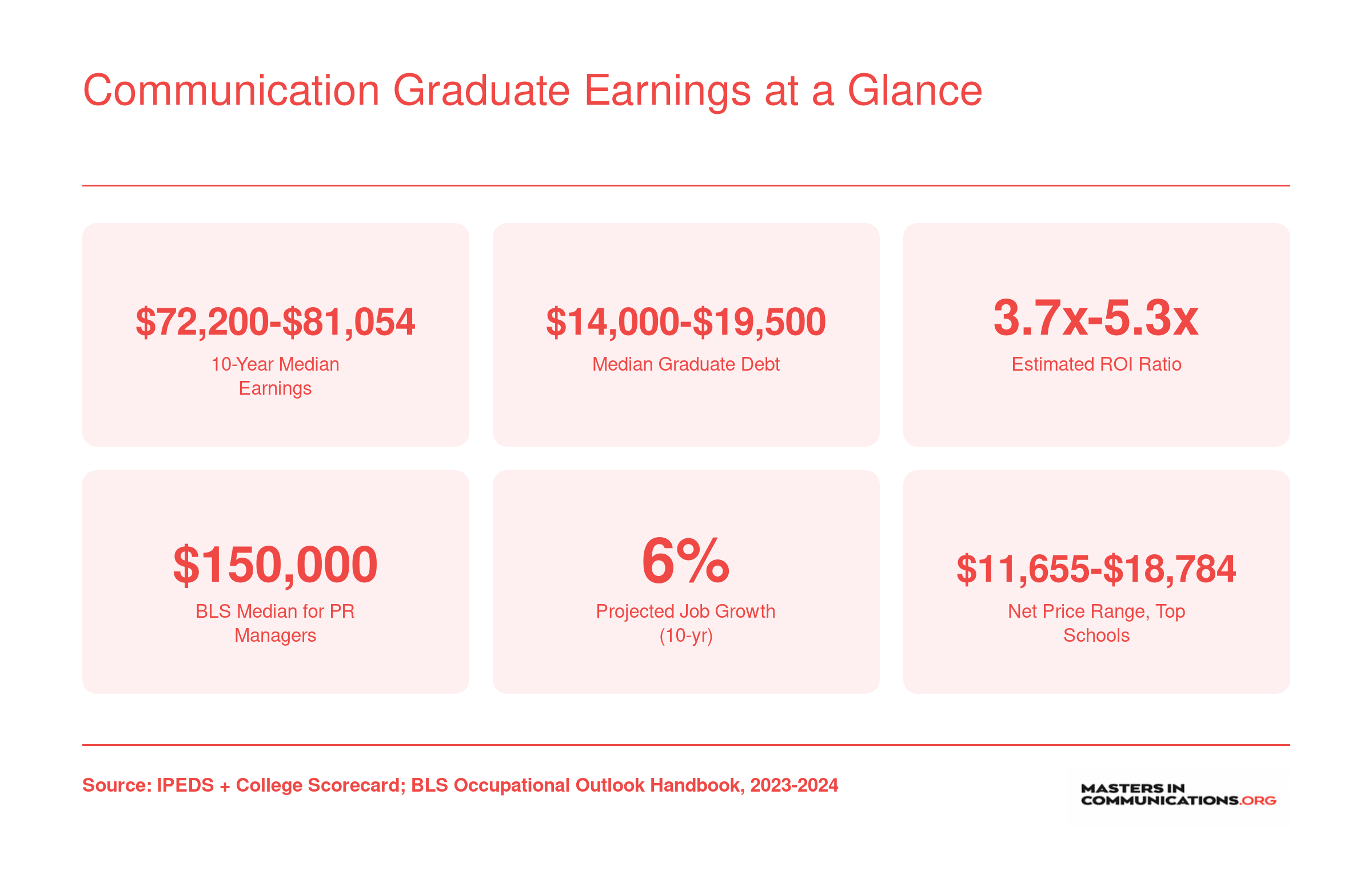
More targeted data from the Bureau of Labor Statistics (BLS) shows that media and communication workers earned a national median annual wage of $70,300 in 2024, with around 104,800 job openings projected each year through 2034.1 For communications degree holders specifically, the median sits at $65,000 across over 3 million jobs.2 However, these broad categories mask wide variation. According to career research firm Daybook, entry-level communication roles in 2026 carry a median salary of $64,480, while mid-level positions jump to $90,000, and senior professionals command a median of $140,000.3
Is the Investment Worth It? Comparing Debt and Earnings
A key measure of value is how quickly earnings outpace student debt. The return-on-investment (ROI) ratio compares median debt to median earnings. Across the top-ranked online programs, ROI ratios consistently exceed 3.5, meaning graduates earn at least 3.5 times their total debt. For example, San Jose State University shows an ROI ratio of 5.27, with a median graduate debt of $15,000 and strong earnings. The University of North Carolina at Chapel Hill, with a median debt of $14,000, boasts an ROI ratio of 5.16. Even on the lower end, Florida State University's ratio of 3.43 still signals a solid financial return.
This metric is especially important for working professionals weighing tuition against future salary bumps. An online master's from a public university often keeps debt low while unlocking access to the mid-level and senior salary tiers described above.
Where the Jobs Are: Industry Demand
Employer appetite for communication master's graduates continues to grow, particularly in corporate, healthcare, and technology sectors. Daybook's analysis of 2,420 recent communication job postings reveals steady demand for roles like public relations manager, marketing director, and technical writer.3 While the BLS doesn't break out every niche occupation, its broader "media and communication workers" category includes these positions, and the projected 10-year outlook suggests faster-than-average growth.1
Hiring trends in 2025 and 2026 point to employers valuing the strategic thinking, data literacy, and digital fluency that a master's program sharpens. Graduates interested in climbing the corporate ladder may want to explore online masters in communication management, which blends leadership training with communication strategy. Whether you're aiming for a corporate communications department, a healthcare nonprofit, or a tech startup's content team, the degree can act as a differentiator in competitive markets.
The true salary outcome depends on your specialization, location, and prior experience. But the data available today suggests that an online communication master's is a credible path to meaningfully higher earnings, especially when you choose a program with a proven record of graduate success.
Communication Graduate Earnings at a Glance
How do online communication master's programs pay off? These figures draw from institutional data across our top-ranked programs alongside national labor market projections, giving you a snapshot of the financial picture for 2026 graduates.
MA Vs. MS in Communication: Which Online Degree Is Right for You?
Should you pursue an MA or an MS in communication? It sounds like a minor distinction, but the two degrees point toward meaningfully different curricula, capstone requirements, and career trajectories. Knowing which one fits your goals can save you two years of effort and tuition.
The Core Difference: How Each Degree Thinks About Communication
An MA in Communication is rooted in humanistic and rhetorical traditions. Coursework tends to explore communication theory, media culture, rhetoric, qualitative research, and ethics. The intellectual framework asks: how does meaning get made, and why does it matter? That orientation suits students who want to interrogate ideas, work at the intersection of culture and media, or prepare for doctoral study.
An MS in Communication takes a social-scientific approach. Expect quantitative research methods, statistics, organizational communication, digital media, and specialized tracks in areas like health communication or crisis communication. The MS asks: what does the data tell us, and how do we act on it? That framing fits professionals who want to work in data-informed roles, corporate communication environments, or applied fields such as UX or technical communication.
Curriculum Comparison at a Glance
- MA coursework: Communication Theory, Rhetorical Theory, Media Culture, Qualitative Research Methods, Interpersonal and Intercultural Communication, Ethics
- MS coursework: Quantitative Research, Statistics, Strategic Communication, Organizational Communication, Digital Media, Media Law, Health and Crisis Communication
Both degrees typically conclude with a thesis or a substantial applied research project. MS programs sometimes carry heavier methods requirements, reflecting the emphasis on empirical rigor.1
Matching Degree Type to Career Goals
If you are aiming toward concept-heavy strategic roles, masters in public relations, media studies, or eventually a PhD program, the MA is the more natural path. The rhetorical and theoretical depth it builds translates well into storytelling, advocacy, and academic work.
If you want to move into corporate communication, marketing communications, PR analytics, or a specialized applied field, the MS tends to open more doors. Employers in those areas increasingly value professionals who can design research, interpret data, and connect insights to strategy.
Syracuse University Online, which offers both types of communication graduate programs, frames the distinction similarly: the MA leans theoretical and humanistic while the MS leans applied and analytical.1 Whatever direction you choose, the key is honest alignment between the degree's intellectual DNA and the work you actually want to do.
Choosing the Right Online Communication Master's Program
Prestige and program fit often pull in opposite directions, and choosing the right online communication master's program means reconciling what looks impressive on paper with what actually works for your schedule, learning style, and career goals. The good news: a methodical approach to evaluating accreditation, delivery format, and program structure can narrow your options quickly.
Verify Accreditation First
Accreditation is the single most consequential checkbox on your list. A degree from an unaccredited or improperly accredited institution may not transfer, may not satisfy employer requirements, and could disqualify you from federal financial aid. Start by searching the Council for Higher Education Accreditation (CHEA) database and the U.S. Department of Education's accreditation lists to confirm that a school holds recognized regional or national accreditation. If you are pursuing a journalism or mass communication concentration, look for programmatic accreditation from the Accrediting Council on Education in Journalism and Mass Communications (ACEJMC) as well. Always cross-reference what you find with the accreditor's own website and the school's accreditation page, because status can change between review cycles.
Evaluate Delivery Models Carefully
Not every "online" program works the same way. Some require you to log in at set times for live lectures and group discussions (synchronous), while others let you complete coursework on your own timeline (asynchronous). A growing number blend both. Review each program's curriculum details on its official website, paying close attention to course descriptions that mention live sessions, discussion-board participation windows, or required campus residencies. If the information is vague, contact admissions directly or reach out to current students. A five-minute conversation with someone enrolled in the program can tell you more about day-to-day demands than any brochure.
Cohort vs. Self-Paced Structures
Cohort models lock you into fixed start dates and a predetermined sequence of courses taken alongside the same group of peers. This structure builds strong professional networks but limits flexibility. Self-paced programs let you accelerate or slow down as life demands, though they require more self-discipline and may offer fewer organic networking opportunities. Look for program descriptions that specify group courses, rolling admissions, or flexible scheduling. Student reviews on platforms like GradReports and alumni posts on LinkedIn can provide candid perspectives on how each structure plays out in practice.
Align With Industry Standards
Professional associations are underused resources during the program-selection process. The National Communication Association publishes guidance on graduate competencies that employers expect, and ACEJMC standards outline skill benchmarks for media-focused roles. The Bureau of Labor Statistics (BLS.gov) can help you confirm that a program's stated career outcomes match real labor-market demand. Staying current with latest trends in communication also helps you gauge whether a program's curriculum reflects the skills employers actually need. Supplement all of this with direct outreach: connect with program alumni on LinkedIn, ask what skills proved most valuable on the job, and find out whether the degree opened doors they expected. These conversations ground your decision in outcomes rather than marketing promises.
Admission Requirements and Application Tips
Whether you hold a 3.8 GPA from an undergraduate communication program or a 2.7 from an unrelated major, there is likely an online master's pathway that fits your profile. The admission landscape for online communication graduate programs has grown more flexible in recent years, but understanding what committees look for can help you present your strongest application.
Standard Application Materials
Most online master's in communication programs require a core set of documents:
- Bachelor's degree: Any regionally accredited four-year degree qualifies, though some programs prefer a background in communication, journalism, or a related field.
- Minimum GPA: Requirements typically fall between 2.5 and 3.0. The University of Texas at Tyler and the University of West Florida both require a 3.0, while West Virginia University admits students with a 2.75 and offers provisional admission for those slightly below that threshold who earn a B or better in their first two graduate courses.123 Liberty University and the University of Central Missouri set the bar at 2.5.45
- Statement of purpose: A one-to-three-page essay explaining your academic interests, career goals, and reasons for choosing the specific program.
- Letters of recommendation: Usually two, ideally from supervisors or professors who can speak to your analytical abilities and professional potential.
- Writing sample: Programs such as UT Tyler request a sample to assess your communication skills and critical thinking.1
- Professional resume: Particularly valuable if you have workplace experience that demonstrates leadership or communication competencies.
GRE Requirements Have Shifted
The standardized test landscape has changed dramatically. Programs at Michigan State University, UT Tyler, the University of West Florida, West Virginia University, Liberty University, and the University of Central Missouri all waive the GRE entirely.6 If you are exploring additional options that skip standardized testing, our guide to online masters in communication no GRE covers even more programs. When test scores are not required, admissions committees place heavier emphasis on your professional experience, writing portfolio, and how clearly your statement of purpose aligns with the program's focus.
How Selective Are These Institutions?
Institution-wide admission rates offer a general sense of competitiveness, though graduate programs may differ. The University of Florida accepts roughly 24 percent of applicants overall, while Florida State University admits about 24 percent as well. The University of North Carolina at Chapel Hill is more selective at around 15 percent. By contrast, Eastern New Mexico University and California State University, Monterey Bay admit upward of 90 percent of applicants. These figures reflect entire universities rather than specific communication programs, so treat them as context rather than precise predictors.
Three Tips to Strengthen Your Application
- Tailor your statement of purpose: If the program emphasizes strategic communication or public relations, highlight relevant projects, campaigns, or professional responsibilities that demonstrate your fit. Generic statements rarely impress.
- Showcase professional experience: For GRE-optional programs, your work history carries extra weight. Quantify achievements when possible, such as managing a team, leading a campaign, or increasing audience engagement.
- Apply early for financial aid consideration: Priority deadlines for assistantships, scholarships, and institutional aid often arrive weeks before final application deadlines. Submitting early also gives you time to address any missing materials.
Frequently Asked Questions About Online Communication Master's Programs
Prospective students naturally have questions about cost, accreditation, and career payoff before committing to an online master's in communication. Below are straightforward answers drawn from the program data and research compiled across mastersincommunications.org.
- Are online master's in communication programs accredited?
- Yes. Reputable online communication master's programs hold regional institutional accreditation, the same standard applied to on-campus degrees. Many are also housed in departments accredited by discipline-specific bodies such as ACEJMC. Always verify accreditation through the U.S. Department of Education's database before enrolling, because accreditation status directly affects financial aid eligibility and employer recognition.
- How much does an online master's in communication cost?
- Tuition varies widely. Across the programs reviewed on this site, per-credit rates range from roughly $400 to more than $2,000, putting total program costs anywhere from about $12,000 to over $70,000 depending on the school and residency state. Comparing cost per credit is one of the fastest ways to narrow your list, and the tuition comparison table earlier in this article breaks those numbers down.
- What can you do with a master's in communication?
- Graduates move into roles such as public relations manager, corporate communications director, digital marketing strategist, media analyst, UX researcher, and higher education administrator. The degree also qualifies holders for mid-level and senior positions that typically require advanced credentials. Some graduates pursue doctoral study or pivot into adjacent fields like organizational development and political consulting.
- Is a master's in communication worth it?
- For most working professionals, the answer is yes. BLS data shows that workers with a master's degree earn significantly more over a career than those with only a bachelor's. The degree also opens doors to leadership roles that are otherwise difficult to reach. The salary and career outcomes section of this article provides more specific earnings figures tied to communication occupations.
- Do online communication master's programs require the GRE?
- Many programs have dropped the GRE requirement or made it optional, especially since the pandemic accelerated test-optional policies. Schools increasingly weight professional experience, writing samples, and undergraduate GPA more heavily. That said, a handful of competitive programs still request GRE scores. Check each school's admissions page for the most current policy.
- Can international students enroll in online communication master's programs in the U.S.?
- International students can enroll in fully online programs, but a fully online format does not qualify for an F-1 student visa. Students studying from abroad will need to plan around time zone differences for any synchronous sessions. Most schools require English proficiency scores (typically TOEFL or IELTS), and some may ask for credential evaluations from services like WES or ECE.
- How long does it take to complete an online master's in communication?
- Most programs require 30 to 36 credits. Full-time students taking nine or more credits per term typically finish in 12 to 24 months, while part-time students carrying three to six credits per term usually need 24 to 36 months. Accelerated tracks at schools like Pace University and UCCS can bring completion down to about 18 months. Maximum time limits generally fall between five and seven years.
More Online Master's in Communication Programs to Consider
The programs below extend the list beyond our top 10 ranked schools, offering a diverse set of options tailored to different career goals, budgets, and learning preferences. Whether you prioritize affordability, specialization, or flexibility, these additional programs merit a closer look.
University of Houston-Downtown
Utah State University
University of New Mexico
Murray State University
Austin Peay State University
Marshall University
University of North Carolina at Greensboro
Texas Woman's University
The University of Tennessee-Martin
Morehead State University
Middle Georgia State University
Stony Brook University
University of Illinois Urbana-Champaign
Western Kentucky University
Georgia State University
Explore Online
- Best Online Faith-Based Masters in Communication
- Best Online Master's in Communication Disorders
- Best Online Master's in Communication Management
- Best Online Master's in Communication Studies
- Best Online Master's in Communications No GRE
- Best Online Master's in Global Communication
- Best Online Master's in Health Communication
- Best Online Master's in Journalism
- Best Online Master's in Marketing
- Best Online Master's in Mass Communication
- Best Online Master's in Media Communication
- Best Online Master's in Organizational Communication
- Best Online Master's in Public Relations
- Best Online Master's in Social Media Marketing
- Best Online Master's in Sports Communication
- Best Online Master's in Strategic Communication
- Best Online Master's in Technical Communication
- Best Online MBA in Marketing
- Best Online PhD in Communication Programs by State
- Online Communication Programs Are Expanding
- Online Master's in Political Communication
- Online vs. Hybrid Master's in Communication