
What you’ll learn in this article…
- Colorado offers six ranked communication master's programs with net prices ranging from roughly $10,000 to over $30,000 per year.
- CU Denver, Colorado State, and the University of Denver each provide multiple concentration tracks spanning media, strategic communication, and design.
- National median wages for common communication careers fall between roughly $62,000 and $80,000, though Colorado-specific program earnings are not yet published.
- ROI varies dramatically across programs, so comparing total tuition against post-graduation earning potential is essential before committing.
Denver's corporate communication roles and Boulder's tech and media sector pull from the same pool of graduates, but the programs feeding that pool look nothing alike. Seven Colorado schools offer communication-related master's degrees, ranging from a $9,298 in-state MA at CU Denver to a $42,173 fully online program at the University of Denver.
Formats split across campus, hybrid, and fully online tracks, with concentration counts ranging from one to six. That spread creates a real decision problem: affordability, specialization depth, and delivery format rarely align in the same program, so trade-offs are unavoidable.
Graduate debt across these seven schools clusters between roughly $19,500 and $25,000, a tighter band than tuition alone suggests. If you are also exploring options beyond Colorado, our overview of 2026 Master's in Communication Programs can help you benchmark what the state offers against the national landscape.
Best Master's in Communication Programs in Colorado
Colorado's communication graduate landscape spans generalist MA programs, journalism and media research degrees, strategic design intensives, and fully online communication management tracks. The ranking below weights affordability most heavily, using net price and financial aid as primary factors alongside graduation rates and program quality. Whether you want evening hybrid classes in Denver, a research-driven campus experience, or a fully online program you can finish from anywhere in the state, there is a strong in-state option for you.
- Net price and financial aid
- Institutional graduation rate
- Program breadth and flexibility
- Student-to-faculty ratio
- Regional workforce alignment
- NCES-IPEDS federal institutional data — nces.ed.gov
- College Scorecard graduate earnings — collegescorecard.ed.gov
- Independent program research
- Internal program database
University of Colorado Denver/Anschutz Medical Campus
#1Denver, CO · $10,000 – $15,000/yr
Best for: Working Denver professionals seeking hybrid flexibility
CU Denver's Communication MA is a generalist degree built for working professionals along the Front Range, combining communication theory, research methods, and applied practice across corporate, nonprofit, and government contexts. The hybrid format pairs online coursework with evening in-person classes in downtown Denver, and students can earn certificates in Strategic Communication, Health Communication, or Digital Studies alongside the degree. Up to 12 transfer credits are accepted with program director approval, which is helpful if you started graduate work at another Colorado campus. A civic engagement and social justice thread runs through the curriculum, and teaching assistantships are available for qualified applicants.
- 30-credit curriculum with 5 core courses and 5 electives
- Hybrid delivery: online plus evening in-person sessions
- Three start dates per year (fall, spring, summer)
- Certificate add-ons in Health, Strategic, or Digital Studies
- Rolling admissions with priority scholarship deadlines
- Capstone required; thesis or project options
- Teaching assistantships and scholarships available
- Comprehensive exam required for degree completion
Colorado State University-Fort Collins
#2Fort Collins, CO · ~$21,000/yr (est.)
Best for: Research-minded communicators in science or media
Colorado State's MS in Journalism and Media Communication combines communication theory with hands-on research inside a major land-grant university tied closely to Colorado's environmental, agricultural, and public-sector organizations. Students choose from focus areas such as Science Communication, Strategic Communication, Digital Culture and Identities, and Storytelling, Media, and Democracy. Small cohorts and close faculty mentorship define the experience, and graduates have landed roles at organizations like Microsoft and the National Park Service or moved on to top doctoral programs. CSU participates in the Western Regional Graduate Program (WRGP) for some specializations, which lets students from other WICHE states pay in-state tuition rates.
- 30-credit, two-year program with fall start
- Five focus areas including Digital Culture and Identities
- Plan A (research thesis) or Plan B (applied project) option
- Full-time and part-time enrollment available
- WRGP eligible for select specializations
- Graduate assistantships with funding available
- Centers in Science Communication and Strategic Communication
- Prepares graduates for doctoral study or industry careers
University of Colorado Boulder
#3Boulder, CO · $25,000 – $30,000/yr
Best for: Aspiring UX or brand strategists near Boulder
CU Boulder houses both a research-focused MA in Communication and an accelerated MA in Strategic Communication Design, giving prospective students two distinct pathways within one institution. The Communication MA emphasizes theory, rhetoric, and organizational communication and is ideal for students considering doctoral work, while the 12-month Strategic Communication Design program builds portfolios through a human-centered design studio in downtown Boulder. Graduates of the design track have gone on to roles at Google, Apple, and Uber. As a public university, Boulder offers meaningful tuition savings for Colorado residents compared to its out-of-state sticker price.
- Intensive 12-month, 39-credit campus program
- Portfolio-building curriculum with human-centered design focus
- Professional studio space in downtown Boulder
- Two concentration options available
- Faculty with direct industry experience
- Graduates pursue UX, brand strategy, and copywriting roles
- Campus-based, research-intensive degree
- Emphasis areas in Organizational Communication and Rhetoric
- Strong pipeline to PhD programs in communication
- Clinical and theoretical learning tracks available
- Located within College of Media, Communication and Information
- In-state tuition: approximately $16,634 per year
Regis University
#4Denver, CO · ~$18,000/yr (est.)
Regis University's online MA with a Communication specialization is designed for working professionals who need maximum schedule flexibility without sacrificing interaction with experienced faculty. The 33-credit program covers persuasive messaging, media ethics, organizational communication, and crisis management, and students graduate with a portfolio demonstrating expertise across digital media, writing, and strategic initiatives. As a private Jesuit university, Regis charges a flat per-credit rate regardless of residency, and its 11-to-1 student-faculty ratio is the smallest among the programs on this list. Discounts are available for licensed educators, and a FastForward dual-degree pathway can accelerate additional credentials.
- Fully online, 33-credit program at $679 per credit
- Flat tuition rate for in-state and out-of-state students
- Covers crisis communication, media ethics, and digital media
- Licensed educator tuition discount available
- FastForward dual-degree option for added credentials
- Portfolio capstone showcasing real-world projects
- Financial aid and scholarships available
- 11-to-1 student-faculty ratio
University of Denver
#5Denver, CO · $36,000/yr
The University of Denver's fully online MA in Communication Management offers six concentrations, including Organizational Communication, Marketing Communication, Public Relations, Learning and Development, and a newer AI Strategy and Application in Communication track. The 48-credit curriculum is one of the most extensive on this list, featuring industry advisory board guidance, hands-on case studies, and a portfolio capstone. DU is a private institution, so tuition is the same regardless of where you live, though the net price is the highest among these programs. Graduates pursue roles in communication management, change consulting, and organizational development.
- Fully online, 48-credit master's degree
- Six concentration options including AI Strategy
- Industry advisory board shapes curriculum
- Portfolio capstone course required
- Hands-on projects and real-world case studies
- Data-driven storytelling and ethics integrated throughout
- Minimum 2.5 GPA for admission
- Instructors with current industry experience
Metropolitan State University of Denver
#6Denver, CO · $15,000/yr (net price)
Metropolitan State University of Denver offers a Master of Science in Speech-Language Pathology, a 23-month clinical program focused on ASHA certification rather than a general communication studies degree. The full-time, in-person program admits cohorts of 24 students each June and includes bilingual specialization options. MSU Denver's net price is competitive among public institutions, and the university is an HSI with strong financial aid support. Note that the institution-wide graduation rate of 31.5% reflects MSU Denver's large, diverse undergraduate population and should not be read as a program-specific completion figure.
- 23-month, full-time, in-person clinical program
- 24-student cohort starting each June
- Eligible for ASHA Certificate of Clinical Competence
- Bilingual specialization option available
- Graduate research assistantships offered
- Admissions through CSDCAS with January 15 deadline
- On-campus clinic facilities for hands-on training
University of Northern Colorado
#7Greeley, CO · $18,000/yr (net price)
The University of Northern Colorado in Greeley provides a mostly online MA in Speech-Language Pathology as well as a campus-based MA in Communication with evening and weekend classes designed for working adults along the Front Range. The SLP track requires only one summer visit to Greeley and covers articulation, language, voice, and neurological conditions. UNC's separate Communication MA focuses on rhetorical criticism, interpersonal communication, and communication technology, making it one of the few in-state options with flexible scheduling for non-SLP communication students. Both in-state and out-of-state tuition tiers apply.
- Primarily online with one required summer visit to Greeley
- 60 to 69 credit hours over approximately three years
- No GRE required; 3.0 GPA minimum for admission
- 14 clinical practicum credits included
- CAA accredited, ASHA certification eligible
- Cohort-based model welcoming out-of-state students
- Federal financial aid eligible
- Evening and weekend classes for working professionals
- Coursework in rhetoric, theory, and communication technology
- Research methods foundation applicable to PhD study
- Located on UNC's Greeley campus
- In-state and out-of-state tuition tiers available
- 14-to-1 student-faculty ratio
Online Vs. On-Campus Communication Master's Programs in Colorado
Colorado's communication master's programs span fully online, hybrid, and traditional on-campus formats, so you can find a structure that fits your schedule whether you work full time or plan to study intensively. The table below compares key program details across delivery modes. Credit requirements range from 30 to 48 depending on the school, which directly affects both total cost and time to completion.
| Feature | Online (Asynchronous) | On-Campus / Hybrid | Best For |
|---|---|---|---|
| Representative Programs | CU Boulder MA in Corporate Communication; Regis University MA in Communication; University of Denver MA in Communication Management (Organizational Communication) | Colorado State MA in Communication Studies; CU Denver MA in Communication (hybrid, with evening classes) | Online options favor working professionals; on-campus suits full-time students seeking research or thesis tracks |
| Total Credit Hours | 30 credits (CU Boulder), 33 credits (Regis), 48 credits (University of Denver) | 42 credits (Colorado State), 30 credits (CU Denver), 48 credits (University of Denver on-campus MA in Media and Public Communication) | Lower credit counts (30 to 33) translate to faster, more affordable paths for career changers |
| Typical Completion Time | Approximately 19 months (CU Boulder); completion timelines for Regis and DU are not published in standard program materials | About 24 months full time (Colorado State, University of Denver on-campus) | Professionals seeking the shortest path should look at CU Boulder's 19-month online track |
| Part-Time Pacing | Asynchronous coursework at CU Boulder and DU allows flexible weekly scheduling; Regis also delivers online with self-paced modules | Colorado State offers both full-time and part-time enrollment; CU Denver schedules evening classes for working students | Part-time pacing is available in both formats, though asynchronous online programs offer the most day-to-day flexibility |
| Capstone or Thesis | Capstone required (CU Boulder); portfolio capstone (DU online) | Thesis or capstone option (Colorado State Plan A or Plan B); capstone required (CU Denver) | Students interested in doctoral study may prefer Colorado State's thesis track; applied professionals often favor capstone projects |
| Interaction Style | Pre-recorded lectures, discussion boards, and asynchronous group projects; no required campus visits at CU Boulder | Face-to-face seminars, small cohorts, and direct faculty mentorship; CU Denver blends online and in-person sessions | Learners who thrive on peer collaboration and real-time discussion may prefer hybrid or on-campus formats |
Questions to Ask Yourself
Tuition and Cost Comparison for Colorado Communication Master's Programs
The table below compares annual tuition, institution-wide average net price, and median graduate debt across the Colorado programs featured in our rankings. Keep in mind that the net price shown is an institution-wide average for all students receiving aid, not a personalized quote for your specific situation. Per-credit rates, where available, come from published university tuition schedules for 2025-2026. Program-level debt and earnings data are not yet available for these programs, so the median graduate debt figures reflect institution-wide borrowing across all degree levels.
| School | In-State Tuition | Out-of-State Tuition | Per-Credit (In-State) | Avg. Net Price | Median Graduate Debt | Est. Monthly Payment (10 yr) |
|---|---|---|---|---|---|---|
| UC Denver | $9,298 | $27,154 | $480 to $557 | $11,900 | $20,500 | ~$213 |
| Metropolitan State U of Denver | $11,017 | $13,033 | Not published | $15,327 | $21,500 | ~$224 |
| Colorado State U (Fort Collins) | $14,125 | $30,813 | Not published | $21,279 | $20,000 | ~$208 |
| U of Northern Colorado | $15,376 | $26,446 | Not published | $17,760 | $20,470 | ~$213 |
| U of Colorado Boulder | $16,634 | $38,802 | $877 | $25,346 | $19,500 | ~$203 |
| Regis University | $24,300 | $24,300 | $679 | $18,397 | $25,000 | ~$260 |
| University of Denver | $42,173 | $42,173 | Not published | $36,131 | $21,844 | ~$227 |
Specializations and Concentrations Available in Colorado
Three Colorado programs publicly advertise multiple concentration tracks: CU Denver offers three concentrations within its 30-credit MA, Colorado State University offers five concentrations within its Journalism and Media Communication MS, and the University of Denver offers six concentrations within its online Communication Management degree. That range, three to six tracks per program, is where most of your specialization choices in the state live.
Matching Concentrations to Career Paths
Each concentration tends to map cleanly to a professional destination. Use these as rough translations:
- Strategic communication: Corporate PR, brand management, agency account work, and internal communications roles. CSU Fort Collins houses a dedicated Strategic Communication research center, which signals strong alignment with this track.
- Science communication: Health agencies, environmental nonprofits, research institutions, and science journalism. CSU's Science Communication research center is one of the few of its kind in the region.
- Organizational communication: Internal corporate roles in HR, change management, training and development, and leadership consulting. DU's Communication Management MA leans explicitly toward this interpersonal and managerial focus.
- Rhetoric and civic engagement: PhD preparation, academia, policy advocacy, and nonprofit work. CU Denver's civic engagement and social justice focus serves students aiming at doctoral study or mission-driven roles.
- Media and journalism: Newsrooms, digital content, documentary production, and media analysis, well-suited to CSU's Journalism and Media Communication structure.
Generalist vs. Specialized Tracks
A generalist communication MA makes sense if you are pivoting careers, exploring multiple industries, or want flexibility to combine coursework across rhetoric, media, and strategy. Regis University's MA in Communication is structured this way, with electives chosen alongside an advisor rather than a locked concentration. A specialized track makes sense when you already know your destination, whether that is corporate PR, science communication, or a doctoral program, and want your transcript to reflect that focus to hiring committees. If you are weighing the Public Relations vs. Marketing Master's, choosing between a strategic communication track and a broader management concentration is often the first decision point.
Customizing Without a Formal Track
Even programs without named concentrations frequently allow custom coursework. CU Denver layers three certificate options on top of its MA, and DU builds in elective sequences shaped with a faculty advisor. If none of the named tracks fit your goals exactly, ask admissions whether you can construct a de facto concentration through electives and capstone topic selection. That flexibility often determines whether the careers for Master's in Communication graduates covered later in this guide become realistic for you.
What Communication Master's Graduates Earn in Colorado
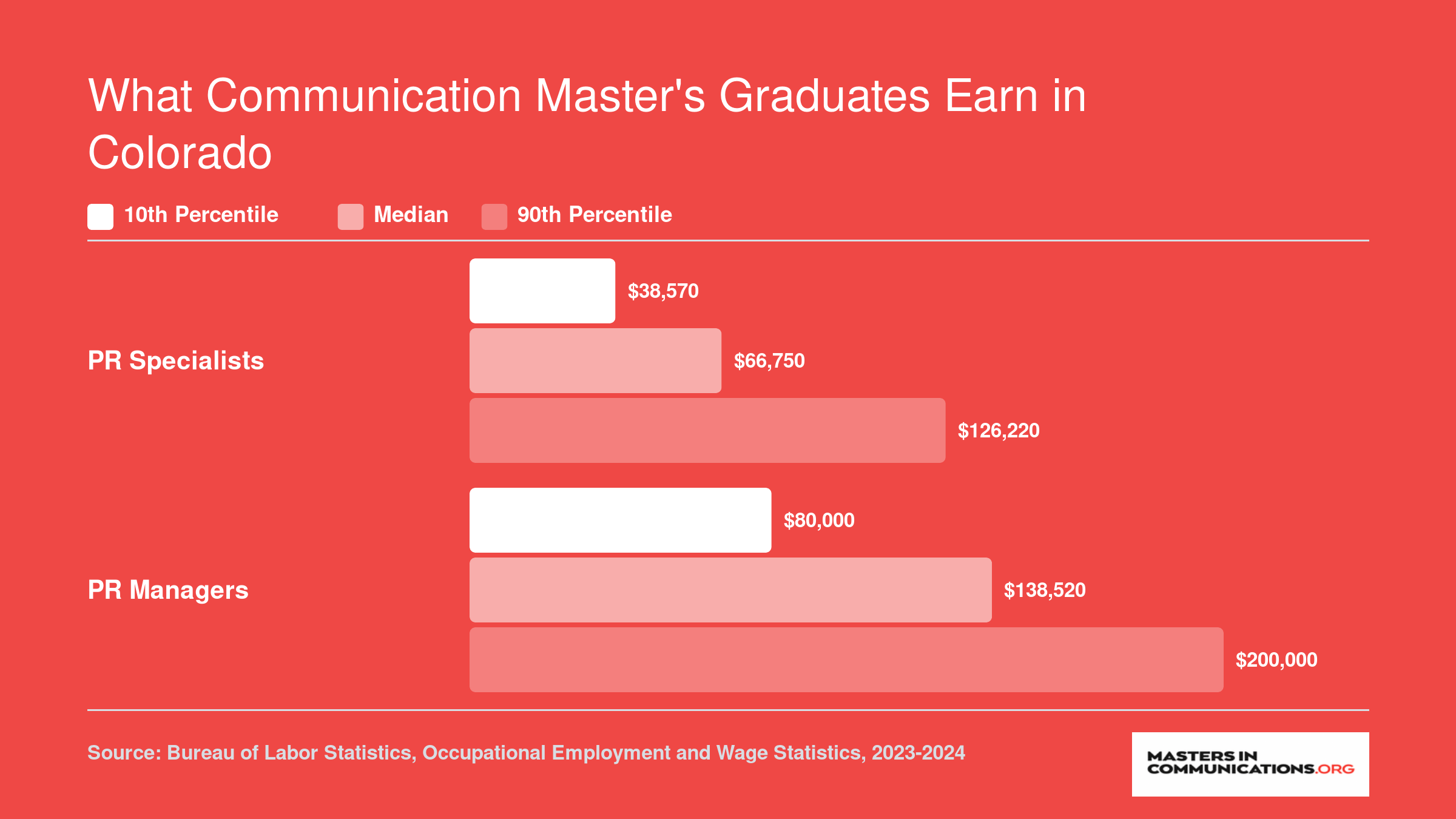
Program-level median earnings shortly after completion are not yet published for the communication master's programs ranked on this page. To give you a useful benchmark, the figures below reflect national median wages for two common communication career tracks, drawn from BLS data. Keep in mind that Denver-area wages often trend above national medians due to Colorado's higher cost of living, though metro-specific figures for these roles were not available at the granularity needed here.
Career Outcomes and Job Opportunities With a Communication Master's in Colorado
Colorado's communication job market is being reshaped by the convergence of Denver's booming tech scene, healthcare expansion, and robust public sector needs, creating multi-industry demand for skilled messaging professionals.
Colorado's Top Employers for Communication Graduates
The Denver metro area alone listed 472 communication-related openings on Glassdoor this month.1 Key hiring sectors span public agencies, technology firms, healthcare systems, higher education institutions, corporate headquarters, and marketing agencies. The City and County of Denver regularly recruits Communications Specialists and Public Information Officers to handle media relations, web content, and spokesperson duties.2 Tech subsectors like SaaS, cybersecurity, and fintech in the Boulder-Denver corridor continually seek corporate communication and content strategists, while large health systems and insurers demand patient- and community-facing communication leads.3 Colorado-focused job boards such as Andrew Hudson's Jobs List and state college listings via The Chronicle of Higher Education further highlight the regional concentration of opportunities.
Earnings, Debt, and ROI: Is a Master's Worth It?
Program-level employment rates and poverty-alleviation statistics are not yet available for Colorado communication master's programs, but earnings and debt data offer a clear snapshot of return on investment. The ROI ratio compares median earnings of federal-aid recipients ten years after entry to their median debt. For example, the University of Denver's online MA in Communication Management reports median earnings of $71,155 and median debt of $21,844, yielding an ROI of 3.26. CU Denver's MA in Communication shows $64,270 earnings and $20,500 debt (ROI 3.14), while Colorado State's MS in Media Communication arrives at $60,543 earnings and $20,000 debt (ROI 3.03). Regis University's online MA in Communication records $72,105 earnings and $25,000 debt, for an ROI of 2.88. These ratios, clustered around 3:1, signal that a graduate degree can pay for itself relatively quickly, though precise timelines depend on career trajectory and industry. For a broader look at reasons not to study a Master's in Communication alongside the benefits, it helps to weigh both sides before committing.
The Job Titles Driving Colorado's Market
Current listings reveal high demand for roles such as Communications Specialist, Corporate Communications Manager, and Public Information Officer.4 Additional titles frequently appearing include Social Media Specialist, Brand/Content Strategist, and Marketing & Communications Director. For those aiming at specialized tracks, common career targets include PR specialist, corporate communications director, digital media strategist, and content marketing manager. Tech firms often value strategic messaging and analyst relations, healthcare organizations prize internal and crisis communication skills, and government agencies need clarity and public trust. With the convergence of these industries in Colorado, the master's credential unlocks cross-sector mobility that a bachelor's alone rarely provides.
Admissions Requirements and Tips for Colorado Communication Programs
A minimum GPA of 2.5 is enough to qualify for some Colorado communication master's programs, though others set the bar considerably higher. Understanding what each school expects, and knowing how to position yourself as a strong candidate, can make the difference between an acceptance and a waitlist.
GPA Expectations Vary by Program
Colorado's communication graduate programs span a range of selectivity. The University of Denver's Media, Film and Journalism Studies master's requires a minimum 2.5 GPA1, while CU Boulder's online M.A. in Corporate Communication asks for at least a 2.75.2 CU Boulder's Journalism M.A. sets a higher floor at 3.2. Keep in mind that these are minimums, not targets; competitive applicants typically exceed them. Institution-wide admission rates (roughly 75 to 89 percent at these universities) offer a general sense of openness, but graduate-level communication cohorts are often smaller and more selective than those numbers suggest.
GRE Policies and Testing
The GRE requirement has become increasingly flexible across Colorado. CU Boulder's Corporate Communication program does not require standardized test scores2, and the University of Denver lists the GRE as optional.1 Colorado State University's M.A. in Communication Studies does not list the GRE as a blanket requirement, though you should verify directly with the department because policies can shift year to year.4 If you have a borderline GPA, submitting a strong GRE score voluntarily may still help your case at GRE-optional schools. For a broader look at test-optional graduate study, see our guide to online Master's in Communications programs with no GRE requirement.
Application Materials You Should Prepare
Most programs ask for a combination of these components:
- Statement of purpose: CU Boulder's Corporate Communication program specifies 500 to 750 words.2 Use this space to connect your professional background to your academic goals rather than restating your resume.
- Letters of recommendation: Expect to submit two (CU Boulder, Colorado State) or three (University of Denver).14 At least one should come from someone who can speak to your analytical or writing abilities.
- Writing sample: Colorado State explicitly requires one.4 Even when not mandatory, a polished writing sample drawn from professional or academic work signals readiness for graduate-level research and analysis.
- Application fee: Budget between $50 (CU Boulder) and $65 (University of Denver).12
Key Deadlines for Fall 2026
Timelines differ dramatically. Colorado State's deadline for fall 2026 was December 15, 20254, while the University of Denver's fell on January 30, 2026.1 CU Boulder's online Corporate Communication program offers a much later window, accepting applications through July 25, 2026.2 If you are reading this mid-year, that later deadline may still be within reach, but funding and assistantship decisions are often made on earlier cycles.
Strengthening a Weaker Application
If your undergraduate GPA falls below a program's stated minimum, all is not lost. Many admissions committees weigh professional experience heavily, especially for working professionals returning to school. Highlight leadership roles, communication projects, or media campaigns in your statement of purpose. A writing sample that demonstrates clear analytical thinking can offset a lower GPA more effectively than almost anything else. Choose a piece that reflects both subject-matter depth and strong organization: a well-argued white paper or long-form feature article works better than a brief blog post.
Funding, Assistantships, and Financial Aid in Colorado
Sticker price tells only part of the story for graduate students in Colorado. Once you factor in assistantships, waivers, and external scholarships, programs that look expensive on paper can become genuinely competitive with lower-cost alternatives.
Graduate Assistantships: What Each Program Offers
Colorado State University's Journalism and Media Communication M.S. stands out for its funding model. Nearly all admitted students receive a graduate assistantship covering full tuition, all mandatory fees, and health insurance.1 Stipends for the 2024-2025 academic year ranged from roughly $17,000 to $23,000 annually (approximately $1,902 per month), in exchange for 20 hours of work per week.1 For students who qualify, the effective out-of-pocket cost drops dramatically compared to the listed tuition rate.
The University of Denver's graduate assistantships also include a tuition waiver, and health insurance coverage may be available depending on the appointment.4 DU's sticker price is among the highest in the state, so an assistantship there can represent substantial value if you land one.
At the University of Northern Colorado, assistantships covering full tuition are available to students working 16 to 20 hours per week, with partial tuition assistance for those working 8 to 15 hours.3 This tiered structure gives students some flexibility based on workload.
CU Denver takes a different approach. Teaching assistantships exist but are limited, typically 3 to 6 per semester, and research assistantships are rare.2 The program does not currently offer a tuition waiver alongside assistantship positions, so competition for those slots is real and the financial benefit, while helpful, is more modest.2
A Note on Institutional Aid Culture
One useful proxy for how generous an institution tends to be with need-based aid is the share of undergraduates receiving Pell Grants. Schools with higher proportions of Pell recipients generally have more experience building financial support structures for students with limited resources. MSU Denver and CU Denver enroll among the highest shares of Pell-eligible undergraduates among Colorado communication programs, suggesting both institutions have robust undergraduate aid infrastructure, though graduate aid operates under different rules and funding pools.
External Scholarships and Federal Aid
Several national professional organizations offer scholarships relevant to communication graduate students. The Public Relations Society of America (PRSA) and the National Communication Association (NCA) both maintain scholarship and fellowship programs open to graduate applicants. Colorado-specific grants through the Colorado Department of Higher Education are generally aimed at undergraduates, but some graduate students may qualify for state-funded work-study or emergency aid depending on their institution.
Federal Direct Unsubsidized Loans and Graduate PLUS Loans remain available to graduate students at accredited programs regardless of assistantship status. If you are weighing a program without strong assistantship support, mapping your expected borrowing against realistic post-graduation salary ranges in Colorado is a worthwhile exercise before enrolling. For a broader look at whether the investment makes sense, our guide on Drawbacks and Reasons Not to Study a Master's in Communication offers a candid breakdown of the tradeoffs.
How to Choose the Right Communication Master's Program in Colorado
The best communication master's program is the one that fits your specific circumstances, not the one with the highest ranking or the lowest sticker price. Colorado offers enough variety that you can find a strong match whether you prioritize flexibility, specialization depth, affordability, or career acceleration. The key is knowing which factors matter most to you before you start comparing programs.
Build Your Decision Around Four Axes
Organize your search around these interconnected priorities:
- Cost and ROI: If minimizing debt is paramount, revisit the tuition comparison table earlier in this article. A $15,000 difference in total cost changes the calculus considerably, especially if you plan to enter public service or nonprofit communications where starting salaries trend lower.
- Format and flexibility: Working professionals often need asynchronous coursework or evening schedules. The format comparison section breaks down which Colorado programs offer fully online tracks versus hybrid or traditional on-campus models. If you are leaning toward a fully remote option, exploring online Master's in Communication programs for 2026 can broaden your search beyond the state.
- Specialization fit: A health communication track at one university will not serve you the same way as a strategic communication concentration at another. Match your intended career path to available curriculum rather than assuming you can retrofit any degree to your goals.
- Career goals: Consider whether you need a degree that emphasizes applied skills and industry connections or one that positions you for doctoral study or academic research.
Practical Steps Before Committing
Once you have narrowed your list to two or three programs, dig deeper:
- Request a virtual campus tour or attend an online information session. Faculty often participate in these events and give you a sense of their teaching style and research priorities.
- Ask the admissions office to connect you with current students or recent alumni. Ask them about workload, professor accessibility, and how well the program prepared them for their current roles.
- Review faculty publications and research areas. If you want to focus on crisis communication but no faculty member has published or consulted in that space, you may struggle to find a thesis advisor or meaningful mentorship.
- Confirm financial aid deadlines, assistantship availability, and any employer tuition reimbursement partnerships your workplace may have with specific institutions.
Context Matters More Than Rankings
A recent graduate with geographic flexibility and time to attend full-time faces a fundamentally different decision than a mid-career professional balancing coursework with a demanding job and family obligations. The working professional may prioritize an online format and part-time pacing even if a traditional program offers marginally better networking events. The recent graduate might accept higher tuition in exchange for a research assistantship that funds tuition while building academic credentials.
Neither choice is wrong. Both can lead to strong outcomes if you have matched the program to your constraints and ambitions. Spend time clarifying what you actually need before letting prestige or convenience drive the decision.
Frequently Asked Questions About Communication Master's Programs in Colorado
Choosing a graduate communication program raises practical questions about cost, format, and career payoff. Below are answers to the most common questions prospective students ask about master's in communication programs in Colorado, drawn from program data and labor market insights discussed throughout this guide.
- How much does a master's in communication cost in Colorado?
- Total tuition for a communication master's in Colorado typically ranges from roughly $15,000 to over $50,000, depending on the institution and residency status. Public universities such as the University of Colorado and Colorado State generally offer lower in-state rates, while private institutions charge higher flat rates. Always factor in fees, technology charges, and any required on-campus intensives when comparing total program cost.
- Which Colorado universities offer online master's in communication programs?
- Several Colorado institutions offer fully online or hybrid communication master's degrees. Colorado State University's online journalism and media communication program is one well-known option. The University of Denver and University of Colorado also provide flexible formats that blend asynchronous coursework with occasional synchronous sessions. Check each program's current delivery mode, because options have expanded in recent years.
- How long does it take to complete a master's in communication in Colorado?
- Most full-time students finish in about two years (four to five semesters). Part-time and online learners often take two and a half to three years. Accelerated cohort formats at some Colorado schools can compress the timeline to roughly 18 months. Program length also depends on whether a thesis or capstone project is required and how many credits transfer in.
- What is the salary for a master's in communication in Colorado?
- Salaries vary widely by role and industry. According to BLS data, the national median for media and communication occupations is approximately $66,500, though Colorado-specific medians for many communication roles tend to track somewhat higher due to cost of living in metro areas like Denver and Boulder. Graduates moving into management, public relations, or corporate communication roles often see salaries above the national median.
- Is a master's in communication worth it for career advancement?
- For most working professionals, yes. A master's credential often unlocks mid-level and senior positions in public relations, corporate communication, marketing leadership, and media strategy that are difficult to reach with a bachelor's alone. The degree also strengthens skills in data-driven storytelling, crisis communication, and digital strategy. ROI is strongest when you choose a program aligned with a specific career goal and keep total debt manageable.
- Do Colorado communication master's programs require the GRE?
- Many Colorado programs have moved away from requiring the GRE. Schools like Colorado State and the University of Denver have adopted test-optional or waiver-eligible admissions policies for applicants who meet minimum GPA thresholds or have relevant professional experience. A few programs still list the GRE as recommended. Check each school's current admissions page, because policies shift frequently.