
What you’ll learn in this article…
- Most ranked programs cost between $10,000 and $45,000 in total tuition, with several public options under $20,000.
- Organizational communication, strategic leadership, and digital media are the three most common specialization tracks across top programs.
- Regionally accredited online degrees carry the same employer credibility as on-campus formats, according to SHRM research.
- Full-time students typically finish in 12 to 18 months, while part-time timelines extend to roughly 24 months.
Employers posted over 30,000 communication roles in 2025, with median advertised salaries near $91,000, a sign that organizations prize specialists who blend organizational communication, digital strategy, and health communication. An online master's lets professionals build those skills without pausing their careers.
Across the 29 ranked programs, total tuition ranges from about $12,000 to over $70,000, and institution-wide median earnings for graduates ten years out span $58,000 to $102,000. That gap sets up a practical tension: affordability versus the salary jump needed to justify the expense.
The programs that sit atop the field share a common financial profile: low debt relative to earnings and an ROI that rewards careful specialization over brand name alone.
Top Online Master's in Communication Studies Programs
The programs below represent the best online master's in communication studies options for 2026, selected from a pool of nearly 30 online-delivery-eligible programs. Rather than ranking on a single factor like price or prestige, our composite weighs completion rates, post-graduation earnings, and affordability together to surface programs that deliver real value for working professionals. Each school card highlights tuition, the institution's overall graduation rate, and program-level earnings when that data is available.
- Institutional graduation and retention rates
- Graduate earnings after completion
- Tuition and net price affordability
- Online delivery eligibility
- Program breadth and flexibility
- Internal program database
- College Scorecard graduate earnings — collegescorecard.ed.gov
- NCES-IPEDS federal institutional data — nces.ed.gov
- Independent program research
University of Florida
#1Gainesville, FL · ~$7,000/yr (est.)
Best for: Social-change communicators on a budget
The University of Florida delivers two fully online M.A. in Mass Communication tracks through its College of Journalism and Communications: Public Interest Communication and Public Relations. Both charge the same tuition regardless of residency, keeping total program costs under $22,000 for 36 credits. The school's overall graduation rate sits at 91.1%, and the asynchronous format with three annual start dates makes it practical for professionals balancing full-time work.
- Total tuition approximately $17,441 for 36 credits
- $484 per credit, same rate for all students
- Completable in as few as 16 months full-time
- 100% asynchronous with live office hours
- Interdisciplinary focus on advocacy and systems thinking
- Capstone project replaces traditional thesis
- Industry advisory board shapes curriculum
- Three start dates: fall, spring, and summer
- Total tuition approximately $21,087 for 36 credits
- $586 per credit, no out-of-state surcharge
- First online PR program with CEPR certification
- Career tracks in crisis management and media relations
- Core courses in strategic writing and PR management
- Completable in about 1.5 years
- 100% online via recorded lectures
- Fall, spring, and summer entry points
University of North Carolina at Chapel Hill
#2Chapel Hill, NC · $12,000/yr
Best for: Mid-career digital media professionals
UNC Chapel Hill's Hussman School of Journalism and Media offers a cohort-based M.A. in Digital Communication capped at 20 students per year. The 30-credit curriculum unfolds over nine sequential courses across roughly 2.5 years, blending asynchronous coursework with two required on-campus residencies in Chapel Hill. With an overall institutional graduation rate of 91.2% and a thesis requirement, the program is a strong fit for mid-career professionals who want rigorous academic grounding alongside practical digital media skills.
- 30 credits across 9 sequential courses
- Cohort limited to 20 students for close mentorship
- Two required on-campus residencies in Chapel Hill
- Primarily asynchronous with optional synchronous sessions
- Three years of professional experience required
- GRE waived; 3.0 GPA minimum
- Thesis project required for completion
- Alumni network of more than 17,000 graduates
University of Central Florida
#3Orlando, FL · $10,000/yr
Best for: Florida professionals exploring hybrid learning
UCF's M.A. in Communication is a hybrid program covering corporate, crisis, health, intercultural, and strategic communication. Students choose from evening on-campus classes and online components, making the degree flexible for Central Florida professionals. In-state tuition runs about $8,872 per year, and the school's overall graduation rate is 78%. The program also prepares students for doctoral study, with alumni admitted to competitive Ph.D. programs.
- Customizable curriculum across five communication areas
- Evening course schedule for working students
- Full-time and part-time enrollment options
- Nationally recognized faculty mentors
- Internship and research opportunities available
- Prepares graduates for doctoral study
- Financial aid and scholarships offered
- Fall start with TOEFL or IELTS for international applicants
Columbia University in the City of New York
#4New York, NY · ~$22,000/yr (est.)
Columbia University's M.S. in Strategic Communication is a part-time hybrid program pairing synchronous online classes with three in-person residencies in New York City. Designed around real-client capstone projects, the curriculum develops skills in stakeholder assessment, storytelling, research design, and digital strategy. Two cohort tracks (early/mid-career and seasoned leader) let the school calibrate rigor to experience level. The institution's overall graduation rate is 96.1%, and its 6:1 student-to-faculty ratio ensures close interaction with instructors.
- Completable in 24 months part-time
- Synchronous online sessions plus NYC residencies
- Capstone consulting project with a real client
- Two cohort tracks based on career stage
- Small class sizes with career coaching
- Access to Columbia's global alumni network
- Financial aid and scholarships available
- Tuition of $57,973 per year (same for all students)
Rutgers University
#5New Brunswick, NJ · $24,000/yr (net price)
Rutgers' Master of Communication and Media offers six concentrations, including Digital Media, Health Communication, Public Relations, and Strategic Leadership. With on-campus, hybrid, and fully online pathways, the 36-credit program is built for Northeast professionals who want flexibility without sacrificing networking in the New York, New Jersey, and Philadelphia corridor. Eighty-six percent of MCM students graduate within 24 months, and the school's overall graduation rate is 83.6%. No GRE is required, and rolling admissions simplify the application timeline.
- 36 credits across 12 courses
- Six concentration options to tailor the degree
- Fully online, hybrid, or on-campus pathways
- Evening classes from 6 to 9 p.m. Eastern
- No GRE required; rolling admissions
- 86% of students graduate within 24 months
- 1,800+ alumni in the professional network
- In-state tuition approximately $23,241 per year
Northwestern University
#6Evanston, IL · $29,000/yr (net price)
Northwestern's M.S. in Communication blends communication theory, data analytics, and leadership practice. Students choose between the in-person Custom Leadership Program (with concentrations in AI, Strategic Communication, and Organizational Leadership) and the fully virtual Online Leadership Program. Both tracks include one-on-one career coaching and alumni mentoring. The school's overall graduation rate is 95.1%, and its 6:1 student-to-faculty ratio means substantial individual attention from faculty who are both leading academics and industry practitioners.
- Three concentration options in the Custom Leadership track
- Fully virtual Online Leadership Program available
- Asynchronous online classes for schedule flexibility
- One-on-one career coaching and alumni mentoring
- Faculty drawn from academia and industry
- Visa sponsorship available for in-person track
- Tuition of $54,655 per year (same for all students)
- Full-time and part-time enrollment paths
State University of New York at New Paltz
#7New Paltz, NY · ~$19,000/yr (est.)
SUNY New Paltz's M.A. in Strategic Communication emphasizes nonprofit leadership, sustainability advocacy, and ethical communication strategy. The 33-credit hybrid program accepts rolling admissions and offers both full-time and part-time pacing. Students may substitute an internship for an elective, and the capstone can take the form of a thesis or an applied research project. In-state tuition is approximately $12,812, and the school's overall graduation rate is 71.6%.
- 33 credits with thesis or applied research capstone
- Nonprofit and sustainability communication focus
- Rolling admissions with fall and spring starts
- Internship can replace one elective course
- Up to 6 transfer credits accepted
- Teaching assistantships available
- 3.0 GPA and three recommendation letters required
- In-state tuition around $12,812; out-of-state around $24,602
Purdue University
#8West Lafayette, IN · $15,000/yr
Purdue's fully online M.S. in Communication spans six concentrations, including Strategic Communication/Public Relations, Branding and Marketing, and Digital Media and Communication Technologies. Tuition is $525 per credit for all students regardless of residency, keeping total costs around $15,750 for 30 credits. Stackable graduate certificates transfer directly into the degree, giving professionals a stepping-stone entry point. The school's overall graduation rate is 83.1%.
- $525 per credit, uniform for all students
- 30 credits completable in as few as 12 months
- No prior communication background required
- Core courses in messaging and reputation management
- Credits from Purdue graduate certificates transfer in
- 100% online with no campus visits required
- Taught by industry-experienced faculty
- Enrollment counselors available for guidance
- 30 credits with a 20-month standard timeline
- Focus on brand strategy and consumer engagement
- Stackable certificate credits apply toward degree
- Part-time pacing and rolling start dates
- No prerequisite coursework in communication
- Develop strategic messaging and campaign skills
- Same $525 per credit rate for all students
- 30 credits covering emerging platforms and tools
- $525 per credit with financial aid available
- Emphasis on digital content and technology trends
- Completable in 12 to 20 months
- Career paths across diverse industries
- No residency or campus visit requirement
- Graduate certificates stack into the full degree
Towson University
#9Towson, MD · ~$17,000/yr (est.)
Towson University's Communication Management M.S. is positioned as the only program of its kind in the mid-Atlantic, focusing on crisis communication, social media strategy, corporate messaging, and media politics. The 36-credit hybrid format keeps at least half of coursework online, and students can choose among comprehensive exams, a professional project, or a thesis to complete the degree. In-state tuition is about $12,636, and the school's overall graduation rate is 69.5%.
- 36 credits with hybrid online and on-campus delivery
- Three completion paths: exams, project, or thesis
- Emphasis on public relations and corporate branding
- Proximity to Baltimore and D.C. job markets
- Full-time and part-time enrollment options
- Small class sizes with experienced faculty
- Prepares graduates for doctoral study
- In-state tuition around $12,636; out-of-state around $22,860
Washington State University
#10Pullman, WA · $15,000/yr
Washington State University's Edward R. Murrow College offers two fully online master's programs: the M.A. in Strategic Communication and the M.A. in Health Communication and Promotion. All online students pay a single Global Campus rate equivalent to in-state tuition (roughly $672 per credit, or about $20,150 total), making it one of the most affordable options for out-of-state learners. Flexible one-, two-, or three-year tracks and a capstone portfolio replace a traditional thesis. The school's overall graduation rate is 60.5%.
- 30 credits at $672 per credit for all students
- Total program tuition approximately $20,150
- Three completion tracks: 1, 2, or 3 years
- No GRE required; 3.0 GPA minimum
- 100% online with weekly faculty office hours
- Capstone portfolio and creative project
- 345 alumni spanning more than 80 professional disciplines
- Military benefits accepted; financial aid available
- 30 credits, 10 courses, fully online
- Same $20,150 flat tuition for all students
- Focus on digital health campaigns and behavior change
- No GRE required; work experience preferred
- Capstone portfolio demonstrates applied expertise
- Fall, spring, and summer start dates
- Weekly online office hours with faculty
- Military benefits and financial aid accepted
How We Ranked These Programs
Choosing a graduate program is rarely a single-variable decision. Cost pulls in one direction, program quality in another, and the flexibility of online delivery somewhere in between. Our methodology tries to hold all three in balance, using publicly available data rather than the reputation surveys that dominate magazine-style rankings. For a deeper look at every data point, see our full Rankings Methodology.
What Goes Into the Score
Every program starts from a baseline that weighs four factors:
- Graduation rate: How reliably does the institution help students finish? A high completion rate signals academic support, not just admissions selectivity.
- Earnings after completion: Median earnings figures come from College Scorecard program-level outcome data, drawing on both one-year and multi-year post-graduation windows. These are federal records, not self-reported alumni surveys.
- Tuition and net price: The net price figure used here is a sector-conditional average, meaning it reflects typical aid levels for students in similar enrollment categories. It is useful for comparing programs side by side, but your actual cost will depend on your financial situation and the aid package the school offers.
- Debt at graduation: Lower typical debt loads relative to earnings matter. A program that leaves graduates underwater is a red flag regardless of its reputation.
Programs that deliver their curriculum fully online receive an additional weight in the composite score, because online access is the central practical need of working professionals.
What We Deliberately Left Out
There is no peer assessment here, no survey of department chairs, and no prestige proxy borrowed from undergraduate rankings. Those inputs measure perception as much as quality, and perception tends to favor well-funded flagship institutions regardless of how well they actually serve part-time or online students.
One important caveat: graduation rates in this analysis are institution-wide figures. Program-specific completion data for individual master's tracks is rarely published in a consistent, comparable form, so the number reflects the university broadly. Keep that in mind when comparing a large public research university against a smaller institution where graduate programs are more central to the mission.
The goal is a ranking that tells you something concrete about value, accessibility, and outcomes, not one that tells you which schools already have the most famous names. If you are curious about how those outcomes translate into career paths, our overview of careers with a masters in communication can help you connect the dots.
Online Communication Studies Specializations Compared
Not all communication master's programs cover the same ground, and the specialization you choose shapes both your coursework and your career trajectory. Below is a side-by-side look at the five most common tracks across ranked programs, the schools that offer them, and the career paths each one typically supports. Use this table to match your professional goals with the right concentration.
| Specialization Track | What You'll Study | Schools Offering This Track | Typical Job Titles | Best For |
|---|---|---|---|---|
| Organizational Communication / Leadership | Internal communication, organizational culture, change management, leadership communication, employee engagement | Gonzaga University (MA in Communication and Leadership Studies), Washburn University (MA in Communication and Leadership), Northwestern University (MS in Communication, Leadership Program concentration) | Director of Communication, Communication Consultant, Corporate Trainer, Internal Communications Specialist | Professionals targeting HR, organizational development, corporate training, or consulting roles where improving how teams and leaders communicate is the core challenge |
| Strategic Communication / PR | Goal-driven external messaging, campaigns, branding, reputation management, public relations strategy | Columbia University (MS in Strategic Communication), Washington State University (MA in Strategic Communication), Purdue University (MS in Communication, Strategic Communication/PR concentration), SUNY New Paltz (MA in Strategic Communication), Rowan University (MA in Strategic Communication), Azusa Pacific University (MA in Strategic Communication), Winona State University (Strategic Communication) | Communications Manager, PR Specialist, Marketing Manager, Brand Strategist, Social Media Manager | Those who want to craft external messaging, run campaigns, or manage brand reputation for agencies, corporations, nonprofits, or government organizations |
| Digital Media / Digital Communication | Digital storytelling, social media analytics, content strategy, emerging media platforms, audience engagement | University of North Carolina at Chapel Hill (MA in Digital Communication), Old Dominion University (Lifespan and Digital Communication), Bowling Green State University (MA in Media and Communication, Strategic Communication and Social Media concentration) | Digital Content Strategist, Social Media Director, Multimedia Producer, Digital Marketing Manager | Working professionals who want to lead digital content initiatives, oversee social media strategy, or manage multimedia production across industries |
| Health Communication | Health messaging, crisis communication in public health, patient engagement, media campaigns for health organizations | Purdue University (MS in Communication, Health Communication concentration), Old Dominion University (concentration option), Georgia State University (concentration option) | Health Communication Specialist, Public Health Campaign Manager, Patient Engagement Coordinator | Professionals in healthcare, public health agencies, or nonprofits who design and evaluate messaging aimed at improving health outcomes |
| Intercultural / General Communication Studies | Cross-cultural communication theory, conflict resolution, rhetoric, applied research methods, broad communication competencies | Arizona State University (MA in Communication), University of Central Florida (MA in Communication), Sam Houston State University (MA in Communication Studies), Liberty University (MA in Communication), Temple University (MS in Communication Management, Conflict Management concentration), University of Nebraska at Omaha (MA in Communication) | Communication Analyst, Diversity and Inclusion Officer, Research Coordinator, Training and Development Manager | Professionals who prefer a flexible, broad-based degree they can tailor through electives, or those working in multicultural or global environments where cross-cultural fluency is essential |
Related Articles
What Communication Master's Graduates Actually Earn
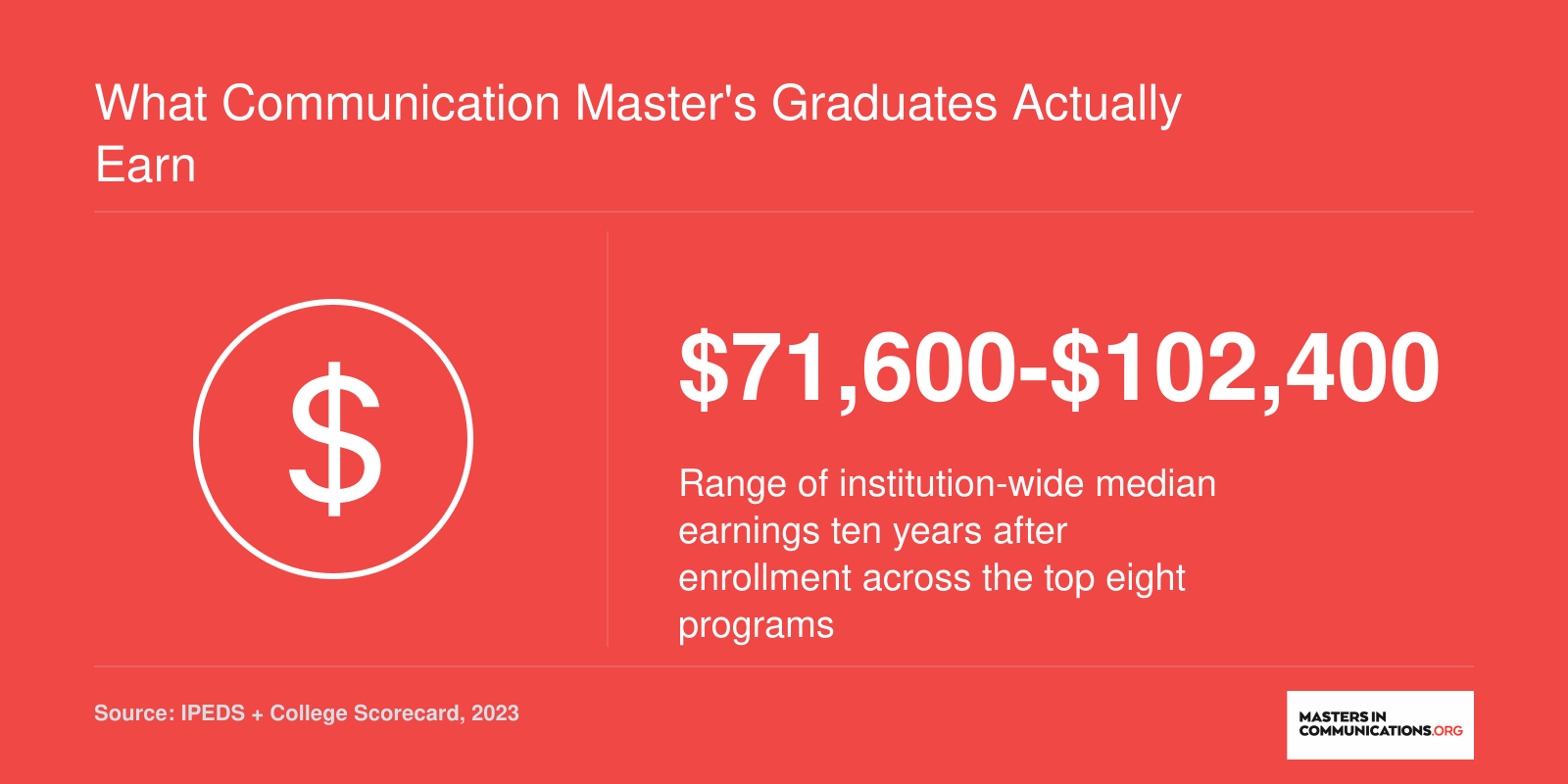
We wanted to show you a side-by-side earnings comparison for the top programs on this list, but program-level earnings data for these communication master's degrees has not yet been published in the College Scorecard. Instead, consider institution-wide outcomes: median earnings ten years after enrollment range from roughly $71,600 at the University of Florida to over $102,400 at Columbia University, reflecting broad differences in graduate earning power across these schools.
Salary and Career Outcomes After an Online Communication Master's
The infographic above focused on what graduates of specific communication programs actually earn after completing their degrees. Those figures, drawn from federal scorecard data, reflect real graduate outcomes regardless of job title. The table below shifts the lens to occupation-level data: what professionals in communication-aligned roles earn nationally, how many positions exist, and how fast those roles are growing. Together, the two perspectives give you a fuller picture of the return on your investment. All wage figures below are national medians reported by the Bureau of Labor Statistics and should not be read as state-specific estimates.
| Occupation | National Median Salary | 25th Percentile | 75th Percentile | Total U.S. Employment | Mean Annual Wage |
|---|---|---|---|---|---|
| Public Relations Managers | $138,520 | $102,300 | $198,000 | 76,060 | $163,520 |
| Public Relations Specialists | $69,780 | $51,970 | $95,940 | 280,590 | $80,310 |
| Media and Communication Workers, All Other | $71,770 | $52,690 | $99,520 | 23,590 | $84,870 |
Questions to Ask Yourself
How Long Does an Online Master's in Communication Take?
Balancing career demands with academic rigor is the central challenge when deciding how quickly to earn your online master's in communication. The timeline you choose directly affects your work-life balance, total cost, and how soon you can apply new skills on the job. Most online communication master's programs are designed to accommodate working professionals, with flexible structures that let you accelerate or slow down depending on your personal circumstances.
Typical Time-to-Completion Ranges
While program duration is not tracked in national data sets, verified details from program websites and admissions pages provide a reliable picture. A full-time online master's in communication can be finished in as few as 12 months through an accelerated track, but 18 to 24 months is the standard for students taking a moderate course load.1 Part-time students, especially those taking one course per term, often need up to 36 months. For example, Liberty University's 33-credit program uses 8-week courses and an accelerated option that can significantly shorten the timeline.2 West Virginia University's 30-credit online M.A. in Communication Studies, meanwhile, is designed to be completed in about 24 months.1
Credit Requirements and Pacing
Most online communication master's degrees require between 30 and 36 credits.2 Since many programs operate on a term-based rather than semester-based calendar, courses may run 7 or 8 weeks each, allowing you to focus on one subject at a time without drawing out the total timeline. If your program offers year-round enrollment with summer sessions, you can distribute credits more evenly across the calendar rather than taking summers off. This flexibility is especially helpful if you receive employer tuition reimbursement that depends on annual course loads.
Thesis vs. Non-Thesis Tracks
A non-thesis option nearly always leads to faster completion. Purdue University, for instance, offers both a thesis and non-thesis route for its online Communication MS.3 The non-thesis track typically replaces a lengthy research project with additional coursework or a comprehensive exam, shaving months off the total time. If you plan to pursue a Ph.D. later, the thesis may be worth the extra duration; otherwise, the applied track lets you graduate sooner and pivot to communication masters jobs.
What Can Speed You Up (or Slow You Down)
Several additional factors influence how long your degree takes:
- Transfer credits: Bringing in up to 6 to 9 graduate credits from prior study can eliminate an entire term.
- Course-load flexibility: Taking two courses per term instead of one can cut your timeline in half, but demands strong time management.
- Summer enrollment: Programs with summer terms allow continuous progress rather than seasonal breaks.
- Practicum or internship requirements: Some programs embed a capstone project that may require extra weeks beyond standard coursework.
Checking each program's maximum time limit for degree completion is wise, too. Most schools set a cap of 5 to 6 years, giving you plenty of room to adjust your pace if life gets in the way.
Tuition, Financial Aid, and ROI
What will an online communication master's cost, and how quickly can you expect to recoup that investment?
Here's what you'll likely owe and what you can expect to earn right after graduation.
Tuition Range: From Public Bargains to Ivy Premiums
Program tuition across our ranked schools spans a wide range, reflecting both institutional sector and program scope. At the most affordable end, Purdue University charges $9,992 for in-state students, while Arizona State University sets tuition at $10,843 for its online Master of Arts in Communication. University of Florida comes in just above, at $12,737 for residents. On the higher end, Northwestern University's hybrid Master of Science in Communication costs $54,655, and Columbia University's part-time Strategic Communication program runs $57,973. These figures represent the published tuition for the full program and do not yet account for financial aid, which can substantially reduce your out-of-pocket cost.
Programs with the Best ROI
Return on investment matters when you're balancing graduate school debt against career advancement. Three programs stand out when we look at the relationship between likely debt and early-career earnings:
- Northwestern University: With a calculated ROI ratio of 5.96, Northwestern graduates enter the workforce with relatively manageable debt and strong earning potential. The program's hybrid format and reputation open doors in corporate communication and strategic leadership roles.
- University of North Carolina at Chapel Hill: UNC's M.A. in Digital Communication delivers an ROI ratio of 5.16. The cohort-based structure and two on-campus residencies keep costs reasonable while building a tight-knit professional network.
- University of Florida: Florida's Public Interest Communication concentration posts an ROI ratio of 4.77. The program's interdisciplinary approach and systems-level thinking focus prepare graduates for advocacy, government, and nonprofit sectors where mission and income align.
Understanding Net Price and Financial Aid
Published tuition is only the starting point. Net price figures (the actual average a student pays after institutional grants and scholarships) vary significantly by sector and individual financial circumstances. For example, Northwestern's net price averages $29,167 despite a sticker tuition above $54,000, while UNC-Chapel Hill's net price sits at $11,655 for in-state students. Columbia's averages $21,590 after aid.
Your personal net price will depend on your FAFSA results, merit awards, employer tuition assistance, and school-specific scholarships. Many programs reserve fellowship funding for standout applicants, and public universities often extend in-state rates to online graduate students regardless of residency. Visit each program's financial aid page directly and speak with an enrollment counselor to model your real cost before committing.
Debt-to-Earnings Reality Check
Most communication master's graduates carry some debt, but the burden varies. Among the programs with available data, median debt at graduation ranges from $15,000 at Northwestern and University of Florida to around $24,454 at Gonzaga University. These figures reflect institutional borrowing patterns rather than a guarantee of what you'll owe. Your actual debt load depends on how much you finance, whether you work while studying, and how aggressively you pay down loans during school.
First-year earnings are not yet published at the program level for most communication degrees, so we rely on institutional outcomes data and national occupation medians. Communication managers, public relations specialists, and corporate communications directors typically earn between $62,000 and $90,000 early in their post-master's careers, with growth accelerating as you move into senior roles. To explore typical salaries in more detail, see our breakdown of where communications majors earn the most. The key is ensuring your total debt remains below your expected first-year salary, a threshold these top-ranked programs generally meet when students borrow responsibly.
Admissions Requirements and What Programs Look For
Open-admission programs versus selective cohort models represent two fundamentally different approaches to graduate admissions in communication studies. Most online master's programs fall somewhere in between, setting baseline criteria while maintaining flexibility for working professionals. Understanding where your target programs sit on that spectrum helps you prepare a stronger application and allocate your time wisely.
GPA Minimums and GRE Policies
Most programs publish a minimum undergraduate GPA requirement, typically 3.0 on a 4.0 scale, though competitive applicants often exceed that threshold. Check the "Admissions" or "How to Apply" section on each program's website for the exact cutoff. GRE requirements have shifted dramatically in recent years. Many schools now offer waivers for applicants with five or more years of professional experience, a prior graduate degree, or a GPA above a specified threshold (often 3.3 or higher). Some programs have eliminated the GRE entirely; you can explore a curated list of online masters in communication no GRE options to narrow your search. If your target school still requires the exam, confirm the minimum scores and whether you can substitute the MAT or other assessments.
Non-Communication Backgrounds Welcome
You do not need a bachelor's in communication to apply. Programs routinely admit students from business, education, journalism, public relations, psychology, and dozens of other fields. If you are still weighing whether to complete your undergraduate degree first, our guide to bachelor of communication online degree programs can help you plan that step. Review the "Prerequisites" or "Background" section of each program's site to see whether any foundational coursework is required before you matriculate. A handful of schools ask students without communication credits to complete one or two undergraduate courses during their first semester, but most integrate background-building into the graduate curriculum itself.
Standard Application Materials
Expect to submit a statement of purpose (typically 500 to 1,000 words), a current resume or CV, two to three letters of recommendation, and official transcripts from every college or university you have attended. Some programs also request a writing sample, particularly if you are interested in a research-focused track. Consult the program's "Application Checklist" or contact the admissions office directly to confirm deadlines, format preferences, and whether rolling admissions are offered. Many online programs accept applications year-round, while others follow strict fall or spring start dates.
Frequently Asked Questions About Online Communication Studies Programs
Choosing the right online master's in communication studies program means sorting through questions about accreditation, career paths, cost, and format. Below are the answers prospective students ask most often, drawn from program data and accreditation guidelines current for 2026.
- What accreditation should an online communication program have?
- Regional institutional accreditation is the most important credential to verify. Look for approval from bodies such as HLC, SACSCOC, MSCHE, NECHE, NWCCU, or WSCUC. ACEJMC accredits journalism and mass communication programs (advertising, public relations, strategic communication, broadcasting) but does not cover standalone communication studies degrees. A regionally accredited institution ensures your credits transfer and that employers and doctoral programs recognize your degree.
- What can you do with a master's in communication studies?
- Graduates move into roles such as corporate communications director, public relations manager, training and development specialist, media strategist, and organizational development consultant. The degree also supports advancement in higher education, government affairs, and nonprofit leadership. Many alumni report that the analytical and persuasion skills refined in a master's program accelerated their path into senior or director-level positions.
- Is an online master's in communication worth it?
- For most working professionals, yes. Programs profiled on mastersincommunications.org show median alumni earnings that generally surpass those of bachelor's-only peers, and the flexible online format lets you keep earning while you study. Return on investment depends on tuition (which ranges roughly from $10,000 to over $50,000 across programs), financial aid, and how directly you apply the credential. Weighing total cost against realistic salary gains is the best way to judge personal ROI.
- What is the difference between communication studies and strategic communication?
- Communication studies is a broader, theory-driven discipline exploring interpersonal, organizational, intercultural, and rhetorical communication. Strategic communication is a practice-oriented specialization focused on crafting messaging for specific organizational goals, often within PR, marketing, or corporate affairs. Some programs nest strategic communication as a concentration inside a communication studies degree, while others offer it as its own distinct master's program.
- Do online communication master's programs require campus visits or residencies?
- Many fully online programs do not require any on-campus visits. When a residency exists, it is typically optional or limited to a short immersion of a few days. Most programs substitute experiential requirements like a capstone project, applied practicum, or virtual internship instead. Always check the specific program page, because residency policies vary and some cohort-based formats include a brief in-person orientation.
- How much does an online master's in communication cost on average?
- Total tuition across the programs reviewed on mastersincommunications.org ranges from roughly $10,000 at the most affordable public universities to over $50,000 at private institutions. Most programs fall between $15,000 and $35,000. Per-credit rates, fees, and whether you qualify for in-state pricing all affect the final number, so request a full cost-of-attendance estimate before committing.
- What does the weekly workload look like?
- Most students should plan for about 15 to 20 hours per week if enrolled in two courses at a time. Programs designed for working professionals often use asynchronous formats, letting you complete lectures, readings, and discussion posts on your own schedule. Heavier weeks around midterms, finals, or major project deadlines can push closer to 25 hours. Part-time enrollment naturally reduces the weekly commitment.
- Is a thesis required in online communication master's programs?
- Not always. Many online programs offer a capstone project or comprehensive exam as alternatives to a traditional thesis. A capstone typically involves an applied research or strategic communication project tied to a real organization. If you plan to pursue a doctorate, a thesis builds stronger research credentials. Check each program's catalog to see which completion pathways are available.
More Online Communication Studies Programs to Consider
These programs also met our ranking criteria and may be strong fits depending on your specialization interest, location, or budget. Browse the directory below to explore additional options beyond our top 10.
Rowan University
Arizona State University
Virginia Commonwealth University
Gonzaga University
Temple University
University of Wisconsin-Whitewater
Georgia State University
Liberty University
University of Nebraska at Omaha
Missouri State University
Winona State University
Southern Illinois University-Edwardsville
Sam Houston State University
University of Wisconsin-Eau Claire
Azusa Pacific University
Explore More
- Best Online Faith-Based Masters in Communication
- Best Online Master's in Communication Disorders
- Best Online Master's in Communication Management
- Best Online Master's in Communications No GRE
- Best Online Master's in Global Communication
- Best Online Master's in Health Communication
- Best Online Master's in Journalism
- Best Online Master's in Marketing
- Best Online Master's in Mass Communication
- Best Online Master's in Media Communication
- Best Online Master's in Organizational Communication
- Best Online Master's in Public Relations
- Best Online Master's in Social Media Marketing
- Best Online Master's in Sports Communication
- Best Online Master's in Strategic Communication
- Best Online Master's in Technical Communication
- Best Online MBA in Marketing
- Best Online PhD in Communication Programs by State
- Online Communication Programs Are Expanding
- Online Master's in Political Communication
- Online vs. Hybrid Master's in Communication