
In Brief
- Online bachelor's in communication tuition ranges from roughly $200 to $700 per credit hour depending on institution type.
- Only about 120 to 125 programs nationwide hold ACEJMC programmatic accreditation, so regional accreditation matters most.
- Degree-completion tracks let students with 30 to 60 existing credits finish faster than full four-year programs.
- Graduates who pair a concentration with a working portfolio consistently report stronger salary and hiring outcomes.
Communication graduates in 2026 enter a labor market that spans public relations, corporate communications, content strategy, digital media production, and internal employee engagement, with the Bureau of Labor Statistics projecting 8 to 10 percent growth for public relations specialists and media planners through 2033. Demand is rising because organizations now manage communications across multiple platforms simultaneously, a shift that favors specialists who can write, edit, produce video, analyze audience data, and manage stakeholder relationships.
Online bachelor's programs in communication now mirror the curricular depth of campus offerings, and most offer both BA and BS tracks. The BA typically emphasizes theory, writing, and humanities electives, while the BS leans toward applied research, quantitative methods, and business communication. Either pathway prepares students for the same entry-level roles, though concentration choice matters more than the letters after the degree.
Cost varies widely, from under $30,000 total at some public universities to over $60,000 at private institutions. Graduates' median earnings depend heavily on occupation and region, with public relations specialists earning a national median near $66,000 and writers and authors closer to $73,000 as of 2023. Not every program reports alumni outcomes clearly, so verifying post-graduation employment rates and salary ranges before enrollment saves time and money.
What Is an Online Bachelor's in Communication?
Campus-based versus online delivery is the most obvious distinction people weigh when researching this degree, but the more consequential question is what the program actually teaches and how it prepares you for a specific career path.
The Core of a Communication Degree
An online bachelor's in communication is a four-year undergraduate program that examines how people create, share, and interpret messages across contexts. Coursework typically spans rhetoric, media studies, organizational communication, persuasion theory, and interpersonal dynamics. Rather than training you for one narrow job function, the degree builds a transferable skill set: critical analysis, audience awareness, strategic messaging, and the ability to navigate complex social environments.
The field is genuinely broad, which is both its strength and the source of some confusion. A communication degree is not the same as a journalism major, an advertising major, or a marketing major, even though concentrations within a communication program often touch on all three. Think of communication as the parent discipline; those others are professional specializations that borrow from it. For a deeper look at the broader field, the mass communication guide is a useful starting point.
BA versus BS: Which Track Are You Likely to Find?
Most online programs award a Bachelor of Arts. A BA tends to sit in the liberal-arts tradition: more elective freedom, sometimes a foreign-language requirement, and emphasis on humanistic inquiry into media and culture. A Bachelor of Science in Communication is less common but does exist, and it leans applied and quantitative, with heavier requirements in statistics, research methods, and data analysis.
If you are drawn to the analytical side of audience research or media measurement, hunting for a BS program is worth the extra search time. If your goals involve writing, public relations, leadership communication, or content strategy, a BA will serve you well.
How Employers Actually View Online Degrees
A degree earned online from a regionally accredited institution carries the same academic credential as its on-campus counterpart at the same school. Employers see the accreditation and the institution's name, not the delivery format. The practical caveat is accreditation itself: a degree from an institution without proper regional or national accreditation can create real problems in hiring and graduate school applications. Accreditation is covered in detail later in this guide, but it is the single most important quality filter to apply before you enroll anywhere.
How to Choose an Online Communication Degree Program
The quality of your online communication degree depends less on brand name than on how well the program's delivery model fits your work schedule, learning style, and career timeline. Instead of relying on rankings or third-party aggregators, dig into the structural details that determine whether you can actually complete the degree while holding a full-time job.
Start at the Source: Official Program Pages
Visit each school's official website and look for pages labeled Program Format, Delivery Method, or Student Experience. These sections spell out whether courses run asynchronously (watch lectures and submit work on your own schedule within weekly deadlines) or synchronously (join live sessions at fixed times), whether the program follows a cohort model (you progress through a set sequence with the same group) or self-paced tracks (you enroll in courses as your schedule allows), and what the expected completion timeline looks like for full-time versus part-time students. Arizona State University's online communication BA, for example, runs fully asynchronous with eight-week course blocks, while Liberty University offers a mix of synchronous and asynchronous elements depending on the concentration. Penn State World Campus emphasizes cohort structures in some programs but allows more flexibility in others. These distinctions matter if you work rotating shifts, travel frequently, or need to pause enrollment for a semester.
Cross-Check Industry and Association Standards
Once you understand a program's format, check authoritative sources like the Bureau of Labor Statistics (BLS.gov) to see how different delivery models affect career timelines and industry expectations. Some communication fields, particularly corporate communication and public relations, care more about portfolio work and internship experience than whether your degree was earned synchronously or asynchronously. The National Communication Association maintains program accreditation guidelines and publishes best-practice standards for online learning formats. These resources help you verify that a program's structure aligns with professional norms in your target industry. If you eventually plan to pursue graduate study, exploring whether a master's in communication is worth it can also help you evaluate how well a bachelor's program prepares you for that next step.
Talk to Admissions Counselors Directly
Email or call admissions offices and ask concrete questions: How many courses per term do working students typically take? What percentage of last year's cohort graduated on the advertised timeline? Are cohort schedules published in advance so you can plan around work commitments? Admissions counselors at schools like University of Florida, SNHU, and Purdue Global can provide enrollment data, typical graduation timelines, and details about credit-transfer policies that rarely appear on marketing pages. This conversation also gives you a sense of how responsive and organized the program's administrative support will be once you enroll.
Questions to Ask Yourself
Accreditation and Quality Indicators for Communication Programs
Only about 120 to 125 programs nationwide hold ACEJMC programmatic accreditation, and nearly all of them sit inside journalism masters programs or mass communication schools.1 That single statistic explains why accreditation works differently for communication degrees than it does for fields like nursing or engineering: there is no universal programmatic seal that every quality communication program carries. Instead, you are evaluating three separate layers.
The Three Layers of Accreditation
- Regional (institutional) accreditation: This is the non-negotiable layer. Bodies like HLC, SACSCOC, MSCHE, NECHE, NWCCU, and WSCUC accredit the entire university and are recognized by both the U.S. Department of Education and CHEA. Without it, your credits will not transfer reliably and you cannot access federal financial aid.1
- Programmatic accreditation (ACEJMC): The Accrediting Council on Education in Journalism and Mass Communications reviews programs on a six-year cycle and is recognized by CHEA.2 It is optional, covers journalism and mass communication specifically, and applies to online delivery the same as on-campus.3 Most general communication, strategic communication, and organizational communication bachelor's programs are not ACEJMC-accredited, and that is normal, not a warning sign.
- State authorization: Online programs must be authorized to enroll students in your state, typically through SARA reciprocity. Verify this before you apply if you live outside the school's home state.
How to Verify Accreditation Yourself
Use the U.S. Department of Education's Database of Accredited Postsecondary Institutions and Programs, cross-check against the CHEA directory, and review the school's own consumer disclosures page.2 For journalism-focused programs, ACEJMC publishes its current accredited list directly.4 Two organizations students sometimes confuse for accreditors, NCA (the National Communication Association) and AEJMC (the Association for Education in Journalism and Mass Communication), are professional associations, not accrediting bodies.1
Red Flags to Watch For
Be cautious of nationally accredited (often for-profit) institutions whose credits frequently fail to transfer to regionally accredited universities or graduate programs. Also avoid any online program that cannot confirm authorization to operate in your home state, since that gap can void your degree's recognition for licensure, employer tuition reimbursement, or further study.
Online Communication Degree Costs: A Program-by-Program Comparison
Tuition for an online bachelor's in communication generally falls between roughly $200 and $700 per credit hour, with the spread driven by three main factors: whether the school is public or private, whether online students pay a flat rate or get charged out-of-state pricing, and how much the institution invests in student support services like coaching, career advising, and live faculty interaction.1 Large-scale online providers often standardize one rate nationwide, while traditional public universities sometimes preserve the in-state versus out-of-state split even for fully online learners. That distinction alone can swing your total bill by tens of thousands of dollars.
Per-Credit Tuition at Eight Online Programs
The figures below reflect the most recent published rates for each institution. Always confirm current pricing directly with the school before enrolling, since tuition is revised annually.
- Fort Hays State University: $205/credit in-state, $618/credit out-of-state (residency applies to online students)2
- University of Florida: $129.18/credit in-state, $552.62/credit out-of-state (residency applies to online students)3
- University of Memphis: $280/credit in-state, $363/credit out-of-state (residency applies to online students)2
- Purdue University Global: $280/credit in-state, $371/credit out-of-state (flat online rate by residency tier)2
- Southern New Hampshire University: $354/credit, flat rate for all online students nationwide4
- Liberty University: $390/credit, flat rate for all online students nationwide1
- Oregon State University (Ecampus): $419/credit in-state, $545/credit out-of-state2
- Arizona State University Online: $574/credit, flat rate for all online students nationwide1
Estimated Total Tuition at 120 Credits
Most bachelor's degrees require 120 credit hours to graduate, so multiplying the per-credit rate gives you a useful sticker-price benchmark before fees, books, and technology charges.
- Lowest end (Fort Hays State or UF in-state residents): roughly $15,500 to $24,600 total
- Mid-range (Memphis in-state, Purdue Global, SNHU): roughly $33,600 to $42,500 total
- Higher end (Liberty, Oregon State, ASU Online): roughly $46,800 to $68,900 total
- Out-of-state public rates without a flat online discount: routinely $65,000 to $74,000 total
If you can transfer in 30 to 60 credits from prior coursework or an associate degree, the effective price drops significantly, which is why degree-completion tracks are worth a serious look for working adults. For a broader view of on-campus and online options, explore Bachelor's in Communication Programs in 2026.
Related Articles
Financial Aid and Scholarships for Online Communication Students
Students enrolled in regionally accredited online bachelor's programs are fully eligible for the same federal financial aid as on-campus undergraduates, including Pell Grants, Direct Subsidized and Unsubsidized Loans, and work-study awards.1 The Free Application for Federal Student Aid (FAFSA) determines your eligibility regardless of whether you take courses in a classroom or over the internet, as long as the institution holds regional accreditation and participates in Title IV programs.2 If a school accepts federal aid for its residential students, it accepts it for online students in the same degree programs.
Communication-Specific Scholarships and Awards
Several professional associations maintain scholarship programs specifically for communication majors. The Public Relations Society of America (PRSA) Foundation awards individual scholarships ranging from $1,500 to $5,000 annually to undergraduate and graduate students pursuing public relations, corporate communication, or related fields. The National Communication Association (NCA) administers multiple scholarships for undergraduate and graduate students, with awards typically between $1,000 and $2,500. Many schools also offer institutional merit scholarships for communication students, especially those with strong portfolios in writing, video production, or strategic communication. Check your target program's financial aid page for department-specific awards, which often have separate application cycles and selection criteria.
Institutional Discounts and Employer Partnerships
Large online programs frequently offer tuition discounts beyond federal aid. Military service members and veterans typically receive dedicated pricing, and many universities hold partnership agreements with major employers that reduce tuition for company employees. Contact the admissions office directly to ask about corporate partnership rates, cohort discounts for groups of students from the same organization, or regional tuition reciprocity agreements. These arrangements are rarely advertised on public websites but can lower your per-credit cost by 10 to 25 percent.
Estimating Your Net Price
Every college receiving federal aid must provide a net price calculator on its website.3 These tools estimate your total cost after grants and scholarships, based on your household income, enrollment status, and dependency status. Run the calculator at each school on your shortlist before applying. The result gives you a more accurate picture of out-of-pocket expense than the published sticker price and helps you compare real affordability across programs. Students who discover they want to advance further after completing a bachelor's degree may also find similar aid structures when exploring integrated marketing communications masters programs.
Common Courses and Concentration Options in Online Communication Programs
Breadth-first general curricula versus specialized concentration tracks: most online bachelor's programs in communication let students choose one approach or blend both, starting with a shared core before branching into targeted electives. Understanding what you will study, and which concentration best aligns with your career goals, helps you pick the right program from the start.
Core Courses in Most Communication Programs
Regardless of concentration, students can expect to complete six to eight foundational courses that build the theoretical and applied skills every communication professional needs:
- Introduction to Communication Theory: Examines frameworks for understanding how messages are created, transmitted, and interpreted across contexts.
- Public Speaking: Develops skills in oral presentation, audience analysis, and persuasive delivery.
- Media Writing: Teaches writing for diverse platforms (press releases, web copy, scripts) with attention to style, clarity, and audience.
- Research Methods in Communication: Introduces qualitative and quantitative research design, survey methods, content analysis, and ethical data collection.
- Persuasion and Rhetoric: Explores how messages influence attitudes, beliefs, and behaviors, drawing on classical and contemporary rhetorical theory.
- Intercultural Communication: Focuses on communication across cultures, identities, and global contexts.
- Organizational Communication: Covers internal communication, leadership, change management, and workplace collaboration.
Some programs also require courses in digital communication technologies, ethics, or visual communication as part of the core.
Popular Concentrations and Career Pathways
Concentrations allow students to tailor the degree to specific industries. Graduates who want to explore advanced options later can review careers with a masters in communication for a closer look at where each track can lead.
- Public Relations: Coursework in media relations, crisis communication, and campaign planning prepares graduates for PR specialist, agency account coordinator, and corporate communications roles.
- Digital Media: Emphasizes social media strategy, content creation, analytics, and multimedia storytelling for positions in digital marketing, content management, and community engagement.
- Business and Corporate Communication: Blends strategic communication, data analytics, and marketing communication to support roles in internal communications, brand management, and employee engagement.
- Health Communication: Trains students in patient education, health campaigns, and community outreach for careers in hospital systems, public health agencies, and nonprofit advocacy.
Experiential Learning Components
Most programs integrate hands-on learning even in fully online formats. Virtual internships let students apply classroom theory in real organizational settings, often arranged through employer partnerships or student-initiated placements. Capstone projects require students to design and execute a comprehensive communication campaign, research study, or media product, culminating in a professional portfolio. Some accredited programs mandate a supervised internship of 120 to 240 hours, which online students complete locally or remotely with approved organizations.
Tip for Business-Focused Students
If your goal is a corporate communication or internal-communications role, prioritize programs that include coursework in strategic communication planning, data analytics or audience measurement, and marketing communication. Students drawn to the social media side of corporate work may also want to explore degrees in social media at the graduate level. These courses bridge the gap between communication theory and business outcomes, making graduates more competitive for roles that require both persuasive messaging and bottom-line thinking.
Degree-Completion vs. Full Four-Year Programs: Which Track Fits You?
A degree-completion program is designed for students who already hold transferable college credits, typically 30 to 60 or more, often in the form of an associate's degree. A full four-year program, by contrast, admits first-time freshmen with no prior college coursework and guides them through all 120 credits from start to finish. Both paths lead to the same bachelor's credential, and employers view them identically.4 Yet each suits a different learner profile.
Entry Requirements and Time to Finish
Degree-completion tracks assume you arrive with general education requirements already satisfied. If you hold an associate's degree or equivalent credits, you can often finish in 18 to 24 months of upper-division coursework. Full four-year programs require no prior college experience but demand a longer runway, usually four to five years for full-time students. Data from the National Center for Education Statistics shows that students who transfer after completing an associate's degree graduate on time at higher rates (around 47 percent)1 compared to the 20 to 40 percent on-time rate typical of students who start as freshmen and remain at a single institution.2
Cost Implications
Time is money. Because degree-completion students enter with credits in hand, they pay tuition for roughly half the total coursework. Many working professionals stack prior community college credits, employer-sponsored courses, or military training to shorten and cheapen the path. Full four-year enrollees pay for the entire sequence, though they benefit from a more structured curriculum and often qualify for institutional scholarships unavailable to transfer students. The earnings premium for bachelor's holders over high school graduates sits at roughly 60 percent regardless of which track you choose.4
Watch for Mislabeled Programs
Many online communication degrees appearing in search results are actually degree-completion programs, yet their marketing materials do not always make this obvious. Before you invest time in an application, verify whether the program admits students with zero credits or requires a minimum transfer threshold. A quick call to admissions can save weeks of confusion.
Get a Preliminary Credit Evaluation
If you have prior coursework from another institution, military training, or professional certifications, request a preliminary credit evaluation before committing. Admissions offices typically offer this service at no cost, and the resulting estimate clarifies how many credits will transfer, which courses you still need, and how long completion will realistically take. Six-year completion rates for transfer students who secure clear credit agreements climb as high as 79 to 90 percent1, far above the 53.5 percent average for students navigating full four-year programs without early advising support.3 Once you earn your bachelor's, you may find that a master's in communication is a natural next step for leadership roles.
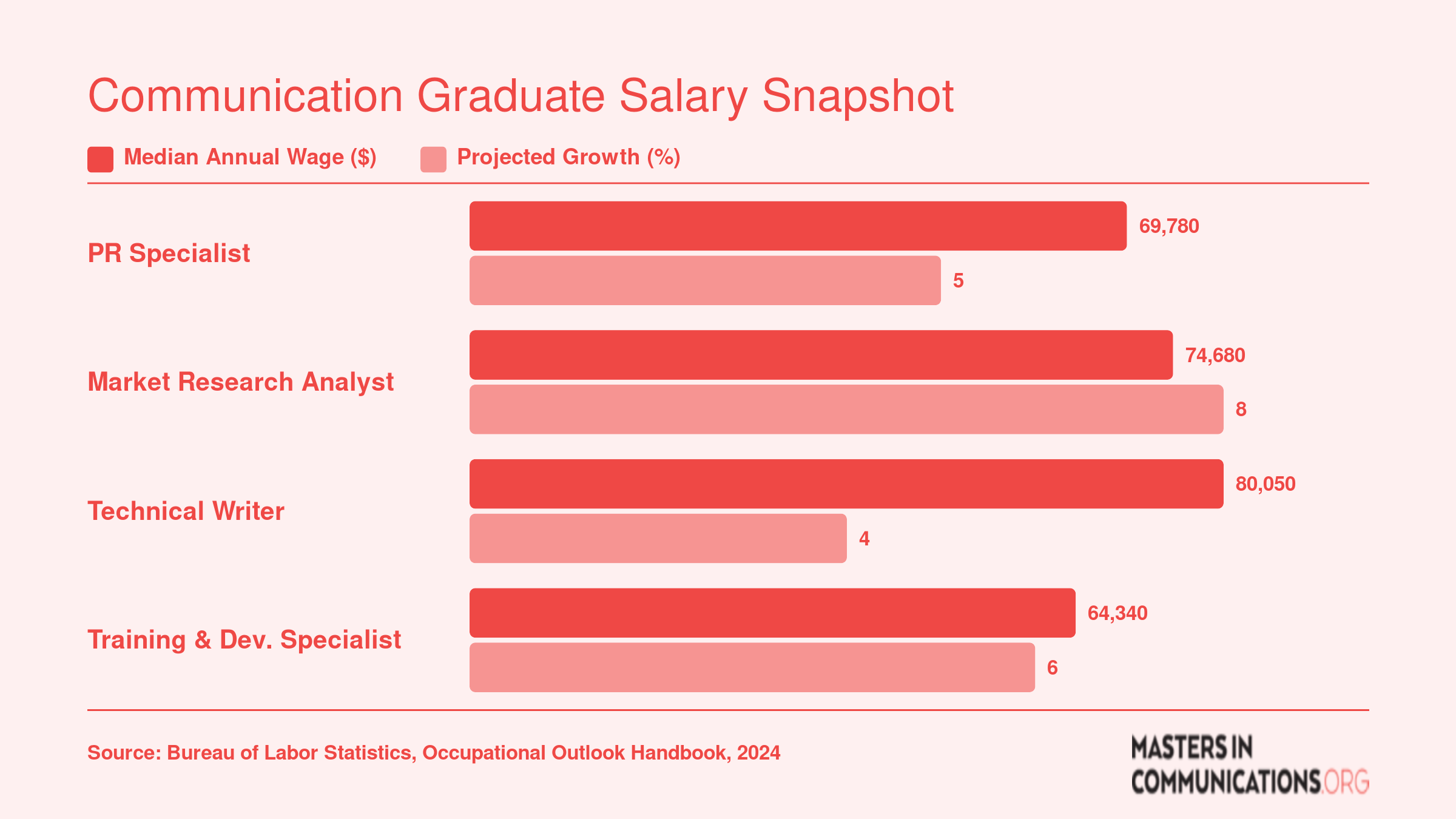
Communication Graduate Salary Snapshot
Communication graduates fan out across a wide range of occupations, so no single job title captures the full picture. The roles below represent some of the most common landing spots for bachelor's holders, each mapped to a different Standard Occupational Classification code. Only the Public Relations Specialists figure shown here reflects a confirmed BLS national median; the remaining roles are included for context, but readers should verify current figures directly with the Bureau of Labor Statistics, as published medians shift with each annual update.
Career Outcomes: What You Can Do With a Communication Degree
What jobs can you actually get with an online bachelor's in communication, and does the salary make it worthwhile?
Few bachelor's degrees travel as well across industries as communication. Graduates land in public relations firms, corporate communications departments, content marketing agencies, human resources and training roles, media production companies, and nonprofit organizations. The credential signals something employers consistently say they cannot teach on the job: the ability to read an audience, shape a message, and move it through the right channel.
What the Salary Data Shows
Skepticism about communication majors often centers on earnings. The data tells a more encouraging story. According to the Bureau of Labor Statistics, communication degree holders nationally report a median annual wage of around $65,000.1 NACE survey data puts the national median starting salary for communication graduates at roughly $58,000, with a year-over-year increase of about 4.8 percent as of 2023.2 Those figures reflect all experience levels and all regions, so individual outcomes vary, but the trajectory is upward rather than flat.
Mid-career progression depends heavily on specialization and industry, but communication professionals who move into management, strategic roles, or specialized fields routinely push past $80,000 to $100,000. The BLS data covering the broad communication workforce nationally shows more than three million employed in fields tied to this degree, which speaks to the sheer scale of demand.1 To see how geography shapes those numbers, explore where communications majors earn the most (and least).
Industries That Value Communication Graduates Most
Advertising and marketing represent the single largest destination for communication graduates nationally, according to BLS field-of-degree data.2 Beyond that, four industries are worth highlighting specifically:
- Technology: Tech companies invest heavily in technical writers, product communicators, and UX content strategists who can translate complex features into plain language.
- Healthcare: Hospitals and health systems need patient educators, public affairs staff, and internal communications professionals.
- Government: Federal, state, and local agencies employ public information officers and communications coordinators at scale.
- Agencies: PR and creative agencies hire communication generalists who can move between clients and campaigns.
The healthcare sector in particular has grown its communication workforce significantly; understanding health communication trends can help you position yourself for these roles.
Addressing the Skepticism Directly
The honest counterargument to the "communication degree is vague" critique is specificity. Graduates who pair the degree with a concrete specialization, whether that is digital analytics, crisis communications, or health messaging, and who build a portfolio of real work, enter the job market with a sharper pitch than the credential alone suggests. The degree is a platform; the skills and specialization built on top of it determine the ceiling.
Frequently Asked Questions About Online Communication Degrees
Choosing the right online bachelor's in communication program raises plenty of practical questions. Below are answers to the ones prospective students ask most often, each grounded in current data and admissions realities for 2026.
- Is an online bachelor's in communication worth it?
- For most working professionals, yes. The BLS reports that the national median annual wage for media and communication occupations was roughly $62,340 as of May 2023, well above the all-occupations median of $46,310. An accredited online program lets you earn that credential while keeping your current job, and many graduates report measurable salary bumps or promotions within a year of finishing.
- How much does an online communication degree cost?
- Tuition varies widely. Among the programs surveyed for this guide, per-credit costs range from under $200 to over $600, putting total tuition for 120 credits anywhere from about $24,000 to more than $72,000. In-state rates at public universities tend to cluster at the lower end. Military-affiliated and competency-based programs can reduce costs further, so comparing net price rather than sticker price is essential.
- Are online communication degrees respected by employers?
- When the degree comes from a regionally accredited institution, most employers treat it the same as a campus-based credential. Transcripts and diplomas from accredited schools typically do not distinguish between delivery formats. What matters more to hiring managers is the school's accreditation status, your portfolio of applied work, and any internship or practicum experience you completed during the program.
- What is the difference between a BA and BS in communication?
- A Bachelor of Arts (BA) usually includes a liberal-arts core with more humanities and foreign-language coursework, while a Bachelor of Science (BS) leans toward quantitative methods, analytics, and applied research. Neither carries a clear advantage in the job market. Your choice should depend on whether you prefer a broader humanistic foundation or a more data-driven, technical curriculum.
- How long does it take to complete an online communication degree?
- A standard program requires about 120 credit hours and takes four years of full-time study. However, many online students finish faster by transferring prior credits or enrolling in accelerated terms. Degree-completion tracks designed for students with an associate degree or 60-plus existing credits can often be finished in 18 to 24 months of full-time enrollment.
- What jobs can you get with a bachelor's in communication?
- Graduates enter roles such as public relations specialist, marketing coordinator, social media manager, corporate communications associate, and content strategist. The BLS projects employment for public relations specialists to grow about 6 percent through 2032, roughly as fast as average. With additional experience, many communication degree holders advance into management positions in marketing, media, or organizational development.
- Will my credits transfer if I switch to a different communication program?
- Transfer policies vary by institution, but regionally accredited schools generally accept credits from other regionally accredited programs. Most schools cap transfer credits at around 60 to 90 of the 120 required. Before enrolling, request a preliminary credit evaluation from your target school so you know exactly how many courses you still need to complete.
- Does a communication degree prepare you for graduate school?
- Absolutely. A bachelor's in communication builds the research, writing, and critical-thinking skills that master's and doctoral programs expect. Many online programs include a capstone or research methods course that mirrors early graduate-level work. Graduates commonly pursue advanced degrees in strategic communication, public relations, organizational leadership, or an MBA with a marketing concentration.