
What you’ll learn in this article…
- Interviewers form lasting judgments within seconds, and nonverbal cues can outweigh even the strongest verbal answers.
- Five common mistakes, from poor eye contact to slouching, signal low confidence or disengagement to hiring managers.
- Virtual interviews distort body language on camera, so gestures and posture need deliberate adjustment for video settings.
- Recording yourself on a phone camera is one of the fastest ways to diagnose and correct nervous habits before interview day.
Research on hiring decisions shows that nonverbal cues can shape an interviewer's perception within the first seven seconds of meeting a candidate. Yet most professionals spend hours perfecting their answers and almost no time auditing the signals their body sends.
That gap is costly. Five specific body language mistakes, from mismanaged eye contact to low-energy posture, consistently undermine otherwise strong candidates. Each one has a concrete fix you can practice before your next interview, whether it takes place across a conference table or through a webcam. The nonverbal rules shift on camera, too, and knowing how to recover mid-conversation when nerves take over matters just as much as getting it right from the start.
Why Nonverbal Communication Can Make or Break Your Interview
The Research Behind First Impressions
Classic communication research has long established that the majority of how we convey meaning comes not from our words but from how we deliver them. One widely cited study found that body language accounts for approximately 55 percent of communication impact, tone of voice another 38 percent, and the actual words spoken only about 7 percent.1 While these percentages represent a specific experimental context rather than a universal law, they underscore an uncomfortable truth for job seekers: your resume might have opened the door, but your nonverbal cues often determine whether you walk through it.
More recent data from 2026 shows that approximately 70 percent of employers report not fully understanding how to assess nonverbal communication in candidates with diverse backgrounds or neurological profiles, and about 75 percent of professionals struggle to adapt their facial signals and the art of body language across different interview formats.1 These gaps create friction on both sides of the hiring table, making intentional body language awareness more critical than ever.
The Psychology of Snap Judgments
Interviewers begin forming impressions within the first seven to ten seconds of meeting you, a window so narrow that it closes before you finish your opening handshake and greeting. During those critical moments, the brain processes dozens of nonverbal signals: posture, eye contact, facial expression, handshake firmness, gait, and even micro-expressions you may not realize you are broadcasting. These snap judgments create an anchoring bias that colors everything that follows. If your body language signals confidence, warmth, and competence in those opening seconds, interviewers will interpret ambiguous answers more charitably. If it signals nervousness, disengagement, or low energy, even strong verbal responses may feel underwhelming.
When Body Language and Words Contradict
Perhaps the most damaging dynamic occurs when your nonverbal cues and your spoken answers send conflicting messages. If you verbally express enthusiasm for the role while slumping in your chair and avoiding eye contact, the interviewer's brain registers the mismatch and typically believes the body language over the words. This disconnect creates an impression of inauthenticity or uncertainty, both of which erode trust. Psychologists call this incongruence, and hiring managers, even those without formal training in nonverbal communication, pick up on it intuitively. The result is a lingering sense that something is off, even if the interviewer cannot articulate exactly what. Learning how to become a better communicator can help you align your verbal and nonverbal signals more effectively.
Accessibility and Neurodiversity Considerations
It is essential to acknowledge that not all candidates can or should be expected to perform the same nonverbal repertoire. Individuals with autism spectrum conditions may find sustained eye contact uncomfortable or unnatural. Candidates with chronic pain, mobility impairments, or conditions like cerebral palsy may exhibit posture or movement patterns that differ from conventional norms. Anxiety disorders can manifest as fidgeting or trembling that has nothing to do with interest or competence. Understanding how stress affects communication can help both candidates and interviewers navigate these dynamics more thoughtfully.
Interviewers have a responsibility to be aware of these differences and to assess candidates on the substance of their answers and qualifications rather than penalizing divergence from a narrow band of neurotypical body language. Candidates who know they present differently should feel empowered to disclose if they are comfortable doing so, and may choose to briefly contextualize their communication style early in the conversation. The goal is not to force everyone into the same nonverbal mold but to ensure that genuine differences are not misread as disinterest or dishonesty.
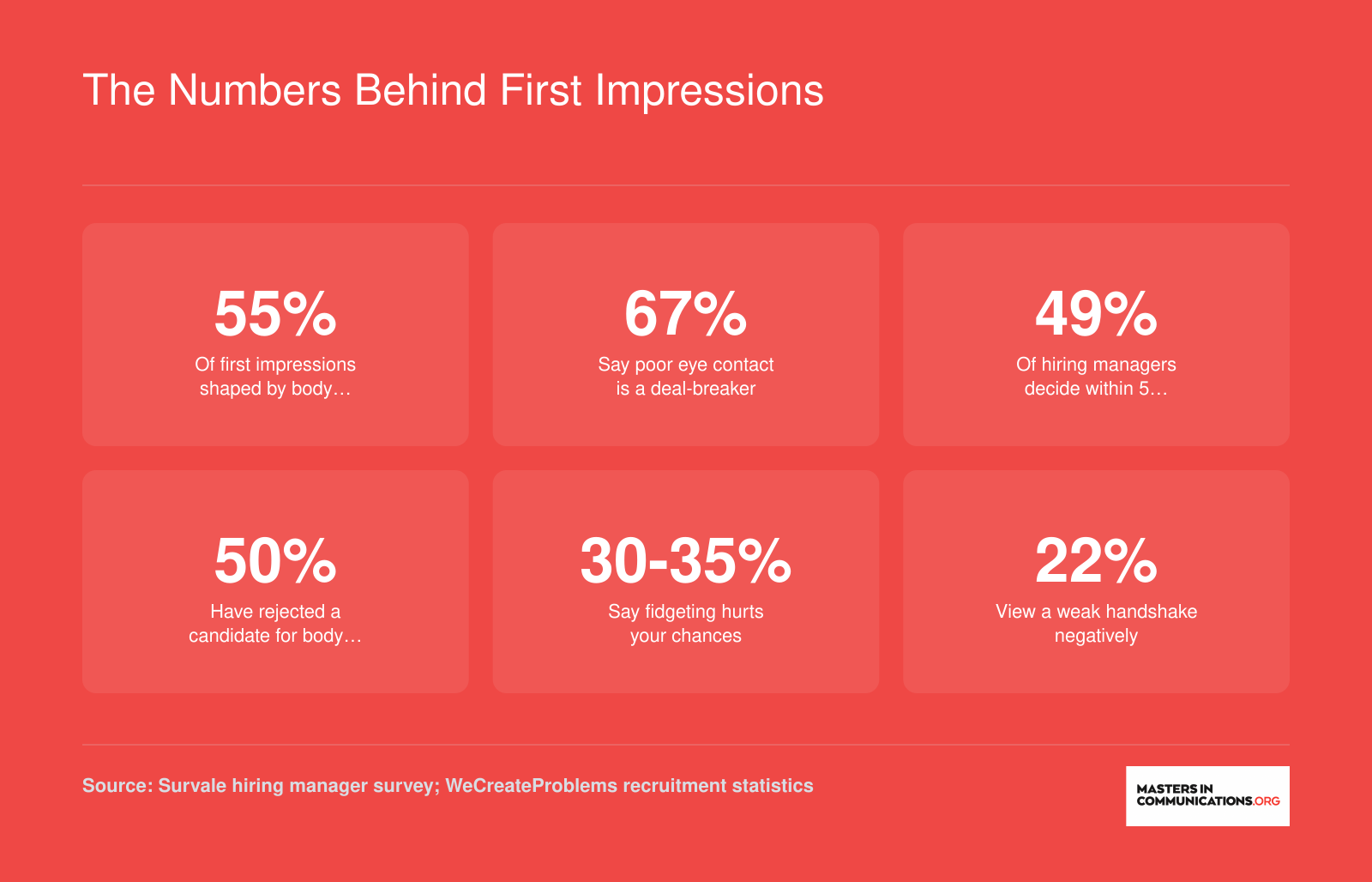
The Numbers Behind First Impressions
Your words may be polished, but interviewers are reading signals you never rehearsed. Research on hiring decisions consistently shows that nonverbal cues carry outsized weight in how candidates are perceived, sometimes within seconds of walking through the door.
Mistake #1: Poor or Excessive Eye Contact
Eye contact is a balancing act: too little and you risk appearing untrustworthy, too much and you might come across as aggressive or unsettling. The key is finding the sweet spot where your gaze signals confidence, engagement, and respect.
Two Ways Eye Contact Can Go Wrong
Avoiding the interviewer's eyes sends powerful unintended messages. It often reads as dishonesty, low self-esteem, or disinterest. If you stare at the floor, your notes, or a spot over the interviewer's shoulder, you erode the personal connection that helps build rapport. On the other end, locking eyes without a break can feel like a challenge or an interrogation. Interviewers may perceive excessive, unbroken eye contact as intimidating or socially awkward, neither of which bolsters your candidacy.
The 50/70 Rule: A Research-Backed Guideline
A widely cited heuristic for striking the right balance is the 50/70 rule: maintain eye contact about 50 percent of the time while you are speaking, and roughly 70 percent of the time while listening. This ratio aligns with findings from communication studies that suggest these percentages convey attention and sincerity without veering into staring. When you are talking, looking away occasionally signals thoughtfulness and natural conversational rhythm. When the interviewer speaks, the higher eye-contact percentage demonstrates active listening.
Practical Fixes for Better Eye Contact
If sustaining eye contact feels awkward, shift your focus gently among the interviewer's eyes and the bridge of their nose, creating a relaxed triangle that softens your gaze. When you need to think, break eye contact by glancing briefly to the side rather than down, which can look dismissive. Practicing with a friend over a video call can help you become accustomed to directing your gaze toward the camera, a habit that translates well to in-person interactions.
A Note on Cultural Nuance
Eye contact norms vary across cultures. In some contexts, sustained direct eye contact with an authority figure can be interpreted as disrespectful or confrontational. Understanding proper etiquette in cross-cultural settings is essential if you are interviewing across cultural lines or in a multicultural environment. Pay attention to the interviewer's own eye contact style and mirror it moderately. Defaulting to the 50/70 rule typically lands in a respectful middle ground, but reading the situation and adjusting accordingly shows emotional intelligence and adaptability.
Mistake #2: Closed-Off Posture and Crossed Arms
Closed-off body language is any physical position that puts space, barriers, or tension between you and the person you are talking to. Crossed arms are the most obvious version, but the category also includes hunched or rounded shoulders, a torso turned slightly away from the interviewer, and holding a bag, folder, or clipboard across your chest like a shield. These postures have one thing in common: they signal that you are not fully present or open to the conversation.
What Interviewers Actually See
Here is the problem: most candidates who sit with crossed arms are not defensive. They are cold, nervous, or just comfortable in that position. But interviewers rarely know that, and they do not have time to ask. Research on nonverbal communication consistently shows that closed postures are read as disinterest, guardedness, or discomfort, regardless of the candidate's intentions. In a high-stakes, short-duration conversation like a job interview, that misreading can quietly undercut an otherwise strong performance. If you want to sharpen your awareness of these signals, understanding how to be a great communicator is a great place to start.
Simple Corrections That Work
The good news is that opening up your posture does not require theatrical effort. A few adjustments get you most of the way there:
- Hands: Rest them on the table or on the armrests of your chair. Visible, relaxed hands read as calm and transparent.
- Shoulders: Keep them square to the interviewer. Imagine a line connecting your two shoulders pointing directly at the person across from you.
- Lean: A slight forward lean, just a few degrees, communicates genuine interest without crowding the space.
The Mid-Interview Recovery
Even prepared candidates catch themselves drifting into crossed arms mid-conversation. When that happens, do not jerk your arms apart or make a show of correcting yourself. Instead, use a natural transition: pick up a pen, shift to rest your hands on the table, or adjust your notepad. The movement looks purposeful rather than self-conscious, and it returns you to an open position without drawing attention to the lapse. Small, seamless corrections are far more effective than dramatic resets.
Mistake #3: Fidgeting, Nail-Biting, and Nervous Habits
Controlled stillness versus unmanaged nervous energy: that contrast is what separates candidates who appear confident from those who appear overwhelmed, even when their spoken answers are identical.
Why Fidgeting Hurts More Than You Think
Interviewers notice nervous habits faster than candidates realize. The most common ones that register negatively include:
- Pen clicking: repetitive sound that pulls attention away from your words
- Hair touching: signals self-soothing and low confidence
- Leg bouncing: visible under most tables and reads as impatience or anxiety
- Nail biting: conveys stress and can interrupt your speaking rhythm
- Phone checking: even a glance signals divided attention and disrespect
- Excessive hand gestures: occasional gestures are natural, but constant movement becomes visual noise
The damage is compounded because fidgeting is contagious. Once an interviewer notices it, they start watching for it, which means less mental bandwidth is going toward evaluating your actual answers.
Four Techniques to Reduce Nervous Movement
The goal is not to freeze your body, but to redirect nervous energy into something that does not distract. Understanding how stress affects communication can help you recognize the triggers behind these habits before they take over.
- Anchor your hands: lightly clasp them together on the table in front of you. This gives your hands a default resting position and reduces the urge to reach for hair, pens, or your face.
- Box breathing before you walk in: inhale for four counts, hold for four, exhale for four, hold for four. Two or three cycles before entering the room measurably lowers physiological arousal.
- Use a pen as a redirect: holding a pen loosely (not clicking it) gives restless fingers a passive outlet. The key is loose. A death grip reads as tension.
- Pre-interview body scan: starting at your feet and moving upward, consciously release tension in each muscle group. Do this in the waiting area or a restroom, not at the table.
If you struggle with interview anxiety specifically, exploring tips on how to be a better public speaker can build the kind of composure that carries over to one-on-one settings.
A Note for Neurodivergent Candidates
If you have ADHD, anxiety, or a related condition, complete stillness is not a realistic or fair standard to hold yourself to. Forced rigidity can actually increase anxiety and make answers harder to retrieve. A more practical target is small, contained movement that stays invisible to the interviewer, such as pressing your fingertips together under the table or grounding a foot flat on the floor. These micro-movements meet the nervous system's need for stimulation without broadcasting anxiety to the person across from you.
Mistake #4: Weak or Overpowering Handshake
The handshake is back in most interview settings, but a lot of professionals are unsure exactly how it should feel in 2026. The tension is real: you want to project confidence without coming across as overbearing, and you want to be respectful of shifting norms without seeming awkward or hesitant. The good news is that recruiters and etiquette experts largely agree on what works, and it starts with avoiding the two classic mistakes that live on opposite ends of the spectrum.
The Two Extremes That Undermine Your Confidence
On one end sits the limp-fish handshake: fingers barely curling, zero palm contact, grip gone in under a second. It can signal passivity, disinterest, or a paralyzing dose of nerves. Psychologically, it tells the interviewer you would rather not be there. On the other end is the bone-crusher, a vise-grip delivered with too much force and often accompanied by aggressive pumping. This one telegraphs dominance or simple obliviousness to social cues, neither of which meshes well with a collaborative workplace. Both extremes leave a lasting, negative impression.
What a Confident Handshake Actually Looks Like
The sweet spot is firm but not tight, with full palm contact so your hand slides fully into the other person's until the webs of your thumbs meet. It lasts about two to three seconds, just long enough to say hello while holding steady eye contact and offering a natural smile. Your grip communicates presence and professionalism without making the exchange a competition. If you have sweaty palms (a common anxiety side effect), discreetly wipe your hand on your clothing before you stand to greet someone, and keep a tissue in your pocket just in case.
Reading the Room in a Post-Pandemic World
Handshake norms have shifted in a way that actually gives you more options. As of 2025 and continuing into this year, the handshake is largely back and expected in most interview settings, but it is no longer mandatory.1 Many HR professionals and etiquette advisors now recommend a simple rule: let the interviewer extend their hand first. That small pause lets you read the room and respects that some people still prefer alternatives like a wave, a nod, or just a warm smile with eye contact.3 The range of acceptable greetings has widened, and incorporating DEI principles and health awareness means no single gesture is imposed on everyone. If you are unsure, especially when crossing cultural, regional, or gender lines, do a little research on the company and interviewers beforehand. Following the interviewer's lead is not a sign of weakness; it is a mark of importance of empathy and adaptability.
Mistake #5: Slouching, Slumping, and Low-Energy Posture
What is the right balance between looking relaxed and looking alert when you take a seat in an interview? It is a more nuanced question than it seems, because posture communicates energy and engagement on a sliding scale. Slumping too far back can read as boredom, laziness, or a lack of confidence, even if you are just trying to get comfortable. Unlike the defensive closed-off posture of crossed arms, slouching is about the absence of investment rather than active resistance. It tells the interviewer you would rather be somewhere else.
The Other Extreme: Rigidity Reads as Arrogance
The opposite mistake is just as common among nervous candidates who overcorrect. Sitting ramrod straight with your chest puffed out and your shoulders locked can make you look arrogant, robotic, or aggressively tense. The goal is not to become a statue. Interviewers respond best to a presence that feels authentic and engaged, not rigidly rehearsed. Think of it as alert relaxation: a posture that communicates you are present, interested, and physically at ease.
The Practical Fix: Sit Into Your Seat, Then Lean In
A simple sequence gets you there in seconds. As you sit, place your back against the chair so you feel the support. Plant your feet flat on the floor about hip-width apart; this grounds you and stops leg fidgeting. Then let your upper body find a natural forward angle, roughly 10 degrees, toward the interviewer. You do not need to measure it. This subtle lean signals curiosity and attention without crowding their space. Let your hands rest on your lap or the table, and keep your chin parallel to the floor so your gaze stays level.
A Reality Check on Power Posing
You may have heard that striking a confident pose before the interview boosts performance. The research behind power posing has been mixed, with early claims failing to replicate in larger studies. Still, a quick posture reset in the hallway or restroom does not hurt and can help you feel more grounded. The real benefit comes from the physical cues you send once the conversation starts. If you want to sharpen every dimension of how you present yourself, learning to prevent conflict in the workplace through better communication is another skill that pays dividends in interviews. Spend your mental energy on maintaining that alert, forward-leaning posture throughout the interview, and you will project the engagement that hiring managers want to see.
Adapting Your Body Language for Virtual and Video Interviews
Virtual interviews don't just change the medium; they distort how body language is perceived. A gesture that would appear natural in person can seem exaggerated on a webcam, while a subtle shift in posture might vanish entirely.1 Because the interviewer's view is limited to a small rectangle, certain cues get amplified and others disappear, making it essential to adjust your nonverbal communication for the camera.
Why Video Magnifies Certain Mistakes
On a video call, your face and upper body dominate the frame, so any movement in that area draws immediate attention.2 Fidgeting hands might be hidden below the desk, but a wandering gaze or habitual shoulder shrug becomes far more conspicuous.1 Eye contact suffers the most: looking at the screen instead of the camera lens reads as disengagement, even if you are focused on the interviewer's image.3 Slouching also gets magnified because the camera compresses depth, making a slight slump appear much worse than it does in person.
Camera-Specific Best Practices
- Position the camera at eye level or slightly above. This angle creates a natural line of sight and prevents the interviewer from feeling as though they are looking up or down at you.1
- Look directly at the camera lens when speaking. On most devices, the lens sits at the top bezel; glancing at the person on your screen breaks the illusion of direct eye contact. While listening, it is fine to look at the screen.3
- Frame yourself from mid-chest up. This allows your hand gestures to be visible without dominating the shot. Keep your hands lightly resting on the desk or in your lap to avoid distracting motion.4
- Use soft front lighting and avoid backlighting. A window behind you turns you into a silhouette; instead, face a window or use a ring light to illuminate your face evenly.1
- Choose a neutral, uncluttered background. A bookshelf or plain wall keeps focus on you; if your space is busy, use a subtle virtual background only as a last resort.
Digital-Specific Mistakes to Avoid
- Checking a second monitor or your phone. Even a brief glance to the side breaks connection and signals disinterest. Close unnecessary tabs and turn off notifications before the call.
- Reading notes too obviously. Prepared talking points are fine, but staring off-screen or reading verbatim makes you appear robotic. Place bullet points right next to your camera so eye movement is minimal.
- Constant self-view distraction. Many platforms show a thumbnail of yourself. Hide it if it makes you self-conscious; glancing at your own image repeatedly reads as distraction.
- Muted-mic body language confusion. If you have muted yourself while the other person speaks, avoid nodding or gesturing emphatically without sound. It can create an odd, silent-movie effect when you unmute.
Simple Fixes to Try Before Your Next Interview
- Do a test recording. Record a one-minute response and watch it back with an objective eye. You will spot nervous habits you were unaware of.
- Place a sticky note near the camera. A small arrow or dot next to the lens gives your eyes a target, helping you maintain the appearance of direct eye contact.
- Eliminate visual clutter behind you. Even out-of-focus clutter can distract. Before the interview, sit in your usual spot, turn on your camera, and check what the interviewer actually sees. Remove any piles of paper, laundry, or busy decor.
In-Person Vs. Virtual: Body Language Cues That Change on Camera
The rise of video interviews has fundamentally shifted how hiring managers perceive candidates, and body language cues that work flawlessly in a conference room can fall flat on screen. Understanding these differences helps you project confidence and engagement regardless of interview format.
Eye Contact Requires a New Target
In a face-to-face meeting, direct eye contact signals engagement and trustworthiness. On video, however, looking at the interviewer's image on your screen creates the impression that you are gazing downward or off to the side.1 The fix is counterintuitive: look directly into your webcam lens when speaking or listening to key points. This simulates natural eye contact from the interviewer's perspective. Practice alternating between the webcam and the screen so you can still read facial cues while maintaining that sense of connection.
Posture and Gestures Shrink to a Frame
Your full-body posture matters in person, but on camera, only your upper torso is visible. This means your gestures must become more deliberate and stay within the frame.2 Sit tall, lean slightly forward to convey interest, and keep your hand movements at chest level rather than below the desk where they vanish. According to research from Duke University on video meeting engagement, deliberate upper-body movement helps maintain viewer attention and reinforces verbal points.1
Attention Cues Become Magnified
Multitasking that might go unnoticed in a large conference room becomes glaringly obvious on camera. Glancing at a second monitor, typing, or checking your phone registers immediately as disengagement.1 Minimize open tabs, silence notifications, and position your webcam at eye level so you are not tempted to look away. The Blanchard Leadership group notes that digital body language, including your use of reactions, camera presence, and chat participation, now functions as an extension of traditional nonverbal cues.2
Building a Reliable Picture of Best Practices
For deeper research on how employers perceive virtual candidates, the New York State Bar Association's guide to nonverbal cues in video conferences offers practical strategies grounded in professional communication. Cross-referencing employer-perception studies with Bureau of Labor Statistics data on remote-role growth can help you understand which industries value polished virtual presence most. Many academic studies are paywalled, so use Google Scholar or your local library's database access for full texts.
How to Practice and Improve Your Nonverbal Interview Skills
Nonverbal fluency is a skill you can develop through deliberate practice, and the simplest diagnostic tool is one you already own: your phone's camera. Unlike verbal rehearsal, which feels easier to monitor in real time, body language mistakes often fly under your own radar during the stress of an interview. Structured practice removes that blind spot.
Record and Review Mock Interviews with the Sound Off
Set up a mock interview with common questions, record yourself on video, and then play it back with the audio muted. Without the distraction of evaluating your answers, your posture, facial expressions, hand gestures, and energy level become startlingly clear. You will notice crossed arms you did not realize you folded, eye contact that drifts to the ceiling during complex answers, or a slumped posture that emerges when you feel uncertain. Run the recording at 1.5x speed to spot patterns quickly. This drill is particularly effective for virtual interview prep, where subtle shifts in camera angle or slouching can look worse than they feel.
Enlist a Body Language Spotter
Ask a trusted friend, mentor, or colleague to observe a mock session and deliver cue-by-cue feedback. Give them a short checklist: eye contact, posture, hand placement, facial engagement, nervous habits. A live observer catches real-time lapses you might edit out of a recording and can prompt you mid-answer to reset when you begin to fidget or lean away from the camera. The external accountability trains your self-monitoring reflex, much like building effective listening skills strengthens your ability to stay present in conversation.
Consider Formal Communication Coaching
If nonverbal awareness feels foreign or you have received feedback about distracting mannerisms in past interviews, structured coaching can accelerate improvement. Many university career centers offer free or low-cost mock interview services with video playback and personalized feedback, even for alumni. Professional communication coaches and executive presence trainers also specialize in nonverbal refinement, though fees vary widely.
Embrace the Mid-Interview Reset
If you catch yourself slouching, fidgeting, or avoiding eye contact during a live interview, a small, deliberate correction is all it takes. Pause, take a breath, sit up, and re-engage. Interviewers notice self-awareness and effort positively. A single reset signals composure and adaptability, traits that matter far more than flawless posture from start to finish.
Common Mistakes When Reading Your Interviewer's Body Language
While you focus on projecting calm confidence, it is just as tempting to scrutinize every micro-expression from the hiring manager across the table. A furrowed brow might send your mind racing toward rejection, or a glance at the clock might convince you the interview has gone off the rails. The truth? You are probably misreading the signals.1
Single Gestures Are Not Whole Stories
One of the most damaging mistakes candidates make is over-interpreting isolated nonverbal cues. A furrowed brow often signals concentration, not disapproval. An interviewer checking her phone may be waiting for a time-sensitive message from HR, not tuning you out. Crossed arms can mean the room is cold or the chair lacks armrests. Mastering body language means learning to look for clusters of signals rather than drawing conclusions from a single gesture. If an interviewer leans back, crosses his arms, and avoids eye contact all at once, that pattern may suggest disengagement. But any one of those behaviors in isolation tells you almost nothing.
Context and Culture Shape Interpretation
Cultural variations add another layer of complexity. Direct eye contact signals confidence in many Western business settings but can feel confrontational or disrespectful in other cultures. Nodding frequency, personal space preferences, and expressiveness all vary widely. If you are interviewing with a hiring manager from a different cultural background, resist the urge to map your own nonverbal expectations onto theirs. What looks like indifference may simply be a quieter communication style. Communicating with empathy and genuine curiosity about different norms can help you stay grounded rather than reactive.
Protect Your Own Confidence
Perhaps the most dangerous trap is allowing perceived negativity to derail your performance mid-interview. If you think the interviewer seems bored, you may start rushing your answers, second-guessing your examples, or mirroring closed-off body language yourself. That spiral rarely helps. Instead, stay anchored in your preparation. Answer each question fully, maintain your own positive nonverbal presence, and trust that your read on the room is incomplete. Communicating effectively in the workplace requires the same discipline: respond to what is actually said, not what you imagine is meant. Interviewers are human. They get tired, distracted, and preoccupied with internal pressures you cannot see. Your job is to deliver your best case, not to decode theirs in real time.
Frequently Asked Questions About Body Language in Job Interviews
Body language questions come up constantly in interview prep, and the answers are not always intuitive. Below are the concerns working professionals raise most often, along with concrete steps you can put into practice right away.
- What are the most common body language mistakes in a job interview?
- The five biggest offenders are poor or excessive eye contact, crossed arms or closed-off posture, fidgeting and nervous habits like nail-biting, a weak or overpowering handshake, and slouching or low-energy posture. Each of these sends an unintentional signal of disinterest, insecurity, or aggression. The good news is that every one of them can be corrected with focused practice and self-awareness before your next interview.
- How much does nonverbal communication really affect hiring decisions?
- Research consistently shows that nonverbal cues shape the impression interviewers form within the first few seconds, and that impression tends to color the rest of the conversation. Some studies suggest body language accounts for more than half of how a message is received. Hiring managers may not consciously catalog every gesture, but confident posture, steady eye contact, and a genuine smile collectively reinforce the competence your words are meant to convey.
- Is a handshake still expected in job interviews after the pandemic?
- In most 2026 professional settings, a firm, brief handshake has returned as the standard greeting for in-person interviews. That said, follow the interviewer's lead. If they extend a hand, match it with a confident grip lasting about two seconds. If they offer a wave, a nod, or an elbow bump, mirror that gesture comfortably. Showing social awareness in the moment matters more than defaulting to a single ritual.
- How do I stop fidgeting during a job interview?
- Start by identifying your personal fidget triggers, whether that is clicking a pen, bouncing a knee, or touching your hair. Before the interview, practice sitting with both feet flat on the floor and your hands resting loosely on the table or in your lap. Channel nervous energy into purposeful gestures when you speak. Deep, slow breathing also lowers the adrenaline that fuels restless movement.
- What body language cues are different on Zoom vs in-person interviews?
- On camera, your face fills most of the frame, so micro-expressions carry more weight than full-body posture. Eye contact means looking into the lens, not at the interviewer's on-screen image. Nodding and smiling need to be slightly more deliberate because subtle cues get lost in video compression. Hand gestures should stay within the camera's field of view, and sitting a consistent arm's length from the webcam prevents awkward framing.
- How can I recover if I realize I'm sending bad body language signals mid-interview?
- A quiet reset works best. Uncross your arms, plant your feet, sit up, and take one slow breath. You do not need to announce the correction. Interviewers are far more attuned to the body language you display for the majority of the conversation than to a single awkward moment. Shifting to open, engaged posture midway through actually demonstrates adaptability, which is a quality most hiring managers value highly.
- Are body language expectations different across cultures?
- Absolutely. Direct eye contact signals confidence in many Western business cultures but can be perceived as confrontational in parts of East Asia and the Middle East. Personal space norms, acceptable gestures, and even handshake firmness vary widely. Before an interview with an international organization or a culturally diverse panel, research the cultural context. When in doubt, mirror the interviewer's energy and body language, which is a universally safe strategy.