
What you’ll learn in this article…
- Mehrabian's 7-38-55 rule applies only to emotionally ambiguous statements, not to 93 percent of all communication.
- Reading body language accurately requires observing clusters of three or more congruent cues, never a single gesture in isolation.
- Eighty-four percent of hiring managers report that nonverbal cues significantly shape their candidate assessments, per HireVue research.
- A weekly self-rating paired with one specific behavior goal turns body language awareness into a lasting professional habit.
First impressions crystalize in about a tenth of a second, shaped by facial expression and posture before you speak. Yet we receive far more training in words than in the nonverbal signals that dominate those judgments. That gap costs professionals influence and clarity every day.
Body language mastery isn't about trick poses. It means learning to read clusters of cues accurately and aligning your own signals with your intent so your message lands as you mean it. Developing effective listening skills is part of the same discipline, because reading a room starts with paying genuine attention to the people in it.
In a world of video calls and remote teams, professionals who can control their unspoken language hold a distinct edge. Your body is already talking. The question is whether it says what you want it to.
What Is the Art of Body Language?
What does it actually mean to master body language, and why does it take more than just knowing to smile?
Most people think of body language as a grab-bag of tips: stand tall, make eye contact, don't cross your arms. But the art of body language is something more intentional than that. It is the deliberate awareness and use of nonverbal signals, including posture, gestures, facial expressions, eye contact, vocal tone, and physical proximity, to communicate more clearly and connect more powerfully with other people.
More Than Sending a Message
The organizational psychologist Keith Davis, writing in his foundational work "Human Behavior at Work," defined communication as "the process of passing information and understanding from one person to another."1 That word "understanding" is doing a lot of work. Davis was clear that a message transmitted is not automatically a message received. Real communication requires that meaning lands, not just that words travel.2
Body language is a primary vehicle for that understanding. When someone delivers difficult feedback with a warm tone and open posture, the meaning arrives differently than the same words spoken with a cold stare and crossed arms. The words are identical. The communication is not.
Flora Davis, in "Inside Intuition: What We Know about Nonverbal Communication," put it plainly: words are often the least important part of a conversation.3 Through the way people move and hold their bodies, they supply a whole emotional undercurrent. That undercurrent is frequently what the listener actually responds to.
What You Leak vs. What You Craft
Here is where the real skill lives. Body language operates on two levels simultaneously. The first is unconscious: the micro-expressions that flicker across your face before you can suppress them, the slight lean away from someone you distrust, the furrowed brow that signals confusion even when you say you understand. This is what you leak.
The second level is deliberate: the steady eye contact you choose to hold during a negotiation, the open-palm gesture that signals honesty, the measured pause before responding that projects confidence rather than anxiety. This is what you craft. Professionals who develop this deliberate control often find they become better communicators across every context, from boardrooms to virtual meetings.
Mastering the art means developing fluency in both. You learn to notice what your body is broadcasting without your permission, and you learn to shape what it sends with intention.
Why This Skill Matters More Now
In hybrid work environments, signals that once traveled naturally across a conference table now have to survive a video grid. On cross-cultural teams, gestures carry entirely different meanings depending on context, and the cost of misreading them is real.4 In a world of relentless information overload, attention is scarce, and people who communicate with congruent, confident nonverbal signals simply command more of it.
The professionals who understand and practice the art of body language are not just better conversationalists. They read rooms faster, build trust more quickly, and avoid conflict in the workplace by catching the invisible friction that derails negotiations, presentations, and leadership moments. That is a meaningful professional edge, and it starts with understanding what nonverbal communication actually is.
The Science Behind Nonverbal Communication
Before you can master body language, you need to understand what the science actually says, and just as importantly, what it does not say. A surprising amount of popular advice about nonverbal communication rests on a foundation that has been misquoted for decades.
The Real Story Behind the 7-38-55 Rule
In 1967, psychologist Albert Mehrabian published two small studies. The first (Mehrabian and Wiener) had participants judge the meaning of single spoken words.1 The second (Mehrabian and Ferris) asked participants to evaluate feelings conveyed through photographs and audio recordings. Both studies used groups of around 30 to 40 people, and both focused on a very specific situation: how people communicate feelings and attitudes when the verbal message and the nonverbal signals contradict each other.
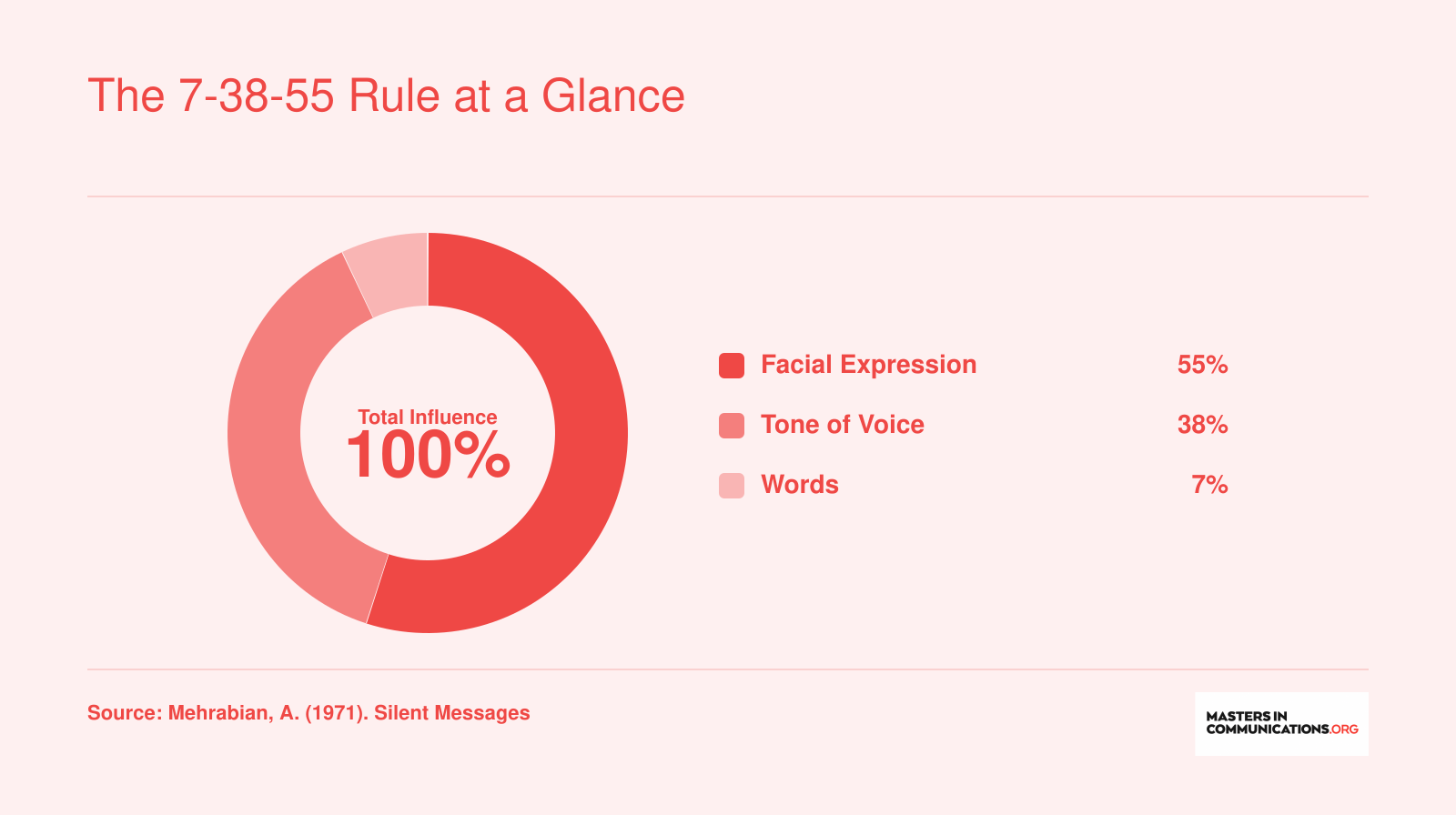
From combining those two studies, Mehrabian derived his now-famous percentages: 7 percent of emotional meaning comes from the words themselves, 38 percent from vocal tone, and 55 percent from facial expression.4
That finding has been stretched far beyond what the methodology supports. The studies did not examine all communication. They did not involve full sentences, complex conversations, or professional contexts. They examined incongruent emotional signals in a controlled laboratory setting. Mehrabian himself has repeatedly clarified that applying his percentages to ordinary communication is a misreading of the research.
Why the '93 Percent Nonverbal' Myth Causes Real Problems
The popular distortion, that "93 percent of communication is nonverbal," has taken on a life of its own in management seminars, sales training, and leadership coaching. Scholars who have reviewed the original work describe the rule as something close to an urban legend in how broadly it gets applied.
The practical harm is concrete. When people believe their words account for only 7 percent of their message, they start over-rehearsing gestures and posture while paying less attention to whether what they are actually saying is clear, accurate, or persuasive. A confident stance cannot rescue a confusing argument. If you want to understand what genuinely separates good communicators from mediocre ones, learning how to be a better communicator is a more productive starting point than memorizing gesture catalogs.
Power Posing and the Replication Problem
Another corner of the research landscape has seen similar turbulence. Amy Cuddy's widely shared 2012 work on "power posing" suggested that adopting expansive postures before a stressful event could raise testosterone, lower cortisol, and improve performance. The findings spread quickly. Then, systematic attempts to replicate the hormonal effects largely failed. Dana Carney, one of the study's original co-authors, publicly stated she no longer believed the effect was real, and a critical analysis by Simmons and Simonsohn raised serious methodological concerns. The behavioral confidence effects remain a subject of active debate, but the stronger physiological claims are not well supported by the current body of evidence.
More recent nonverbal research from 2020 through 2026 has moved toward studying credibility and trust in realistic settings, including video calls and hybrid workplaces. That work tends to find more modest but durable effects: consistent eye contact, open posture, and controlled facial expression reliably increase how trustworthy and competent a speaker is perceived to be. These are probabilistic tendencies, not guaranteed outcomes, and they interact meaningfully with what a person actually says.
What the Evidence Actually Supports
The practical takeaway from honest science is this: body language powerfully shapes first impressions and perceived credibility, and it does so faster than words can. But it supplements your message rather than replacing it. The goal is alignment, making sure your posture, expression, and tone reinforce the content of your words rather than contradicting them. Recognizing common body language mistakes to avoid in job interviews is one tangible way to put this principle into practice. When those elements work together, communication becomes both more convincing and more trustworthy. When they work against each other, audiences notice the conflict even if they cannot name it.
The 7-38-55 Rule at a Glance
Albert Mehrabian's 1967 research revealed how listeners weigh different channels when someone expresses feelings or attitudes and the words don't match the delivery. The breakdown below shows each channel's relative influence. Common myth: "93% of all communication is nonverbal." Actual finding: the 93% figure applies only when verbal and nonverbal signals conflict during emotional expression, not to everyday factual conversation.
Types of Body Language Cues and What They Mean
Body language encompasses far more than crossed arms or a firm handshake. The table below breaks nonverbal communication into seven core categories, each with practical examples you can start noticing today. One important caveat: individual cues rarely tell the whole story. Skilled communicators read signals in clusters, combining posture, facial expression, and tone before drawing conclusions, a skill explored in more depth in the next section.
| Cue Category | Example Signal | Common Interpretation | Watch Out For |
|---|---|---|---|
| Posture | Leaning slightly forward during a conversation | Engagement, interest, or eagerness to contribute | Cultural norms vary; in some settings, leaning in can feel intrusive rather than attentive |
| Gestures (Illustrators) | Open palms while explaining an idea | Honesty, openness, and willingness to collaborate | Overusing hand movements may distract listeners and undermine your message |
| Gestures (Adaptors) | Touching your neck or fidgeting with a pen | Nervousness, self-soothing, or discomfort with the topic | Adaptors can also be simple habits with no emotional meaning, so look for accompanying cues |
| Gestures (Emblems) | Thumbs up or a nod of the head | Agreement, approval, or encouragement | Emblems are culturally specific; a thumbs up is offensive in parts of the Middle East and West Africa |
| Facial Expressions | Raised eyebrows with a slight smile | Surprise paired with warmth, often signaling genuine delight | Microexpressions can flash and vanish in under a second, making them easy to miss without practice |
| Eye Contact | Sustained but relaxed eye contact during a one on one meeting | Confidence, sincerity, and active listening | Too much unbroken eye contact can feel aggressive; too little may suggest evasion or distraction |
| Proximity (Proxemics) | Standing within about 18 inches of someone in a professional setting | Familiarity, trust, or an attempt to establish intimacy | Personal space expectations differ by culture, relationship, and context; misjudging distance can create discomfort |
| Touch (Haptics) | A brief, firm handshake at the start of a meeting | Professionalism, respect, and mutual acknowledgment | Uninvited touch, even a pat on the shoulder, can cross boundaries and feel presumptuous |
| Paralanguage (Tone, Pace, Volume) | Speaking at a measured pace with a steady, warm tone | Calm authority and approachability | A monotone delivery may signal boredom or disengagement even when the words themselves are supportive |
Questions to Ask Yourself
How to Read Body Language Accurately
Three or more congruent nonverbal signals, observed together, are far more reliable than any single cue on its own. That principle, often called the cluster rule, is the foundation of accurate body language reading, and skipping it is the fastest way to misread a room.
The Cluster Rule: Look for Patterns, Not Snapshots
Imagine a colleague leans back in her chair, crosses her arms, and avoids your gaze during a pitch meeting. Any one of those signals could mean almost anything. Together, they form a cluster that points toward disengagement or disagreement. The lesson is simple: never hang a conclusion on a single gesture. Wait until you spot at least three signals moving in the same emotional direction before you form an interpretation. Clusters reduce guesswork and keep you from making snap judgments that damage relationships.
The Context Principle: Baselines Beat Assumptions
Body language exists inside a context, and ignoring that context leads to costly misreads. Crossed arms on a chilly rooftop patio are about temperature, not resistance. A coworker who rarely makes eye contact during casual conversation is not necessarily hiding something; that may simply be their baseline. To read people well, you need to know what "normal" looks like for them first.
Before a negotiation or a difficult conversation, spend the opening minutes observing the other person's relaxed state: their default posture, their typical gesture range, how much eye contact they naturally maintain. Changes from that baseline are what matter, not any textbook checklist of "defensive" or "open" poses.
Cross-Cultural Differences You Cannot Afford to Ignore
Culture rewrites the meaning of almost every gesture. A few examples worth memorizing:
- Eye contact: In the United States and much of Northern Europe, steady eye contact signals confidence and honesty. In Japan and South Korea, softer and more indirect eye contact conveys respect, especially toward a senior colleague. A firm Western-style gaze can feel confrontational in those settings.1
- Thumbs-up: A sign of approval across most Western business cultures, this gesture is considered vulgar in parts of the Middle East and the Mediterranean.1
- Head nodding: In Bulgaria and parts of the Balkans, an up-and-down nod means "no," while a side-to-side shake means "yes," the exact reverse of what most North Americans and Europeans expect. In Greece, a quick upward head jerk also signals "no."1
- Smiling norms: Frequent smiling reads as friendly in the U.S., but in some East Asian and Northern European business contexts, a neutral expression is the professional default. Interpreting a composed face as coldness is a projection, not a reading.1
Berlitz's overview of body language across cultures offers additional examples and is well worth reviewing before any international engagement.
The Three Biggest Misinterpretation Traps
Even experienced communicators fall into predictable errors. Watch for these:
- Assuming crossed arms always mean defensiveness. People cross their arms because they are cold, comfortable, or simply in the habit. Without supporting signals, this posture tells you very little.
- Reading fidgeting as dishonesty. Research consistently shows that fidgeting correlates more strongly with anxiety, boredom, or excess energy than with lying. Treating movement as proof of deception can erode trust with nervous but truthful colleagues.
- Projecting your own cultural norms onto others. If you grew up equating a firm handshake with trustworthiness, you may unconsciously distrust someone from a culture where a gentler grip is standard, such as Japan or Turkey.1 Recognizing this bias is the first step toward correcting it.
Accurate body language reading is not a party trick. It is a disciplined practice of gathering clusters, weighing context, establishing baselines, and suspending cultural assumptions. Professionals who build this skill set make better hiring decisions, negotiate more effectively, and lead with greater empathy, outcomes that no amount of verbal eloquence alone can guarantee.
Mastering Body Language in Professional Settings
High-stakes professional moments demand more than polished words. Your posture, gestures, and eye contact either reinforce your message or quietly undermine it. The key is not manipulation but alignment: making your nonverbal signals match your genuine intent so others perceive you as credible, confident, and trustworthy.1
Job Interviews: Making a Strong First Impression
Interviews compress judgment into minutes. An upright, relaxed posture signals confidence without arrogance, while steady (not staring) eye contact conveys engagement.1 A firm handshake, natural smile, and controlled hand movements complete the picture.
- Do this: Mirror the interviewer's energy subtly. If they lean forward with enthusiasm, match that engagement. This builds unconscious rapport.
- Avoid this: Crossing your arms or touching your face repeatedly. These self-soothing gestures (called adaptors) can read as nervousness or dishonesty, even when neither is true.
Negotiations: Projecting Calm Authority
Negotiations reward composure. Restrained, purposeful gestures and deliberate pausing signal that you are thinking carefully rather than reacting emotionally.2 Attentive eye contact shows you are listening, which builds trust even during disagreement.
- Do this: Use strategic silence. After making a key point, pause and hold steady eye contact. It gives weight to your words and invites the other party to respond.
- Avoid this: Self-touch adaptors like rubbing your neck or picking at your nails. These small movements telegraph anxiety and can weaken your perceived position.
Presentations: Commanding the Room
Standing tall with an open stance projects presence. Purposeful movement, such as walking toward different sections of the room or stepping closer to emphasize a point, keeps attention without appearing restless. Scanning the room with your gaze makes each audience member feel included. If you struggle with stage fright, learning how to be a better public speaker can help you channel nervous energy into commanding delivery.
- Do this: Use open gestures, palms visible, to emphasize key ideas. This signals transparency and invites trust.2
- Avoid this: Pacing aimlessly or staying rooted behind a podium. Either extreme makes you seem nervous or disconnected from the audience.
Sales Conversations: Building Connection
Sales rely on rapport. Leaning in slightly, nodding to acknowledge the client's concerns, and matching their energy (calm if they are measured, animated if they are enthusiastic) creates a sense of partnership rather than pressure.
- Do this: Subtly mirror the client's posture and pacing. Research suggests this nonconscious mimicry fosters liking and trust when done naturally.1
- Avoid this: Invading personal space or overwhelming the conversation with aggressive gestures. Adjust physical distance based on context and the client's comfort signals.
Beyond technique, becoming a great communicator means integrating verbal and nonverbal skills into a cohesive style that feels natural.
A Note on Gender and Power Dynamics
Research indicates that context and culture heavily influence how body language is perceived, and this includes gender.3 The same expansive posture that reads as confident leadership in one person may be judged as aggressive or inappropriate in another, depending on audience expectations. Rather than prescribing rigid rules, the practical approach is awareness: observe how your cues land with different audiences, gather feedback when possible, and calibrate accordingly. Authenticity matters more than performance. When your body language aligns with your real emotions and intentions, others sense congruence. When it does not, the mismatch creates distrust, no matter how polished the technique.
According to HireVue research, 84 percent of hiring managers say nonverbal cues significantly influence their assessment of a candidate. That means your posture, eye contact, and gestures may shape a hiring decision before you finish answering the first question.
Body Language for Remote and Hybrid Communication
The shift to remote and hybrid work has redefined how professionals convey presence, authority, and rapport without sharing physical space. Video calls compress three-dimensional interactions into a flat rectangle, altering the dynamics of eye contact, gesture scale, and spatial awareness. Mastering body language in these environments requires deliberate adjustment to camera-specific constraints and an understanding of how digital mediation changes the art of nonverbal communication.
Camera Positioning and Eye Contact
Effective video presence begins with camera placement. Position your webcam at or slightly above eye level to simulate natural eye contact. Looking directly at the lens, rather than at faces on your screen, creates the perception of engagement for your audience. Practice alternating between glancing at the camera during key points and monitoring participant reactions on screen. This balance prevents the flat, disconnected stare that undermines rapport. Lighting should illuminate your face evenly from the front, eliminating harsh shadows that obscure facial expressions. Natural light from a window or a ring light positioned behind the camera works well. Avoid backlighting from windows, which silhouettes you and erases nonverbal cues.
Gesture Scale and Framing
Gestures that feel natural in a conference room often disappear or distract on camera. Frame yourself from mid-chest up, leaving room for hand movements within the visible area. Keep gestures smaller and closer to your body than you would in person. Broad, sweeping motions can blur on lower-quality connections or move out of frame entirely. Use deliberate hand movements to emphasize points, pausing briefly to let the gesture register before continuing. Nodding and facial expressions carry more weight on video than in physical meetings, so amplify these slightly without exaggerating into caricature.
Maintaining Presence in Hybrid Meetings
Hybrid settings, where some participants gather in a room while others join remotely, create asymmetries in engagement. Remote attendees must work harder to project presence. Turn on your camera even when others do not, lean slightly forward to signal attentiveness, and use the chat function strategically to reinforce verbal contributions. In-room participants should position the camera to capture the full group and make a habit of naming remote colleagues before addressing them, bridging the physical divide.
Professionals seeking deeper training in remote communication techniques can explore resources from the International Association of Business Communicators, and those interested in broader theoretical foundations may benefit from our guide to mass communication. Academic research on computer-mediated communication offers evidence-based strategies for adapting body language to digital contexts. University communication departments frequently publish white papers and practical guidelines grounded in current research, while structured Master's in Communication programs can provide a comprehensive pathway to advanced skills. The art of body language in remote and hybrid settings is a learnable skill, not an innate gift, and these authoritative sources offer structured pathways to fluency.
Common Body Language Mistakes and How to Fix Them
Even seasoned professionals unknowingly broadcast signals that undermine their message. The good news: most body language mistakes have simple, repeatable fixes. One important note before diving in. There is a meaningful difference between refining your nonverbal communication and manipulating others. Authentic mastery of body language means aligning your external signals with your genuine intent, not constructing a false persona to deceive.
Pros
- Use the triangle technique (shift your gaze between each eye and the mouth) instead of staring or avoiding eye contact entirely.
- Rest your hands on the table or let them fall naturally at your sides to replace the closed, defensive posture of crossed arms.
- Anchor your hands by placing them together on the desk or lightly clasping them, eliminating fidgeting with pens, phones, or rings.
- Replace nervous rapid-fire speech with deliberate pauses that let your points land and give you time to breathe and recalibrate.
- Read the other person's lean during networking: if they shift backward, widen the gap rather than stepping further into their personal space.
- Practice in low-stakes settings first so that fixes become reflexive habits rather than conscious performances under pressure.
Cons
- Avoiding eye contact makes you appear disengaged or untrustworthy, even when you are listening closely to the speaker.
- Defaulting to crossed arms signals defensiveness and can shut down open dialogue before a conversation truly begins.
- Fidgeting with a phone or pen draws attention away from your message and suggests nervousness or disinterest to your audience.
- Speaking too fast when anxious compresses your ideas, overwhelms listeners, and robs you of the presence that pauses create.
- Stepping too close during networking triggers discomfort and causes others to retreat physically and emotionally from the interaction.
- Overcorrecting into exaggerated gestures or forced smiles can feel inauthentic, crossing the line from improved communication into manipulation.
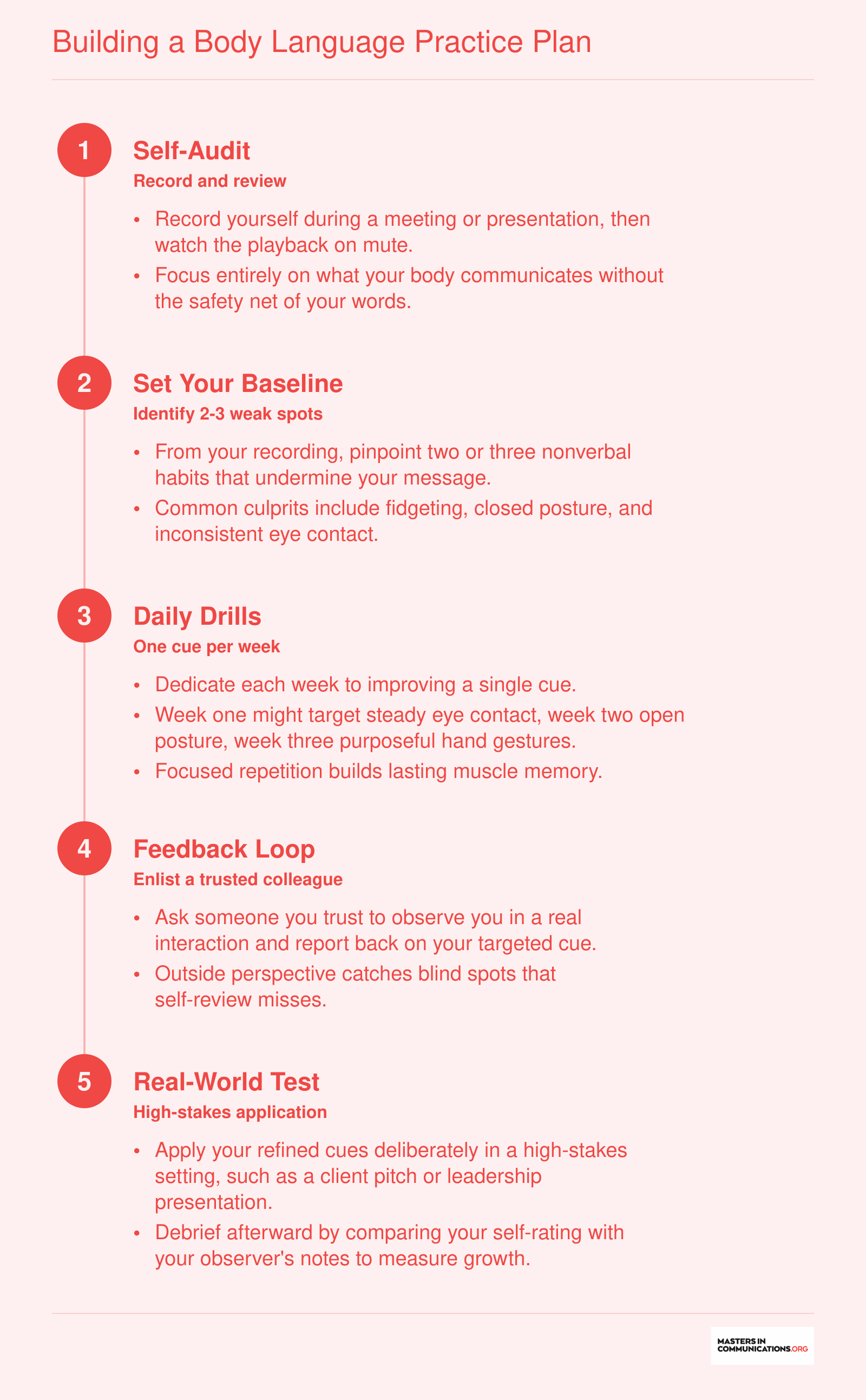
Building a Body Language Practice Plan
Body language mastery is a practice, not a revelation. Expect weeks of conscious repetition before new habits feel natural. Track your progress with a simple weekly self-rating from 1 to 10 on nonverbal awareness, paired with one specific behavior goal each week.
Frequently Asked Questions About Body Language
These are some of the most common questions readers ask about nonverbal communication. Each answer draws on the concepts explored throughout this article, from the science of unspoken language to practical strategies for mastering body language in everyday professional life.
- What is the 7%-38%-55% rule?
- Developed by psychologist Albert Mehrabian in 1967, this rule suggests that when someone expresses feelings or attitudes, only 7% of the message comes from words, 38% from vocal tone, and 55% from facial expressions and body language. As discussed earlier in this article, the rule applies specifically to emotionally charged or ambiguous messages, not to all communication. It remains a powerful reminder that wordless communication often carries more weight than the words themselves.
- What did Keith Davis say about communication?
- Keith Davis observed that communication is the transfer of information and understanding from one person to another. He emphasized that effective communication requires not just sending a message but ensuring it is received and understood. His perspective reinforces a core theme of this article: mastering body language means aligning your nonverbal signals with your verbal message so that the listener's understanding matches your intent.
- What is the art of body language?
- The art of body language is the deliberate practice of reading, interpreting, and projecting nonverbal cues such as posture, gestures, eye contact, and facial expressions. It goes beyond passive awareness. Mastering body language means actively shaping how others perceive your confidence, credibility, and openness, whether you are presenting to a boardroom, negotiating a deal, or connecting with a colleague over a video call.
- How do you master body language in professional settings?
- Start by auditing your own habits: record a meeting or presentation and watch for closed postures, fidgeting, or inconsistent eye contact. Then practice intentional adjustments like maintaining an open stance, using purposeful hand gestures, and mirroring the energy of your conversation partner. As covered in the professional settings section above, consistency between your verbal message and nonverbal signals builds trust faster than polished words alone.
- What are common body language misinterpretations?
- One frequent mistake is assuming crossed arms always signal defensiveness; sometimes a person is simply cold or comfortable that way. Another is reading a single cue in isolation rather than looking at clusters of signals. Avoiding eye contact may reflect cultural norms or introversion, not dishonesty. Context matters enormously. The earlier section on reading body language accurately outlines how to evaluate multiple cues together before drawing conclusions.
- How does body language differ across cultures?
- Gestures, personal space, and eye contact norms vary widely. In many Western cultures, direct eye contact signals confidence, while in parts of East Asia and the Middle East it can be perceived as disrespectful. The "OK" hand sign is positive in the United States but offensive in Brazil. If you work across cultures, invest time in learning region-specific norms and default to open, neutral postures when you are uncertain.
- Can you improve your body language on video calls?
- Absolutely. Position your camera at eye level so you appear to make direct eye contact. Keep your upper body visible to allow natural hand gestures, and sit slightly forward to convey engagement. Good lighting on your face helps others read your expressions clearly. As outlined in the remote and hybrid communication section, small adjustments to your on-screen presence can dramatically improve how colleagues perceive your attentiveness and authority.
Body language is not a trick or a shortcut. It is a literacy, and most people stopped developing it around age five. Every interaction you have already carries a nonverbal layer; the only question is whether you are fluent in it or not.
Three moves will take you the furthest: read signals in clusters rather than isolating a single cue, align your nonverbal signals with what you actually intend to convey, and practice one specific behavior at a time until it becomes automatic. Small, deliberate changes compound quickly. Professionals who want to deepen their overall skill set can also explore communicating with empathy, which pairs naturally with stronger nonverbal awareness. Pick one professional interaction this week, a meeting, a video call, a hallway conversation, and consciously apply a single technique from this guide. That is how literacy is built, one practiced moment at a time.