

What you’ll learn in this article…
- Only 37% of higher education institutions updated their emergency response plans during the 2023-2024 academic year.
- Cross-functional crisis teams that include student affairs, police, legal, and communications leadership reduce message conflicts and delays.
- Federal laws like FERPA, the Clery Act, and Title IX each impose distinct notification obligations that shape what campuses can disclose.
- A master's in communication, typically 30 to 36 credits, builds the strategic and trauma-informed skills campus crisis leaders need.
American colleges and universities logged more than 28,000 Clery Act-reportable crimes in a single recent academic year, and that count excludes cyberattacks, mental health emergencies, and public health disruptions that have become equally destabilizing. The frequency is not the core problem. The coordination failure is.
When an incident breaks, presidents, provosts, campus safety directors, communications staff, and student affairs leaders too often operate on separate timelines with separate information. Alerts go out before legal has reviewed them. Student affairs counselors learn about an active threat from the same mass text as everyone else. A parent hotline rings unanswered while social media fills the vacuum with rumor.
Higher education has produced extensive policy frameworks for emergencies, yet the human coordination layer, the real-time trust and protocol among senior leaders, remains underdeveloped at most institutions. Graduate training in strategic communication is increasingly where that gap gets addressed. How to become a better communicator under pressure is, ultimately, what separates a managed crisis from a compounding one.
Why Fragmented Leadership Communication Worsens Campus Crisis Outcomes
Why do campus emergency alerts sometimes arrive too late or deliver contradictory instructions? The root cause often traces back to fragmented leadership communication. When key decision-makers operate in silos (campus police acting without coordinating with student affairs or the communications team), critical warnings get delayed, messages conflict, and trust erodes quickly. Recent high-profile campus crises illustrate just how damaging these gaps can be.
Siloed Decision-Making in Action
At Michigan State University on February 13, 2023, a mass shooting left three dead and five injured. A university-commissioned review found that the first campus-wide alert went out 12 minutes after the first 911 call, with no centralized command structure in place.1 Different offices issued updates without a single, clear point of guidance, leading to confusion during an active threat. Similarly, at the University of North Carolina at Chapel Hill in 2023, two separate lockdowns occurred within weeks. The institution failed to provide multilingual instructions, and shifting narratives between updates left families and students uncertain about safety protocols.2 A cyberattack at Munster Technological University that same year exposed 6 GB of sensitive data. The initial response did not identify what information had been compromised, offered no credit monitoring to affected individuals, and did not acknowledge known security vulnerabilities.3 These cases show that when leadership teams do not communicate with one another first, the public receives inconsistent, incomplete, or dangerously late information.
The Leadership Roles That Must Be in the Loop
Effective crisis response requires a predefined team that cuts across silos. The growing demand for skilled communicators in crisis scenarios underscores why communications pros should have a seat at the executive table. During a campus emergency, the following roles need to be in continuous contact:
- President or Chancellor: Sets the overarching tone and makes final decisions on public statements and resource allocation.
- Provost: Ensures continuity of academic operations and manages faculty concerns.
- Campus Safety or Police Chief: Provides real-time threat assessment and coordinates physical security measures.
- Vice President of Student Affairs: Addresses immediate student needs, housing, and mental health support.
- Director of Communications: Crafts consistent messaging for all audiences, manages media inquiries, and monitors social media.
- Legal Counsel: Advises on FERPA, Clery Act, and Title IX obligations to minimize liability.
- IT or Cybersecurity Lead: Handles data breaches, system outages, and digital threats, ensuring technical facts are accurately communicated.
When these leaders meet regularly and practice joint simulations, the response time shrinks dramatically.
The Golden Hour: Why the First 60 Minutes Matter
In crisis communication, the golden hour refers to the initial 60 minutes after an incident breaks. During this window, stakeholder trust is either reinforced or lost. A coordinated leadership team can release a verified, empathetic first statement, acknowledge the situation, and promise regular updates. Without that coordination, each office may wait for permission or issue its own version of events, leaving a vacuum that rumors and speculation quickly fill. At both MSU and UNC, the delay in issuing a single authoritative message allowed anxiety and misinformation to spread, compounding the trauma.2 Past incidents, such as the YouTube shooting that prompted increased need for crisis communication experts, reinforce just how quickly public narratives can spiral when leadership is unprepared.
What Is at Stake: Safety, Reputation, and Enrollment
Beyond the immediate threat to life and safety, fragmented communication carries long-term consequences. Public confidence in the institution collapses when a crisis is mishandled. Prospective students and their parents recall these failures when making enrollment decisions. Legal exposure also grows: violations of timely warning requirements under the Clery Act or mishandling of student privacy under FERPA can result in fines, lawsuits, and loss of federal funding. Every campus crisis is a test of leadership communication. When leaders speak with one voice after collaborating behind the scenes, they protect their community more effectively.
Types of Campus Crises and How Communication Strategies Should Differ
A campus crisis plan that treats every emergency identically leaves leaders scrambling to adapt messaging, channels, and tone on the fly. Effective response demands tailoring the communication strategy to the nature of the threat, the needs of the audience, and the roles of those leading the response. Across higher education, frameworks consistently match distinct crisis types to specific lead communicators, urgency timelines, and channel mixes.1
Matching Communication Approaches to Crisis Type
- Active threat or violent incident: The entire campus community is the audience. Lead by Campus Police or Emergency Management. Channels include SMS emergency alerts, app push notifications, public address systems or sirens, an emergency website banner, email, and social media. Tone is directive and urgent for safety instructions, later shifting to supportive. Initial alert must go out within minutes, with updates every 15 to 30 minutes until the situation stabilizes.
- Cyberattack or data breach: Recipients include students, faculty, staff, and sometimes alumni or vendors. Lead communicator is the CIO or CISO. Use out-of-band channels like SMS or secondary email if primary systems are compromised, plus status pages, the main website, and social media. Tone should be technical, honest about scope and impact, and transparent about remediation steps. Aim for initial notification within one to two hours, then daily updates as the investigation proceeds.
- Pandemic or health emergency: Campus-wide audiences rely on guidance from Public Health or Student Health officials. Centralize information on a dedicated health portal, supported by email, LMS announcements, social media, and physical signage. Messaging is reassuring, empathy-driven, and grounded in data from public health authorities. Rapid initial communication sets the baseline, followed by weekly updates or more frequently if conditions shift.
- Student death (non-criminal): Primary audience includes the deceased student's close contacts, classmates, and the broader campus. Lead communicator is typically the Dean of Students or Student Affairs. Utilize internal notifications to affected groups, direct email, counseling center outreach, and in-person gatherings or vigils. Tone must be empathetic, respectful, and avoid speculation about cause. Notifications should occur within hours, no later than 24 hours after confirmation.
- Reputational scandal or protest: Internal and external stakeholders need a leadership voice from the President or Chancellor. Channels: campus-wide email, a public statement on the institutional website, social media engagement, and town hall meetings. Tone is transparent and accountable, acknowledging the issue clearly while outlining steps taken. Expect an initial statement within hours, with a more substantive response within 24 to 48 hours, allowing time for fact-gathering and legal review.
Crises like high-profile protests or Title IX investigations introduce competing stakeholder interests. The increased need for crisis communication experts underscores why these situations require especially careful coordination among communications, legal, and student affairs teams to balance transparency, safety, and regulatory compliance. The one-size-fits-all instinct breaks down here, as messaging must navigate legal constraints while preserving institutional trust. Staying current on latest trends in communication can help leaders adapt their playbooks as new crisis types, from AI-generated misinformation to social media pile-ons, continue to emerge.
Questions to Ask Yourself
Building a Cross-Functional Crisis Communication Team
The era of improvising communication protocols in the moment is over. Institutions now build standing crisis communication teams long before an emergency strikes. A well-structured team eliminates duplication, closes information gaps, and builds the trust essential for rapid, coordinated response.
Composition of the Standing Committee
A standing crisis communication committee should meet at least quarterly, with authority to convene within minutes during an event. Core members include the president or a designated proxy with decision-making authority, the vice president of communications, the vice president of student affairs, the campus police chief, legal counsel, the IT security lead, and a faculty representative. This blend of executive, operational, legal, and academic perspectives ensures that messages address safety, policy, and community sentiment simultaneously. Understanding what is mass communication can help committee members appreciate how their messages will cascade across audiences.
Role Clarity Through a Communication Matrix
Ambiguity costs time when seconds matter. The team should operate from a written role matrix that specifies: - Drafting: Communications staff draft initial messages, pulling from pre-approved templates and incident-specific details. - Approval: The president or designee and legal counsel approve external statements; internal updates may be cleared by the VP of communications. - External delivery: Designated spokespersons (typically the president or VP of communications) handle press briefings and official statements. - Internal delivery: Student affairs and human resources push updates via campus email, portal alerts, and text systems. - Social media monitoring: A dedicated team member tracks platforms in real time to correct misinformation and gauge sentiment, feeding insights back to the drafting group.
Practicing the Plan with Tabletop Exercises
A written plan is only as good as its execution under pressure. Quarterly tabletop exercises walk the team through a simulated scenario, whether a weather emergency, an active threat, or a student mental health crisis, requiring participants to activate their roles in sequence. Institutions like Duke and Tufts make their structures and exercise protocols public, providing adaptable models. After each drill, a debrief identifies bottlenecks, unclear handoffs, or out-of-date contact lists.
Pre-Authorizing Urgent Messages
The first alert needs to reach the community within minutes, not after a chain of approvals. Standing authorization for certain message templates (shelter-in-place, campus closure, all-clear) lets the communications lead issue an immediate lockdown or evacuation notice without waiting for committee sign-off. This pre-authorization is a formal board-level policy that defines the exact circumstances and wording, reviewed annually by legal counsel to stay compliant with the Clery Act and other mandates.
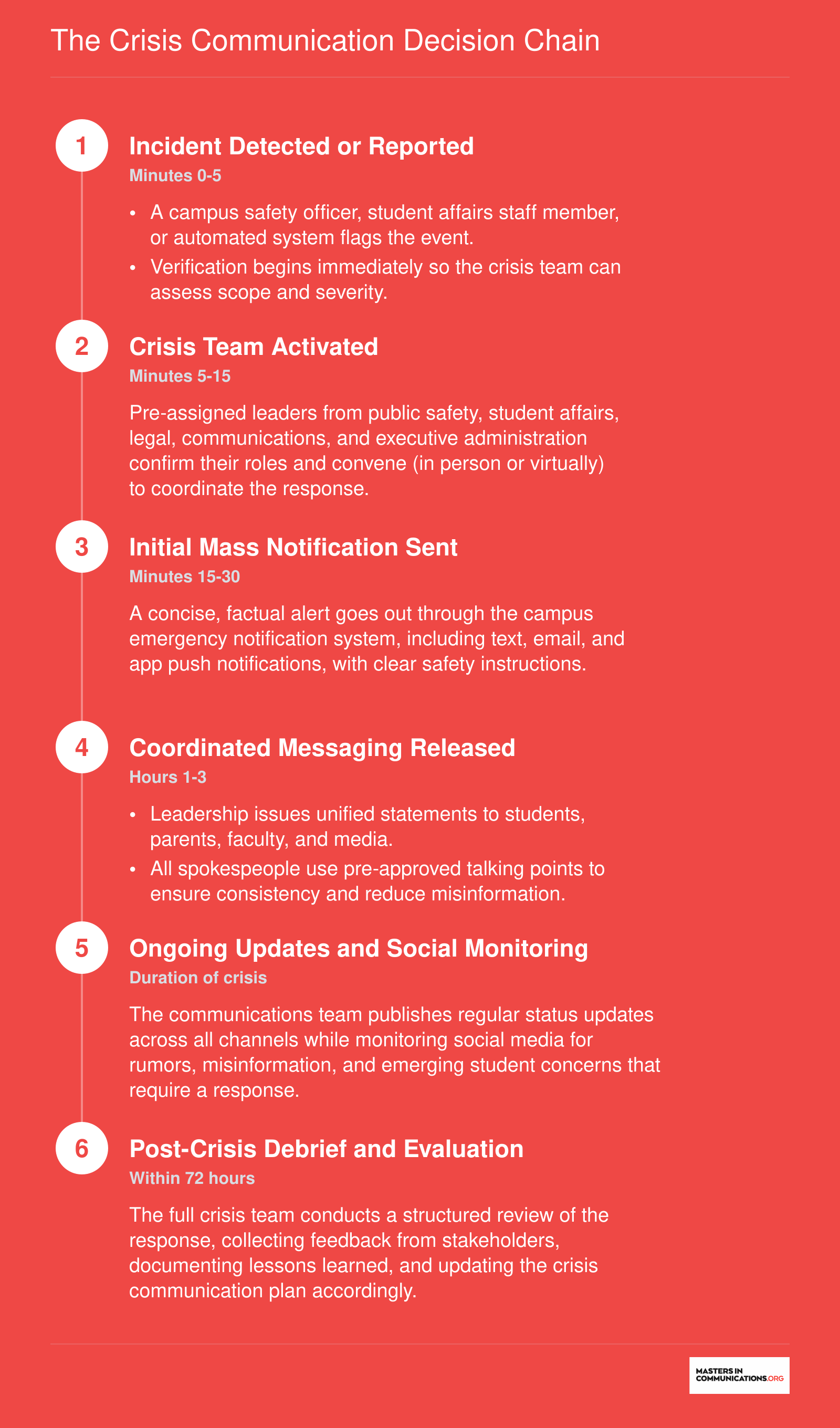
The Crisis Communication Decision Chain
Regardless of whether a campus faces a natural disaster, an active threat, or a mental health emergency, the underlying communication workflow should follow the same repeatable sequence. This six-step decision chain gives every member of your crisis team a shared roadmap, reducing confusion and keeping stakeholders informed at every stage.
Trauma-Informed Messaging and Student Mental Health Communication
Trauma-informed crisis communication in higher education rests on five core message components: clearly delineating what is known and unknown, describing concrete actions being taken, designating where updates will appear, listing available supports with direct contact information, and using accessible language free of jargon.1 These components, drawn from evidence-based frameworks in trauma-informed practice, replace reactive, logistics-only updates with messages that acknowledge emotional impact, reduce re-traumatization risk, and connect students proactively to counseling and support services.2 Campus leaders who center mental health in their crisis messaging recognize that how information is delivered shapes whether students feel safe enough to seek help or withdraw into silence.
Lead With Empathy Before Logistics
Crisis communications that open with procedural details (building closures, class cancellations, police activity) before acknowledging human impact can alienate students in acute distress. Trauma-informed messaging principles reverse that order: begin by naming the emotional weight of the event, validate the range of reactions students may experience, and then provide logistical guidance.2 For example, a message about a campus death might open with "We are heartbroken to share that a member of our campus community has died" before detailing memorial plans or adjusted schedules. This sequencing honors students' need for voice, choice, and belonging while delivering facts clearly.
Provide direct links and phone numbers to counseling, crisis hotlines, employee assistance programs, and community mental health resources in every major update. Students in crisis rarely have the cognitive bandwidth to navigate institutional websites or recall where support lives; embedding those pathways into the message itself reduces barriers and signals institutional care.1 Understanding how stress and tiredness affect communication can help leaders appreciate why simplicity and directness matter most during acute events.
Avoid Graphic Details and Speculation
Messages that include graphic descriptions of violence, injury, or death can trigger secondary trauma among survivors, witnesses, and students with prior exposure to similar events.4 Stick to confirmed, essential facts without dramatizing or sensationalizing the incident. Similarly, avoid speculation about motives, identities, or causes until official investigations provide verified information. Premature or inaccurate details deepen distrust and can expose the institution to legal risk, particularly in cases involving discrimination or bias.
Equity Considerations: Marginalized Communities Experience Crises Differently
Crises affect marginalized student populations disproportionately, and communication must reflect that reality. International students need multilingual translations and culturally clear explanations of U.S. emergency protocols they may not intuitively understand. Students of color require messaging that avoids color-blind framing and explicitly acknowledges systemic inequities when incidents involve racism, police presence, or bias.5 LGBTQ+ students benefit from affirming language and assurance that support services are inclusive and knowledgeable about their specific needs. Students with disabilities depend on accessible formats including captions, screen-reader-compatible web design, and low-barrier pathways to accommodations during disruptions.
Poorly worded crisis messages can increase help-seeking barriers, deepen distrust among already marginalized populations, and amplify the very harms leaders intend to mitigate. Research on trauma-informed practices in school crisis recovery emphasizes that institutions applying an explicit equity lens see higher engagement with support services, faster community stabilization, and stronger long-term trust.4 Accessible, culturally responsive communication is not an add-on; it is foundational to ethical crisis management in diverse campus environments.
Multi-Channel and Social Media Strategies for Real-Time Crisis Updates
Multi-channel crisis communication means delivering the same urgent information through several coordinated platforms simultaneously, so a student is reached whether they are in a lecture hall, asleep across a time zone, scrolling TikTok, or checking email between shifts. No single channel covers everyone, and during a crisis, redundancy is a feature, not waste.
Mapping the Omnichannel Toolkit
A functional campus crisis communication plan assigns a clear purpose to each channel rather than blasting identical copy everywhere:
- Mass text/SMS alerts: Reserved for immediate physical threats (active shooter, severe weather, evacuation). Short, directive, action-oriented.
- Email: Detailed follow-ups, resource lists, counseling contacts, and timeline updates that need more than 160 characters.
- LMS announcements: Course-level disruptions, assignment extensions, and academic continuity instructions posted in Canvas, Blackboard, or Brightspace.
- Campus app push notifications: Targeted alerts that can be geofenced or audience-segmented.
- Website banner and dedicated incident page: The authoritative source of record everyone else links back to.
- Social media (X, Instagram, TikTok, Facebook): Broad reach, rumor control, and live updates where students already are.
Claiming the Narrative on Social Media
Students routinely learn about an unfolding campus incident from TikTok or X before the institution issues a word.1 If your first official post lands ninety minutes after the rumor wave, you are no longer informing; you are correcting. Crisis teams should keep pre-drafted holding statements ready ("We are aware of reports near [location]. Public Safety is on scene. More information shortly.") and use social listening platforms such as Hootsuite, Sprout Social, Brandwatch, Mention, Brand24, or Reputation.com to monitor mentions, hashtags, and sentiment in real time.2 Posting a credible holding statement within minutes is how institutions claim the narrative before misinformation hardens. Understanding the broader landscape of communication and mass media can help crisis teams appreciate why speed matters so much on these platforms.
Reaching Populations the Default Plan Misses
A campus emergency communication strategy fails if it only reaches residential, on-campus, English-speaking, fully-abled students. Build deliberate touchpoints for remote and online learners (LMS plus email), commuters (SMS and app push), international students in distant time zones (asynchronous email digests with timestamps), and students with accessibility needs. That last group means captioned video, transcripts, plain-language summaries, screen-reader-friendly web banners, and ASL interpretation for press conferences. Leaders who understand how autism affects communication can design more inclusive messaging that accounts for neurodivergent processing styles as well.
Designate a Social Media Lead
During an active event, one person on the crisis team should do nothing except monitor social channels, respond to verified questions, and escalate misinformation to leadership for rapid correction. Splitting this role across someone's other duties guarantees it gets dropped at the worst possible moment. EAB's climate crisis management toolkit emphasizes this dedicated-monitor model as a baseline expectation, not a luxury.3 Guidance from Strathmore Business School similarly treats a designated social media lead as essential for any institution serious about real-time crisis response.1
Legal Compliance in Crisis Communication: FERPA, Clery Act, and Title IX
Proactive transparency versus legal exposure: campus communicators face this tension in nearly every crisis. Getting the balance wrong in either direction carries real consequences. Say too little and you may violate federal notification obligations; say too much and you risk breaching student privacy protections that carry their own enforcement weight. Understanding how FERPA, the Clery Act, and Title IX interact during a crisis is not optional for communication leaders; it is foundational.
FERPA and the Health or Safety Emergency Exception
The Family Educational Rights and Privacy Act restricts disclosure of student education records without consent, but it includes a carefully bounded exception when a genuine emergency exists. Under 34 C.F.R. § 99.31(a)(10), institutions may disclose otherwise protected information to appropriate parties, including law enforcement, public health officials, trained medical personnel, and parents, when there is an articulable and significant threat to the health or safety of the student or others.12
The word "articulable" matters here. The U.S. Department of Education applies a good-faith documented assessment standard, meaning institutions that make a reasonable, documented judgment call about the threat are given deference even if the threat does not ultimately materialize.3 That protection disappears if you cannot show your work. Every disclosure made under this exception must be recorded, including what information was shared, with whom, and why the emergency exception was determined to apply.4
Importantly, FERPA does not restrict communication about non-identifying information.5 A campus-wide message describing the nature of a threat, protective actions to take, or resources available does not require any FERPA analysis as long as it contains nothing that identifies an individual student.
Clery Act: Timely Warnings vs. Emergency Notifications
These two obligations, governed by 34 C.F.R. § 668.46, are frequently confused, and the Department of Education has flagged misclassification as a significant enforcement concern between 2024 and 2026.6
A timely warning applies to Clery-reportable crimes that represent an ongoing threat to the campus community. The timing standard is simply "timely," which in practice means as soon as pertinent information is available. An emergency notification, by contrast, is triggered by an immediate threat to health or safety and must be issued without delay, subject only to narrow exceptions such as compromising law enforcement operations.
The practical difference: a pattern of off-campus thefts near student housing might require a timely warning issued within hours or a day. An active threat on campus triggers emergency notification obligations measured in minutes. Misclassifying the second situation as the first is one of the most common Clery compliance failures documented in federal enforcement actions. Professionals who study health communication gain deeper insight into how these regulatory frameworks shape messaging during public safety events.
Title IX and Survivor Privacy in Crisis Messaging
When a campus crisis involves sexual violence or harassment, communication obligations become especially sensitive. Title IX, as shaped by the 2020 regulations and amended in 2024, creates a clear constraint: no crisis communication may identify the survivor.7 This holds even when broader community safety messaging is warranted.
The tension arises because community members sometimes demand more information than institutions can legally provide. The communicator's job is to convey the seriousness of the institution's response, the resources available, and any relevant safety guidance, while keeping all identifying details out of every channel. Vague but protective language is not evasiveness here; it is compliance.
A Pre-Release Compliance Checklist
Before any crisis message goes out, run it through these checkpoints:
- Legal review trigger: Determine whether the message involves any student-specific information, a Clery-reportable crime, or a Title IX matter. If yes, legal counsel reviews before release.
- FERPA-safe language audit: Confirm the message contains no information that could identify an individual student, even indirectly through detail combinations such as residence hall, year, and condition.
- Clery classification check: Confirm whether the situation meets the threshold for a timely warning, an emergency notification, or neither, and document the reasoning.
- Title IX identity screen: For any message touching on sexual misconduct, confirm that survivor identity is fully protected and that language does not inadvertently narrow the field of who is described.
- Documentation log: Record the time of release, who approved it, what legal basis was applied for any privacy-exception disclosures, and what channels were used. This record is your institutional defense in any subsequent review.
According to the Campus Safety Magazine 2025-2026 Campus Safety and Security Report, only 37% of higher education institutions updated their emergency response plans during the 2023-2024 academic year. That means nearly two-thirds of campuses entered the following year relying on protocols that may not reflect current threats, technologies, or student needs.
Measuring Crisis Communication Effectiveness: Metrics and KPIs
Most campus leaders know when a crisis response felt chaotic, but far fewer have the data to prove why it failed or to demonstrate that it succeeded. Without deliberate measurement, institutions repeat the same gaps across incidents, unable to distinguish genuine improvement from good luck.
Start With Speed and Reach
The most foundational metrics focus on whether alerts actually arrived and how quickly. Industry practice, reflected in FEMA's National Incident Management System (NIMS) documentation and in after-action reports from university emergency programs, consistently treats alert delivery time as a primary benchmark. A commonly cited target in emergency management planning is delivery of the initial notification to the campus community within 10 minutes of a confirmed threat, though institutions vary in how they define the clock start. Alongside delivery speed, reach rate matters: what percentage of registered users, enrolled students, and staff actually received the message through at least one channel? Low reach often signals enrollment gaps in opt-in alert systems or outdated contact databases.
Engagement and Behavioral Compliance
Delivery alone does not tell you whether anyone acted. Message open rates for email and push notifications provide a rough proxy for engagement, though they systematically undercount audiences who receive SMS or outdoor alerts. More meaningful are behavioral compliance indicators: the percentage of people who followed a specific instruction, such as sheltering in place, evacuating a building, or checking in through a safety portal. These figures are harder to collect in real time but are often reconstructed through after-action interviews and facility access logs. Some institutions track compliance rates as a standing KPI in their crisis communication plans, using them to calibrate future messaging clarity and channel selection.
Post-Crisis Trust and Community Perception
Crisis communication does not end when the immediate threat resolves. NACUBO's risk management resources and peer-reviewed crisis communication literature both point toward post-crisis trust surveys as a critical but underused evaluation tool. A brief survey administered within two to four weeks of an incident can measure whether students, faculty, and staff felt informed, respected, and confident in institutional leadership. Declines in trust scores across successive incidents are a signal that communication processes need structural repair, not just tactical tweaks.
Building a Continuous Improvement Loop
Effective measurement requires a formal after-action review process. Reviewing publicly available crisis communication plans from large public universities reveals a common structure: a timeline reconstruction, a channel-by-channel delivery audit, a community feedback summary, and a set of corrective actions with assigned owners and deadlines. Pairing quantitative metrics with qualitative stakeholder input creates the feedback loop that turns a single crisis into lasting institutional learning. For professionals looking to deepen their expertise in this area, careers with a masters in communication often include crisis and risk communication roles where these measurement skills are essential. Without that feedback loop, KPIs become paperwork rather than change drivers.
How a Master's in Communication Prepares Leaders for Campus Crises
Graduate programs in communication typically require 30 to 36 credit hours and are designed to transform working professionals into strategic communicators capable of navigating high-stakes, rapidly evolving crises. Every competency outlined in this guide (stakeholder coordination, trauma-informed messaging, media relations, legal compliance, data-driven evaluation) maps directly to core and elective coursework in a modern master's in communication curriculum.
Core Curriculum Areas That Build Crisis Leadership
Strategic communication courses teach students to design and execute communication plans that align with organizational goals and stakeholder needs, precisely the skill set required when a campus crisis demands immediate, coordinated messaging across multiple audiences. Organizational communication coursework examines how information flows through complex institutions, how power dynamics shape decision-making, and how to diagnose and repair communication breakdowns between departments and leadership teams.
Media and public relations training equips students with the frameworks and techniques to manage media inquiries, craft press releases under tight deadlines, and protect institutional reputation during negative news cycles. Research methods courses provide the tools for audience analysis, survey design, and impact measurement, enabling leaders to evaluate crisis communication efforts using the same metrics and KPIs discussed earlier in this guide. Many programs also offer dedicated crisis and risk communication courses that simulate real-world scenarios, from active shooter situations to Title IX violations, allowing students to practice rapid response in a low-stakes learning environment.
Flexible Pathways for Working Higher Education Professionals
Online and hybrid master's programs are specifically designed for professionals who cannot leave their current roles. Student affairs staff, campus safety directors, enrollment managers, and university communicators can complete coursework asynchronously, applying new skills to live crises on their own campuses in real time. This applied learning model accelerates both degree completion and professional impact, as students bring case studies from their institutions into classroom discussions and capstone projects.
The Growing Demand for Formal Communication Training
As campus crises grow more complex, public, and legally fraught, institutions increasingly seek leaders with formal training in communication strategy, not just functional expertise in housing, counseling, or campus police work. A master's in communication signals to employers that a candidate can translate subject-matter knowledge into clear, ethical, legally compliant messaging that protects students, maintains trust, and supports institutional mission during the most challenging moments of campus life. For professionals weighing the investment, it is worth exploring whether a masters in communication is worth it given these expanding career demands.
Frequently Asked Questions About Campus Crisis Communication
Campus crises raise urgent questions about coordination, compliance, and care. Below are answers to the most common questions university leaders and communication professionals ask when building or refining their crisis response frameworks.
- What are the key elements of a campus crisis communication plan?
- A strong plan includes clearly defined roles and a decision chain, pre-drafted message templates for different crisis types, designated spokespersons, a multi-channel distribution strategy (text, email, social media, website), protocols for legal compliance with FERPA and the Clery Act, and a post-crisis review process. The plan should be tested through tabletop exercises at least twice a year and updated after every real incident.
- How should university leaders coordinate communication during a crisis?
- Leaders should operate through a cross-functional crisis communication team that brings together student affairs, campus police, counseling services, legal counsel, public relations, and academic leadership. Assigning a single incident commander who holds final message-approval authority prevents contradictory statements. Real-time coordination tools, such as a shared crisis dashboard or group messaging channel, keep all stakeholders aligned as the situation evolves.
- What role does social media play in campus crisis communication?
- Social media is often the fastest channel for reaching students, and platforms like Instagram, X, and TikTok can spread information (or misinformation) within minutes. Universities should designate trained social media managers who can post verified updates quickly, monitor emerging rumors, and correct inaccuracies. A campus emergency communication strategy should include platform-specific message templates and clear escalation steps for trending misinformation.
- How can universities balance transparency with student privacy laws during a crisis?
- Transparency builds trust, but FERPA, the Clery Act, and Title IX each impose specific limits on what can be disclosed. The key is to share the nature of the threat and protective actions without revealing personally identifiable student information. Legal counsel should be embedded in the crisis communication team so compliance questions are answered in real time, not after a message has already gone out.
- How should crisis messaging address student mental health and trauma?
- Messaging should follow trauma-informed principles: acknowledge the emotional impact of the event, avoid graphic or sensationalizing language, and provide clear directions to counseling and support resources. Including specific contact information for campus mental health services, crisis hotlines, and peer support groups makes it easier for affected students to seek help immediately rather than navigating a website during a high-stress moment.
- What metrics should campuses use to evaluate crisis communication effectiveness?
- Useful metrics include message delivery speed (time from incident confirmation to first official communication), audience reach across each channel, open and click-through rates for email and text alerts, social media engagement and sentiment analysis, and post-crisis survey results from students, faculty, and staff. Tracking these KPIs after every incident helps identify gaps and provides data to justify future investments in communication infrastructure.