
What you’ll learn in this article…
- SLPs practice across nine distinct clinical areas, from articulation and fluency to swallowing and cognitive communication.
- Becoming a licensed speech language pathologist requires roughly 6 to 7 years of post-secondary education including a master's degree.
- BLS projects SLP employment to grow 3 percent through 2033, with telepractice and AI tools expanding access further.
- National SLP salaries range widely by state and setting, with Georgia and Florida topping the 25-state comparison.
The Bureau of Labor Statistics projects 18% growth for speech-language pathologist jobs between 2024 and 2034, nearly triple the average for all occupations. That demand reflects the sheer range of communication and swallowing disorders SLPs treat, from toddlers forming first words to adults recovering speech after a stroke.
SLPs work across schools, hospitals, and private practices, and their expertise spans nine distinct practice areas. The field rewards those who complete a master's degree and state licensure, but the path demands careful planning around cost and admission. For career-changers and new graduates alike, the central question is whether the upfront investment of six to seven years of training aligns with the versatility and stability the profession provides.
What Is Speech Language Pathology?
Speech language pathology is the clinical discipline dedicated to evaluating, diagnosing, and treating disorders that affect how people communicate and swallow. This field spans the entire lifespan, from premature infants struggling to feed safely to older adults recovering speech after a stroke. The speech pathology definition encompasses far more than helping someone pronounce words clearly: it includes language comprehension, voice quality, fluency, cognitive communication, and the complex mechanics of safe swallowing. For a broader look at how these conditions are classified, our overview of communication disorders provides helpful context.
Understanding the Speech Language Pathologist Meaning
A speech language pathologist (SLP) is a licensed healthcare professional who holds graduate-level training in communication sciences. You may hear the terms "speech therapist" and "speech-language pathologist" used interchangeably in everyday conversation, and they do refer to the same credentialed professional. However, SLP is the clinical title formally recognized by the American Speech-Language-Hearing Association (ASHA), the field's national certifying body. Using the precise terminology matters when navigating licensure requirements or verifying a clinician's credentials.
Where SLPs Practice
One defining feature of speech language pathology is its remarkable breadth of practice settings. SLPs work in:
- Public and private schools: Supporting children with speech sound disorders, language delays, stuttering, and augmentative communication needs.
- Hospitals and rehabilitation centers: Treating adults and children with swallowing dysfunction (dysphagia), voice disorders, or communication impairments following neurological events.
- Private practices and outpatient clinics: Offering specialized therapy for accent modification, professional voice use, or pediatric feeding difficulties.
- Skilled nursing facilities: Addressing communication and swallowing changes associated with aging, dementia, or progressive neurological conditions.
This variety distinguishes SLPs from related specialists. Audiologists focus specifically on hearing assessment and amplification, while ear, nose, and throat physicians (ENTs) address the surgical and medical management of structural abnormalities. SLPs collaborate with both, but their scope centers on functional communication and swallowing rehabilitation rather than surgical intervention or hearing technology.
The CCC-SLP Credential
ASHA grants the Certificate of Clinical Competence in Speech-Language Pathology (CCC-SLP), widely regarded as the gold standard for the profession. Earning this credential requires completing a master's degree from an accredited program, passing the national Praxis examination, and finishing a supervised clinical fellowship. Students interested in flexible graduate options can explore masters in communication disorders online to find accredited pathways. Most states also require separate licensure, though holding the CCC-SLP often streamlines that process. For prospective students, understanding ASHA's role clarifies why program accreditation and clinical hours carry so much weight during graduate admissions.
What Does a Speech Language Pathologist Do? The 9 Areas of Practice
What exactly does a speech language pathologist treat, and how broad is the scope of this profession? The answer surprises many newcomers: SLPs work across nine distinct areas of practice recognized by the American Speech-Language-Hearing Association (ASHA), spanning everything from childhood articulation challenges to adult swallowing disorders.1 Understanding these areas is the first step toward deciding whether, and how, to enter this field.
The 9 ASHA-Recognized Areas of SLP Practice
Each area addresses a different dimension of human communication or swallowing. Here is what they look like in real clinical work:
- Speech Sound Production (Articulation): Covers articulation disorders, phonological patterns, and motor speech conditions such as apraxia and dysarthria. A four-year-old who consistently replaces the "r" sound with "w" might receive targeted articulation therapy to reshape how she positions her tongue during speech.
- Fluency and Fluency Disorders: Addresses stuttering and cluttering. A teenager who experiences blocks and repetitions before class presentations may work with an SLP on fluency-shaping techniques that build confidence alongside smoother speech.
- Voice and Resonance: Focuses on vocal quality, pitch, loudness, and resonance. A teacher referred for chronic hoarseness could receive voice therapy aimed at reducing vocal strain and rebalancing breath support.
- Receptive and Expressive Language: Encompasses spoken and written language, including morphology, syntax, semantics, and pragmatics. A second-grader struggling to follow multi-step directions or construct complete sentences would benefit from structured language intervention that supports both academic and social growth.
- Social Communication: Centers on the pragmatic, social use of verbal and nonverbal communication. An adult with a traumatic brain injury who has difficulty reading conversational cues or taking turns in dialogue might practice these skills through structured role-play scenarios.
- Cognitive-Communication: Targets attention, memory, organization, problem solving, and executive functions as they relate to communication. A stroke survivor who can speak clearly but cannot organize thoughts well enough to hold a meeting at work would receive cognitive-communication rehabilitation.
- Augmentative and Alternative Communication (AAC): Involves selecting and training individuals to use speech-generating devices, picture boards, or apps when natural speech is limited or absent. A child with cerebral palsy who communicates through eye-gaze technology relies on an SLP to program, calibrate, and expand the system as language develops.
- Feeding and Swallowing (Dysphagia): Addresses the oral, pharyngeal, and esophageal phases of swallowing, plus feeding behaviors. An elderly patient in a hospital who chokes on thin liquids after surgery may need an SLP-led swallow evaluation and a modified diet plan.
- Hearing and Aural Rehabilitation: Deals with the communication impacts of hearing loss, including auditory training and aural rehabilitation strategies. A retiree adjusting to new hearing aids might work with an SLP to improve speech perception in noisy environments.
Specialization Is the Norm
While the list above is broad, most practicing SLPs do not treat across all nine areas day to day. Professionals tend to specialize based on their work setting and the populations they serve. An SLP in a public elementary school, for example, may spend most sessions on articulation, language, and fluency with pediatric caseloads, while an SLP in a hospital's acute care unit focuses heavily on dysphagia and cognitive-communication in adults. Setting, patient age, and clinical interest typically shape a career path more than any requirement to be a generalist. It is worth noting that telepractice is now considered a valid service delivery model across all areas of SLP practice, expanding access for both clinicians and clients.2
Where the Areas Overlap
In practice, neat boundaries between these nine areas often blur. A child on the autism spectrum, for instance, may simultaneously need receptive and expressive language intervention, social communication coaching, and AAC support, all coordinated by the same clinician. To better understand how autism affects communication, it helps to see how these overlapping needs play out in real therapy sessions. Similarly, an adult recovering from a stroke might present with voice changes, swallowing difficulties, and cognitive-communication deficits at the same time. SLPs are trained to assess the full picture and address co-occurring needs, which is part of what makes the profession both challenging and rewarding.
ASHA has also placed growing emphasis on literacy and academic language within SLP practice, particularly in school settings.3 This trend reinforces that language-based interventions extend well beyond spoken conversation into reading, writing, and classroom success.
Understanding these nine areas gives you a clearer sense of day-to-day clinical reality and helps you evaluate which graduate programs align with the population and setting you find most compelling. The curriculum breakdown later in this guide maps coursework directly to these practice domains, so you can see how academic preparation translates into clinical competence.
According to ASHA's Member and Affiliate Profile, more than 212,000 SLPs held ASHA certification as of 2024, making it one of the largest allied health professions in the country. Nearly half of them, about 49.6 percent, work in school settings, underscoring how central SLPs are to public education.
The Speech Pathology Process: From Assessment to Discharge
Speech-language pathology follows a structured clinical workflow, a sequence of decision points that takes a person from "something seems off with communication or swallowing" to "goals met, services ended." Whether the client is a toddler not yet babbling or a stroke survivor relearning to swallow, the underlying process is remarkably consistent across five stages: referral and screening, comprehensive assessment, diagnosis, treatment planning and therapy, and finally discharge with a maintenance plan.
Stage 1 and 2: Referral, Screening, and Comprehensive Assessment
Referrals come from pediatricians, teachers, parents, neurologists, or self-referral in the case of adults. A brief screening determines whether a full evaluation is warranted. If it is, the SLP moves into comprehensive assessment, combining case history, observation, parent or patient interview, and standardized testing.
The instruments chosen depend on the suspected communication disorder. For pediatric articulation, the Goldman-Fristoe Test of Articulation (GFTA-3) samples consonant production in children ages 2 to 21.1 For school-age language, the Clinical Evaluation of Language Fundamentals (CELF) probes receptive and expressive language, sentence structure, and working memory. Younger children may receive the Preschool Language Scales (PLS-5), normed from birth to age 7.2 Fluency clinicians often use the Stuttering Severity Instrument (SSI-4).3 On the medical side, the Mann Assessment of Swallowing Ability (MASA) is a common bedside dysphagia screen4, while the Western Aphasia Battery-Revised (WAB-R) is widely used with adults after stroke or brain injury.2
Stage 3 and 4: Diagnosis, Goal Writing, and Therapy
Results are synthesized into a diagnosis and severity rating, which then drive the treatment plan. SLPs write goals using the SMART framework: Specific, Measurable, Achievable, Relevant, and Time-bound. A vague aim like "improve speech" becomes "produce /s/ in single words with 80% accuracy across three consecutive sessions." Data is collected every session, and goals are revised when progress stalls or accelerates.
Therapy intensity varies dramatically by setting. A school-based SLP might see a child twice a week for 30 minutes in a small group, while an inpatient rehab SLP may treat a stroke patient daily. Evidence-based protocols often guide the work: LSVT LOUD for adults with Parkinson's disease, PROMPT's tactile-kinesthetic cueing for childhood apraxia, the Hanen Program for parent-coached early language, and the Lidcombe Program for preschool stuttering.2
Stage 5: Discharge, Caregiver Training, and Carryover
Discharge happens when goals are met, progress has plateaued, or the client can maintain skills independently. Throughout therapy, caregiver training and structured home programs are not optional add-ons. They are what turns 30 minutes a week into meaningful, generalized change.
How to Become a Speech Language Pathologist: Education and Licensure
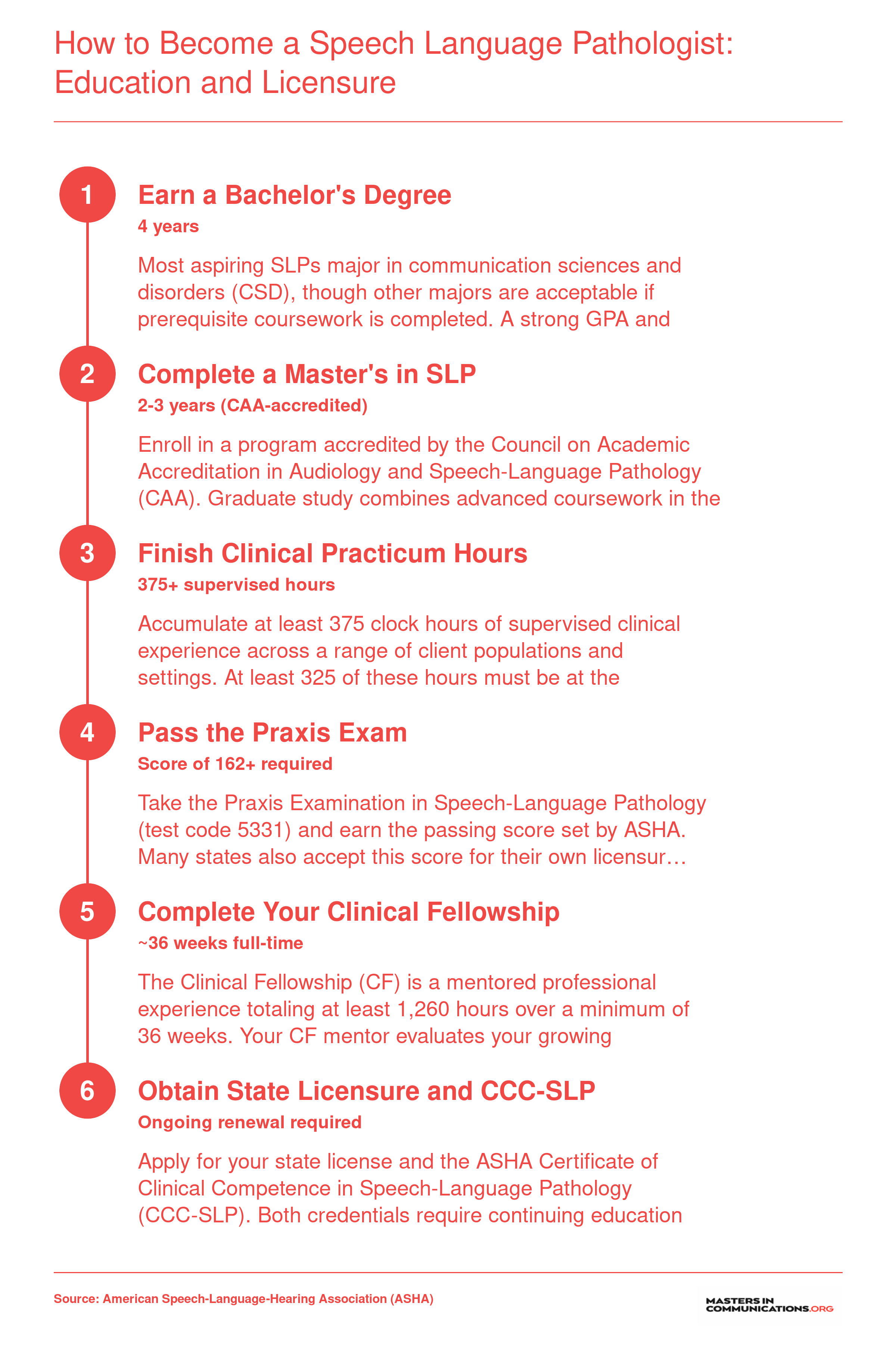
The master's degree is the entry-level clinical degree for speech language pathologists, so there is no shortcut past it. From your first undergraduate course to full licensure, expect the journey to take roughly 6 to 7 years after high school.
SLP Program Curriculum, Prerequisites, and What to Expect
The central tradeoff most prospective students wrestle with is cost versus access: a well-regarded public in-state program may cost half as much as a private university, but seats are scarce and admissions are competitive. Understanding what you are paying for, and what you will need to get in, helps you make a smarter choice from the start.
Prerequisites: What You Need Before You Apply
CAA-accredited master's programs typically require 6 to 12 prerequisite courses covering the biological, physical, social, and behavioral sciences.1 In practice, admissions committees want to see anatomy and physiology of the speech and hearing mechanism, phonetics, introduction to linguistics, developmental psychology, and statistics. If your undergraduate degree was in psychology, education, or another field outside communication sciences and disorders, most programs expect you to complete a post-baccalaureate leveling year, sometimes called a "leveling sequence," before beginning graduate coursework. Completing those prerequisites at a local university or through an online post-bacc program keeps your options open without delaying your eventual master's start by more than a year.
Core Master's Curriculum
Once admitted, expect a 2- to 2.5-year program spanning roughly 50 to 65 credits.1 Courses are tightly structured to meet CAA accreditation standards, so the syllabus looks similar across schools even when the delivery format differs. Representative course titles you will encounter include:
- Speech Sound Disorders: Articulation and phonological assessment and intervention
- Language Disorders Across the Lifespan: From early childhood language delays through acquired aphasia in adults
- Voice Disorders: Evaluation and treatment of dysphonia and resonance disorders
- Fluency Disorders: Stuttering assessment, counseling, and evidence-based treatment
- Dysphagia: Swallowing evaluation, instrumental assessment, and dysphagia management
- Motor Speech Disorders: Dysarthria and apraxia of speech
- Augmentative and Alternative Communication (AAC): Device selection, feature matching, and implementation
- Audiology for Speech-Language Pathologists: Hearing screening, audiogram interpretation, and aural rehabilitation
- Research Methods and Evidence-Based Practice: Reading and applying the clinical literature
- Clinical Seminar or Capstone: Integrating coursework with supervised clinical experience
The Clinical Practicum
Academic coursework alone does not make you a clinician. ASHA standards for 2025-2026 require a minimum of 400 supervised clock hours across the master's program: 25 hours of guided observation and at least 375 hours of direct client contact.1 A supervisor holding the Certificate of Clinical Competence (CCC-SLP) must provide direct supervision for at least 25 percent of each student's total contact hours. Programs are required to expose students to clients across multiple populations and age groups and in at least two distinct clinical settings, which may include an on-campus clinic, a local school, a hospital, or a community agency.
After graduation, you will complete a Clinical Fellowship (CF) before earning your CCC-SLP: 36 weeks of full-time supervised practice totaling 1,260 hours, mentored by a CCC-SLP.1
Program Cost and Return on Investment
Public in-state programs generally run between $25,000 and $45,000 in total tuition. Out-of-state tuition at public universities typically falls between $45,000 and $70,000, and private programs range from $60,000 to $100,000. As a concrete example, Cal State East Bay's MS-SLP program charges approximately $850 per credit across 60 to 62 credits, bringing total program cost to roughly $51,000 to $53,000 for most students.3
Context matters when you look at those numbers. The national median annual wage for speech-language pathologists, according to the Bureau of Labor Statistics, sits in the mid-$80,000s (that figure is national in scope and individual state medians vary). A graduate who completes a public in-state program and carries $35,000 in debt enters a field where the salary-to-debt ratio is reasonable by healthcare professional standards. Those who attend private programs should weigh whether a specific school's clinical placement network or faculty research access justifies the added cost, rather than assuming prestige alone delivers a premium salary.
Questions to Ask Yourself
Speech Language Pathologist Salary by State
Compensation for speech language pathologists varies considerably depending on where you practice. The table below draws from the most recent Bureau of Labor Statistics data for the SLP occupation (29-1127) across 25 states. Georgia and Florida currently lead the list with median salaries approaching or exceeding $97,000, while states in the Midwest and Mountain West tend to cluster in the low-to-mid $80,000 range. Keep in mind that cost of living, demand, and work setting all influence what you can actually expect to earn.
| State | Total Employed | 25th Percentile | Median Salary | 75th Percentile | Mean Salary |
|---|---|---|---|---|---|
| Georgia | 4,190 | $75,630 | $99,100 | $104,630 | $91,960 |
| Florida | 8,990 | $79,940 | $97,150 | $103,950 | $92,770 |
| Arizona | 2,830 | $78,680 | $95,990 | $110,330 | $98,390 |
| Virginia | 3,850 | $76,820 | $94,370 | $108,750 | $96,180 |
| Pennsylvania | 6,860 | $76,870 | $93,800 | $105,880 | $93,980 |
| South Carolina | 2,150 | $71,510 | $91,880 | $105,390 | $88,410 |
| Texas | 18,600 | $73,600 | $89,450 | $113,390 | $94,850 |
| Ohio | 7,660 | $74,300 | $88,340 | $103,500 | $89,740 |
| North Carolina | 5,160 | $69,640 | $87,420 | $102,960 | $89,980 |
| Wyoming | 270 | $67,560 | $85,820 | $107,130 | $88,930 |
| Utah | 1,450 | $62,960 | $85,320 | $102,510 | $83,640 |
| Indiana | 3,080 | $71,650 | $84,330 | $104,230 | $90,180 |
| Oklahoma | 2,040 | $62,300 | $84,310 | $106,440 | $87,210 |
| Missouri | 2,700 | $65,570 | $83,950 | $100,550 | $84,930 |
| New Hampshire | 790 | $70,350 | $83,800 | $102,710 | $86,900 |
| Tennessee | 3,510 | $65,070 | $82,990 | $100,050 | $83,200 |
| Kentucky | 2,520 | $67,140 | $82,910 | $102,190 | $86,260 |
| Illinois | 9,100 | $69,220 | $82,480 | $105,480 | $87,940 |
| Minnesota | 3,730 | $68,220 | $82,450 | $97,840 | $82,020 |
| Michigan | 4,410 | $66,550 | $81,860 | $98,740 | $84,330 |
| Nebraska | 1,230 | $67,110 | $81,710 | $98,390 | $83,880 |
| Maine | 610 | $71,440 | $81,700 | $91,660 | $80,100 |
| Kansas | 1,790 | $66,190 | $81,360 | $100,580 | $84,230 |
| Iowa | 1,390 | $73,700 | $81,120 | $98,470 | $85,230 |
| Wisconsin | 3,210 | $69,620 | $80,580 | $99,980 | $84,090 |
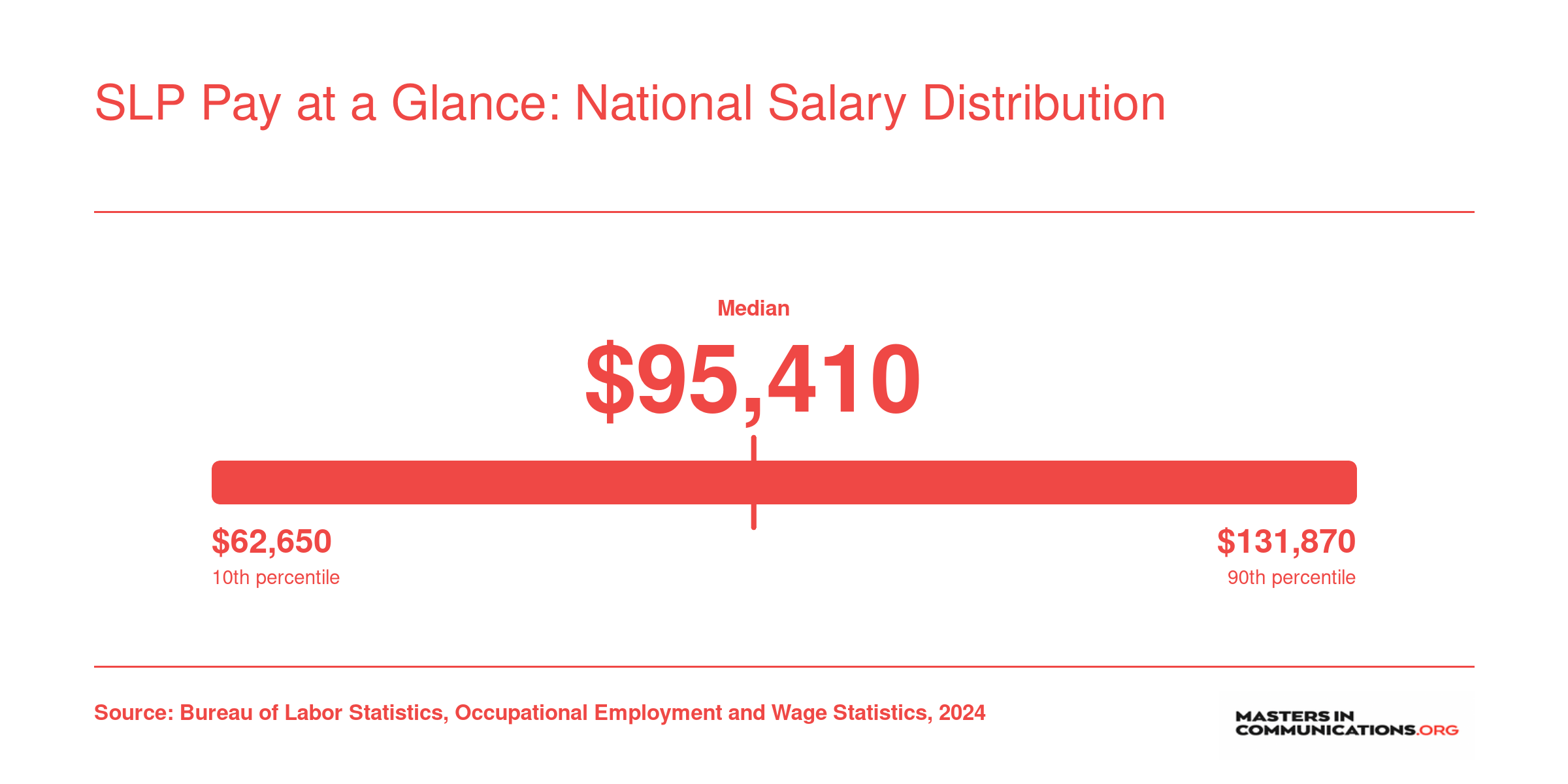
SLP Pay at a Glance: National Salary Distribution
Speech language pathologist salaries span a wide range nationally, shaped by practice setting, geographic region, and years of experience. Entry-level school-based SLPs typically earn near the 25th percentile, while hospital-based or highly specialized clinicians often surpass the 75th percentile.
SLP Work Settings Compared: Schools, Hospitals, Private Practice, and More
Where you practice shapes nearly every aspect of your daily life as an SLP, from the size of your caseload to the complexity of your cases and the paycheck you take home. Choosing the right setting is less about finding the "best" option and more about aligning your clinical interests, lifestyle preferences, and financial goals.
Public Schools
Roughly 54% of SLPs work in educational settings, making schools the single largest employer in the field.1 School-based SLPs typically manage caseloads of around 50 students across K-12 grade levels, addressing articulation, language, fluency, and social communication needs. Your schedule mirrors the school calendar, which means summers off, holidays, and predictable daytime hours. That structure appeals to many clinicians, though the trade-off is compensation: school SLPs earned a national median of approximately $75,000 in 2024, the lowest tier among the four primary settings.3 High caseloads have also become a retention concern, with some districts pushing numbers well above recommended limits.4
Hospitals and Acute Care
Hospital SLPs work with medically complex adults, often addressing dysphagia, cognitive-communication disorders following stroke or traumatic brain injury, and voice disorders tied to intubation or surgery. Daily caseloads are smaller (typically 6 to 12 patients) but far more intensive, and shifts may include weekends or holidays. The clinical autonomy is substantial, with SLPs functioning as integral members of interdisciplinary care teams. The national median wage for hospital-based SLPs was around $95,000 in 2024, reflecting the acuity and scheduling demands of the role.3
Skilled Nursing Facilities
SNF-based SLPs serve older adults managing conditions such as dementia, Parkinson's disease, and post-stroke recovery. Caseloads generally range from 8 to 14 patients per day, and schedules tend to follow regular daytime hours. Productivity expectations can be high, as reimbursement models in skilled nursing hinge on billable minutes. Compensation, however, tops the four settings, with a national median near $99,000 in 2024.3 Clinicians who enjoy geriatric care and rehabilitative progress often find this environment deeply rewarding.
Private Practice and Outpatient Clinics
Private practice offers the widest range of autonomy. SLPs in this setting see roughly 20 to 35 sessions per week and may specialize in pediatric articulation, adult voice therapy, accent modification, or any number of niches. Schedules are flexible but often include evening or weekend appointments to accommodate clients. Strong effective listening skills are especially valuable in private practice, where building client rapport directly influences referrals and retention. Income is variable: the national median hovered around $93,000 in 2024, yet practice owners who build a strong referral base can earn well above that figure.3 The flip side is the business overhead, from insurance credentialing to office leases, that salaried positions do not require.
Choosing the Right Fit
A quick comparison of the key dimensions:
- Caseload: Schools carry the highest volume (around 50 students); hospitals the lowest per-day count (6 to 12 patients).
- Population: Schools serve children; hospitals and SNFs primarily treat adults and older adults; private practice spans all ages.
- Schedule: Schools and SNFs offer the most predictable hours; hospitals may require shift work; private practice is self-directed.
- Autonomy: Private practice ranks highest; schools involve IEP-driven service delivery with less clinical latitude.
- Pay tier: SNFs and hospitals generally pay the most; schools pay the least; private practice income depends on business success.
Many SLPs move between settings over the course of a career. Starting in schools to build foundational skills and then transitioning into medical or private practice settings is a common trajectory. What matters most is matching the setting to the phase of life and career goals you are navigating right now.
Job Outlook and Career Growth for Speech Language Pathologists
How fast is the job market for speech language pathologists growing, and what does a long-term career in the field actually look like?
According to the Bureau of Labor Statistics Occupational Outlook Handbook, employment of speech-language pathologists is projected to grow 15 percent between 2024 and 2034.1 That rate is well above the average projected growth for all occupations, and it translates to roughly 13,300 job openings annually over the same period.1 Those openings reflect both new positions and the need to replace practitioners who retire or shift to other roles.
What Is Driving Demand
Three converging forces are pulling SLPs into the workforce faster than the field can currently supply them.
First, the aging baby boomer population is increasing the prevalence of stroke, traumatic brain injury, and dementia-related communication disorders. These conditions frequently require both speech therapy and swallowing intervention, putting SLPs on the front lines of neurological rehabilitation.
Second, early-intervention mandates at the federal and state level have expanded access to services for infants and toddlers with developmental delays. Caseloads in school districts and early childhood programs continue to grow as eligibility criteria broaden.
Third, public awareness of developmental speech and language delays has risen sharply. Families are seeking evaluations earlier, primary care providers are making more referrals, and the window for effective intervention is being recognized sooner, which sustains steady demand across pediatric settings.
Career Pathways and Advancement
A clinical career in speech-language pathology follows a fairly clear progression. Most practitioners begin as staff SLPs, then move into lead or senior clinician roles as they build caseload expertise. From there, clinical supervisors oversee graduate students and new clinicians, while program directors and department heads manage entire service lines within hospitals, school systems, or rehabilitation centers.
For those drawn outside direct care, the field also opens doors into research, university faculty positions, and healthcare administration. Communication disorders programs consistently need faculty with clinical backgrounds, and ASHA's data on member trends reflects a growing segment of SLPs in education and policy roles.2 Professionals exploring related careers with a masters in communication will find that an SLP background provides strong crossover value in these areas.
Subspecialty Certifications as Career Accelerators
Board-recognized specialty certifications through ASHA can distinguish clinicians in a competitive market and often lead to higher-level positions. Three of the most pursued credentials are:
- BCS-S (Swallowing and Swallowing Disorders): Valued in medical and acute care settings, where dysphagia management is a core service.
- BCS-F (Fluency and Fluency Disorders): Sought by clinicians who focus on stuttering and related conditions across the lifespan.
- BCS-CL (Child Language): Relevant for SLPs working in early intervention, schools, or pediatric outpatient clinics.
Earning any of these certifications typically requires at least three years of focused specialty experience, a set number of supervised clinical hours within that specialty, and a written examination. The process is rigorous by design: the credential signals a depth of expertise that generalist licensure alone does not convey, and employers in specialized settings routinely view it as a differentiator when evaluating candidates for senior or supervisory positions.
The Future of Speech Language Pathology: Telepractice, AI, and AAC
Speech language pathology is evolving rapidly as technology reshapes how clinicians assess, treat, and connect with clients. Three developments are particularly transformative: the widespread adoption of telepractice, the emergence of AI-assisted therapy tools, and significant advances in augmentative and alternative communication (AAC) devices. Understanding these trends helps aspiring SLPs prepare for a dynamic, tech-enhanced career.
Telepractice: From Emergency Measure to Standard Option
Telepractice has moved from a niche service delivery model to a mainstream option across multiple settings. According to ASHA's 2023 SLP Health Care Survey, between 10 and 40 percent of health care SLPs now carry telepractice caseloads, with the highest adoption in outpatient and home health settings.1 Younger clinicians are more likely to incorporate telehealth into their practice, reflecting generational comfort with digital platforms.1
School-based telepractice has grown substantially, particularly in rural areas where SLP shortages make in-person services difficult to sustain. ASHA's 2024 Schools Survey found that rural school districts rely on telepractice at notably higher rates than urban counterparts.2 The modality works especially well for school-age articulation and language therapy, where visual demonstrations and verbal cueing translate effectively to video platforms.
However, telepractice has clear limitations. Hands-on dysphagia assessment, oral mechanism examinations, and tactile cueing techniques remain challenging or impossible through a screen. Clinicians must exercise judgment about which clients and goals are appropriate for remote delivery. ASHA now permits graduate students to complete up to 125 of their 400 required clinical hours via telepractice, and Clinical Fellows may deliver up to 25 percent of their 1,260 hours remotely, signaling the profession's confidence in supervised telehealth training.3
AI-Assisted Therapy Tools
Artificial intelligence is entering the SLP toolkit in practical, time-saving ways. Platforms like Articulation Station and Speech Blubs use speech recognition algorithms to provide automated articulation analysis, offering clients immediate feedback during practice sessions. Meanwhile, natural language processing tools can analyze language samples more quickly than manual transcription, helping clinicians track progress and identify patterns.
AI-generated therapy materials are also gaining traction, allowing SLPs to create customized activities, social stories, and visual supports in minutes rather than hours. These tools handle administrative and preparatory tasks, freeing clinicians to focus on direct client interaction and clinical reasoning. For professionals eager to stay informed on the latest communication trends, following ASHA's practice portals and technology-focused continuing education is a smart starting point.
AAC Technology Advances
Augmentative and alternative communication technology has progressed dramatically. Eye-gaze systems now offer reliable communication access for individuals with severe motor impairments, while predictive text AAC apps learn user vocabulary patterns to speed message construction. Devices are lighter, more affordable, and more customizable than ever before.
SLPs are increasingly serving as AAC specialists, conducting comprehensive feature-matching assessments, training clients and families, and programming devices for individual needs. This specialization represents a growing career pathway within the field.
Technology Augments, Not Replaces
Despite these advances, technology augments SLPs rather than replacing them. Automated tools cannot build therapeutic rapport, interpret subtle client responses, or adjust treatment in real time based on a child's frustration or a stroke survivor's fatigue. Clinical judgment, individualized treatment planning, and human connection remain at the heart of effective speech language pathology. The SLPs who thrive in coming decades will be those who integrate new tools thoughtfully while preserving the relational core of their practice.
Frequently Asked Questions About Speech Language Pathology
Whether you are just exploring the field or actively planning your graduate education, these common questions can help clarify what speech language pathology involves, how to enter the profession, and what the career looks like in 2026.
- What is the difference between a speech therapist and a speech-language pathologist?
- In everyday conversation the two terms are used interchangeably, but 'speech-language pathologist' (SLP) is the recognized professional title. SLPs hold at least a master's degree and earn national certification through ASHA's Certificate of Clinical Competence. 'Speech therapist' is an informal label that does not reflect the full scope of practice, which extends well beyond speech to include language, cognition, swallowing, and voice disorders.
- What are the 9 areas of speech-language pathology?
- ASHA identifies nine core practice areas: articulation, fluency (such as stuttering), voice, receptive language, expressive language, pragmatics (social communication), cognitive communication, augmentative and alternative communication (AAC), and swallowing (dysphagia). An SLP may specialize in one or two of these areas or work across several, depending on the clinical setting and population served.
- How long does it take to become a speech-language pathologist?
- Most aspiring SLPs complete a four-year bachelor's degree followed by a two-year master's program in speech-language pathology. After graduation, a supervised clinical fellowship of roughly 36 weeks is required before full licensure. In total, plan on approximately six to seven years of education and supervised practice from your first day of undergrad through independent practice.
- Can speech-language pathologists diagnose disorders?
- Yes. Licensed SLPs are qualified to evaluate and diagnose communication and swallowing disorders within their scope of practice. They use standardized assessments, clinical observation, and case history analysis to identify conditions such as aphasia, childhood apraxia of speech, and dysphagia. For medically complex cases, SLPs often collaborate with physicians, audiologists, and other specialists to ensure a comprehensive diagnosis.
- Do SLPs only work with children?
- Not at all. While pediatric caseloads are common, especially in school settings, SLPs also serve adults and older adults in hospitals, rehabilitation centers, skilled nursing facilities, and private practices. Adult-focused work includes treating stroke-related aphasia, traumatic brain injury, voice disorders in professionals, and swallowing difficulties. The field spans every age group from neonates to geriatric patients.
- Is speech-language pathology a good career in 2026?
- The outlook is strong. The Bureau of Labor Statistics projects employment for SLPs to grow much faster than average through the early 2030s, driven by an aging population and increased awareness of developmental disorders. The national median annual wage already exceeds $89,000, and demand consistently outpaces supply in many regions. For professionals who value clinical variety, job security, and meaningful patient impact, SLP remains an excellent career choice.
Speech language pathology pairs meaningful patient impact with one of the strongest job outlooks in healthcare. You can move across neonatal care, schools, hospitals, and private practice, all with the same license, while earning a competitive salary that grows with specialization. The education commitment is real, but so is the security and versatility that follow. To start, identify a few CAA-accredited master's programs and schedule a conversation with a practicing SLP. Their firsthand perspective will sharpen your direction more than any brochure can. The path takes dedication, but the rewards last a career.