
In Brief
- BLS reports a national median salary of $157,620 for marketing managers, a top destination for social media master's graduates.
- Most ranked programs cost between $20,000 and $50,000 in total tuition and can be completed in 12 to 24 months.
- A master's degree pays off most clearly at the director level and above, where the salary premium over certificate holders is largest.
- Curricula in 2026 center on three overlapping tracks: analytics and data science, content strategy, and paid media management.
Social media roles now split into two tiers: content creators who execute and strategists who design campaigns, measure ROI, and lead teams. Marketing manager jobs will grow 10 percent by 2031, but director-level competition is fierce. A master's degree often separates analytically minded applicants from those who can only post.
The 21 ranked programs below provide graduate-level training in analytics, paid media, and brand leadership, with cost and earnings data to help you weigh tuition against salary trajectories.
As the field matures, curricula are shifting toward data fluency and strategy, while the credential debate (master's versus certificate) has become one of the most consequential decisions a social media professional can make.
Best Online Master's in Social Media Marketing & Management Programs
The programs below represent some of the strongest online options for earning a master's in social media marketing or management in 2026. Each blends strategic communication theory with hands-on digital skills, and all are designed with working professionals in mind. Net prices, graduation rates, and earnings figures are institution-wide (not program-specific) unless otherwise noted. Program-level earnings data is not yet available for these degrees.
- Institutional graduation and retention rates
- Net price and student debt levels
- Median alumni earnings over time
- Program format and completion speed
- Curriculum relevance to social media careers
- College Scorecard graduate earnings — collegescorecard.ed.gov
- Internal program database
- NCES-IPEDS federal institutional data — nces.ed.gov
- Independent program research
University of Florida
#1Gainesville, FL · ~$7,000/yr (est.)
Best for: Career changers seeking a recognized brand
The University of Florida pairs a top-ranked public university reputation with a focused MA in Mass Communication concentration in Social Media. An Advisory Council of industry professionals shapes the curriculum to keep pace with platform changes, and a capstone ties everything together with real-world application. With an institution-wide graduation rate above 91% and median alumni earnings of $71,588 at ten years, UF consistently signals strong outcomes.
- 100% online with recorded lectures and live sessions
- 36 credit hours completable in about 16 months
- Total program tuition listed at $29,367 ($815/credit)
- Industry Advisory Council guides curriculum updates
- Capstone project integrating analytics and strategy
- Three annual start dates: fall, spring, and summer
- Covers branding, video production, metrics, and content strategy
Arkansas State University
#2Jonesboro, AR · $8,000 – $15,000/yr
Best for: Budget-focused professionals wanting platform certifications
Arkansas State University delivers one of the most affordable paths to a master's in social media management, with a flat $10,500 total tuition regardless of residency. The MS in Strategic Communications folds in HootSuite certification, Google Ads training, and Nielsen analytics so graduates leave with verifiable platform credentials. Accelerated seven-week courses let motivated students finish in as few as 10 months.
- $10,500 flat tuition for all students, in-state or out
- 30 credit hours in accelerated 7-week course blocks
- Completable in as few as 10 months
- Includes HootSuite, Google Ads, and Nielsen training
- Capstone applies strategy to real-world business challenges
- Four start dates per year with rolling deadlines
- 100% online format with no campus visits required
University of Arizona
#3Tucson, AZ · ~$17,000/yr (est.)
Best for: Globally minded communicators exploring media ethics
The University of Arizona's MA in Global Media takes a wider lens, examining comparative media systems, disinformation, and human rights alongside branding and content creation. At $650 per credit for 31 credits, it is competitively priced for a research-intensive flagship. The global orientation suits professionals whose social media work crosses borders or touches policy and advocacy.
- 31 credit hours at $650 per credit, fully online
- Coursework on disinformation, propaganda, and media ethics
- Capstone project or report aligned with career goals
- Skills training in Adobe Photoshop and digital tools
- Comparative media systems perspective across regions
- Prepares for nonprofit, government, and media org roles
Sam Houston State University
#4Huntsville, TX · ~$16,000/yr (est.)
Sam Houston State University's MA in Emerging and Social Media stands out for weaving AR, VR, and mobile media into a social-media-centric curriculum. Rolling admissions and seven-week accelerated courses give flexibility, and no prior media background is required. Students can choose a fully online track or mix in campus sessions, making it adaptable to different learning styles.
- 30 credit hours, 100% online or hybrid option available
- Accelerated 7-week course format with rolling admissions
- Covers AR, VR, mobile media, and data visualization
- Customizable elective pathways for career specialization
- No prior media background required for admission
- Portfolio-building integrated throughout the curriculum
- Starts fall, spring, or summer each year
The University of Tennessee-Knoxville
#5Knoxville, TN · ~$19,000/yr (est.)
The University of Tennessee-Knoxville's MS in Communication and Information draws coursework from four separate schools, creating an interdisciplinary blend of advertising, journalism, information science, and communication studies. The Strategic and Digital Communication concentration is fully asynchronous and requires no prerequisite courses, making it accessible for professionals pivoting into social media strategy. The institution-wide graduation rate of nearly 74% and ten-year median earnings above $60,000 reflect solid institutional strength.
- 30 credit hours, 100% online and asynchronous
- Interdisciplinary curriculum spanning four academic schools
- Courses in social media strategy, audience analysis, and web design
- No prerequisite courses or entrance exams required
- Designed for full-time or part-time working professionals
- Prepares for director-level digital communication roles
Stephen F. Austin State University
#6Nacogdoches, TX · $14,000/yr (net price)
Stephen F. Austin State University offers a flexible MA in Mass Communication with three completion tracks: a thesis path, a media project route, and a non-thesis option with a comprehensive exam. The generalist approach covers advertising, public relations, broadcasting, and journalism, letting students steer electives toward digital and social media careers. Assistantships and internship opportunities add practical value.
- 30 or 36 credit hours depending on track chosen
- Thesis, media project, or non-thesis exam options
- 100% online with faculty advisor guidance
- Electives can be tailored toward social media and digital PR
- Internships and graduate assistantships available
- Financial aid accessible for qualifying students
Saint Cloud State University
#7Saint Cloud, MN · $14,000/yr
St. Cloud State University structures its Strategic Media Communications MS around two stackable graduate certificates, so students can earn incremental credentials on the way to the full degree. Faculty bring decades of experience in advertising, PR, and broadcasting. The capstone requires building a strategic communications plan for an organization of the student's choosing, providing a portfolio-ready deliverable.
- Completable in five semesters, two courses per term
- Fully online with stackable certificate milestones
- Capstone: applied strategic plan for a chosen organization
- Faculty with award-winning industry backgrounds
- Covers analytics, content marketing, and ethical leadership
- Same tuition rate for in-state and out-of-state students
Rutgers University
#8New Brunswick, NJ · $24,000/yr (net price)
Rutgers University's Master of Communication and Media program offers six concentrations, including Communication and Media Studies, Public Relations, and Digital Media, all relevant to social media careers. With over 1,800 graduates and a 36-credit curriculum completable in 24 months, Rutgers combines research depth with professional flexibility. The hybrid and fully online formats include weeknight live sessions, and no GRE is required.
- 36 credit hours completable in 24 months or less
- Hybrid and fully online delivery options
- Rolling admissions, no GRE required
- Weeknight live sessions (6 to 9 p.m. Eastern)
- Strong alumni network across media and PR industries
- Coursework in media analysis, cultural studies, and ethics
- 36 credit hours with synchronous and asynchronous options
- Focus on digital content strategy and online platforms
- Rolling admissions with fall start date
- Fully online track available for remote learners
- Over 1,800 program graduates across all concentrations
- 60% of students work while completing the degree
- 36 credits with six concentration choices within the MCM
- No entrance exam required, test-optional admissions
- Online, hybrid, or on-campus attendance flexibility
- Weeknight evening classes designed for professionals
- Prepares for careers in PR, reputation management, and media
- Direct access to program director for advising
Fitchburg State University
#9Fitchburg, MA · $14,000/yr (net price)
Fitchburg State University's MS in Applied Communication with a Social Media concentration is a 100% online, rolling-admission program that requires no GRE. A small 11-to-1 student-to-faculty ratio supports close mentoring, and the curriculum blends ethics, visual design, intercultural competence, and data analytics. Students complete a capstone project applying social media skills to a real-world challenge, and the flexible pacing accommodates timelines from two to six years.
- 36 credit hours, 100% online and accelerated format
- No GRE or MAT required, rolling admissions
- Completable in as few as two years
- Capstone project addressing a real-world social media challenge
- Coursework covers analytics, visual design, and new media theory
- 11-to-1 student-to-faculty ratio for close mentorship
- Welcomes international applicants with TOEFL pathway
Virginia Commonwealth University
#10Richmond, VA · $23,000/yr
Virginia Commonwealth University's MS in Mass Communications with a Media Leadership concentration targets professionals ready to move into director-level digital and social media roles. The 30-credit program covers digital production, media law, entrepreneurial management, and cross-platform writing. Full-time students can finish in as few as 12 months, and no GRE is required. A capstone leadership project rounds out the applied curriculum.
- 30 credit hours, completable in 12 months full-time
- Fully online with part-time pacing available
- No entrance exam required for admission
- Capstone leadership project with real-world application
- Training in analytics, media law, and digital management
- Entrepreneurial and managerial skill development
- Prepares for director-level media and social media roles
How We Ranked These Social Media Master's Programs
Social media has shifted from a marketing add-on to a discipline with its own master's-level pipeline, which means more programs than ever now compete for your tuition dollars. Our ranking is built to cut through that noise and surface the programs where the math actually works for a working professional.
What We Weighted Most Heavily
Affordability carries the most weight in our scoring. We look at net price (what students actually pay after grants and scholarships, not the sticker tuition), the share of students receiving financial aid, and typical debt loads at graduation. From there, we factor in institutional graduation rates and post-graduation earnings for alumni, because a cheap program that does not move your career forward is not a bargain.
Where the Numbers Come From
The underlying figures are pulled from the U.S. Department of Education's College Scorecard and the federal IPEDS database. Both are standardized, audited sources that every accredited U.S. institution reports to annually, so the comparisons across schools are apples to apples rather than marketing claims pulled from program brochures. For a deeper look at the formulas and weighting behind every score, see our full Rankings Methodology.
What We Filtered Out, and the Honest Caveats
We included only programs delivered fully online or in a hybrid format that does not require relocation. Campus-only master's degrees were excluded, even highly ranked ones, because they do not fit the audience this guide serves.
A few limitations are worth naming. Graduation rates and net price figures reported by the federal government are institution-wide averages, not specific to the social media master's program itself. A university with a 70% overall graduation rate may see higher or lower completion within any single graduate program, and net price is calculated primarily from undergraduate data. Treat these numbers as directional signals, not guarantees, and verify program-specific costs with each school's admissions office before you commit.
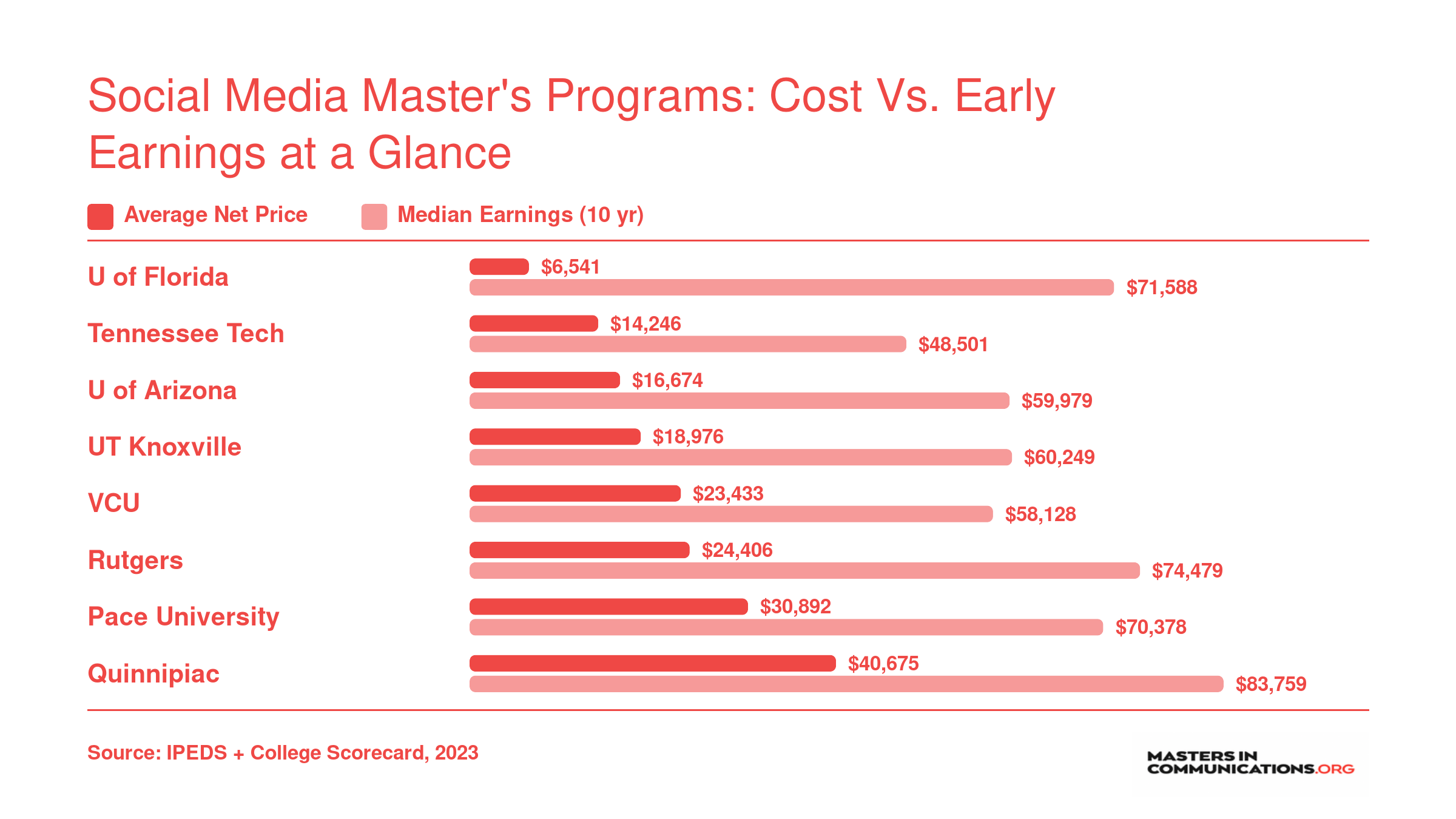
Social Media Master's Programs: Cost vs. Early Earnings at a Glance
Program-level earnings data for these social media master's degrees are not yet published by the College Scorecard, so the chart below uses each institution's median earnings ten years after enrollment (all programs combined) alongside the average net price. This gives you a useful proxy for how far your investment dollar stretches at each school. The University of Florida stands out with the lowest net price and a strong earnings figure, while Quinnipiac carries a higher sticker cost but also reports the highest median earnings of the group.
Choosing the Right Online Social Media Master's Program
Not every master's program is built the same way, and a degree in social media marketing or management is a real investment of time and money. Taking a systematic approach to your search saves you from enrolling somewhere that does not fit your career goals or schedule.
Verify Accreditation First
Accreditation is the single most important quality signal for any graduate program. For social media and digital marketing master's programs, three accreditation types matter most:
- Regional accreditation: The baseline credential recognized by employers and other universities. Check that the institution itself holds regional accreditation.
- AACSB: The gold standard for business schools. If a program sits inside a college of business, look for AACSB recognition at aacsb.edu.
- ACEJMC: The benchmark for journalism and mass communication programs. Verify standing at acejmc.org.
Never take a program's own marketing copy at face value. Cross-reference the accreditor's official directory to confirm current status before you apply.
Understand Credit Requirements and Timeline
Most online social media master's programs run between 30 and 36 credit hours. At a full-time pace, that typically translates to one to two years of study. Part-time options can stretch the timeline further, which matters if you are working while enrolled.
The U.S. Department of Education's College Navigator lets you compare programs side by side on basic institutional data. For specifics on curriculum structure and sequencing, visit each program's own graduate pages directly, since credit loads and course schedules vary widely even within the same credit-hour range.
Know the Admissions Requirements Before You Apply
GPA minimums for graduate admission typically sit at 3.0 on a 4.0 scale, though some programs set the bar slightly higher for competitive cohorts. On the test-score front, many online programs now offer GRE waivers, particularly for applicants with relevant professional experience. Check the university's graduate admissions page for each school, because waiver policies are program-specific and change from cycle to cycle.
If you want a broader starting point, professional associations like the American Marketing Association and PRSA maintain program directories with search filters that can help you build an initial list. You might also explore related fields such as online masters in communication management, which share significant curriculum overlap with social media programs. From there, contact admissions offices directly for the details that matter most to your situation: cohort size, transfer credit policies, and whether synchronous attendance is required.
For career outlook context, BLS.gov offers solid data on roles that typically require graduate-level education in marketing and communications. Reviewing careers with a masters in communication can also help you pressure-test whether the investment lines up with your target role.
Questions to Ask Yourself
What You'll Study in a Social Media Master's Program
Social media master's curricula have shifted dramatically since 2024, and the programs producing the strongest graduates in 2026 organize coursework around three distinct tracks that often overlap within a single degree plan.
Analytics and Data Science
If you gravitate toward numbers, expect heavy exposure to Google Analytics 4, Tableau, and social listening platforms like Brandwatch. Courses in social media metrics and evaluation teach you to move beyond vanity metrics (likes, shares) and build dashboards that tie platform activity to business outcomes. GA4's built-in AI features and Tableau's Explain Data function are now standard teaching tools, reflecting how the industry itself has embedded machine learning into everyday reporting. The University of Florida's MA in Mass Communication, Social Media concentration, for example, includes a dedicated course on Social Media Metrics and Evaluation alongside Research Methods in Digital Communication.2
Creative Content and Production
Programs on the creative side emphasize content strategy, video production, UX writing, and visual storytelling. You will likely work inside Adobe Creative Cloud, Canva, and generative AI content tools such as Jasper and ChatGPT to prototype campaigns and refine brand voice. Quinnipiac University's MS in Digital Content Creation and Strategy is a good example: its core skill areas span web design and production, digital audio/video/graphics, and UX/UI, all built around a practice-based portfolio that students present at graduation.3
Strategic and Managerial Coursework
The third track centers on brand management, crisis communication, and campaign ROI. Here you will encounter Meta Business Suite, Hootsuite, and Sprout Social for scheduling and community management, along with marketing automation platforms like HubSpot and Salesforce Marketing Cloud for lead nurturing and audience segmentation. Northwestern's Medill IMC program and the University of Kansas DIMC program both culminate in client-based campaigns that mirror real agency workflows, requiring students to pitch strategy, execute across channels, and report measurable results.45
AI and Automation: The Newest Curriculum Layer
Perhaps the most notable shift from even two years ago is the integration of AI and automation coursework into nearly every track. Programs now dedicate modules to prompt engineering for content creation, AI-powered social listening through tools like Sprout Social's sentiment analysis, and predictive analytics via GA4 AI and Gemini. Keeping up with these latest trends in communication is essential, because these topics are no longer elective add-ons; they appear in core syllabi across analytics, creative, and strategy concentrations alike.
Capstones Vary Widely, So Check the Details
One area where programs diverge significantly is the capstone requirement. Some degrees, like Florida's, require a client or simulated-client campaign.2 Others, like Quinnipiac's, ask for a portfolio of creative work. A smaller number still offer a traditional research thesis. Before you apply, pull up course descriptions or sample syllabi and look specifically at what the capstone demands. A client-based campaign sharpens consulting and presentation skills; a portfolio showcases production ability; a thesis suits candidates eyeing doctoral work or research roles. The right fit depends entirely on where you want your career to go next.
Career Outcomes and Salary Expectations for Social Media Master's Graduates
The social media field has matured from a single-channel coordinator role into a layered career ladder spanning content strategy, paid media, analytics, and brand leadership, and that maturity is showing up in graduate earnings data. Programs in this ranking report median earnings (ten years after entry) ranging from roughly $54,000 at Sam Houston State University to nearly $84,000 at Quinnipiac University, with the University of Florida's mass communication program reporting about $71,600. Those figures cover all graduates of the broader institution or program category, not social media specialists alone, but they offer a useful floor for what mid-career alumni tend to earn.
What Graduates Earn Early and Mid-Career
Entry-level pay is more modest. Industry salary surveys put social media specialist roles in the $51,000 to $55,000 range for 2025-2026, which aligns with what most graduates can expect in their first post-degree role.1 The jump from specialist to manager, director, or strategist is where the master's tends to pay off, and federal wage data backs that up:
- Public relations specialists (national): median annual wage of $69,780 in 2024, with the 75th percentile near $92,290 and the top 10% earning above $126,000. Projected growth is 5% through 2034, with about 27,600 openings per year.2
- Advertising, promotions, and marketing managers (national): projected 8% growth through 2033 and roughly 36,600 annual openings, a faster-than-average trajectory that absorbs many master's graduates moving into leadership.1
- Social media specialists: typical pay sits in the low-to-mid $50,000s nationally, with significant upside in tech, agency, and finance settings.1
Dedicated social media manager and digital strategist roles are not yet broken out as separate occupations by the Bureau of Labor Statistics, so the PR specialist and marketing manager categories remain the closest proxies for tracking the field.2
Common Job Titles and Hiring Industries
Graduates from these programs typically land roles as social media director, content strategist, digital marketing manager, brand strategist, community manager, or paid social lead. If you are still weighing pr or marketing, which master's degree best fits your goals, the good news is that social media programs draw from both disciplines. Hiring industries skew toward agencies, consumer brands, healthcare systems, higher education, nonprofits, professional sports, entertainment, and increasingly B2B technology firms building content engines.
Reading the Debt-to-Earnings Picture
Median graduate debt across the ranked programs sits between roughly $15,000 (University of Florida) and $26,000 (Quinnipiac), well below the reported mid-career earnings at every school listed. The University of Florida posts the strongest debt-to-earnings ratio in the group, with Rutgers and Quinnipiac close behind. For working professionals weighing the investment, the math generally favors the degree, provided you target manager-track roles rather than staying in entry-level coordinator work.
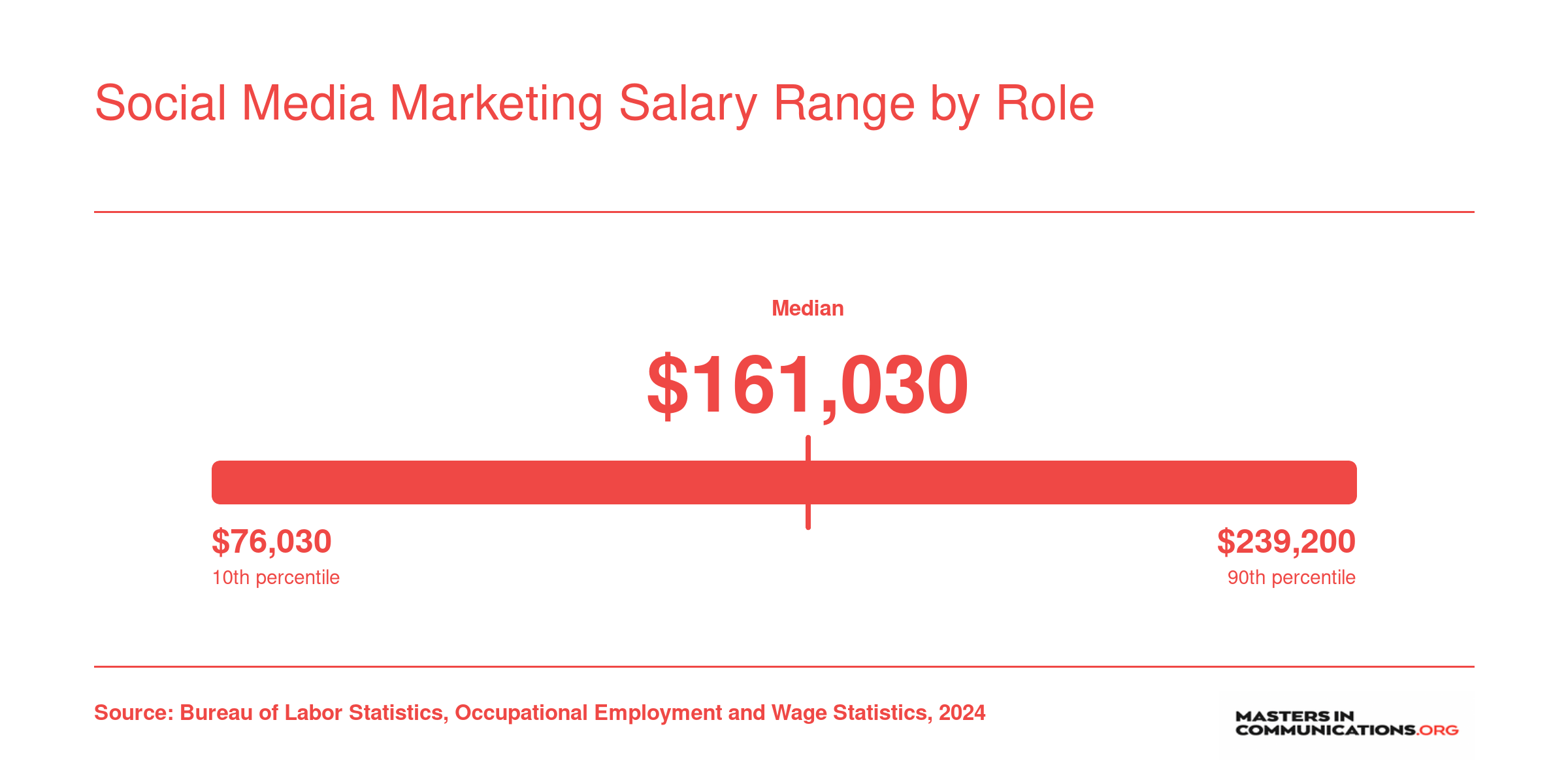
Social Media Marketing Salary Range by Role
Salary outcomes for social media master's graduates vary widely depending on the role you target. The BLS reports national median wages for marketing managers and advertising/promotions managers, two common destinations for graduates of these programs. Because BLS does not publish a separate occupation code for "digital strategist" or "social media manager," the advertising and promotions manager category serves as a useful proxy. The spread from the 10th to 90th percentile shows that experience, industry, and geography can shift your earning potential by six figures.
Master's Degree vs. Certificate in Social Media: Which Credential Is Right for You?
A four-month certificate and a two-year master's degree both promise to sharpen your social media expertise, but they serve very different career goals. Understanding where each credential excels, and where it falls short, helps you invest your time and tuition wisely.
How the Two Credentials Compare
- Time to complete: Certificate programs typically run one to five months, making them easy to fit around a full-time job.1 A master's degree requires 12 to 24 months of sustained coursework, research, and often a capstone or thesis project.2
- Typical cost: Certificates from providers like UT Arlington or eCornell generally fall in the $2,000 to $4,000 range.1 Master's programs range from roughly $20,000 to $70,000 depending on the institution, format, and residency status.2
- Depth of curriculum: Certificate coursework leans tactical: platform algorithms, content calendars, paid-ad optimization, analytics dashboards. A master's curriculum layers on strategic and analytical depth, covering consumer behavior research, brand management theory, crisis communication, and data-driven decision-making at the organizational level.
- Career advancement potential: Certificates can unlock entry-level to mid-level roles or help a current practitioner add a specific skill set quickly. A master's degree positions graduates for senior management, director-level, or VP-track positions where strategic oversight matters more than day-to-day execution.
- Employer perception: Hiring managers generally view certificates as evidence of initiative and current technical fluency. A master's degree signals broader leadership readiness and the ability to synthesize research, which tends to carry more weight in competitive applicant pools for senior roles.
- Salary premium: While precise salary premiums vary by industry and employer, BLS and industry survey data consistently show that professionals holding a master's degree in marketing-related fields earn more over the course of their careers than those with only a bachelor's or a standalone certificate. The gap tends to widen at the director level and above.
Who Benefits Most from a Certificate
If you are testing the waters of social media marketing, pivoting from an unrelated field, or simply need to close a specific skills gap, a certificate offers a low-risk entry point. It lets you build a portfolio, earn a recognized credential, and decide whether deeper study is worth pursuing, all within a single semester and at a fraction of the cost.
Who Should Pursue a Master's Degree
Professionals aiming for director-level strategy roles, those who want to lead cross-functional teams, or anyone considering an eventual move into academia or consulting will find the master's degree far more valuable. The extended curriculum builds the analytical frameworks and leadership competencies that certificates simply do not have time to cover. If you are weighing the broader pros and cons, our look at drawbacks and reasons not to study a master's in communication offers a candid breakdown.
The Bottom Line
Think of a certificate as a tactical upgrade and a master's as a career-trajectory shift. If your goal is to execute campaigns more effectively right now, a certificate delivers fast ROI. If you are building toward a seat at the leadership table, or if you want the academic depth to shape brand strategy rather than just implement it, the master's degree is the stronger long-term investment.
Advantages of Earning Your Social Media Master's Online
For most working professionals, the real question isn't online versus on-campus. It's whether you can earn the credential without stepping away from the paycheck and momentum you've already built. Online programs answer that question directly, and the format has matured enough that the old tradeoffs (weaker networking, lower prestige) no longer hold the way they once did.
Flexibility That Fits Around a Full-Time Job
Most online social media master's programs run asynchronously, meaning lectures, readings, and discussion boards are available on your schedule. Programs that include live sessions typically hold them in the evening or on weekends. Graduates routinely report finishing their degree without taking leave from work, and many use current campaigns at their job as the basis for course projects, turning weekly assignments into portfolio pieces.
Real Cost Savings
Online enrollment strips out the line items that inflate a campus degree: relocation, on-campus housing, parking, and most facility fees. A meaningful number of online programs also charge a single tuition rate to all students regardless of residency, so you aren't penalized for living out of state. Across the programs covered in this guide, total tuition generally lands between roughly $15,000 and $45,000, with most clustering in the $20,000 to $30,000 range.
A Credential Multiplier, Not a Reset Button
Think of the degree as something that compounds on top of the experience you already have. It rarely replaces the grind of entry-level roles, but it does help mid-career marketers move into director, head-of-social, or strategy roles where employers expect formal training in analytics, brand management, and team leadership. For a broader look at where an advanced communication credential can take you, explore communications masters degree jobs.
Networking Has Caught Up
The fair objection to online learning used to be isolation. Today, most reputable programs build in virtual cohort projects, private Slack or Discord communities, alumni directories, and structured mentorship pairings with industry practitioners. The relationships look different from a campus quad, but they exist, and they tend to be national rather than regional, which is an advantage in a field where the best agencies and in-house teams are distributed everywhere.
Frequently Asked Questions About Social Media Master's Programs
Below are answers to the questions prospective students ask most often about online master's programs in social media marketing and management. Where possible, we have included specific program data from the 2025 to 2026 catalog year.
- Is a master's degree in social media marketing worth it?
- For working professionals aiming at senior or director-level roles, a master's delivers both strategic depth and a credential that sets you apart from candidates with only a bachelor's degree. Graduates typically qualify for higher-paying positions in social media strategy, brand management, and digital analytics. The investment makes the most sense when you can apply coursework to real projects at work while you study.
- What can you do with a master's in social media management?
- Common career paths include social media director, digital marketing manager, brand strategist, content marketing lead, community engagement manager, and analytics consultant. Many graduates also move into adjacent roles such as public relations director, UX researcher, or chief communications officer. The strategic and data-driven coursework positions you for leadership rather than entry-level execution.
- How long does it take to get a master's in social media marketing online?
- Timelines vary, but most programs require 30 to 36 credits and take 10 to 24 months to complete. Arkansas State's MS in Strategic Communications can be finished in as few as 10 months. The University of Florida's online MA in Mass Communication takes roughly 15 months, while Fitchburg State's MS in Applied Communication follows a 24-month track. Accelerated pacing is common for students who enroll full time.
- How much does an online master's in social media cost?
- Total tuition depends on the institution, residency status, and credit load. Programs typically range from 30 to 36 credits. Per-credit rates vary widely, from under $400 at some public universities to more than $2,000 at private institutions. Always check whether the school charges a flat online rate regardless of residency, and factor in fees, technology charges, and any required campus visits.
- What is the difference between a social media certificate and a master's degree?
- A certificate usually covers a narrower set of skills in 12 to 18 credits and can be completed in a few months. A master's degree requires 30 to 36 credits, includes research methods and strategy courses, and results in a graduate-level credential recognized across industries. Certificates can boost tactical skills quickly, but a master's carries more weight for promotions, salary negotiations, and leadership roles.
- Do I need work experience to apply to a social media master's program?
- Most online social media master's programs do not require professional experience for admission. Programs at schools like Arkansas State, Fitchburg State, ASU, and USC Annenberg focus on GPA thresholds and application materials instead. Arkansas State asks for a minimum 2.5 GPA, while Fitchburg State requires a 3.0. Pace University does ask for a portfolio, which can benefit applicants with prior work, but formal employment requirements are uncommon.
- What are the best online master's programs for social media marketing?
- Standout options in 2026 include USC Annenberg's MS in Digital Social Media, Arizona State's MS in Digital Audience Strategy (33 credits), the University of Florida's online MA in Mass Communication with a social media concentration, and Pace University's MA in Communications and Digital Media. mastersincommunications.org maintains a ranked list that weighs factors like tuition, early earnings, and program flexibility to help you compare.
More Online Social Media Master's Programs to Consider
Beyond our top-ranked programs, these additional schools offer excellent online master's degrees in social media marketing and management. Each program provides unique strengths in curriculum, flexibility, or cost.