
In Brief
- UAF's 33-credit MA in Professional Communication is Alaska's only in-state graduate communication degree.
- Online and on-campus formats at UAF share identical tuition rates, with assistantships covering up to full tuition.
- Alaska median wages for several communication roles exceed national figures, notably public relations and media positions.
- Dozens of regionally accredited online programs from Lower 48 schools compete with UAF on cost and specialization options.
Alaska has exactly one in-state option for a master's in communication: the University of Alaska Fairbanks MA in Professional Communication. UAA does not offer a graduate degree in this field, so residents weighing local programs against out-of-state alternatives face a straightforward comparison.
UAF's 33-credit curriculum blends strategic communication with Alaska-specific content, and the program runs fully online or on campus at identical tuition rates. Graduate assistantships can offset costs significantly for those who qualify.
Communication skills translate directly into roles across state government, tribal health systems, natural resource agencies, and regional healthcare networks. Alaska median salaries for public relations specialists and media and communication workers exceed national figures, making this credential a practical investment for professionals rooted in the state.
Best Master's in Communication Programs in Alaska
Alaska offers a single in-state graduate communication program, so the value proposition here comes down to cost, delivery format, and outcomes rather than a head-to-head comparison. Because the University of Alaska Anchorage's only communication-adjacent master's is in Communication Sciences and Disorders (a clinical speech-pathology track), students seeking a broader professional communication degree will want to weigh this option carefully against online programs from outside the state. Below, we break down UAA's program on the metrics that matter most to working Alaskans: affordability, flexibility, and post-graduation earnings.
- Net price and tuition affordability
- Program delivery format flexibility
- Institution-level graduation outcomes
- Graduate earnings and debt metrics
- Student-to-faculty ratio
- Internal program database
- College Scorecard graduate earnings — collegescorecard.ed.gov
- NCES-IPEDS federal institutional data — nces.ed.gov
- Independent program research
University of Alaska Anchorage
#1Anchorage, AK · $15,000/yr
Best for: Alaska clinicians pursuing speech-language pathology
The University of Alaska Anchorage is a public research institution in the state's largest city, serving a diverse student body with a student-to-faculty ratio of 11:1 and a notably high share of Pell Grant recipients (about 68%). Its average net price of roughly $15,300 and median graduate debt near $20,200 position it as a relatively affordable option, while institution-wide median earnings reach approximately $51,900 ten years after enrollment. The institution-level graduation rate of about 30% reflects UAA's open-access mission and part-time student population, so it should not be read as a direct indicator of graduate-program completion.
- Hybrid format blending online coursework with Alaska-based clinical hours
- Three-year, full-time program that includes summer sessions
- Partnership with East Carolina University for graduate coursework
- Leads to eligibility for ASHA certification upon completion
- Requires bachelor's degree with minimum 3.0 cumulative GPA
- Prerequisite coursework must carry a 3.2 GPA or higher
- Competitive admission includes GRE scores, interview, and Casper test
- 25 documented observation hours required before enrollment
UAF MA in Professional Communication: Curriculum, Credits & Concentrations
The University of Alaska Fairbanks offers the only in-state graduate program in communication, and its MA in Professional Communication is built around a focused, 33-credit curriculum.1 The program reflects UAF's distinctive location and institutional strengths, weaving in themes tied to science communication, environmental issues, Indigenous communities, and Arctic contexts.2 That regional perspective gives the degree a character you won't find in generic communication programs elsewhere.
Core Coursework
The foundation rests on six core seminars (COM F603, COM F622, COM F625, COM F631, COM F645, and COM F680) covering areas such as communication theory, ethics, organizational communication, and applied professional skills.1 Alongside those, students complete a research methods requirement by choosing either COM F601 or COM F602, depending on their background and interests. Together, the core and methods courses establish both conceptual grounding and practical research competence before students move into electives and their culminating project. If organizational communication resonates with your career goals, you may also want to explore masters in organizational communication programs that offer online flexibility.
Electives and Emphasis Areas
Students have room to shape the degree around their professional goals. Elective options include courses in public relations theory and practice, communication in health contexts, training and development communication, and seminar topics that rotate based on faculty expertise and current issues.1 This flexibility means someone entering the program with a healthcare background can orient coursework differently than a colleague coming from a corporate communication role. The program does not formally label these as named concentrations, but the elective structure achieves a similar effect.
Thesis vs. Non-Thesis Path
Graduates choose between two culminating options. The thesis route (COM F699, carrying 6 credits) suits students interested in original research or who may consider doctoral study later.1 The non-thesis option (COM F698) involves a substantial research project or professional portfolio and tends to appeal to practitioners who want rigorous academic training without committing to a full research thesis. Both paths include a comprehensive examination completed no later than the fourth semester, which keeps students on a structured timeline.
How Long It Takes
Full-time students typically finish in two years.1 Part-time completion will extend that timeline, so students juggling work obligations in Alaska's professional landscape should plan accordingly and discuss pacing with their advisor early. The relatively compact 33-credit requirement makes the program manageable, but fieldwork, research design, and the culminating requirement all demand sustained attention across the final semesters.
Questions to Ask Yourself
Tuition, Costs & Financial Aid for Communication Graduates at UAF
Graduate tuition at public universities has been creeping upward nationwide, which makes funding packages like the one UAF offers its communication MA students worth understanding before you apply.
In-State vs Out-of-State Tuition
UAF charges different tuition rates depending on whether you qualify as an Alaska resident. For graduate students, establishing Alaska residency generally requires living in the state with the intent to remain, typically for at least one year before enrollment. If you are moving to Fairbanks specifically to attend UAF, plan on paying out-of-state rates for your first year unless you meet residency criteria through other means (such as military assignment or prior Alaska employment).
As a reference point, UAF's published graduate tuition for 2025, 2026 sits at several thousand dollars less per year for in-state students compared to out-of-state rates, though exact figures are updated annually and should be confirmed directly with the UAF Admissions and Registrar offices.1 There is no separate reduced tuition tier for online-only students, and UAF's MA in Professional Communication does not participate in the Western Regional Graduate Program (WRGP), so out-of-region students cannot access the reduced rate that program provides.2
Teaching Assistantships: The Most Valuable Funding Path
For eligible students, a teaching assistantship is the clearest route to substantially cutting your cost of attendance. UAF's communication MA program offers TA positions that come with a full tuition waiver, health insurance coverage, and an hourly rate of $25.17 (2025-2026 academic year).3 That combination can eliminate the bulk of direct program costs for students who secure a position.
TA slots are competitive and not guaranteed with admission. Students interested in assistantship funding should signal that interest clearly in their application materials and follow up directly with the department. Seniors enrolled in UAF's accelerated BA/MA track are also eligible for TA consideration, which is worth knowing if you are still completing your undergraduate degree at UAF.5
Net Price and Debt Context
Program-specific earnings and debt outcomes for UAF's MA in Professional Communication are not separately reported in federal data at this time. For general institutional context, the net price figure for UAF reflects average costs after institutional and federal aid, but individual graduate costs vary considerably based on residency status, credits taken, and whether you receive assistantship support.
If you are weighing UAF against fully online alternatives, our guide to the best online master's in communication programs can help you compare costs and formats side by side. Within this program, though, securing a TA position before or shortly after enrollment is the single highest-leverage financial move available.
Related Articles
Online vs On-Campus at UAF: Cost, Flexibility & Outcomes Compared
Both the online and on-campus versions of UAF's Master of Arts in Professional Communication carry the same base graduate tuition, determined solely by your residency status, not by the delivery format you choose.1 That parity extends to every meaningful dimension of the program: identical core courses, identical electives, and the same thesis or project capstone requirement.2 Your diploma and transcript make no distinction between the two paths.
Tuition and Fees
Because UAF charges the same per-credit rate regardless of delivery mode, the total cost difference between online and on-campus comes down to indirect expenses.1 On-campus students should budget for housing, meal plans, parking, and transportation in Fairbanks. Online students avoid those costs entirely but may encounter technology fees or proctoring charges for certain assessments. Either way, Alaska residents pay the same resident rate, and out-of-state students pay the same nonresident rate, whether they log in from Juneau or sit in a Fairbanks classroom.
Flexibility and Program Length
Online delivery is fully virtual with no on-campus residency or intensive weekends required for domestic students. That makes it a practical lifeline for professionals living in rural or remote communities across the state, where driving to Fairbanks is not a weekend errand but a multi-day commitment. Students in both formats typically complete the degree in roughly the same timeframe, though online learners often find it easier to maintain full-time employment while progressing through coursework at a steady pace.
Faculty Access and Networking
The same faculty teach across both formats, so academic mentorship does not change based on how you attend. On-campus students do gain informal hallway interactions and easier access to campus events, guest speakers, and study groups. Online students can offset that gap through virtual office hours, discussion boards, and professional organizations. Alaska's communication industry is tight-knit enough that building connections through practicum placements or capstone projects can matter just as much as classroom networking, regardless of format. If you are weighing UAF's program against other fully virtual options, our guide to the best online master's in communication programs 2026 can help you benchmark cost and curriculum.
Quick Comparison
- Tuition: Same base rate for both formats; residency status is the only variable.
- Curriculum: Identical courses, electives, and capstone options.
- Credential: One degree title on the transcript, no format designation.
- Residency requirement: None for online domestic students; traditional attendance for on-campus.
- Best fit: On-campus suits Fairbanks-area students who value face-to-face interaction. Online suits remote residents, working professionals, and anyone balancing career obligations.
For most working adults in Alaska, particularly those outside the Fairbanks metro area, the online format removes the single biggest barrier to earning this credential without sacrificing academic rigor or employer recognition.
Admissions Requirements & How to Apply to UAF's Communication MA
UAF's M.A. in Professional Communication is designed to be accessible for working adults, and the admissions process reflects that. There is no entrance exam to prep for, no obscure prerequisite sequence to clear, and the program accepts students across multiple entry points each year.
What You Need to Apply
The application package is straightforward. You will submit:
- Official transcripts: UAF requires transcripts from every college or university you have attended.
- Resume or CV: A current professional resume that documents your work history and relevant experience.
- Statement of academic goals: Your chance to explain why you are pursuing this degree, what you hope to study, and how the program fits your professional trajectory. Treat this seriously; a focused, specific statement carries real weight.
- Two letters of recommendation: References who can speak to your academic ability, professional competence, or both.
- Academic writing sample: A paper or report from prior coursework that demonstrates your analytical writing skills. If you have been out of school for a while, a substantial professional report or white paper may also work; check directly with the program to confirm what qualifies.
GRE Policy
The GRE is not required and is not considered in admissions decisions.1 This reflects a broader shift at UAF and many peer programs nationwide, where entrance exam requirements have been dropped in recognition that standardized test scores are a weak predictor of graduate-level success. You do not need to register for or take the exam. If you are exploring other programs with the same policy, you can browse a wider list of online masters in communication no GRE.
GPA Minimum
UAF sets a minimum undergraduate GPA of 3.0 for admission to the M.A. in Professional Communication.1 If your GPA falls just below that threshold, it is worth contacting the Graduate School directly; programs sometimes consider applicants holistically when other materials are strong.
Application Deadlines and Start Terms
UAF uses a rolling admissions review, meaning applications are evaluated as they come in rather than in a single competitive pool after a hard deadline.1 This takes some pressure off the calendar, but earlier applications generally receive earlier decisions and give you more time to arrange funding.
The program admits students for fall, spring, and summer terms, which is a genuine advantage over programs that lock you into a September start. If your circumstances make a January or summer entry more practical, that option is available.
What Communication Professionals Earn in Alaska
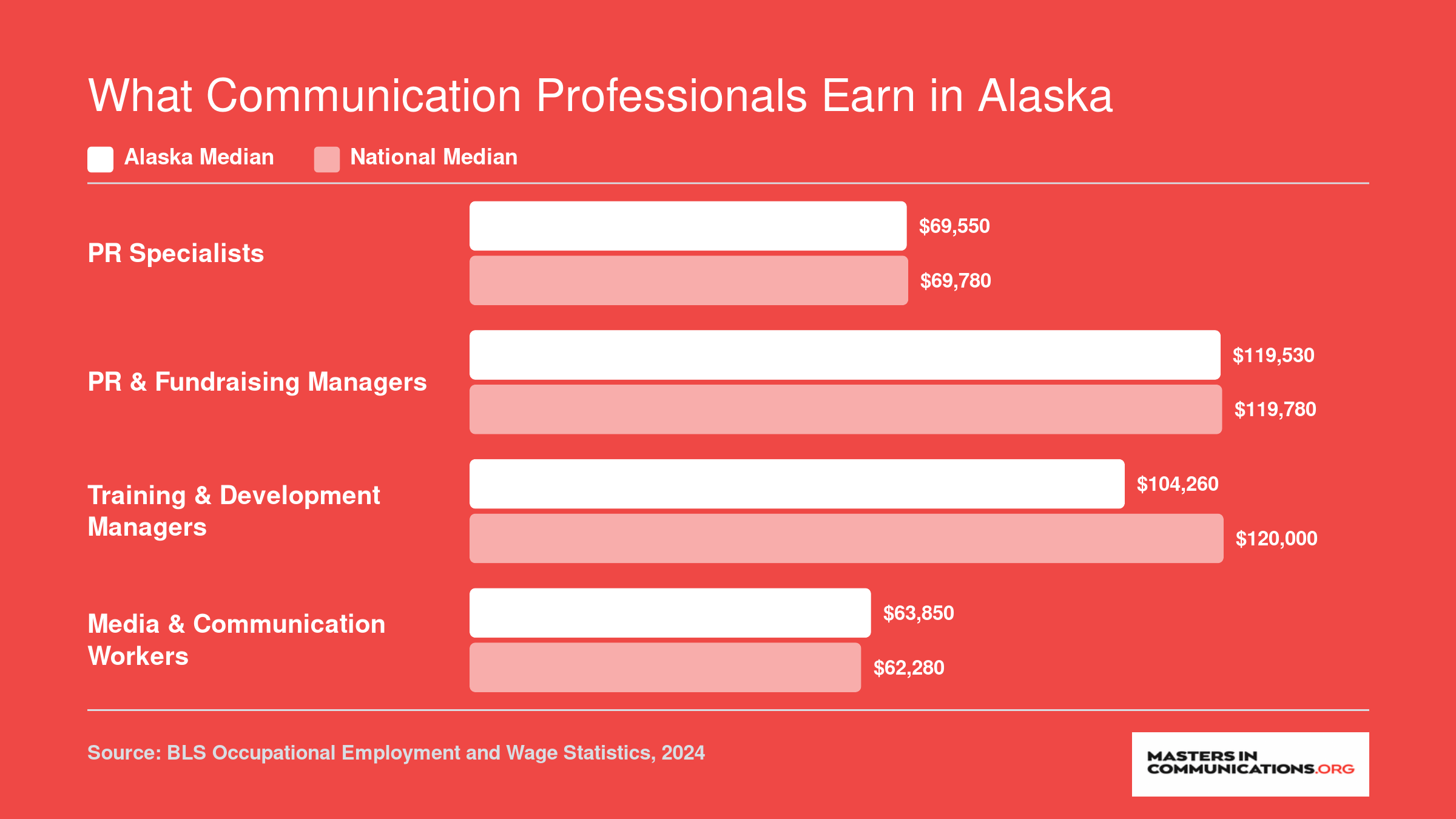
Alaska's communication salaries hold up well against national benchmarks, and for several roles they exceed the U.S. median. The chart below compares 2024 Alaska median wages with national figures for four communication-related occupations. When you weigh these earnings against UAF's in-state tuition costs, the ROI picture becomes clearer: even the entry-level PR specialist role pays nearly $70,000, while management tracks push well past six figures.
Career Paths With a Master's in Communication in Alaska
Alaska's communication job market blends steady institutional roles with frontier opportunities that require a distinct skill set. Whether you're eyeing public information positions in state government, crafting outreach for tribal health systems, or handling crisis messaging for remote communities, a master's in communication positions you to lead where geographic and cultural challenges demand clarity. For a broader look at what the degree can unlock, explore careers with a masters in communication across industries and salary levels.
Where to Look for Alaska-Focused Communication Jobs
The Alaska Department of Labor and Workforce Development (labor.alaska.gov) is your first stop for real-time job postings and employment projections. Filter by occupation to see demand for public relations specialists, technical writers, and media professionals. The site also publishes wage data specific to Alaska, so you can compare what communicators earn in different industries without relying on national averages that fail to capture local premiums.
- State government and oil: The state's largest employers, including the State of Alaska and major oil companies, regularly seek communication directors, public affairs officers, and community liaison roles. These positions often offer stability and competitive benefits.
- Healthcare and tribal organizations: Alaska's unique healthcare infrastructure, including the Alaska Native Tribal Health Consortium, needs skilled communicators to bridge cultural and linguistic gaps. Jobs in health communication, patient education, and digital outreach are growing.
- Remote and rural contexts: Crisis communication for isolated communities, emergency alert systems design, and messaging for subsistence-based populations are niches where local knowledge amplified by advanced communication training sets you apart.
What Occupational Outlook Data Tells You
The Bureau of Labor Statistics (BLS.gov) provides Alaska-specific projections for communication roles. When visiting the site, filter to "Alaska" for accurate growth trends rather than the national picture. Current data indicates steady demand for public relations specialists and writers, with media and communication occupations projected to grow at a pace aligned with the state's slow but stable population trends. Major industry employers include state agencies, federal contractors, and the burgeoning telehealth sector.
- Wage premiums: BLS data for Alaska often reflects a higher cost-of-living adjustment, meaning salaries for PR specialists and technical writers exceed the national median. Be sure to check the most recent statewide estimates, as the BLS national median for marriage and family therapists, for instance, is not the same as Alaska's median; a similar nuance applies to communication roles.
Leveraging UAF's Alumni Network and Career Services
The University of Alaska Fairbanks (UAF) career services office and alumni network are underutilized resources. They can connect you with graduates working in niche communication fields: crisis response for avalanches or wildfires, digital storytelling for tribal corporations, or public affairs for the military bases. Reach out to the communication department directly for introductions, or attend virtual career panels that often feature alumni from uniquely Alaskan sectors.
- Remote/rural specialization: Alaska's geographic isolation creates demand for communication strategies that other states rarely encounter. Alumni have built careers developing satellite internet outreach programs, managing public health campaigns in villages accessible only by plane, or running radio networks that serve as lifelines.
Professional Associations Worth Joining
The Alaska Press Club and the PRSA Alaska chapter offer job boards, salary surveys, and networking events tailored to the state's communication landscape. If you're interested in masters in public relations, these professional chapters can help you translate that credential into Alaska-specific opportunities. These organizations regularly publish industry reports that highlight emerging roles, such as social media managers for eco-tourism or communication leads for maritime corporations. Membership can give you access to postings before they hit public boards and to mentors who understand the Alaska-specific challenges and rewards of the profession.
Alaska vs Out-of-State Online Programs: How to Decide
Staying with UAF versus enrolling in a nationally recognized online program: both paths lead to a master's in communication, but the right choice depends heavily on where you plan to work and what you want to specialize in.
The Case for UAF
For Alaskans who plan to stay in-state, UAF's MA in Professional Communication has real structural advantages. In-state tuition keeps costs manageable, graduate assistantships are available to on-campus students, and faculty connections reach into Alaska's media, government, and nonprofit sectors. Local employers recognize the degree, and those relationships can matter when you are job-hunting in a small professional community. UAF is also a participant in the Western Regional Graduate Program (WRGP), which can allow residents of certain neighboring Western states to enroll at reduced tuition rates.
The Case for an Out-of-State Online Program
Alaska participates in the National Council for State Authorization Reciprocity Agreements (NC-SARA), which means Alaska residents can legally enroll in online programs from any SARA-member institution across the country without those schools needing a separate Alaska authorization.2 That opens the door to programs with broader specialization tracks, larger alumni networks, and in some cases lower total costs.
A few well-regarded options worth comparing:
- University of Florida MA in Communication: Total program cost around $12,115, making it one of the most affordable accredited options available to Alaska students.
- Southern New Hampshire University MS in Communication: Total program cost approximately $15,288, with flexible pacing suited to working professionals.
- Arizona State University MA in Communication: Total program cost around $18,654, with multiple specialization tracks backed by a large research university infrastructure.
- Northwestern University MS in Communication: A premium option at roughly $76,516 total, oriented toward students seeking a flagship brand name for competitive markets.
How to Choose
If your career is rooted in Alaska, UAF's local network and assistantship opportunities are difficult to replicate from afar. If you are open to relocating, or if you want a specialization UAF does not offer (such as masters in political communication or masters in technical communication), an out-of-state online program may deliver more value. Budget matters too: the gap between UAF's in-state rate and a program like Florida's or SNHU's is narrower than many applicants expect, so run the full cost comparison before assuming one is cheaper.
Frequently Asked Questions About Communication Master's Programs in Alaska
Choosing a graduate communication program in Alaska raises practical questions about cost, format, timeline, and career outcomes. Below are the most common questions prospective students ask, answered with specifics drawn from program and labor market data.
- Is a master's in communication worth it in Alaska?
- For many working professionals, yes. Alaska's small media and public affairs market rewards advanced credentials because competition for mid-level and senior roles is tight. A master's can qualify you for higher-paying positions in public relations, organizational communication, and government affairs. The degree also strengthens your candidacy if you plan to teach at the community college level or pivot into strategic communications consulting across remote communities.
- How much does a master's in communication cost at UAF?
- UAF's MA in Professional Communication typically runs 30 credits. In-state graduate tuition at UAF is roughly $509 per credit, placing the total tuition estimate near $15,270 before fees. Out-of-state students pay significantly more per credit. Campus fees, textbooks, and living expenses in Fairbanks add to the bottom line. Financial aid options include graduate assistantships, UA Foundation scholarships, and federal student loans.
- Does UAF offer an online master's in communication?
- UAF delivers several courses through distance learning, but the MA in Professional Communication is primarily structured as an on-campus program in Fairbanks. Some elective and core courses may be available in online or hybrid formats depending on the semester. Students who need full online flexibility should also explore accredited out-of-state programs that accept Alaska residents, many of which charge competitive flat-rate tuition.
- What are the admissions requirements for UAF's MA in Professional Communication?
- Applicants generally need a bachelor's degree with a minimum 3.0 GPA, official transcripts, a statement of purpose, a writing sample demonstrating analytical ability, and two or three letters of recommendation. GRE scores may be requested but are not always required. Professional experience in communication fields can strengthen an application, and the department may admit students conditionally if one criterion is borderline.
- How long does it take to complete a master's in communication in Alaska?
- Most full-time students finish UAF's 30-credit MA in about two years. Part-time students, common among working professionals in Alaska, may need three years. A thesis track can extend the timeline if research and committee scheduling take additional semesters. Summer coursework, where available, can help accelerate completion by a semester.
- Does UAA offer a master's in communication?
- The University of Alaska Anchorage does not currently offer a standalone master's degree in communication. UAA has undergraduate communication programs, but graduate-level study in this field within the UA system is housed at UAF. Anchorage-based students sometimes commute for intensive sessions or combine distance courses from UAF with local professional development, though a fully online out-of-state program may be more convenient.
- What can you do with a master's in communication in Alaska?
- Graduates pursue roles such as public relations manager, corporate communications director, government public information officer, nonprofit communications strategist, and higher education instructor. Alaska's state agencies, tribal organizations, healthcare systems, and energy companies all employ communication specialists. The degree also positions you for freelance consulting, which is common in a state where organizations in smaller communities often contract communication work rather than hiring full-time staff.