

What you’ll learn in this article…
- The University of Maine is the sole in-state institution offering communication master's degrees in 2026.
- In-state tuition runs $573 per credit, while out-of-state students pay $1,747 per credit.
- Public relations specialists in Maine earn a median annual wage of $52,420 according to BLS data.
- Graduates carry roughly $25,000 in median debt yet earn $48,653 within ten years, producing a 1.95 ROI ratio.
Why does Maine offer only one graduate degree in communication, and what does that mean for your career trajectory? The University of Maine anchors the state's offerings with an M.A. in Communication Sciences and Disorders, a campus-based program that immerses students in clinical practice from the very first semester. With no fully online alternative, prospective speech-language pathologists in Maine must either attend in person or look out of state, a reality that elevates decisions about cost, relocation, and admissions competitiveness.
Best Master's in Communication Programs in Maine
Maine's graduate communication landscape is compact but purposeful. The University of Maine in Orono, the state's flagship public university, is the sole in-state institution offering master's-level communication degrees, and it does so across two distinct disciplinary tracks. Whether your interests lean toward communication theory, media studies, or clinical speech-language pathology, UMaine provides a focused, research-active environment with faculty strengths in risk communication, environmental communication, media psychology, and the rhetoric of health and medicine. Program-level earnings and debt figures are not yet available for these specific degrees, though institution-wide data offers useful context.
- Academic quality and faculty expertise
- Program format and flexibility
- Tuition and financial aid options
- Career preparation and outcomes
- Accreditation and licensure alignment
- NCES-IPEDS federal institutional data — nces.ed.gov
- College Scorecard graduate earnings — collegescorecard.ed.gov
- Internal program database
- Independent program research
University of Maine
#1Orono, ME · $18,000/yr (net price)
Best for: Maine residents seeking in-state graduate study
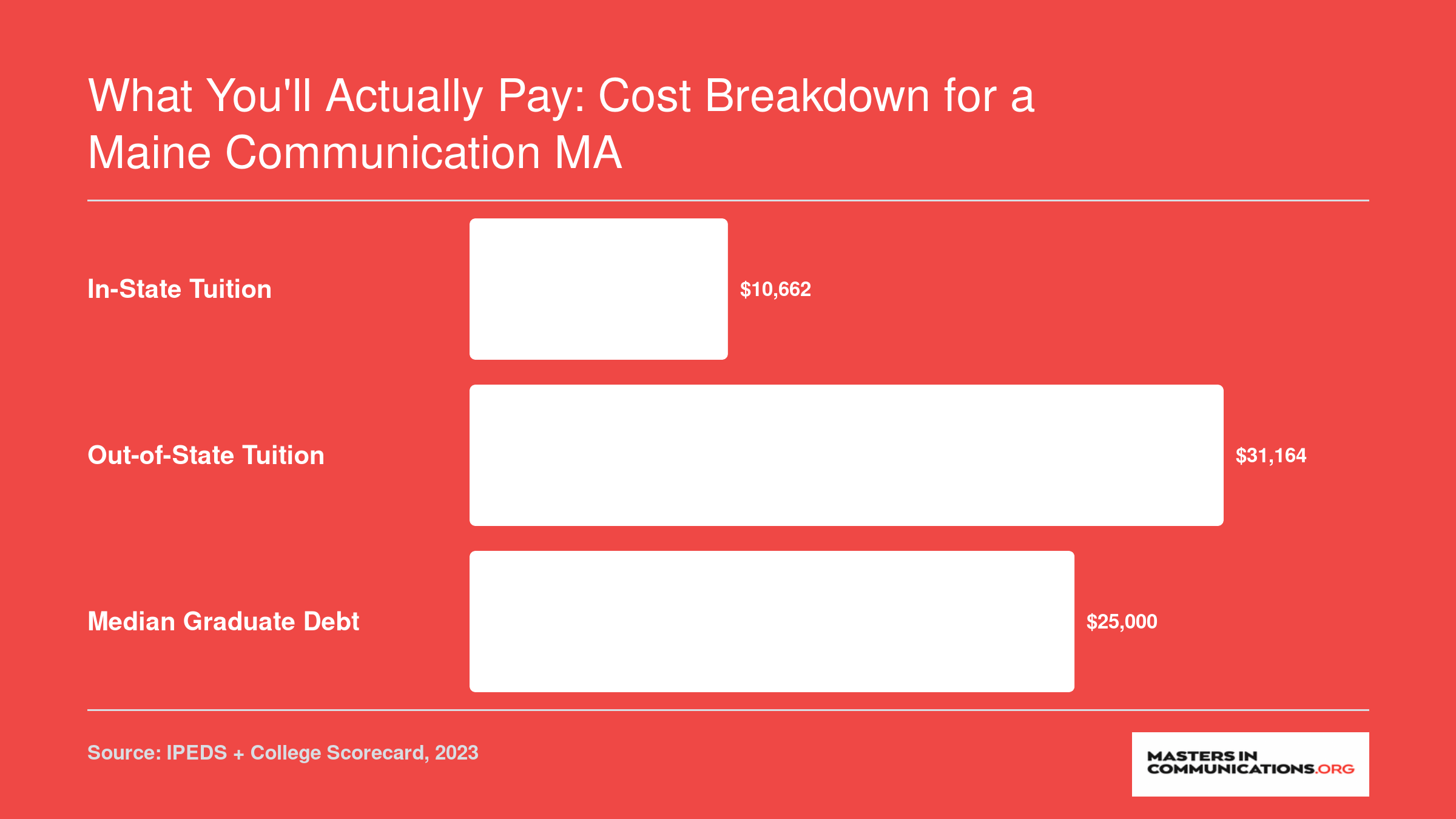
The University of Maine is the state's flagship public research institution and the only school in Maine offering master's degrees in communication. Recognized by the National Communication Association as one of the top M.A. programs in the Eastern United States, UMaine pairs small-state accessibility with faculty research that spans environmental communication, media psychology, and health rhetoric. The institution-wide graduation rate is 54.9% (note: this is an institution-wide figure and does not reflect the completion rate of any individual graduate program). In-state tuition runs approximately $10,662 per year, while out-of-state students pay around $31,164, and a New England tuition break is available for eligible regional applicants.
- On-campus program with fall-only admission
- Thesis or research paper option for degree completion
- No entrance exam required for admission
- Apply by January 15 for fall enrollment
- Prepares students for doctoral study or professional careers
- Faculty research in risk, environmental, and health communication
- Financial aid and scholarships available
- Full-time enrollment expected
- Focused concentration within the Communication M.A.
- On-campus format at the Orono campus
- Thesis or capstone option available
- No entrance exam required
- Apply by January 15; one start date per year
- Scholarships and financial aid accessible
- PhD pathway also offered in the department
- Two concentration options within the same degree
- Two-year, full-time on-campus program (18 courses)
- Clinical practicum experience begins in the first semester
- Thesis or non-thesis (capstone) tracks available
- Meets ASHA certification standards for SLP licensure
- The only speech-language pathology program in Maine
- NEBHE tuition break for New England residents
- Graduate assistantships with stipend offered
- Generalist preparation for clinical work in any setting
How Much Does a Master's in Communication Cost in Maine?
At the University of Maine, graduate communication coursework runs $573 per credit for Maine residents and $1,747 per credit for out-of-state students in the 2025, 2026 academic year, with an additional $28 per credit infrastructure and technology fee.1 Students from other New England states qualify for a reduced NEBHE tuition break rate of $1,003 per credit. Across a typical 30-credit master's program, those rates translate to roughly $18,000 in resident tuition or about $53,000 for non-resident students before fees, books, and living costs.
How Maine Stacks Up Against New England Neighbors
Maine's public graduate tuition sits at the lower end of the New England range, which is worth flagging because the region is not cheap. Comparable communication-adjacent master's programs at the University of New Hampshire, the University of Vermont, and UMass Amherst generally charge resident graduate rates in the $800 to $1,100 per credit band and out-of-state rates that often exceed $1,500 to $1,800 per credit. Exact figures shift each academic year and vary by program, so always confirm current rates directly with each school's graduate office. The regional pattern holds: UMaine's in-state rate is one of the more affordable public options in northern New England, and the NEBHE break makes it competitive for residents of Vermont, New Hampshire, Massachusetts, Connecticut, and Rhode Island who would otherwise pay full out-of-state tuition. If budget flexibility is a priority, you might also explore the best online master's in communication programs, which can expand your options beyond geographic constraints.
The Real Total Cost Picture
Sticker price is only part of the equation. Federal data for the University of Maine reports an average net price (after grants and scholarships) of roughly $17,500 per year for undergraduates, and graduate students typically rely more on loans than need-based aid. The median student debt at graduation across all UMaine programs sits near $25,000, with median earnings ten years after entry around $48,000. That context is useful for thinking about repayment, though graduate-specific figures for the communication M.A. are not separately published.
Budgeting Beyond Tuition
When you build your own cost estimate, plan for:
- Fees: The $28 per credit infrastructure fee plus any program or activity fees layered on top.
- Books and software: Typically $500 to $1,200 per year for communication coursework.
- Living expenses: Orono is affordable by New England standards, but budget realistically for housing if you relocate.
- Opportunity cost: Part-time enrollment stretches tuition over more years but lets you keep working.
What You'll Actually Pay: Cost Breakdown for a Maine Communication MA
Tuition at the University of Maine varies significantly depending on residency status. Here's a side-by-side look at annual tuition rates and median graduate debt to help you budget for a communication master's degree in Maine.
Admission Requirements for Maine Communication Master's Programs
The University of Maine's MA in Communication operates without a strict minimum GPA threshold for 2026, giving the admissions committee flexibility to evaluate each applicant holistically.1 The program has adopted a fully test-optional policy, requiring neither the GRE nor any other standardized exam for admission.2 If you are exploring other programs that share this approach, many online masters in communication no GRE options follow a similar trend. Applications for fall 2027 entry open on February 1, 2026, with a preferred deadline of January 15, 2027.3 While the program accepts applications on a rolling basis after mid-January, candidates seeking graduate assistantships or funding consideration should treat the January 15 date as firm, since assistantship decisions are made concurrently with priority admissions.2
Required Application Materials
Every applicant must submit three letters of recommendation, ideally from professors or supervisors who can speak to research ability, writing skill, and readiness for graduate-level communication scholarship.3 A personal statement is mandatory, typically addressing your academic interests, career goals, and how the UMaine program aligns with both. The program does not explicitly require a separate writing sample in its published checklist, though applicants with published articles, policy briefs, or substantial research papers may choose to upload them as supplementary materials.2 International applicants must provide TOEFL or IELTS scores if English is not their first language, with financial documentation due by July 15, 2026, for visa processing.3
Thesis Versus Non-Thesis Tracks
UMaine offers both a thesis track and a non-thesis research-paper option, allowing students to tailor the degree to professional or academic goals.2 The thesis route culminates in a supervised original research project and formal defense, suitable for those preparing for doctoral study or research-intensive roles. The non-thesis track substitutes a comprehensive research paper and exam, appealing to working professionals seeking applied expertise without the extended research commitment. Both paths require the same core coursework and total credit hours, so your choice hinges on career trajectory rather than program length.
Specializations and Prerequisites
The program lists Communication and Media Studies as its primary focus areas, though coursework integrates health communication, organizational communication, and digital media theory depending on faculty expertise and cohort interest.2 Applicants without an undergraduate communication degree face no formal prerequisite coursework requirement, but the admissions committee expects a demonstrated foundation in writing, critical analysis, or adjacent social science disciplines. Candidates from journalism, public relations, political science, or English backgrounds regularly gain admission and thrive. If your bachelor's degree lies outside these fields, use your personal statement to explain how your prior experience translates into communication research questions and to identify faculty whose work aligns with your interests.
Questions to Ask Yourself
Online vs. On-Campus Communication Master's Programs in Maine
Choosing between online and on-campus study is one of the most consequential decisions you will make as a prospective communication graduate student in Maine. The University of Maine's M.A. in Communication Sciences and Disorders is offered as a campus-based program in Orono, which means Maine residents currently have limited in-state, on-campus options. Several accredited universities outside Maine do offer fully online or hybrid communication master's degrees that can be completed from anywhere in the state, widening the field considerably.
Pros
- Online programs let working professionals study on their own schedule without relocating to Orono or adjusting commute logistics.
- Total cost for an online degree can be lower once you factor in eliminated housing, parking, and travel expenses.
- On-campus study at UMaine provides access to graduate assistantships, tuition waivers, and the New England tuition break for regional residents.
- Campus students benefit from direct faculty mentorship, research collaboration, and supervised clinical practicum starting in the first semester.
- Hybrid formats, where available through out-of-state schools, combine the scheduling flexibility of online coursework with periodic immersive residencies.
- On-campus cohorts often build stronger peer networks through daily interaction in seminars, labs, and campus organizations.
Cons
- UMaine's on-campus format requires a two-year, full-time commitment that may be difficult for professionals who cannot pause their careers.
- Fully online programs may not include graduate assistantship funding, leaving students to cover tuition entirely through loans or employer support.
- Remote learners can miss out on spontaneous mentorship and the collaborative research culture that an on-campus setting fosters.
- Out-of-state online programs may charge higher per-credit rates than Maine's in-state tuition, so always compare total program costs carefully.
Career Outcomes and Salary Potential with a Maine Communication MA
Public relations specialists in Maine earn a median annual wage of $52,420, according to 2023 Bureau of Labor Statistics data.1 This figure provides a solid earnings benchmark for entry- and mid-level communication roles in the state, though those who earn a master's degree and move into management can expect substantially higher pay.
In-Demand Roles for Communication Graduates
A communication master's degree unlocks a variety of career paths that reward strategic thinking, audience insight, and digital fluency. For a deeper look at the full landscape, explore careers with a masters in communication. Common titles for graduates include:
- PR Manager: Directs public relations strategy, media outreach, and crisis communication, often commanding a salary well above the state median for specialists.
- Corporate Communications Director: Leads enterprise-wide messaging, executive communications, and brand reputation efforts.
- Media Analyst: Uses data to evaluate coverage and campaign performance, a role that blends communication with market research skills.
- Digital Content Strategist: Shapes an organization's online voice through content planning, SEO-driven writing, and social media management.
- Higher Ed Communications Coordinator: Handles public relations and marketing for colleges, a stable niche especially relevant in Maine's higher education sector.
While Maine-specific BLS data is available only for public relations specialists, other communication-adjacent roles show strong earnings nationally.1 Market research analysts, for instance, earn a national median of $74,680. Broader categories like "media and communication workers" also indicate higher pay, though localized figures are often not reported separately for smaller states.
Earnings Potential and Program Data
The University of Maine grants an M.A. in Communication Sciences & Disorders, a specialized clinical degree. As of 2026, the College Scorecard has not released program-level earnings or employment data for this specific program, meaning median wages at one, two, or four years after graduation are not publicly available. However, national data for speech-language pathologists, the primary occupation for graduates of this program, shows median wages in the range of $80,000 to $90,000, with Maine's cost of living adjustments keeping salaries competitive.
For students interested in a broadly focused communication MA (not currently offered as a standalone program in the state), the BLS figures for public relations and market research roles provide a realistic foundation. Advanced degrees typically lead to positions with greater strategic responsibility and correspondingly higher salaries, especially for those who develop expertise in digital analytics or integrated marketing communication. Students exploring flexible options may want to consider a masters in public relations program available online.
Employment Outcomes and Poverty-Threshold Performance
Because recent federal data for UMaine's Communication Sciences & Disorders MA is not yet reported, employment shares and poverty-threshold performance figures are unavailable. In general, clinical graduate programs like this one maintain strong employment records, in part due to required practicum hours and licensure-driven demand. Maine's need for speech-language pathologists remains stable, particularly in school and healthcare settings. Students who complete the program while gaining hands-on experience through the on-campus clinic and off-site placements are well positioned to secure positions shortly after graduation.
For communication professionals in other subfields, the state's market is smaller but offers opportunities in corporate, nonprofit, and agency environments. Building a professional network through local chapters of national communication associations can accelerate job placement and career progression.
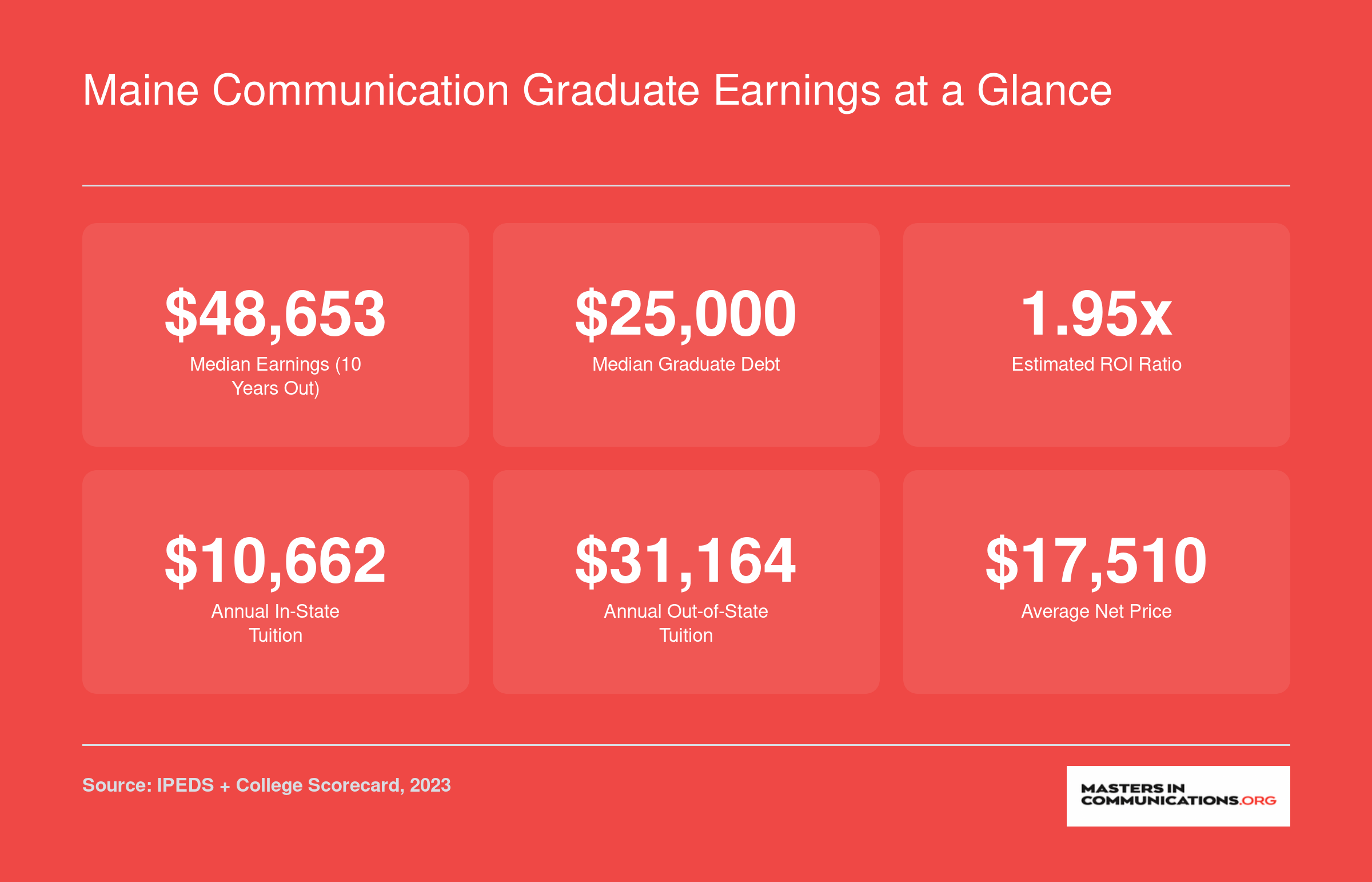
Maine Communication Graduate Earnings at a Glance
Here is a snapshot of the financial picture for communication graduate students at the University of Maine, the state's primary option for an on-campus communication-related master's degree. These figures can help you weigh potential earnings against your investment in tuition and student debt.
Financial Aid, Assistantships, and Scholarships for Communication Grad Students
Graduate funding in communication has tightened in recent years as humanities departments compete with STEM fields for institutional dollars, which makes assistantships more valuable, and more competitive, than they were a decade ago. At the University of Maine, the assistantship package remains the single biggest lever for reducing what you actually pay out of pocket for the master's.
UMaine Graduate Assistantships
The Department of Communication and Journalism offers graduate assistantships (GAs) with a minimum stipend of $17,000 for the 2024, 2025 academic year, paired with a tuition waiver covering up to 9 credits per semester.1 The waiver applies to standard graduate coursework but excludes audited courses, pass/fail enrollments, and anything below the 400 level. Course and program fees are typically not covered, and the university contributes up to 50% toward health insurance.2
GA appointments require a minimum of 20 hours per week of teaching, research, or administrative work, with domestic students permitted up to 30 hours and international students capped at 20 by visa rules. You must enroll in at least 6 graduate credits during the fall and spring (1 credit in summer if your appointment extends). Most positions are awarded through department nomination or extended directly with the admission offer, so a strong application package, with a clear research or teaching fit, matters more than a separate funding form.1
Other Funding Sources
Beyond GAs, fill out the FAFSA to access federal Direct Unsubsidized and Grad PLUS loans, plus federal work-study where eligible. Maine does not run a dedicated state grant program for graduate students, but the UMaine Graduate School maintains listings of fellowships and travel awards worth checking each cycle.
Net Cost in Context
The published average net price at UMaine sits around $17,510 per year for in-state students. That's a useful baseline, but a funded GA line (stipend plus tuition waiver) can flip the equation entirely: instead of paying $17k out of pocket, you're earning a modest income while completing the degree. Apply early, signal teaching interest, and ask the department directly about funding before you commit.
Is a Master's in Communication Worth It?
University of Maine's communication-related graduate program carries a median debt of approximately $25,000 at completion, while graduates from the institution earn a median of $48,653 within ten years, yielding an ROI ratio near 1.95. That means for every dollar borrowed, graduates can expect to earn nearly two dollars in return over the early career window. These figures provide a useful benchmark, though individual outcomes depend heavily on your career path and how strategically you apply the credential.
When the Degree Pays Off
A master's in communication delivers clear value for specific career trajectories:
- PR and corporate communications leadership: Director-level roles at agencies and in-house teams increasingly require graduate credentials, and the degree signals strategic thinking beyond tactical execution.
- Higher education positions: Academic advising, student affairs, and institutional communications roles often list a master's as a minimum qualification.
- Healthcare and nonprofit communications: These sectors value the research methods and crisis communication training that graduate programs emphasize.
- Media management: News directors, digital content strategists, and editorial leadership positions favor candidates with advanced training in media theory and audience analytics.
For mid-career professionals aiming at these paths, the investment typically accelerates advancement by two to five years compared to relying solely on experience.
When It May Not Be Necessary
Entry-level marketing coordinators, social media specialists, and content creators rarely need a master's degree to land their first roles. If your goal is hands-on creative work rather than strategic leadership, the degree may not justify the time and cost. Freelancers and entrepreneurs often benefit more from portfolio development and client relationships than additional credentials.
Comparing Maine's Value Proposition
Maine's in-state graduate tuition at the flagship university runs around $10,662 annually, well below the national average of approximately $12,000 to $15,000 for public institutions and significantly lower than the $25,000 to $40,000 range typical of private programs. Even out-of-state students benefit from New England Regional tuition agreements that reduce costs substantially. If you're open to studying remotely, an online masters in communication management program can offer comparable savings with added scheduling flexibility. This pricing positions Maine programs as strong value options compared to metropolitan alternatives.
Factoring in Time Costs
Most full-time students complete their degree in two years, while part-time students typically finish in three. Beyond tuition, consider the opportunity cost of reduced work hours or delayed promotions during your studies. Online and hybrid formats, including masters in organizational communication programs, help working professionals minimize this trade-off by maintaining employment throughout the program.
The bottom line: a communication master's is worth the investment when it unlocks a specific career goal you cannot reach otherwise. Run your own numbers, factor in your current salary trajectory, and weigh the credential against your target role's actual requirements before committing.
Frequently Asked Questions About Communication Master's Programs in Maine
Choosing a graduate communication program raises plenty of practical questions, from costs and timelines to career payoff. Below are straightforward answers to the questions prospective Maine students ask most often.
- Is it worth getting a master's in communication?
- For most working professionals, yes. A master's in communication sharpens strategic thinking, research skills, and leadership capabilities that employers value in mid-level and senior roles. Graduates frequently move into higher-paying positions in public relations, corporate communications, and media management. The degree also opens doors to teaching at the college level or pivoting into specialized fields like health or political communication.
- What can you do with a master's in communication?
- Career paths include public relations manager, communications director, marketing strategist, media analyst, corporate trainer, and higher education instructor. Graduates also find roles in nonprofit advocacy, government affairs, digital content strategy, and UX research. The versatility of the degree means you can apply it across industries, from healthcare and technology to entertainment and public policy.
- How many years does it take to get a master's in communication?
- Most full-time students complete a communication master's in about two years, or roughly 30 to 36 credit hours. Part-time and accelerated options can shift that timeline: some accelerated programs wrap up in 12 to 18 months, while part-time schedules may stretch to three years. Check each program's course load and thesis or capstone requirements, because these directly affect your completion date.
- How much does a master's in communication cost in Maine?
- Costs vary depending on the institution and residency status. At the University of Maine, in-state graduate tuition is considerably lower than out-of-state rates, and total program costs typically fall within a range competitive with other New England public universities. Factor in fees, books, and living expenses as well. Assistantships and scholarships can significantly reduce out-of-pocket spending.
- What are the admission requirements for a communication master's program in Maine?
- Typical requirements include a bachelor's degree (not necessarily in communication), a minimum GPA around 3.0, a statement of purpose, two or three letters of recommendation, a writing sample or professional portfolio, and official transcripts. Some programs also request a resume highlighting relevant work experience. Requirements can differ by department, so review each school's graduate admissions page carefully.
- Are there online master's in communication programs in Maine?
- Maine-based universities offer limited fully online communication master's options, but several regionally accredited schools across the country deliver online programs accessible to Maine residents. These programs typically mirror on-campus curricula and allow you to complete coursework around a full-time job. If staying local matters, look for hybrid formats that blend online classes with occasional on-campus intensives.
- Do Maine communication master's programs require the GRE?
- Many programs have moved away from requiring the GRE in recent years, and several Maine graduate programs now list it as optional or waived entirely. That said, submitting a strong GRE score can still bolster a borderline application. Always confirm the current policy on your target program's admissions page, because requirements can change from one admission cycle to the next.
- How do Maine communication master's programs compare to other New England options?
- Maine programs tend to offer smaller cohorts, closer faculty mentorship, and lower tuition than counterparts in Massachusetts or Connecticut. Schools like the University of Maine emphasize hands-on research and community engagement. Larger New England metros may provide more networking events and internship pipelines, so the best fit depends on whether you prioritize affordability and personalized attention or proximity to major media markets.