
What you’ll learn in this article…
- Missouri offers more than a dozen communication master's programs, with the majority available fully online or in hybrid formats.
- Annual tuition ranges from under $7,000 at some public universities to over $20,000 at private institutions.
- BLS data show Missouri public relations specialists and media professionals earn competitive salaries, with demand projected to grow through the decade.
- GPA requirements start as low as 2.5 at several programs, making admission accessible for working professionals changing careers.
A master's in communication in Missouri covers a focused set of graduate degrees: MA programs in communication and leadership, MA and MS tracks in strategic communication, technical communication, and applied speech and communication sciences. Tuition runs from roughly $4,800 to $25,600 per year at in-state rates, and several programs finish in 12 to 18 months.
The practical tension for most applicants is format versus price. St. Louis and Kansas City anchor the state's PR, healthcare communications, and corporate marketing employer base, but more than half of Missouri's graduate communication options are now delivered online or hybrid, putting Springfield, Columbia, and Warrensburg programs within reach of metro workers. GPA thresholds sit between 2.5 and 3.3, and most strategic communication tracks have dropped the GRE entirely.
Best Master's in Communication Programs in Missouri, Ranked
Missouri's graduate communication landscape stretches from speech-language pathology clinics in Kirksville to strategic communication courses you can finish entirely online from Kansas City. The programs below were evaluated with a value-first lens, so you will see affordable public universities competing alongside private institutions that punch above their weight on outcomes. Whether you are eyeing a clinical career or aiming for a corporate communications leadership role, this ranked list will help you zero in on the right fit.
- Net price and overall affordability
- Graduate earnings after completion
- Institution-wide graduation rates
- Financial return on investment
- Program delivery and flexibility
- NCES-IPEDS federal institutional data — nces.ed.gov
- Internal program database
- Independent program research
- College Scorecard graduate earnings — collegescorecard.ed.gov
Truman State University
#1Kirksville, MO · ~$13,000/yr (est.)
Best for: Budget-minded aspiring speech-language pathologists
Truman State University pairs a low net price (around $12,780) with a 12:1 student-to-faculty ratio, giving graduate students unusually close access to mentors. Its CAA-accredited Communication Disorders program trains future speech-language pathologists through hands-on work at the on-campus Speech and Hearing Clinic, and rolling admissions make the application timeline forgiving. The university reports top job-placement outcomes in Missouri, with research and study-abroad options adding breadth to a clinically focused curriculum.
- CAA-accredited by the American Speech-Language-Hearing Association
- Total estimated tuition of $28,224 ($588 per credit)
- Rolling admissions with priority deadlines in February and September
- On-campus Speech and Hearing Clinic for clinical training
- Research opportunities and study-abroad option in Mexico
- Financial aid available for students enrolled in 6+ credits
University of Missouri-St Louis
#2Saint Louis, MO · $15,000 – $20,000/yr
Best for: St. Louis professionals exploring multiple specializations
Located in the St. Louis metro, UMSL offers a broad Master of Arts in Communication grounded in social-behavioral science. The 30-credit curriculum (or 36 without a thesis or internship) lets students customize their path across strategic, interpersonal, mass, and health communication. A net price near $15,071 and a 13:1 student-to-faculty ratio make the program competitive for professionals who want a research-informed degree without relocating from the state's largest metro.
- 30 total credit hours (36 without thesis or internship)
- Four concentration options spanning strategic and health communication
- 15-credit core in communication theories and research methods
- 3.3 minimum GPA for admission
- Thesis or internship capstone to finish the degree
- On-campus format with access to diverse faculty perspectives
Southeast Missouri State University
#3Cape Girardeau, MO · $16,000/yr (net price)
Best for: Clinically focused students seeking high licensure pass rates
Southeast Missouri State University in Cape Girardeau delivers a CAA-accredited MA in Communication Disorders with a Speech-Language Pathology concentration. At a net price of roughly $15,882, the 58-credit program features small cohorts of 20 to 22 students, a 95% licensure pass rate, and a reported 100% job-placement rate. Graduate assistantships with stipends and reserved cohort spots for SEMO graduates sweeten the deal for returning alumni.
- CAA-accredited; 58 total credit hours
- No GRE required; 3.0 GPA minimum for admission
- 95% Praxis licensure pass rate with 100% job placement reported
- Cohort size of 20 to 22 students per year
- Graduate assistantships with stipend available
- Three semesters of supervised clinical practicum
- Summer start only; January 15 application deadline
University of Central Missouri
#4Warrensburg, MO · $14,000/yr
The University of Central Missouri in Warrensburg focuses its communication graduate offerings on a Master of Science in Speech-Language Pathology. Continuously accredited since 1977, the program requires 400 clinical hours across an onsite clinic with 15 treatment rooms and offsite placements in schools and hospitals. A net price near $14,462 and total program tuition around $22,560 make it one of the more affordable clinical pathways in the state.
- CAA-accredited continuously since 1977
- 50 total credit hours; 6-semester completion timeline
- 98% Praxis pass rate and 100% reported job placement
- 400 clinical hours across onsite and offsite settings
- No entrance exam required; 3.0 GPA minimum
- Full-time and part-time enrollment options
- Graduate assistantships and scholarships available
Missouri State University
#5Springfield, MO · $18,000/yr (net price)
Missouri State University in Springfield stands out for offering both a clinically oriented MS in Communication Sciences and Disorders and a versatile MA in Communication with concentrations in Organizational Communication, Conflict, and Communication and Culture. The MA side is delivered in a hybrid format and features graduate assistantships with tuition waivers, while the CSD track boasts a 100% licensure pass rate and externships spanning the lifespan. Net price sits around $17,613.
- Three concentration tracks: Organizational, Conflict, Communication and Culture
- Hybrid delivery with service-learning and internship components
- Graduate assistantships with tuition waivers available
- Published expert faculty offering individualized research mentorship
- Prepares graduates for consulting, HR, and PR careers
- Financial aid and scholarships available
- CAA/ASHA-accredited; two-year completion timeline
- 100% licensure pass rate and 99% job placement reported
- Externships across the lifespan in varied clinical settings
- Leveling courses available for non-CSD undergraduate majors
- $80,000 median earnings reported by the program
- Approved Education of the Deaf and Hard of Hearing track also offered
Northwest Missouri State University
#6Maryville, MO · $15,000 – $20,000/yr
Northwest Missouri State University's fully online MA in Strategic Communication is built for working professionals who need maximum scheduling flexibility. The 30-credit program can be completed in as few as 12 months through seven-week accelerated courses, and in-state and out-of-state students pay the same tuition of $407 per credit ($12,210 total). Coursework spans public relations, brand management, data analysis, and conflict management.
- 100% online with seven-week accelerated courses
- Completable in as few as 12 months
- $12,210 total tuition; same rate for in-state and out-of-state
- 30 credit hours covering PR, brand management, and data analysis
- 2.5 GPA minimum; no GRE required
- Capstone project required to finish the degree
- Multiple start dates throughout the year
- Higher Learning Commission accredited
Missouri University of Science and Technology
#7Rolla, MO · ~$16,000/yr (est.)
Missouri S&T in Rolla brings a distinctive STEM perspective to communication studies through its Master of Science in Technical Communication. The 30 to 33 credit program covers technical editing, usability studies, proposal writing, and web-based communication, all taught by faculty who actively research in these areas. Available in both online and on-campus formats, it appeals to professionals bridging engineering or IT environments with clear, effective messaging.
- 30 to 33 credit hours with thesis and non-thesis options
- Hybrid delivery: courses available online or on campus
- Curriculum includes usability studies and advanced proposal writing
- Faculty are active researchers in technical communication
- Prepares graduates for roles as technical writers and usability specialists
- Financial aid and scholarships available
University of Missouri
#8Columbia, MO · $20,000/yr
The University of Missouri in Columbia, the state's flagship, houses both an MA in Communication and an MHS in Speech, Language and Hearing Sciences with a Speech-Language Pathology emphasis. Mizzou's journalism school also offers a fully online MA in Journalism with a Strategic Communication emphasis. With a 74.9% institution-wide graduation rate (highest on this list) and median alumni earnings of $63,403 ten years out, the campus delivers strong long-term returns despite a higher net price near $20,268.
- 30 credit hours with thesis and non-thesis pathways
- January 15 application deadline; three letters of recommendation
- Must be completed within eight years
- On-campus format at MU's Columbia campus
- Minimum B average required throughout the program
- No more than 12 hours of research coursework allowed
- 48 credit hours; grades of B- or higher required
- At least 375 supervised clinical practicum hours
- Two-year timeline for students with a CSD background
- 26 prerequisite credit hours for career changers
- CSDCAS application with January 15 deadline
- Prepares for ASHA certification and Missouri licensure
- 100% online delivery; 33 total credit hours
- Thesis or capstone option
- Housed in the renowned MU School of Journalism
- Ideal for professionals pursuing strategic communication remotely
Park University
#9Parkville, MO · $20,000 – $25,000/yr
Park University, a private institution near Kansas City, markets itself as offering a private-school education at state-school prices. Its 36-credit MA in Communication and Leadership blends communication theory with organizational leadership skills through an asynchronous online format. A 2.75 GPA gets you in the door, and the curriculum emphasizes cross-cultural communication, ethical reasoning, and strategic change management, preparing graduates for PR, HR, and community-service leadership roles.
- 36 credit hours; part-time and full-time pacing available
- Asynchronous online format for maximum flexibility
- 2.75 to 2.8 GPA minimum for admission
- Covers ethnographic and quantitative research methods
- Faculty hold doctoral degrees in communication-related fields
- Prepares for careers in PR, HR, and community-service management
- Financial aid and scholarships available
Maryville University
#10Saint Louis, MO · ~$22,000/yr (est.)
Maryville University in west St. Louis County rounds out the list with both online and on-campus MS in Speech-Language Pathology options. The online track requires 57 credits over five semesters at a total cost of roughly $57,300, while the campus version structures 36 credits of coursework alongside 21 credits of clinical experience. No GRE is needed, and start dates in January and August give applicants two entry points per year. A 66.2% institution-wide graduation rate and 13:1 student-to-faculty ratio reflect the university's investment in student support.
- 57 total credits; five-semester completion timeline
- Fully online coursework with clinical practicums in final semesters
- No GRE required; 3.0 GPA minimum
- Total cost approximately $57,300 including tuition and fees
- January and August start dates
- Personalized clinical coordinator support throughout the program
- 36 credits of coursework plus 21 credits of clinical experience
- Includes both school and medical externships
- Prepares for PRAXIS exam, ASHA certification, and state licensure
- February 1 admission deadline
- Covers speech sound disorders, dysphagia, voice, and fluency
- Emphasis on evidence-based practice and cultural competence
Tuition and Cost Comparison Across Missouri Programs
Cost is one of the most consequential factors when choosing a communication master's program, and Missouri's options span a wide range. The table below compares annual tuition rates, estimated net price (what students typically pay after grants and scholarships), and median graduate debt across 14 schools. Keep in mind that net price figures are institution-level averages reported to IPEDS and College Scorecard; your actual out-of-pocket cost will depend on financial aid, residency status, and course load.
| School | In-State Tuition | Out-of-State Tuition | Net Price | Median Graduate Debt | Student-to-Faculty Ratio |
|---|---|---|---|---|---|
| Park University | $4,783 | $4,783 | $21,032 | $21,685 | 13:1 |
| Southeast Missouri State University | $7,702 | $7,702 | $15,882 | $21,500 | 20:1 |
| Northwest Missouri State University | $8,096 | $8,096 | $16,244 | $21,500 | 16:1 |
| Missouri State University | $8,204 | $14,990 | $17,613 | $21,992 | 21:1 |
| University of Central Missouri | $10,296 | $19,092 | $14,462 | $21,000 | 18:1 |
| Avila University | $10,800 | $10,800 | $16,053 | $25,000 | 19:1 |
| Truman State University | $12,168 | $12,168 | $12,780 | $21,000 | 12:1 |
| University of Missouri | $13,681 | $32,581 | $20,268 | $20,500 | 17:1 |
| Webster University | $13,736 | $13,736 | $27,047 | $23,000 | 16:1 |
| Missouri University of Science and Technology | $14,944 | $26,056 | $16,298 | $23,250 | 17:1 |
| University of Missouri, St. Louis | $15,480 | $36,792 | $15,071 | $20,000 | 13:1 |
| Maryville University | $16,246 | $16,246 | $22,066 | $22,000 | 13:1 |
| Rockhurst University | $20,842 | $20,842 | $25,884 | $18,250 | 12:1 |
| Saint Louis University | $25,590 | $25,590 | $24,398 | $25,000 | 9:1 |
Questions to Ask Yourself
Online vs. On-Campus Communication Programs in Missouri
Missouri's communication master's landscape splits roughly into three delivery formats: fully online, fully on-campus, and hybrid programs that blend both. Your ideal format depends on how you weigh flexibility against face-to-face professional connections, so it helps to see the tradeoffs side by side.
Pros
- Online programs like those at Northwest Missouri State, Webster University, and Avila University let you study from anywhere in the state on your own schedule, which is ideal if you are balancing a full-time job.
- Fully online tuition is often lower in practice: Northwest Missouri State charges the same $407 per credit regardless of residency, keeping total costs around $12,210.
- On-campus programs at schools such as UMSL, Saint Louis University, and Rockhurst University place you directly in the St. Louis or Kansas City media markets, opening doors to networking events, guest lectures, and internship pipelines with local employers.
- Campus-based cohort models build lasting peer relationships and accountability; programs like the University of Missouri's speech-language pathology track pair classroom learning with hundreds of supervised clinical hours.
- Hybrid options at Missouri S&T and Park University offer a middle path, combining asynchronous online coursework with periodic in-person intensives or practicum placements.
Cons
- Online learners can feel isolated from classmates and faculty, and they miss the informal hallway conversations that often lead to job referrals in competitive markets like St. Louis PR and corporate communications.
- Fully online formats provide less direct access to local employer partnerships, which can make securing practicum placements or internships more of a self-directed effort.
- On-campus programs demand commuting to locations that may not be near you, since Missouri's campus options are spread across Columbia, Cape Girardeau, Warrensburg, Springfield, and the Kansas City and St. Louis metros.
- Rigid class schedules at campus programs can clash with work obligations; many on-campus tracks run during weekday business hours and require summer enrollment to stay on pace.
- Hybrid programs require you to plan around occasional on-site residencies, which can mean travel costs and time away from work even though most coursework is completed remotely.
Related Articles
What Missouri Communication Graduates Actually Earn
The salary conversation around communication careers has shifted noticeably in the past few years, with employers in corporate communications, healthcare PR, and digital content strategy bidding up wages to attract talent who can navigate an increasingly fragmented media landscape. If you are weighing the return on a master's in communication in Missouri, concrete wage data is the best starting point for an honest cost-benefit analysis.
Where to Find Missouri-Specific Salary Data
The Bureau of Labor Statistics publishes free Occupational Employment and Wage Statistics (OEWS) for every state and major metro area. For communication graduates, the three SOC codes worth tracking are 27-3031 (Public Relations Specialists), 11-2031 (Public Relations and Fundraising Managers), and 27-3099 (Media and Communication Workers, All Other). The most recent release typically covers the prior May, so data from May 2025 should be available or imminent by mid-2026. You can search these codes at bls.gov/oes and filter by Missouri statewide, the Kansas City metro, or the St. Louis metro to see how wages differ across the state.
For national context, the BLS reported a median annual wage of $69,780 for Public Relations Specialists as of May 2024.1 That is a national figure, not a Missouri figure, so do not treat it as a local benchmark. Missouri-specific medians and metro-level breakdowns are published separately and may sit above or below the national number depending on industry mix and cost of living. For a broader look at how these roles translate into careers with a masters in communication, salary benchmarking across geographies and specializations becomes essential.
University Alumni Outcome Reports
Another reliable source is the career services or alumni outcomes pages maintained by Missouri universities. Schools like the University of Missouri, UMKC, and Saint Louis University often publish post-graduation salary reports that break out earnings by major or college. These reports can tell you what communication master's graduates actually earned in their first year or at mid-career, which is far more specific than broad occupation-level BLS data. If the data is not posted publicly, a quick email to career services usually yields it.
Professional Association Salary Surveys
PRSA (Public Relations Society of America) and IABC (International Association of Business Communicators) both conduct periodic salary surveys that include regional breakdowns. The Missouri chapters of these organizations sometimes share localized results or can point you toward member-only reports. These surveys tend to capture a wider slice of communication roles, including internal communications, crisis management, and executive-level positions, than BLS categories alone. Graduates who pursue an online master's in public relations often find these surveys especially useful for benchmarking salaries in agency versus in-house settings.
Metro-Level Comparisons: Kansas City vs. St. Louis
Because Missouri's two largest metros anchor very different industry clusters, wages can vary meaningfully between them. Kansas City's economy leans on logistics, agribusiness, and a growing tech sector, while St. Louis has deep roots in healthcare, financial services, and defense contracting. Local chambers of commerce and regional economic development agencies in both cities occasionally compile wage data organized by industry or occupation. Checking the Kansas City Area Development Council and the St. Louis Regional Chamber can surface reports that layer industry demand on top of raw salary figures, giving you a clearer picture of where communication professionals command the strongest compensation.
Putting the Numbers Together
When you compare multiple data sources, a few practical steps help you avoid apples-to-oranges mistakes:
- Match the geography: Always note whether a figure is national, statewide, or metro-specific before drawing conclusions.
- Distinguish experience levels: BLS medians include all experience levels; alumni reports often reflect early-career wages, which will naturally be lower.
- Factor in industry: A PR specialist in healthcare or tech typically out-earns one in nonprofit work, even within the same city.
- Check the date: Salary surveys age quickly, so prioritize data published within the last two years.
Armed with these resources, you can build a realistic earnings projection tailored to your target role, preferred metro area, and industry of interest, rather than relying on a single national average that may not reflect what Missouri employers are actually paying.
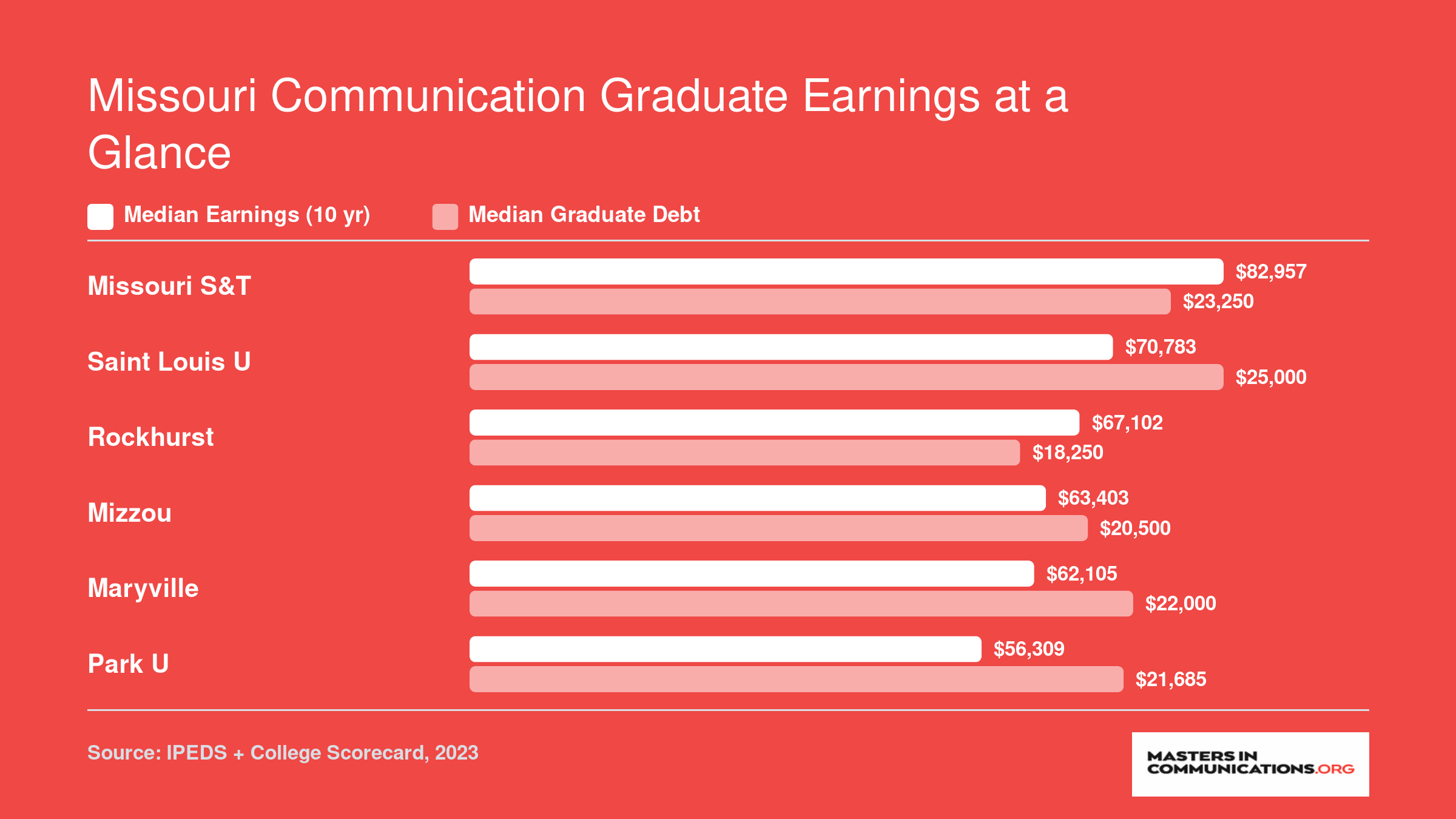
Missouri Communication Graduate Earnings at a Glance
Program-level earnings data (at one year and four years post-completion) are not yet published for these Missouri communication master's programs. The chart below compares each school's median institutional earnings at ten years after enrollment alongside median graduate debt, giving you a useful debt-to-earnings snapshot for ROI planning.
Missouri's Communication Job Market: Growth and Employer Demand
Missouri's communication job market refers to the demand for professionals who manage how organizations talk to the public, to employees, to journalists, and to customers. That includes public relations specialists, corporate communications managers, media planners, marketing communications coordinators, and the growing crop of digital and social media strategists. Understanding where this market is headed in Missouri requires triangulating national projections with state and metro-level signals, because no single source captures the full picture.
Start With National and State-Level Projections
The Bureau of Labor Statistics Occupational Outlook Handbook (bls.gov/ooh) is the anchor point for long-range growth projections in roles like public relations specialists, advertising and promotions managers, and PR and fundraising managers. These projections run on a ten-year horizon and tell you the broad direction of the field nationally. Exploring the full range of communication masters jobs can help you identify which titles to track.
For Missouri-specific numbers, the Missouri Economic Research and Information Center (missourieconomy.org) publishes state employment outlooks that disaggregate national trends by occupation and region. MERIC's data is where you confirm whether Missouri is tracking above, below, or roughly in line with national projections for your target role.
Zoom Into Kansas City and St. Louis
Missouri's communication hiring concentrates in its two major metros, so metro-level reporting matters. The Kansas City Area Development Council (kcsourcelink.com) and the St. Louis Regional Chamber (stlregionalchamber.com) regularly publish economic development reports that highlight industry expansions, corporate relocations, and sector hiring forecasts. When a major employer announces a regional headquarters move or a healthcare system expands its marketing footprint, these reports typically flag it first, and communication roles follow. Many of these openings favor candidates with a background in masters in organizational communication, particularly in corporate or healthcare settings.
Read Real-Time Employer Signals
Projections describe the next decade. Job boards describe right now. Set saved searches on LinkedIn, Indeed, and Glassdoor filtered by Kansas City and St. Louis metros and by titles you actually want: communications manager, PR specialist, content strategist, internal communications lead. Track whether postings are increasing month over month and watch for newer role categories that have surfaced in 2024 through 2026, such as AI communications strategist, ESG communications, or community engagement lead.
Finally, connect with PRSA Missouri chapters and IABC's St. Louis and Kansas City affiliates. Staying current on latest trends in communication through their member surveys, monthly programs, and informal networking conversations surfaces hiring trends well before they show up in published data, and reveals which skills local employers are actively bidding up.
Admissions Requirements and GPA Thresholds Compared
What GPA and test scores do you actually need to get into a communication master's program in Missouri? The answer varies more than you might expect. Missouri programs range from highly accessible entry points to moderately selective thresholds, giving working professionals multiple pathways regardless of undergraduate performance.
GPA Minimums: A Wide Spread
Minimum GPA requirements across Missouri communication programs span nearly a full grade point. At the most accessible end, the University of Central Missouri accepts applicants with a 2.50 undergraduate GPA, while Northwest Missouri State sets the bar at 2.75.12 These lower thresholds open doors for professionals whose undergraduate records may not reflect their current capabilities or career trajectory.
Mid-tier programs expect stronger academic foundations. Missouri State University requires a 3.0 GPA for admission consideration, positioning itself as moderately selective. The University of Missouri-St. Louis maintains the highest threshold in the state at 3.25, though it balances this requirement with test-optional admissions.4
The University of Missouri does not publish a minimum GPA cutoff, instead evaluating applications holistically based on the strength of the overall package, including relevant work experience and professional goals.5
Standardized Test Policies: Mostly Optional
Most Missouri communication programs have eliminated standardized testing requirements, reflecting a broader national trend toward holistic admissions. The University of Missouri, UMSL, and Northwest Missouri State do not require the GRE or any equivalent exam for 2026 admission.542
Missouri State stands as the notable exception, still requiring either the GRE General Test or the Miller Analogies Test (MAT). If standardized testing isn't your strength, this requirement may steer you toward one of the test-optional alternatives.
Prerequisite Coursework and Background
Several programs expect applicants to arrive with communication foundations already in place. The University of Missouri prefers candidates with an undergraduate degree in communication or a related field, though exceptions exist for strong applicants from other backgrounds.5 UMSL similarly looks for a baccalaureate in communication or a related discipline.4
The University of Central Missouri takes a more specific approach, requiring 15 credit hours of undergraduate communication coursework.1 If your bachelor's degree lies outside communication, you may need to complete prerequisite courses before matriculating or during your first term. For those still finishing their undergraduate work, exploring a bachelor of communication online degree could help you build the required foundation on a flexible schedule.
Application Deadlines
Deadlines vary widely by program. The University of Missouri enforces the earliest cutoff at January 15 for fall admission, requiring careful planning for professionals balancing application prep with full-time work.5 Missouri State offers more flexibility with a June 1 deadline, while the University of Central Missouri extends the window to July 15, accommodating later decision-makers or those completing spring prerequisite work.1
How to Choose the Right Communication Master's Program
Choosing the right program often comes down to a tension between what fits your career goals and what fits your budget, schedule, and life. A prestigious research track may look great on paper, but an applied program with asynchronous coursework could deliver a faster return if you are already working full time. Here is a framework to help you weigh the options clearly.
Match the Specialization to Your Career Path
Missouri's communication master's programs generally fall into three lanes:
- MA research track: Designed for students who want to study communication theory, conduct original research, and potentially pursue a doctorate. Best if you are drawn to academia or policy work.
- Strategic or applied communication: Emphasizes organizational communication, corporate messaging, crisis communication, or digital strategy. A strong fit for mid-career professionals looking to move into leadership roles.
- Public relations and media: Focuses on media relations, campaign planning, and reputation management. Ideal if your career centers on earned media, stakeholder engagement, or brand storytelling.
Picking the wrong lane can cost you time and tuition dollars, so map each program's curriculum against the job title you want two to five years from now.
Weigh Earnings Against Debt
The tuition and earnings data presented earlier in this article give you a concrete decision tool. Compare each program's total cost of attendance (tuition plus fees, books, and any travel for residencies) against post-graduation earnings reported for its graduates. A program that costs $10,000 more but consistently places graduates in higher-paying roles may still be the better investment. Conversely, a low-sticker-price program with limited career outcomes data deserves extra scrutiny before you commit.
Prioritize Flexibility If You Are Working
If you hold a full-time job, look for programs that offer asynchronous coursework and do not require on-campus residencies. Several Missouri institutions deliver their entire communication master's curriculum online, which means you can complete readings, discussions, and assignments on your own schedule. Professionals interested in leadership-oriented tracks may also want to explore an online masters in communication management, which pairs well with strategic roles. Synchronous sessions (live class meetings at a fixed time) can create conflicts with shift work, travel, or family obligations. Confirm the delivery model before you apply.
Verify Accreditation Before You Enroll
Accreditation serves as a quality check that matters for employer recognition and future doctoral admission. Every institution on this list should hold regional accreditation through the Higher Learning Commission (HLC), which signals that the university meets baseline academic standards. Beyond that, two Missouri programs carry specialized accreditation from ACEJMC, the Accrediting Council on Education in Journalism and Mass Communications: the University of Missouri at Columbia (continuously accredited since the late 1940s) and Southeast Missouri State University.12 ACEJMC reviews programs on an eight-standard framework every six years and focuses on profession-oriented journalism and mass communication units.34 If you plan to work in news media or mass communication, ACEJMC accreditation adds a meaningful credential. For broader strategic communication or organizational communication tracks, HLC regional accreditation is the primary box to check.
Take a Concrete Next Step
Research alone will not get you to a decision. Narrow your list to two or three programs, then:
- Request information packets directly from each program so you can compare curriculum maps side by side.
- Ask each admissions office for a detailed financial aid breakdown, including assistantships, employer tuition reimbursement partnerships, and any merit scholarships for working professionals.
- Attend at least one virtual information session or webinar. These events let you hear from current students and faculty, ask pointed questions about career placement, and gauge whether the program's culture matches your learning style.
Taking these steps moves you from browsing to deciding, and that shift is where real momentum begins.
Frequently Asked Questions About Communication Master's Programs in Missouri
Choosing a graduate communication program raises plenty of practical questions, from cost and format to career payoff. Below are the answers Missouri applicants ask most often, grounded in current program data and state salary benchmarks.
- What can you do with a master's in communication?
- Graduates move into roles such as public relations manager, corporate communications director, media strategist, training and development specialist, or marketing manager. The degree also opens doors to higher education, nonprofit leadership, and political communication. Because coursework blends research, strategy, and messaging, employers across industries value the credential for leadership and senior specialist positions.
- How much does a master's in communication cost in Missouri?
- Tuition varies widely. Programs in the state range from roughly $11,000 to over $38,000 in total tuition depending on the institution, residency status, and credit requirements (most require 30 to 36 credits). The tuition comparison table earlier in this article breaks down per-credit and total costs at each Missouri school so you can compare apples to apples.
- Are there fully online master's in communication programs in Missouri?
- Yes, and online options dominate the state's offerings. Northwest Missouri State's MA in Strategic Communication is entirely online and can be completed in as few as 12 months. Other schools, including the University of Central Missouri and Missouri State University, also deliver their programs online or in hybrid formats. These flexible structures are especially popular among working professionals.
- Is a master's in communication worth it for salary growth?
- For most professionals, yes. Missouri communication master's holders tend to earn noticeably more than those with only a bachelor's degree, particularly in management and strategic roles. The earnings section of this article details median salaries for graduates of Missouri programs. Beyond salary, the degree often accelerates promotion timelines in PR, marketing, and corporate communications.
- How long does it take to complete a master's in communication?
- Most Missouri programs take 18 to 24 months of full-time study. Northwest Missouri State offers an accelerated 12-month online track, while Missouri State University has a 4+1 pathway that lets undergraduates start graduate coursework early. Part-time students typically need longer; the University of Missouri, for example, allows up to eight years to finish its 30-credit MA.
- What are the admission requirements for communication master's programs in Missouri?
- Common requirements include a bachelor's degree (not necessarily in communication), a minimum GPA around 3.0, a statement of purpose, letters of recommendation, and a writing sample or professional resume. Some programs accept the GRE but do not require it. Specific GPA thresholds and document checklists vary by school, so review each program's admissions page carefully.
- What is the difference between an MA in Communication and an MS in Strategic Communication?
- An MA in Communication typically emphasizes communication theory, research methods, and broad scholarly inquiry. An MS in Strategic Communication (or a related professional studies degree) focuses on applied skills like campaign planning, organizational messaging, and leadership communication. Missouri offers both tracks: the University of Missouri and Saint Louis University award the MA, while Northwest Missouri State's program centers on strategic practice.
More Master's in Communication Programs in Missouri
Beyond our ranked top 10, several other Missouri schools offer communication master's programs that may align better with your specific goals, budget, or preferred learning format. The following directory lists these additional options for your consideration.