
What you’ll learn in this article…
- Only two Montana universities offer communication master's programs, creating small cohorts with strong faculty mentorship.
- In-state tuition at both schools falls well below the national average of $30,000 to $40,000 per year.
- Full-time students at the University of Montana can typically finish the M.A. in two years.
- Out-of-state online programs significantly expand options for Montana residents seeking flexible schedules.
Montana offers exactly two master's-level programs in communication and public relations, a deliberately focused lineup that makes the selection process simpler than in states with a dozen competing options. The University of Montana's M.A. in Communication Studies and Montana State University Billings' M.S. in Public Relations both run between $8,000 and $16,000 per year for in-state students, well below the $30,000 to $40,000 national average for public graduate tuition.
That small program footprint means tighter cohorts, stronger faculty mentorship, and clearer pathways into professional roles across Montana's nonprofit, government, and corporate sectors. For working professionals, the real tension is delivery format: Montana residents can pursue an on-campus degree with embedded research opportunities, or choose from a growing roster of fully online programs that offer greater schedule flexibility without requiring relocation.
National data show communication master's graduates earn median salaries between $60,000 and $75,000, and Montana's lower cost of living amplifies the value of those gains. Most full-time students complete their degrees in two years, though thesis requirements can extend timelines by one or two additional semesters.
Best Master's in Communication Programs in Montana
Montana's graduate communication landscape is intentionally compact: just two universities offer master's-level programs in the communication and public relations space. That small footprint translates into tighter cohorts, stronger faculty mentorship, and more hands-on research and professional opportunities than you would find at a sprawling mega-program. Below, we break down what each school brings to the table so you can match the right program to your career goals.
- Academic quality and graduation rates
- Net price and graduate debt levels
- Program format and flexibility
- Faculty ratio and cohort size
- Post-graduation earning potential
- NCES-IPEDS federal institutional data — nces.ed.gov
- College Scorecard graduate earnings — collegescorecard.ed.gov
- Independent program research
- Internal program database
The University of Montana
#1Missoula, MT · ~$17,000/yr (est.)
Best for: Research-minded communication scholars
The University of Montana in Missoula is the state's flagship research institution and the only Montana university offering a dedicated Communication Studies M.A. With a 17:1 student-to-faculty ratio and multiple graduate communication pathways, UM gives students access to faculty-led research, clinical training, and professional development across rhetoric, journalism, and speech-language pathology. The institution-wide graduation rate is 48%, and median graduate debt sits at $22,400, while graduates report median earnings of $44,511 ten years after enrollment.
- 35 total credit hours with 2 concentration options
- Thesis or professional paper completion pathway
- Proseminar course focused on professional development
- Curriculum covers rhetorical criticism and qualitative methods
- Prepares students for doctoral study or professional careers
- 3.0 minimum GPA required for admission
- On-campus format in Missoula
- 36 total credit hours blending journalism and science
- Thesis, capstone, or professional portfolio completion options
- Core externship provides real-world field experience
- Travel abroad component for research opportunities
- Coursework spans multiple journalistic media formats
- Hard science coursework requirement included
- 3.0 minimum GPA required for admission
- 68 to 71 total credits with ASHA-certified faculty
- On-campus and distance delivery options available
- Minimum 375 supervised clinical clock hours
- Thesis or portfolio project to complete degree
- On-campus track finishes in 4 semesters plus 1 summer
- Part-time study available for working professionals
- Clinical practicum across multiple healthcare settings
Montana State University Billings
#2Billings, MT · $17,000/yr (net price)
Best for: Working PR professionals seeking flexibility
Montana State University Billings offers a fully online Master of Science in Public Relations designed for working professionals who want to sharpen strategic communication, advocacy, and organizational messaging skills. The program can be completed in three to four semesters, and all coursework is available online with evening class options. Median graduate debt is $18,209, notably lower than many peer institutions, and ten-year median earnings reach $44,296. The institution-wide graduation rate is 30%, and the 14:1 student-to-faculty ratio supports close mentorship. Note that these graduation and earnings figures reflect institution-wide data, not this specific program.
- Fully online format with evening class options
- Completable in 3 to 4 semesters
- Graduate assistantships and internships available
- Admission requires transcripts, essay, resume, and reference
- WICHE-eligible for reduced out-of-state tuition
- Practical advocacy and career development focus
- Welcomes students with diverse PR backgrounds
- Builds skills in organizational and public communication
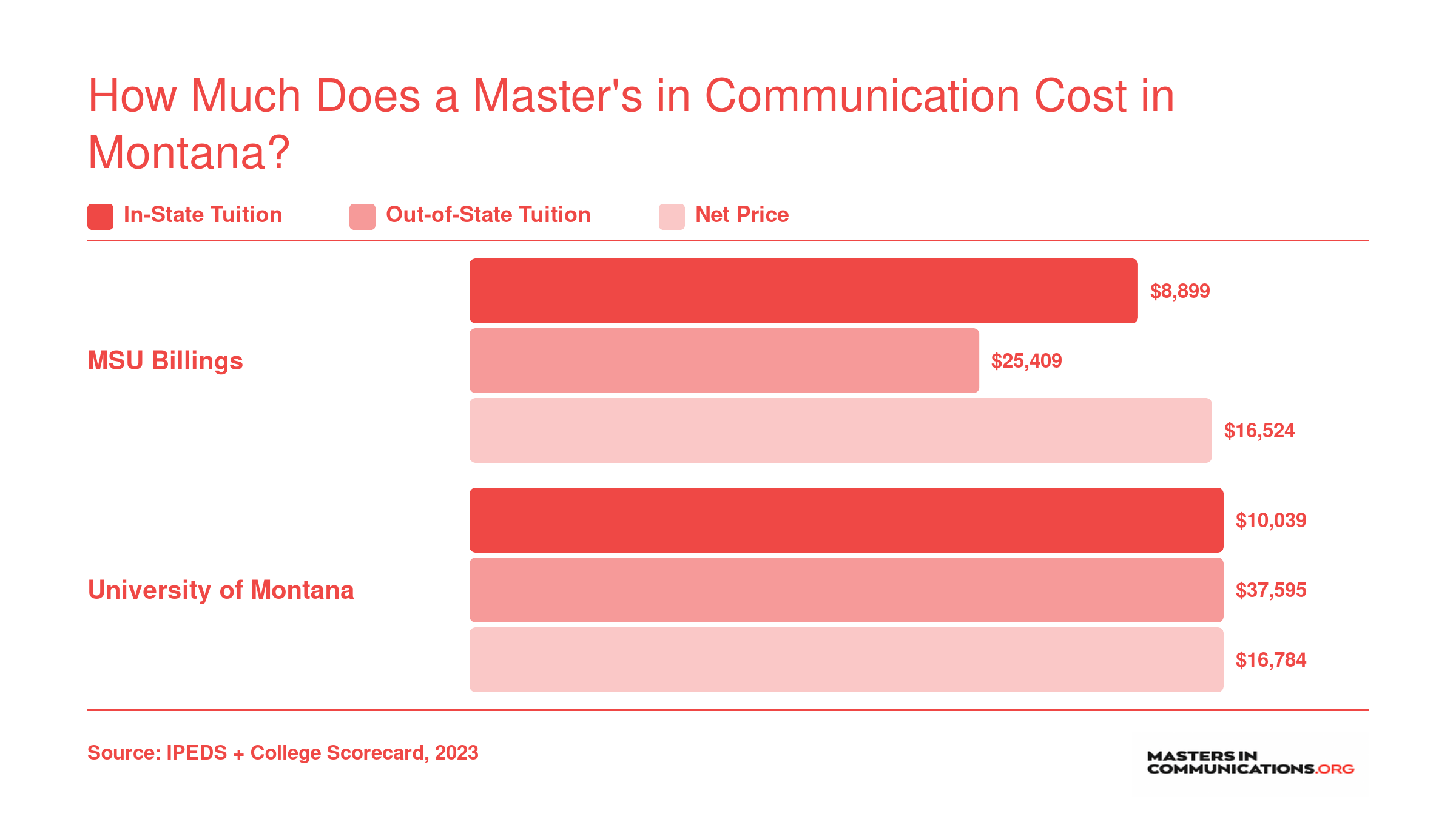
How Much Does a Master's in Communication Cost in Montana?
Montana's two graduate communication programs offer tuition well below the national average for master's-level study, which typically runs $30,000 to $40,000 per year at public institutions for out-of-state students. In-state residents benefit from especially competitive pricing, though net price after aid narrows the gap between the two schools considerably.
Admissions Requirements and Application Tips
Getting into a graduate communication program starts with understanding exactly what each school expects before you submit a single document. Montana's two primary options, the University of Montana's M.A. in Communication Studies and Montana State University Billings' M.S. in Public Relations, each have distinct entry points worth knowing before you apply.
University of Montana: What the Program Expects
The University of Montana requires a minimum undergraduate GPA of 3.0 for admission to the Communication Studies M.A.1 You'll need a bachelor's degree in hand before enrolling, though the degree does not have to be in communication. If your undergraduate background was in another field, the department may ask you to complete additional coursework in communication studies (listed in the catalog as COMX courses) before or alongside your graduate work.2 Think of it as a leveling requirement, not a barrier.
As of 2025-2026, the program's GRE policy should be confirmed directly with the Graduate School, since test-optional stances have shifted at many institutions in recent years. Check the University of Montana Graduate School policies page for the current requirement rather than assuming either direction. If you discover the GRE is not required, you may also want to explore online masters in communication no GRE options for comparison.
Typical supplemental materials for graduate communication programs like this one include:
- Writing sample: Usually an academic paper demonstrating your ability to engage scholarly literature and construct an argument.
- Letters of recommendation: Most programs expect two or three letters from faculty or professional supervisors who can speak to your academic or analytical abilities.
- Statement of purpose: Your chance to explain your research interests, career goals, and why this specific program fits your plans.
Montana State University Billings: A Different Focus
MSU Billings does not offer a standalone master's in communication. Its Department of Communication and Theatre houses a 30-credit M.S. in Public Relations, delivered fully online.3 If your interests lean toward PR strategy, media relations, or organizational communication with a public-facing emphasis, this program deserves a close look alongside UM's more research-oriented track.
Three Tips to Strengthen Your Application
First, reach out to faculty before you apply. A brief, specific email about a faculty member's current research, not a generic inquiry, signals genuine interest and can clarify whether your goals align with what the program actually offers.
Second, tailor your statement of purpose to Montana. UM faculty have research strengths in areas like environmental communication, health communication, and interpersonal communication. Connecting your interests to those areas, even loosely, shows you have done more than skim the website.
Third, treat the writing sample as a portfolio piece. Choose work that reflects your sharpest analytical thinking, not necessarily your most recent paper. If nothing from your undergraduate years feels strong enough, consider revising before you submit.
Related Articles
How Long Does It Take to Complete a Master's in Communication in Montana?
How many semesters should you plan for when pursuing a communication master's degree in Montana, and can you finish faster by choosing one capstone track over another?
The University of Montana's M.A. in Communication Studies is designed for full-time students to complete in roughly two years, or four semesters.1 That timeline is the standard benchmark, though individual factors like course load, capstone choice, and summer enrollment can shift your graduation date in either direction.
Credit Requirements by Capstone Track
The program offers two culminating experiences, and each carries a slightly different credit total:1
- Thesis track: 35 credits, which includes 9 credits of thesis work alongside 8 credits of core coursework and additional elective or directed-study credits.
- Professional paper track: 38 credits, with 6 credits devoted to the professional paper and the same 8-credit core, plus a larger share of coursework credits.
At first glance, the three-credit difference may seem minor, but it can influence how you distribute your schedule across semesters. Students choosing the thesis route take on a heavier independent research commitment; those opting for the professional paper complete more structured coursework instead. Neither path dramatically lengthens or shortens time to degree for a full-time student, but the thesis track's reliance on committee scheduling and research timelines can sometimes extend the final semester if progress slows.
Part-Time Enrollment and Summer Options
Part-time enrollment is generally available at the University of Montana, which is a meaningful consideration for working professionals balancing jobs and coursework. Spreading 35 to 38 credits over a part-time schedule typically stretches completion to three or even four years, depending on how many credits you carry each term. If the university offers relevant summer courses in the communication studies department, enrolling during those sessions can help compress either a full-time or part-time timeline. Check directly with the department for current summer course availability, as offerings may rotate year to year.
Transfer Credits and Time-to-Degree
Graduate transfer credit policies vary by institution and program, so it is worth confirming with the University of Montana's Graduate School whether any previously completed graduate coursework can apply toward the 35- or 38-credit requirement. Even a handful of accepted transfer credits could shave a semester off your plan, particularly if you are enrolled part-time. Keep in mind that core courses and capstone credits are less likely to transfer, so the savings usually come from elective slots.
Planning Your Timeline
For most students, budgeting two full academic years is a reliable starting point. If you can enroll in summer terms and maintain a full course load, you may finish in as few as 18 months. Conversely, part-time students should plan for a longer runway and build in extra time for the thesis or professional paper process. Reaching out to the Communication Studies program coordinator early in the admissions process will give you the clearest picture of how your specific circumstances map onto the degree timeline.
Questions to Ask Yourself
Career Outcomes and Salary Potential After Graduation
Pursuing a master's in communication can follow two distinct career trajectories: agency and corporate roles in competitive urban markets, or positions within Montana's smaller but tight-knit professional landscape. Understanding how regional salaries compare to national figures helps you weigh the trade-offs between earning potential and the lifestyle benefits of working in Big Sky Country.
Program-Level Earnings Data
Federal program-level earnings data for Montana's communication master's programs is not yet published in available reporting cycles. This means specific median salaries at one year or four years after completion are not available for graduates of programs like Montana State University Billings' Master of Science in Public Relations. As more cohorts complete these programs and enter the workforce, this data should become accessible in future reporting periods. In the meantime, occupation-level wage statistics offer valuable context for setting realistic expectations.
Montana Salaries vs. National Benchmarks
According to Bureau of Labor Statistics data, the national median annual wage for public relations specialists stood at $66,750 in 2023.1 Entry-level professionals at the 10th percentile earned around $38,570, while those at the 75th percentile brought home approximately $92,290. Top earners at the 90th percentile reached $126,220 nationally.1
Montana-specific median wages for public relations specialists are not published in BLS occupational tables.1 However, industry salary aggregators suggest Montana's median for this occupation falls closer to $56,879, roughly $10,000 below the national figure.2 This gap reflects the state's smaller market size and lower cost of living rather than diminished opportunity.
For context, housing costs in Missoula and Billings run significantly lower than in Denver, Seattle, or other regional hubs where communication professionals often cluster. A salary that appears modest on paper may stretch further when rent, commuting costs, and everyday expenses are factored into the equation.
Employment Outlook and Realistic Expectations
While specific employment share and earnings-above-poverty metrics for Montana communication master's graduates are not currently reported, the state's economic profile provides useful clues. Montana's communication sector is concentrated in healthcare systems, higher education, tourism marketing, and state government. Graduates often find roles as public relations specialists, communications managers, marketing directors, or media coordinators within these industries. For a broader look at what's possible, explore careers with a masters in communication across the field.
The path to higher earnings typically involves either advancing into management positions or gaining specialized expertise in areas like crisis communication, digital strategy, or stakeholder relations. Public relations and fundraising managers nationally earn considerably more than specialists, though Montana-specific data for this management-level occupation is similarly limited.
Cost-of-Living Considerations
When evaluating salary potential, consider what your compensation actually buys. Montana's lower living costs can offset the gap between local and national wages. A communications professional earning $57,000 in Billings may enjoy comparable purchasing power to someone earning $70,000 or more in Portland or Minneapolis. If you value outdoor access, community connection, and a slower pace, the financial calculus shifts in Montana's favor.
For those willing to work remotely, completing a Montana-based program while pursuing clients or positions in higher-paying markets offers another strategy. Several of the state's programs are available fully online, and graduates interested in public relations specifically may also want to consider an online master's in public relations to broaden their options. These flexible formats position you to leverage your credentials wherever opportunity calls.
Online vs. On-Campus Options for Montana Residents
Montana residents have a handful of in-state graduate communication programs, but the real decision often comes down to delivery format. Below is a side-by-side comparison of the two Montana-based programs listed in our rankings alongside three well-regarded out-of-state online options. Each program is regionally accredited, and all five are accessible from anywhere in the state.
| Program | Delivery | Approximate Annual Tuition | Timeline | Flexibility for Working Professionals | Networking and Local Connections | Tuition Reciprocity for MT Residents |
|---|---|---|---|---|---|---|
| Montana State University Billings, M.S. in Public Relations | Fully online with evening class options | About $8,899 (in-state); roughly $25,409 (out-of-state) | 3 to 4 semesters | High: all courses available online, evening scheduling | Strong regional ties in Montana; internship opportunities in Billings area | WICHE-eligible program, so eligible students from participating states may receive reduced rates |
| University of Montana, M.S. in Speech Language Pathology | Online and on-campus options available | About $10,039 (in-state); roughly $37,595 (out-of-state) | Minimum 4 semesters (68 to 71 credits) | Moderate: distance delivery available, but clinical practicum hours required on site | Direct access to Missoula-area clinical settings and ASHA-certified faculty | In-state tuition applies to Montana residents; no specific WICHE note for this program |
| Purdue University Global, M.S. in Communication | Fully online | Varies by credit load; contact admissions for current rates | 18 to 24 months | High: designed for working adults with asynchronous coursework | National alumni network, though limited Montana-specific connections | No WICHE or WUE discount offered |
| Arizona State University, Online M.A. in Communication | Fully online | Varies; ASU Online publishes per-credit rates that differ from on-campus tuition | 18 to 24 months | High: fully asynchronous with strong digital learning infrastructure | Large national and international alumni base; robust virtual career services | No WICHE or WUE discount offered |
| Southern New Hampshire University, M.S. in Communication | Fully online | Among the more affordable private online options; check SNHU's published rate schedule | 15 to 24 months | High: rolling starts and accelerated terms suit busy schedules | Nationwide career services, though fewer direct ties to Montana employers | No WICHE or WUE discount offered |
Why Earn a Master's in Communication?
The honest question isn't whether a master's in communication is worth it in the abstract. It's whether the payoff of leveling up justifies the time and money you'd spend doing it while juggling a full-time job. For most working professionals eyeing director, manager, or strategist titles, the math tends to favor the degree, but the case is sharper when you look at what specific Montana programs return relative to what they cost.
The Career Advancement Case
Management-tier communication roles (communications director, PR manager, internal comms lead, public affairs strategist) increasingly list a master's as required or strongly preferred. A bachelor's gets you into the field; a master's is what hiring committees often want to see when the job involves running a team, owning a budget, or advising executives. If you've spent five or ten years in coordinator and specialist roles and keep watching the next title go to someone with a graduate credential, that pattern isn't coincidence.
Versatility Across Industries
One underrated feature of this degree: it travels. Communication graduates work in healthcare systems translating clinical information for patients, in tech firms running product communications, in state and federal agencies handling public affairs, and in nonprofits driving advocacy campaigns. You're not locked into journalism or advertising. The skills (audience analysis, message strategy, crisis response, stakeholder management) are portable across sectors that all need clearer storytelling. If you're drawn to team leadership and strategy, an online masters in communication management can sharpen those competencies further.
The Financial Picture
Montana's two main options score well on return relative to debt taken on. Montana State University Billings posts the stronger ratio between what completers earn and what they borrow, with median graduate debt around $18,200. The University of Montana follows close behind, with median debt near $22,400. Both sit well under the debt loads typical of out-of-state private programs.
Built for Working Professionals
Both Montana programs offer online or evening delivery, part-time pacing, and admissions processes that weight professional experience. You don't have to quit your job to enroll, and frankly, most students don't.
Frequently Asked Questions About Communication Master's Programs in Montana
Choosing a graduate program raises plenty of practical questions, from cost and timeline to career payoff. Below are straightforward answers to the questions Montana residents ask most often about earning a master's in communication.
- How much can I make with a master's in communication?
- Earnings vary widely by role and industry. Nationally, the BLS reports that media and communication occupations carry a broad salary range depending on the specific position. Graduates commonly move into public relations, corporate communications, marketing management, and higher education, where salaries tend to climb with experience and leadership responsibility. Montana salaries may differ from national figures, so check state-level wage data for the most accurate picture.
- Why would someone get a master's in communication?
- A master's degree deepens analytical and strategic skills that employers value in leadership roles. It can qualify you for positions in organizational communication, media strategy, public affairs, and academia. Many working professionals also pursue the degree to pivot into a new specialty, strengthen research abilities, or meet the qualifications for senior roles that require an advanced credential.
- What are the admissions requirements for a master's in communication in Montana?
- At the University of Montana, the M.A. in Communication Studies requires a minimum cumulative GPA of 3.0 for admission consideration. Applicants typically submit transcripts, a statement of purpose, letters of recommendation, and a writing sample. Specific materials and deadlines are detailed on the university's graduate application page.
- How long does it take to earn a master's in communication?
- Most full-time students finish in about two years. Part-time enrollment can extend the timeline to three years or more, depending on course load and thesis requirements. Some accelerated or online formats may allow completion in as few as 18 months, though availability depends on the program.
- Are there online master's in communication programs available to Montana residents?
- The University of Montana's M.A. in Communication Studies is primarily campus-based. However, Montana residents can enroll in accredited online programs offered by universities in other states. WICHE's Western Regional Graduate Program may provide tuition discounts at participating institutions, so it is worth exploring those options if flexibility is a priority.
- Is the GRE required for communication master's programs in Montana?
- The University of Montana does not require the GRE for admission to its M.A. in Communication Studies program. Policies vary at other institutions, so if you are considering online or out-of-state programs, confirm each school's testing requirements before you apply.
- Is a master's in communication worth it financially?
- For many professionals the degree pays for itself through higher earning potential and access to senior-level roles. The return depends on factors like your current salary, tuition costs, and career goals. Comparing program costs against projected salary gains in your target field helps you make a grounded decision.
- What concentrations or focus areas are available in Montana communication master's programs?
- The University of Montana's M.A. in Communication Studies emphasizes areas such as interpersonal communication, rhetoric, and organizational communication. Students often tailor their coursework and thesis topic to align with specific career interests. Online programs from other institutions may offer additional concentrations like digital media, public relations, or health communication.