
What you’ll learn in this article…
- UNLV and UNR are Nevada's only two public universities offering a master's in communication studies.
- In-state tuition at both schools stays well below national averages, though out-of-state rates roughly triple the cost.
- Both programs admit on a fall-only cycle, so applicants need materials ready by early spring deadlines.
- Neither university currently offers a fully online communication master's, making schedule flexibility limited for working professionals.
Nevada's graduate communication landscape is compact but consequential: the state's two public universities, UNLV in Las Vegas and UNR in Reno, offer MA programs with distinct strengths. Applicants encounter a single fall admission cycle at each school, in-state tuition under $10,000 per year, and a choice between thesis and non-thesis tracks. Below, a direct UNLV vs. UNR comparison breaks down curriculum emphasis, faculty research, and post-graduation placement realities. What's absent is equally telling: neither program offers an online option, and federal earnings data for communication master's graduates remains unpublished, so salary projections rely on broad occupational categories rather than program-specific outcomes.
Best Master's in Communication Programs in Nevada
Nevada's communication master's landscape is compact: only two public universities offer graduate degrees in the field, which means this ranking also serves as a comprehensive directory. Because the pool is small, choosing between them comes down to program focus, cost structure, and how each school's strengths align with your career goals. Both institutions are regionally accredited by the Northwest Commission on Colleges and Universities, and both deliver on-campus instruction with no fully online option currently available in-state.
- Affordability and net price
- Post-graduation earnings
- Median graduate debt
- Institutional graduation rate
- Program depth and concentration options
- College Scorecard graduate earnings — collegescorecard.ed.gov
- NCES-IPEDS federal institutional data — nces.ed.gov
- Internal program database
- Independent program research
University of Nevada-Reno
#1Reno, NV · $16,000/yr (net price)
Best for: Research-minded communicators seeking mentorship
The University of Nevada, Reno pairs a social-justice-oriented M.A. in Communication Studies with a media-focused M.A. in Media Innovation, giving students broad flexibility within a single institution. UNR's scorecard earnings figure of $60,614 at the ten-year mark and a median graduate debt of $18,922 reflect a strong return on investment, while a 17:1 student-to-faculty ratio supports close mentorship. The communication studies program channels Nevada-relevant themes like intercultural dialogue and organizational dynamics, and faculty are active in Western-region scholarship networks.
- Concentrations in organizational, intercultural, interpersonal, and rhetorical studies
- Thesis or non-thesis capstone pathway
- Social justice lens woven through the curriculum
- Teaching assistantships may offset tuition costs
- Fall-only admission cycle with January 15 priority deadline
- Prepares graduates for Ph.D. programs or industry roles
- Three tracks: Strategic Communications, News Innovation, Media Studies
- 30 total credit hours required for completion
- CAMS research grants available to support graduate work
- Builds on a journalism tradition dating to 1922
- Graduates placed in public radio, news, and digital media
- 3.0 minimum GPA required for admission
University of Nevada-Las Vegas
#2Las Vegas, NV · $10,000/yr
Best for: PR and marketing professionals in Las Vegas
UNLV offers an M.A. in Communication Studies alongside an M.A. in Journalism and Media Studies, with the latter featuring an Integrated Marketing Communication concentration ideal for advertising and PR professionals. The university's net price of $10,359 is the lowest among in-state options, making it especially attractive for budget-conscious students, though the median ten-year earnings figure of $55,037 and graduation rate of 50.5% trail UNR's numbers. Faculty expertise spans health communication, political communication, and converged media, and the Hank Greenspun School provides high-definition broadcast studios, radio production facilities, and editing labs.
- Focus areas in Relational Communication and Public Communication
- Thesis, comprehensive exam, or scholarly research project options
- Faculty expertise in health and political communication
- Campus-based format in the heart of Las Vegas
- Prepares students for doctoral study or professional careers
- Two concentration options allow targeted skill-building
- Integrated Marketing Communication concentration available
- State-of-the-art HD broadcast facility and editing labs
- Campus cable TV (UNLV TV) and FM radio (KUNV) stations
- Three tracks: thesis, professional paper, or strategic digital
- Grounding in mass communication theory and research methods
- Careers in advertising, PR, broadcasting, and digital media
UNLV vs. UNR: Side-by-Side Program Comparison
Nevada has just two public universities offering a graduate communication degree, so your decision comes down to UNLV in Las Vegas or UNR in Reno. The table below stacks them across cost, curriculum structure, and post-graduation outcomes. You won't find this level of detail in a single comparison anywhere else on the web.
| Dimension | University of Nevada, Las Vegas (UNLV) | University of Nevada, Reno (UNR) |
|---|---|---|
| Degree Offered | M.A. in Communication Studies (also offers M.A. in Journalism and Media Studies with an Integrated Marketing Communication concentration) | M.A. in Communication Studies |
| In-State Graduate Tuition (per year) | $7,413 | $7,032 |
| Out-of-State Graduate Tuition (per year) | $25,555 | $25,174 |
| Average Net Price (institutional) | $10,359 | $15,927 |
| Median Graduate Debt | $19,450 | $18,922 |
| Median Earnings (10 years after entry, institution-wide) | $55,037 | $60,614 |
| Thesis vs. Non-Thesis Tracks | Both: thesis track and non-thesis professional paper track | Both: thesis and non-thesis options |
| Key Specialization Areas | Relational communication, strategic digital and social media, integrated marketing communication | Relationships and family communication, social justice and communication |
| Typical Completion Time (full-time) | 2 years | 2 years |
| Teaching Assistantships (with tuition support) | Available; contact the graduate coordinator for current funding | Available; highlighted as a program feature |
| Student-to-Faculty Ratio (institution-wide) | 19:1 | 17:1 |
| Program Format | Campus-based (Las Vegas) | Campus-based (Reno) |
| Admission Rate (institution-wide) | 96.2% | 73.7% |
Questions to Ask Yourself
Tuition, Financial Aid, and Assistantship Opportunities
Knowing what a graduate degree actually costs before you apply is one of the most practical steps you can take. For Nevada's two public communication programs, tuition rates are relatively affordable by national standards, but the gap between in-state and out-of-state rates is significant enough to factor into your planning.
What Tuition Looks Like at Each School
At UNLV, graduate in-state tuition for the communication studies program runs approximately $7,413 per year, while out-of-state tuition climbs to around $25,555. At the University of Nevada, Reno, the comparable figures are roughly $7,032 in-state and $25,174 out-of-state. These are program-level tuition figures.
For context, the institution-wide average net price (which reflects tuition, fees, room, board, and other costs minus all grant and scholarship aid) is approximately $10,359 at UNLV and $15,927 at UNR. Those figures cover all enrolled students across degree levels and aid packages, so treat them as a rough benchmark rather than a precise projection for your own situation.
Graduate Assistantships: A Serious Financial Tool
Both schools offer graduate assistantships, and for students who qualify, these awards can dramatically reduce out-of-pocket costs.
At UNLV, communication studies assistantships carry a stipend of $11,250 for the 2025, 2026 academic year.1 The UNLV Graduate College sets a campus-wide minimum GA stipend of $17,000, so it is worth asking the department directly about the structure of any specific offer you receive.2 Assistants typically receive coverage for nine credit hours of tuition per semester, and crucially, the out-of-state tuition differential is fully waived, meaning out-of-state students pay in-state rates.3 Health insurance premiums are also covered.3 Mandatory fees, however, are not automatically waived, so budget for those separately.3 UNLV also makes a $500 emergency loan available to graduate assistants through the Graduate College.3 The department does not publicly list how many GA positions it offers each year, so reaching out early is worthwhile.1
UNR's communication studies program notes that teaching assistantships are available, but specific stipend figures and waiver details for 2025, 2026 are not published on the department's public pages. Contact the department directly for current offers.
Graduate Debt and Monthly Repayment Reality
Federal Scorecard data for recent graduates at UNLV shows a median graduate debt of around $19,450, while UNR graduates carry a median of approximately $18,922. On a standard 10-year repayment plan, those balances translate to monthly payments in the range of $190 to $205, depending on interest rate. That is a manageable figure for most communication professionals, especially when weighed against the salary gains a masters in communication can support, but it is a real cost that deserves honest planning before you enroll.
Related Articles
Admissions Requirements and Application Deadlines
The question most Nevada applicants face isn't whether they can meet the bar, it's whether they can assemble a competitive file in time for a single annual admission window. Both UNLV and UNR run fall-only cycles for their MA in Communication Studies, which means a missed deadline often costs you a full year of momentum.
Is the GRE Required?
For UNLV's MA in Communication Studies, the GRE is not listed among current application materials.1 Applicants submit transcripts, writing samples, letters of recommendation, and a personal statement through the Graduate College, with no standardized test score requirement built into the program's stated checklist. UNR's Department of Communication Studies has historically followed a similar test-optional posture for the MA, though policies can shift year to year, so confirm directly with the department before assuming a waiver applies. If you are exploring programs nationwide that skip standardized testing, our guide to online masters in communication no GRE covers a broader set of options.
One important note about UNLV: the program is currently not accepting new applications while the department redesigns the degree.1 If UNLV is your target, watch the Communication Studies graduate admission page for the relaunch announcement before building your timeline around it.
GPA, Writing Samples, and Letters
UNLV expects a minimum 3.0 GPA calculated on the last two years of undergraduate coursework, giving applicants whose early college years were uneven a fair shot if they finished strong.1 The application asks for:
- Writing samples: One to two documents that demonstrate analytical or research writing, typically a seminar paper or thesis chapter.
- Letters of recommendation: Three letters, with at least two from academic sources who can speak to your research potential.
- Statement of purpose: A one-to-two-page personal statement explaining your research interests and fit with the program.
- English proficiency: Required for international applicants through TOEFL, IELTS, or an approved equivalent.
UNR's MA program asks for a comparable package: transcripts showing a competitive GPA (typically 3.0 or higher), a statement of purpose, letters of recommendation, and a writing sample.
Deadlines and Funding Timing
UNLV's priority deadline for funded positions is January 15 for the following fall.1 Applicants seeking graduate teaching assistantships must also submit a GTA form and CV alongside the standard application. UNR's MA deadlines typically fall in January or February for fall admission with assistantship consideration, with later cutoffs for self-funded applicants. Neither program runs a spring cycle for the MA.
One context point on selectivity: UNLV and UNR both report institution-wide acceptance rates in the 80 to 90 percent range, but those figures reflect undergraduate admissions and tell you almost nothing about graduate program competitiveness. Communication Studies cohorts are small, and funded slots in particular are competitive on the strength of your writing sample and research fit, not raw numbers.
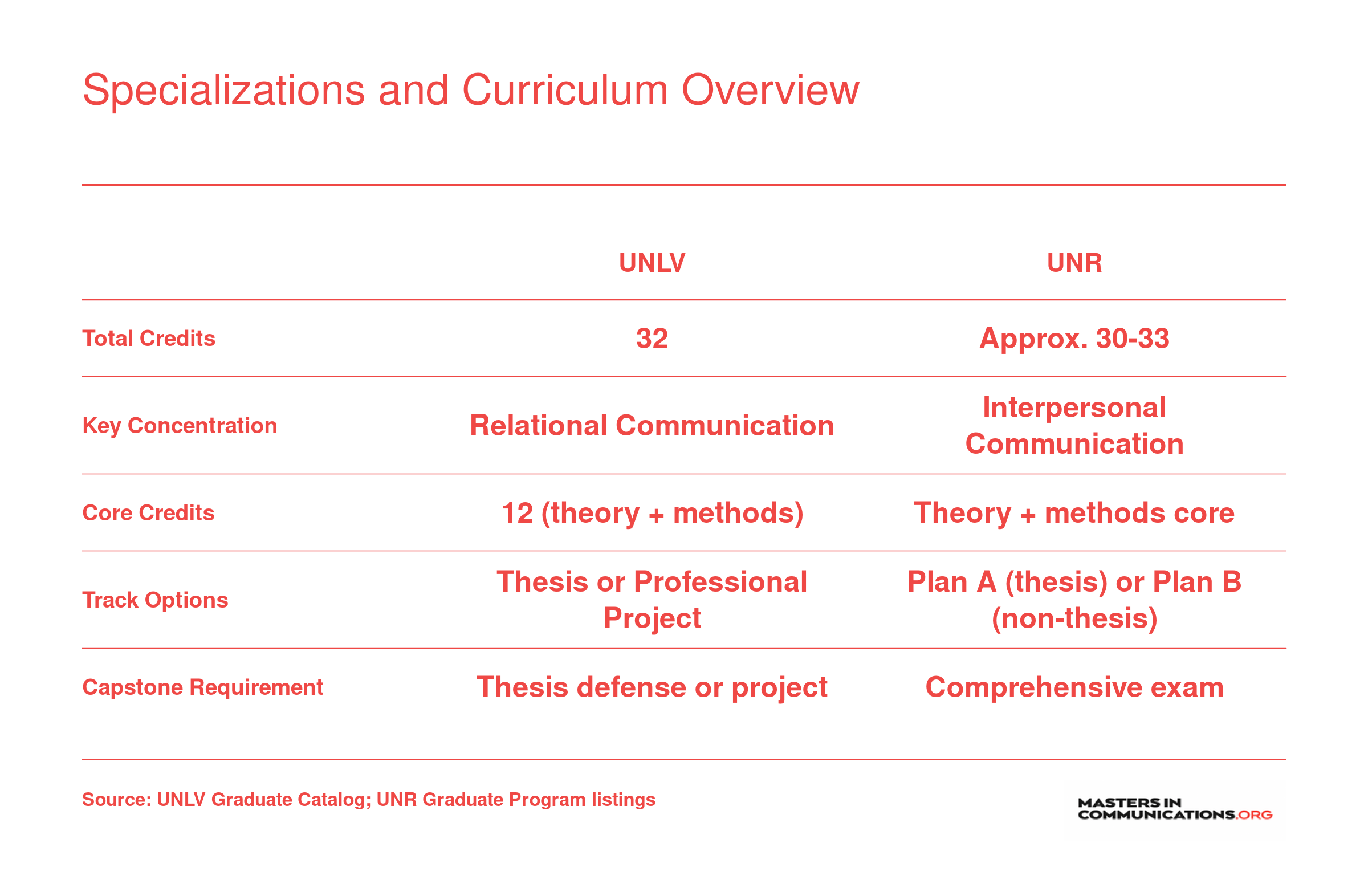
Specializations and Curriculum Overview
Both UNLV and UNR ground their MA in Communication Studies in shared foundational coursework, including communication theory and research methods, before branching into distinct emphasis areas. The biggest curriculum decision you will make is whether to pursue a thesis or non-thesis track. A thesis track suits students aiming for doctoral programs or research-oriented careers, while a non-thesis option (professional project at UNLV, comprehensive exam at UNR) is typically a better fit if you plan to move directly into industry roles such as corporate communications, public affairs, or media strategy.
Career Outcomes and Salary Potential in Nevada
A master's in communication opens doors across Nevada's most active hiring sectors: hospitality and gaming, healthcare, state government, and regional media. Before you commit to a program, it's worth doing some homework on what graduates actually earn and where the jobs are concentrated.
Wage Data to Pull Before You Apply
The Bureau of Labor Statistics publishes detailed wage data by metropolitan area, which is far more useful than national averages when you're planning to work in Nevada. Pull the Occupational Employment and Wage Statistics tables for the Las Vegas-Henderson-Paradise and Reno metros, then filter by the SOC codes most relevant to communication graduates:
- 27-3031 Public Relations Specialists: the most common destination for MA communications graduates moving into corporate communications, agency work, or hospitality marketing.
- 27-3099 Media and Communication Workers, All Other: captures internal communications, digital content strategists, and roles that don't fit neatly into journalism or PR categories.
- 13-1151 Training and Development Specialists: a strong fit for graduates who concentrated in organizational or instructional communication.
For context, the national median annual wage for public relations specialists was $66,750 as of May 20231, and the BLS projects 5% job growth for the occupation between 2024 and 2034, roughly in line with the average across all jobs.2 Metro-level Nevada figures often diverge from the national median, sometimes higher in Las Vegas due to the hospitality sector's reliance on brand communications, so check the OEWS tables directly.
Major Nevada Employers Worth Researching
Nevada's communication job market clusters around a handful of large employers. Spend an afternoon on the careers pages and LinkedIn profiles of MGM Resorts International, Caesars Entertainment, Wynn Resorts, Renown Health, Las Vegas Sands, and the State of Nevada's various agencies. Local media outlets like the Las Vegas Review-Journal and Reno Gazette Journal post communications-adjacent roles regularly. Glassdoor and LinkedIn Salary will give you reported compensation ranges by employer and title, which is useful for negotiating offers later. For a broader look at where your degree can take you, our guide to careers with a masters in communication breaks down job families and salary ranges by specialization.
Local Networks and Forecasts
The PRSA Nevada Chapter and IABC Las Vegas occasionally publish member salary surveys and host events where you can ask practitioners directly about pay bands. For longer-range planning, the Nevada Department of Employment, Training and Rehabilitation (DETR) publishes state-specific occupational projections that complement the BLS Occupational Outlook Handbook. Cross-reference both: DETR captures Nevada-specific demand from tourism rebounds and healthcare expansion that national figures can mask.
Online and Flexible Options for Working Professionals
The demand for flexible graduate education continues to reshape programs nationwide, but Nevada's communication master's offerings remain firmly campus-based. If you are balancing a job with a degree, understanding what is (and isn't) available locally is the first step toward a realistic plan.
The Online Gap in Nevada
No Nevada university currently offers a fully online Master of Arts in Communication Studies. Both UNLV and UNR keep their communication graduate programs on campus, and neither has announced a move to online delivery. UNLV's program is not even accepting applications while it undergoes a full redesign.2 That means for the immediate future, you won't find a remote option from a public Nevada school.
What's Available Locally: Campus Timing and Flexibility
Even if you are willing to attend in person, flexibility is limited. The UNR MA in Communication Studies follows a traditional campus-based schedule, and while individual courses may occasionally be offered in the late afternoon, the department does not advertise a dedicated evening, weekend, or part-time track. Part-time enrollment is typically possible, but you would still need to be present for daytime seminars, which can stretch your degree timeline to three or more years. For the UNLV program, we can't predict the redesigned structure, but historically it operated as a full-time, daytime program.3 Right now, earning a communication master's while working full-time in Nevada requires either an employer willing to accommodate a fluctuating daytime class schedule or relocating closer to Reno.
Out-of-State Online Alternatives for Nevada Residents
Two well-regarded, fully online MA programs accept Nevada residents and give you genuine scheduling control:
- West Virginia University offers an MA in Communication Studies that is entirely asynchronous online. No campus visits are required, and the curriculum covers theory and applied research. Nevada residents should confirm state authorization, but WVU typically enrolls students from all 50 states.
- University of Northern Iowa delivers an MA in Communication and Media in a mix of entirely online, evening, and hy-flex formats. You can complete the degree completely remotely while choosing synchronous or asynchronous engagement. The program emphasizes media literacy and strategic communication, making it attractive for corporate professionals.
Both programs are accredited and designed for working adults, so you can advance without leaving your current job.45 Neighboring states also have strong options worth exploring; for instance, our guide to best master's in communication Arizona covers several flexible programs close to the Nevada border.
Balancing Work, Study, and Assistantships
If you need tuition support, remember that graduate assistantships almost always require full-time enrollment. At UNR, part-time students are typically not eligible for teaching or research assistantships. The same is true at most national programs. So if you pursue the local UNR degree part-time, you'll likely be fully self-funded. The online alternatives above seldom offer assistantships to out-of-state students anyway, but their lower non-resident tuition (compared to relocating) can offset the cost. Weigh the trade-offs carefully: do you need the funding security of a GA position, which demands full-time study, or can you keep working and pay as you go with a flexible online program?
Check the admissions pages of any out-of-state program to verify that they are authorized to enroll Nevada residents and to ask about any synchronous requirements that might conflict with West Coast business hours.
How to Choose the Right Nevada Communication Program
Choosing between Nevada's two graduate communication programs comes down to four decisions, in this order: your long-term academic trajectory, the research questions that energize you, the schedule your life allows, and where you actually want to live for two to three years.
Start With Your Long-Term Trajectory
If a doctorate is on your radar, weigh which program offers stronger pipelines into PhD study, more thesis-track support, and faculty actively publishing in your area of interest. If you are pivoting careers or building on workplace experience, prioritize applied coursework, professional electives, and programs that welcome part-time pacing. If location flexibility is not a constraint, you might also explore best online master's in communication programs to broaden your options. The two Nevada options lean differently on this spectrum, and the earlier comparison section laid out which leans where.
Match Faculty Research to Your Questions
This is the most underused step in graduate school selection. Pull up the faculty directory at each department, read three or four recent publications from professors whose titles intrigue you, and ask: would I want this person on my thesis committee? Health communication, rhetoric, media studies, and organizational communication are not interchangeable subfields, and a program that looks generic on paper often has a clear research center of gravity once you read what its faculty actually write about. Staying current on latest trends in communication can also help you identify which subfields are gaining momentum.
Factor In Schedule and Geography
Reno and Las Vegas are six hours apart and culturally distinct. Evening course availability, hybrid options, and assistantship hours all shape whether you can keep a job. If you are tied to one metro, the decision is partly made for you. If you are mobile, visit both campuses before committing.
Take Two Concrete Next Steps
Email the graduate coordinator at each department this week. Ask about cohort size, recent thesis topics, and funding timelines. Then register for the next virtual info session or campus visit day. Coordinators answer questions admissions websites do not, and a 30-minute conversation often clarifies the fit faster than another week of comparison reading.
Frequently Asked Questions About Communication Master's Programs in Nevada
Choosing a graduate program raises plenty of practical questions, especially when you are balancing work, family, and finances. Below are direct answers to the questions Nevada applicants ask most often.
- What can I do with a master's in communication in Nevada?
- Graduates move into roles such as public relations manager, corporate communications director, media strategist, digital marketing lead, and higher education administrator. Nevada's growing tourism, gaming, and tech sectors create strong demand for skilled communicators. A master's degree also opens doors to community college teaching positions and specialized consulting work across Las Vegas and Reno.
- How much does a master's in communication cost in Nevada?
- At UNLV, in-state graduate tuition and fees run roughly $6,000 to $7,000 per semester, while out-of-state students pay significantly more. UNR's rates are comparable for residents. Both universities offer graduate assistantships that often include tuition waivers and stipends, which can reduce total program cost to a fraction of the sticker price.
- Is the GRE required for master's in communication programs in Nevada?
- Neither UNLV's MA in Communication Studies nor UNR's MA in Communication Studies currently requires GRE scores for admission. Both programs place greater emphasis on your statement of purpose, writing sample, letters of recommendation, and undergraduate GPA. Always verify requirements directly with each department, as policies can change from one admissions cycle to the next.
- Are there online master's in communication programs in Nevada?
- UNLV and UNR primarily deliver their communication master's programs through on-campus coursework. However, both universities have expanded hybrid and evening scheduling options that accommodate working professionals. If a fully online format is essential, you may want to explore accredited programs offered by institutions outside the state that accept Nevada residents at competitive tuition rates.
- How long does it take to complete a master's in communication?
- Most full-time students finish in about two years (four semesters). Part-time enrollment, common among working professionals, typically extends the timeline to three years. Thesis tracks may take slightly longer due to research and defense requirements. Both UNLV and UNR allow flexibility in course load, so you can pace the degree around your career obligations.
- What is the difference between a thesis and non-thesis track in communication?
- The thesis track requires an original research project defended before a faculty committee, making it ideal if you are considering doctoral study or a research-focused career. The non-thesis (or professional) track substitutes additional coursework or a capstone project, which suits students who want to apply skills immediately in industry roles. Credit requirements are generally similar across both options.