
In Brief
- Seattle PR specialists earn a mean annual wage of $96,990, well above the national median for the role.
- Washington offers five distinct master's in communication programs spanning fully online, hybrid, and on-campus formats.
- Specializations range from strategic communication and digital media to rhetoric and political communication.
- Most programs no longer require GRE scores, and minimum GPA thresholds cluster around 3.0.
Washington is home to Amazon, Microsoft, and some of the nation's largest healthcare systems, yet only a handful of universities offer a master's in communication, making program selection a high-stakes decision with relatively few options. The range spans UW-Seattle's 45-credit research thesis track to Gonzaga's fully online Communication and Leadership Studies MA, with in-state graduate tuition running from roughly $14,000 to $22,000 depending on the program.
That small field works in your favor. Each program occupies a distinct niche: research preparation, strategic communication for working professionals, or clinical speech-language pathology. The tradeoff is flexibility versus depth, and the right choice depends on whether your next move is a doctoral program, a director-level role at a Seattle tech firm, or a clinical license.
Best Master's in Communication Programs in Washington for 2026
Washington state offers a compact but surprisingly diverse set of graduate communication programs, from research-intensive thesis tracks at a flagship university to fully online professional degrees designed for mid-career pivots. Whether you want to study political rhetoric in Seattle, train as a speech-language pathologist in Bellingham, or sharpen your strategic communication skills from anywhere in the state, the five programs below represent the strongest options for 2026. Program-level post-completion earnings data is not yet available for these degrees, so we have included institution-wide median earnings at ten years as broader context for return on investment.
- Academic quality and graduation rates
- Program flexibility and delivery format
- Tuition affordability and net price
- Faculty ratio and mentorship access
- Career alignment and earnings potential
- Independent program research
- NCES-IPEDS federal institutional data — nces.ed.gov
- College Scorecard graduate earnings — collegescorecard.ed.gov
- Internal program database
Washington State University
#1Pullman, WA · $15,000/yr
Best for: Career changers wanting multiple online tracks
Washington State University stands out for the breadth of its graduate communication portfolio: working professionals can choose among a fully online MA in Strategic Communication, an online MA in Health Communication and Promotion, or a campus-based MA in Communication at the Murrow College in Pullman. The online programs charge a flat $672 per credit regardless of residency, keeping total tuition around $20,150 for 30 credits. With an institution-wide graduation rate of 60.5% and median earnings of $68,905 at ten years post-enrollment, WSU blends affordability with solid long-term outcomes.
- Fully online, asynchronous 30-credit curriculum
- No GRE required; 3.0 GPA minimum for admission
- Three annual start dates: spring, summer, and fall
- Capstone project replaces traditional thesis
- Covers crisis communication, ethics, and multimedia
- Flexible 1-, 2-, or 3-year completion tracks
- In-state tuition rate extended to all online students
- 27 to 33 credit hours with thesis and non-thesis options
- Test-optional admissions with January 10 priority deadline
- Automatic consideration for funded assistantships
- Strong research orientation in media and society
- No undergraduate prerequisites required
- Prepares scholars, educators, and communication leaders
- 30 credit hours covering health behavior change theory
- Cohort-based, fully online with weekly office hours
- Capstone portfolio project required
- Focuses on digital health communication strategies
- No GRE required; military benefits accepted
- Three start dates per year for scheduling flexibility
University of Washington-Seattle Campus
#2Seattle, WA · ~$14,000/yr (est.)
Best for: Research-driven scholars pursuing doctoral pathways
The University of Washington's MA in Communication is a research-first, thesis-required degree that functions as a launchpad for doctoral study or high-level communication leadership. With only 45 credits and a tight, selective cohort, students work closely with faculty across six research areas including political communication, technology and society, and rhetoric. UW's 85.2% institution-wide graduation rate is the highest among public universities on this list, and median earnings reach $78,466 at ten years, reflecting the Seattle campus's broader alumni trajectory. Net price sits at $14,091 after aid for eligible students, making it competitive despite headline tuition of $18,792 in-state.
- Selective, small-cohort program with close faculty mentoring
- 45 total credit hours with mandatory thesis and oral defense
- Six research concentrations: political, cultural, digital, and more
- Core seminars COM 500 and COM 501 anchor the curriculum
- Bridges humanistic and social scientific research traditions
- Access to Seattle's tech, media, and policy ecosystems
- Strong pipeline into PhD programs at UW and peer institutions
Gonzaga University
#3Spokane, WA · $35,000/yr
Best for: Working professionals seeking leadership-focused credentials
Gonzaga University's MA in Communication and Leadership Studies is built for working professionals who want to earn a graduate credential without pausing their careers. Delivered entirely online with asynchronous coursework, the 36-credit program offers six concentration options, including Change Leadership and Digital Media Strategies. As a private institution, Gonzaga charges a single tuition rate of $21,987 regardless of state residency, eliminating the in-state vs. out-of-state guesswork. The university posts the highest institution-wide graduation rate in this ranking at 86.3%, and median earnings at ten years reach $78,892.
- 36 credit hours, fully asynchronous online delivery
- Six concentrations including Digital Media Strategies
- No GRE required for admission
- Optional domestic immersion trips and study abroad
- Alumni network includes professionals at Google, Amazon, Microsoft
- Covers strategic communication, crisis response, and data visualization
- Flexible pacing allows full-time work throughout the program
- Graduates pursue roles as communication directors and consultants
Eastern Washington University
#4Cheney, WA · $14,000/yr
Eastern Washington University's MS in Communication Sciences and Disorders trains students to become licensed speech-language pathologists, with deep clinical roots in the Spokane region. The five-semester, on-campus program requires 78 to 81 quarter credits and at least 400 clinical practicum hours in diverse healthcare and school settings across eastern Washington. EWU is ASHA CAA-accredited and reports strong completion and job placement rates. In-state tuition of $14,106 and a net price of $13,886 make it one of the most affordable graduate communication-adjacent programs in the state.
- 78 to 81 quarter credits over five semesters
- 400+ clinical hours in hospitals, schools, and clinics
- ASHA Council on Academic Accreditation certified
- Thesis or research project option available
- 3.0 GPA required in last 90 quarter credits
- Oral comprehensive exam at program completion
- Aligned with Washington state SLP licensure requirements
Western Washington University
#5Bellingham, WA · $10,000 – $29,000/yr
Western Washington University's MA in Speech-Language Pathology is a two-year, full-time residential program accredited by ASHA's Council on Academic Accreditation. Located in Bellingham, the program places students in both on-campus clinics and off-site settings throughout Washington and into neighboring Canada for internship rotations. WWU reports a 64.6% institution-wide graduation rate and median earnings of $62,569 at ten years. In-state tuition is the lowest on this list at $13,878, though the net price of $21,193 is higher, reflecting the program's full-time, cohort-based structure.
- Two-year, full-time cohort with no part-time option
- CAA-accredited with robust clinical practica
- Onsite and offsite placements across Washington and Canada
- Plan of study filed early in fall quarter
- Prepares students for Washington state ESA certification
- State-of-the-art campus labs and clinical facilities
- Research opportunities integrated into coursework
Tuition and Cost Comparison for Washington Communication Programs
Funding a graduate communication degree in Washington involves more than comparing sticker prices. Scholarships, graduate assistantships, and employer tuition reimbursement can dramatically reduce your out-of-pocket costs. The table below highlights external scholarship opportunities available to communication graduate students in the state, along with practical next steps for uncovering additional funding at your target university.
| Funding Opportunity | Award Amount (2026) | Eligibility Notes | How to Learn More |
|---|---|---|---|
| Paul & Daisy Soros Fellowship | $90,000 | Open to new Americans (immigrants and children of immigrants) pursuing graduate study at any accredited U.S. institution, including Washington universities | Visit the Soros Fellowship website for application deadlines and eligibility details |
| Seattle Foundation Communications Scholarship | $5,000 | Intended for students pursuing communication studies in the Seattle area; check current eligibility criteria each cycle | Review current scholarship opportunities through the Seattle Foundation |
| Seattle Foundation Graduate Scholarship | $4,000 | Available to graduate students in the greater Seattle region; field of study and residency requirements may apply | Review current scholarship opportunities through the Seattle Foundation |
| Graduate Assistantships (UW, WSU, Gonzaga, others) | Varies by department | Typically include a stipend plus partial or full tuition waiver; awarded by individual communication departments | Contact the graduate program coordinator or department chair directly for the most current stipend ranges and openings |
| Employer Tuition Reimbursement | Varies by employer | Many Washington employers, including major tech companies, offer tuition benefits; confirm eligibility for part-time or online formats | Check your employer's HR policies and the university's tuition benefits page (for example, UW's Tuition Exemption program) |
| NCA and WSCA Discipline Scholarships | Varies | The National Communication Association and Western States Communication Association list discipline-specific scholarships and assistantship resources | Visit the NCA or WSCA websites and search for graduate funding listings updated each academic year |
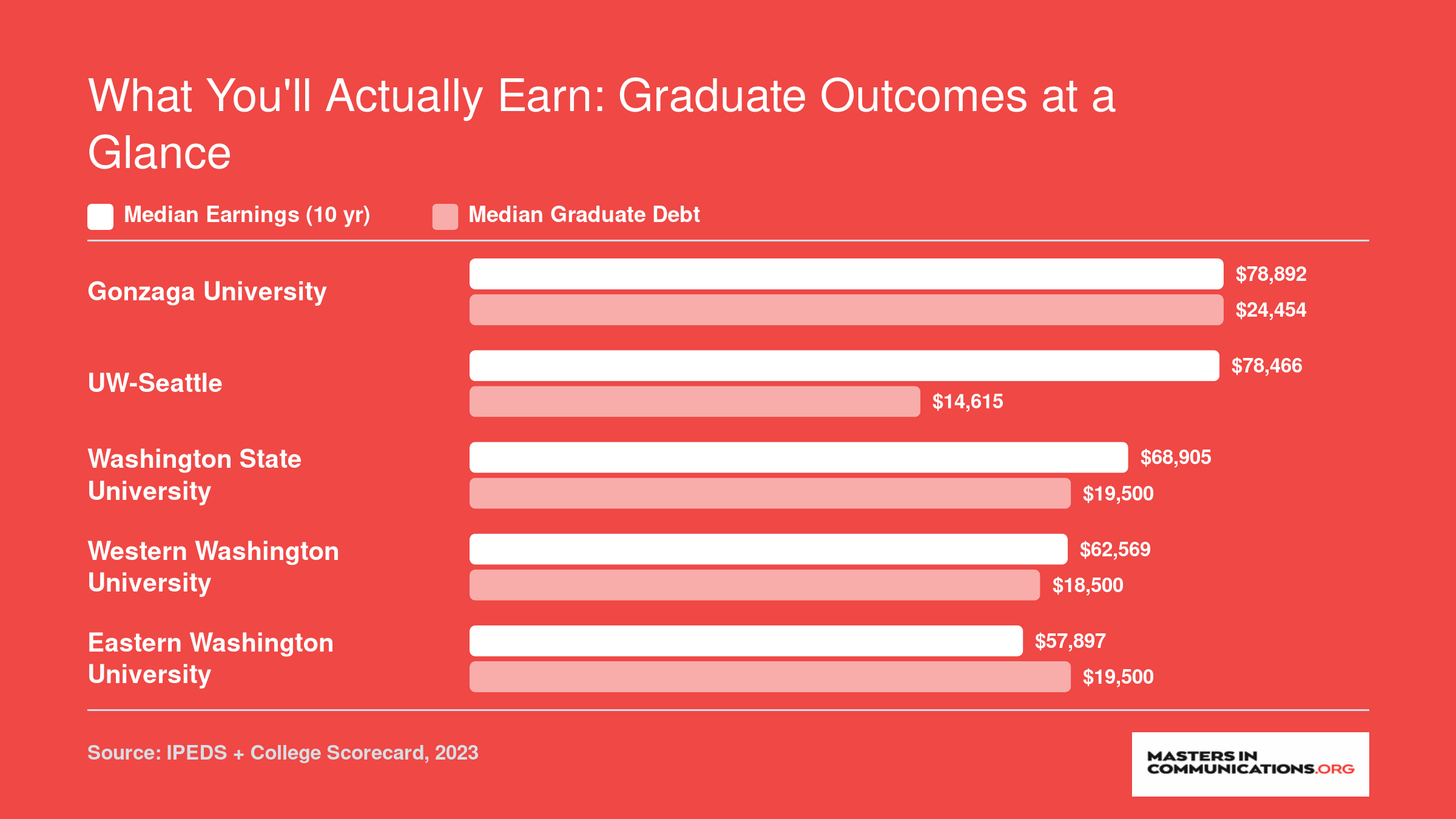
What You'll Actually Earn: Graduate Outcomes at a Glance
Program-level earnings data (such as median salary at one year or four years after completion) are not yet published for these Washington communication master's programs in the College Scorecard. The institution-wide figures below show median earnings ten years after enrollment alongside median graduate debt, giving you a useful debt-to-earnings snapshot across five schools. These are program-completer outcomes reported by the College Scorecard, not occupational wage estimates.
Online vs. On-Campus Communication Programs in Washington
Washington's graduate communication landscape splits neatly between online and on-campus delivery, so your ideal format depends on how much flexibility you need and how much you value in-person interaction. Three programs run fully online with asynchronous coursework, while two are traditional on-campus experiences. Note that observations about networking and cohort dynamics below are general guidance across format types, not program-specific data points.
| Dimension | Fully Online (WSU Strategic Communication, WSU Health Communication and Promotion, Gonzaga Communication and Leadership) | On-Campus (UW Communication, WSU Communication) |
|---|---|---|
| Schools with this format | Washington State University (two programs) and Gonzaga University | University of Washington (Seattle) and Washington State University (Pullman) |
| Pacing and scheduling | Asynchronous: complete weekly modules on your own schedule. None of these programs are self-paced or accelerated. | Set class times on campus; WSU's on-campus MA runs 27 to 33 credits depending on thesis or non-thesis track. |
| Typical credit load | 30 credits for all three online programs | UW requires 45 credits; WSU's on-campus MA ranges from 27 to 33 credits |
| Flexibility for working professionals | High. No commute, no fixed meeting times. Ideal if you hold a full-time role or live outside the Puget Sound or Palouse regions. | Lower. You'll need to be near Seattle or Pullman for regular in-person sessions, which can be challenging alongside a career. |
| Networking and cohort experience | You'll connect through discussion boards, virtual office hours, and cohort projects. Relationship-building requires more intentional effort in a remote setting. | Face-to-face seminars, campus events, and proximity to faculty research labs tend to deepen professional relationships organically. |
| Tuition range (annual, in-state) | WSU: roughly $14,845; Gonzaga (private, flat rate): roughly $21,987 | UW: roughly $18,792; WSU: roughly $14,845 |
| Multiple start terms | WSU online programs offer spring, summer, and fall entry points, giving you more on-ramps throughout the year. | Typically fall-only admission, requiring longer advance planning. |
| Best fit | Professionals prioritizing schedule control, remote access, or a specialized focus such as health communication or strategic communication. | Students seeking immersive research training, in-person mentorship, or preparation for doctoral study. |
Questions to Ask Yourself
Specializations and Concentrations Available in Washington
Washington's communication master's programs split into three clear career tracks, and the culminating experience tells you which path each program serves. UW's research MA requires a thesis with oral defense, while WSU's online Strategic Communication MA wraps up with a capstone portfolio.1 That single design choice signals whether a program is grooming you for doctoral study or sending you straight into industry.
Corporate and Strategic Communication Track
This is the deepest bench in the state. WSU's online Master of Arts in Strategic Communication centers on multimedia content creation, crisis communication, and professional ethics, finishing with a capstone project and comprehensive exam.1 Gonzaga's online MA in Communication and Leadership Studies pairs an applied capstone with a digital portfolio, and its graduates frequently move into communication director roles across diverse industries.1 UW's Communication Leadership Master's Program rounds out this track with a capstone plus internship or portfolio-style work.2 If your goal is PR, corporate communication, or leadership of a comms function, these three programs overlap heavily in outcome even though they differ in delivery and price. For professionals weighing fully online options beyond Washington, online masters in organizational communication programs offer similar strategic skill sets.
Research and PhD-Preparatory Track
UW's MA/PhD in Communication and WSU's thesis-option MA (33 credits) are the two research-oriented choices.1 Both require original research culminating in a defended thesis, and both suit students planning to continue to doctoral study or pursue research-heavy roles. WSU's thesis option offers three named specializations: Health Communication; Media, Politics and Society; and Science Communication. UW spans six research areas including political, cultural, and digital communication, with a unified core anchored by COM 500 and COM 501.1
Hybrid and Applied Options
WSU also offers a non-thesis MA (also 33 credits) that swaps the thesis for a comprehensive exam, giving working professionals a middle path: the same coursework rigor without the research dissertation timeline.1 Eastern Washington and Western Washington focus their graduate communication offerings on Speech-Language Pathology, a clinical track entirely separate from the strategic and research programs above.
Admissions Requirements at a Glance
Applying to a graduate communication program in Washington is more approachable than many prospective students expect. The GRE has largely stepped back from the process, and GPA minimums cluster around a familiar threshold. That said, each program has its own rhythm, and missing a deadline by even a day can cost you a full year.
GRE and GPA Trends
Across the Washington programs covered here, the GRE is either optional or not required at all, reflecting a broader shift toward online masters in communication no GRE admissions nationwide. The University of Washington's research-focused MA/PhD program lists the GRE as optional for Autumn 2026 entry, meaning a strong application can stand on its own without test scores.1 UW's Communication Leadership MA goes a step further and does not require the GRE at all.2 No published minimum GPA appears for the Communication Leadership track, while the UW MA/PhD program sets its floor at 3.0.1 If your undergraduate record falls just below that mark, a compelling writing sample or professional portfolio can sometimes offset the gap.
Deadlines and Start Dates
This is where the programs diverge most sharply. The UW MA/PhD program runs on a competitive annual cycle with a December 1, 2025 deadline for Autumn 2026 admission, so applicants need to plan well ahead.1 Washington State University's MA in Communication closed its most recent cycle on January 10, 2026.3 The UW Communication Leadership MA, by contrast, accepts applications through July 31, 2026 for the same Autumn start, giving working professionals considerably more runway.2
Required Materials at a Glance
- UW MA/PhD: Statement of purpose, transcripts, GRE scores (optional), letters of recommendation; deadline December 1, 2025.1
- UW Communication Leadership MA: Statement of purpose, two to three letters of recommendation, transcripts; deadline July 31, 2026.2
- WSU MA in Communication: Statement of purpose, transcripts, letters of recommendation; prerequisite background in communication or a closely related field expected; deadline January 10, 2026.3
All three programs require a statement of purpose, so treat that document as the centerpiece of your application. WSU also expects applicants to hold an undergraduate degree in communication or an adjacent discipline, which is worth confirming before you invest time in the full package.3
Career Outcomes and Salary Potential for Washington Graduates
Entering the workforce with a communication master's degree versus stopping at the bachelor's level presents two distinct trajectories, and the gap becomes especially clear in Washington's competitive job market. Graduate credentials open doors to senior roles, strategic positions, and salary brackets that remain largely inaccessible to those without advanced training.
What Washington Communication Graduates Actually Earn
Program-level earnings data specific to communication master's graduates at Washington institutions is not yet published in federal databases, which means we cannot report exact median salaries at one or four years post-completion for programs at the University of Washington, Gonzaga University, or Washington State University. However, statewide and metro-area wage data for communication-adjacent occupations provides a useful benchmark.
Public relations specialists in Washington earn a mean annual wage of approximately $85,000, according to state labor data, with the typical range spanning $63,700 to $102,100 depending on experience, employer, and location.1 Nationally, the Bureau of Labor Statistics reports a median of $69,780 for the same occupation, placing Washington well above the national benchmark.2 In the Seattle-Tacoma-Bellevue metro area, private-sector workers across industries average $47 to $48 per hour, reflecting the region's overall premium for skilled professionals.3
Metro-Area Differences: Seattle vs. Spokane
Geography matters. Seattle's concentration of tech headquarters, media companies, and corporate communications departments pushes salaries higher for roles like marketing manager, media relations director, and corporate communications lead. Spokane and the eastern part of the state offer lower cost of living but also more modest salary ceilings for similar positions.
If you are targeting Seattle-based employers, expect starting offers for master's-level communication roles to trend toward the upper half of the statewide range. Those willing to work in Spokane or Pullman may find competitive offers relative to local living costs, even if raw salary figures are lower.
Major Employers Hiring Communication Graduates
Washington's economy creates strong demand for communication professionals across sectors. For a broader look at the roles these employers fill, explore careers with a masters in communication.
- Technology: Amazon and Microsoft employ hundreds of communications specialists across corporate communications, public affairs, product marketing, and internal communications teams. Smaller tech firms throughout the Puget Sound region actively recruit graduate-level talent.
- Healthcare: Systems like Virginia Mason Franciscan Health, Providence, and MultiCare need health communication specialists, patient outreach coordinators, and public affairs professionals.
- State Government: The Washington State Department of Health, Department of Social and Health Services, and various agency communications offices hire graduates for public information roles, crisis communication, and community engagement.
- Nonprofits and Advocacy: Organizations ranging from the Bill and Melinda Gates Foundation to regional advocacy groups seek strategic communicators with advanced credentials.
Is a Communication Master's Worth It?
The earnings gap between bachelor's and master's holders in communication-related fields typically ranges from 15 to 25 percent, depending on industry and role. For a Washington-based PR specialist, that difference could mean $12,000 to $20,000 in additional annual income. Over a 20-year career, even a conservative estimate suggests the degree pays for itself many times over.
Employment rates and share of graduates earning above poverty thresholds are not yet reported at the program level for Washington communication master's programs. However, the state's robust demand for skilled communicators, combined with above-average regional wages, suggests strong employment prospects for those who complete their degrees.
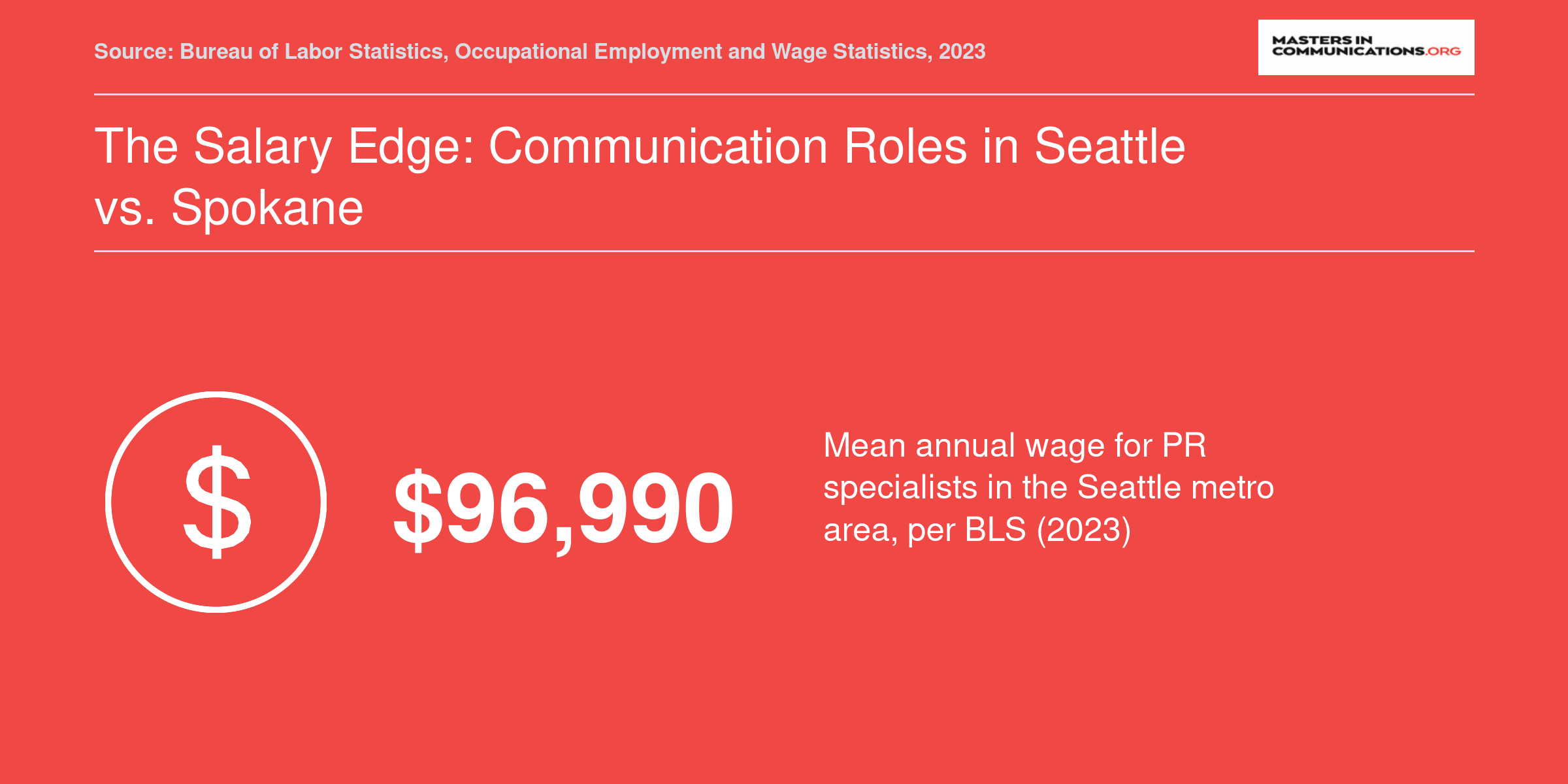
The Salary Edge: Communication Roles in Seattle vs. Spokane
Seattle's larger market and concentration of tech and media companies push communication salaries well above both the national median and figures reported in smaller Washington metros. For public relations specialists, the BLS reports a mean annual wage of $96,990 in the Seattle-Tacoma-Bellevue metro area, compared to a national median of $66,750. Spokane-Spokane Valley metro data for the same role is not published in the most recent BLS release, so prospective students should check the BLS Occupational Employment and Wage Statistics site directly, or contact local chapters of the Public Relations Society of America or the American Marketing Association for regional survey data.
How to Choose the Right Communication Program in Washington
Deciding on a graduate program often pits immediate career practicality against long-term academic ambition, and in Washington's diverse communication landscape, that tension is amplified by the state's unique mix of tech, media, and nonprofit sectors. Whether you are pivoting early in your career or advancing after a decade in the field, the right choice hinges on three interconnected axes: where you are in your professional journey, what you ultimately want to achieve, and what you can realistically invest in time and money.
Align Your Program with Your Career Stage
Early-career professionals often benefit from a broad curriculum that builds a versatile skill set, while mid-career learners usually need targeted specializations to move into leadership roles. If you are entering the field, look for programs that offer core competencies in strategic communication, digital media, and data analysis. If you are already established, a focused concentration in corporate communication, crisis management, or health communication can directly fuel your next promotion. For those targeting Seattle's tech corridor, prioritize schools with strong digital media, strategic communication, or data-driven storytelling tracks. These align with the hiring needs of companies like Amazon and Microsoft, where communication roles increasingly demand cross-platform fluency.
Define Your Academic Goals
Your career ambitions directly shape the academic path you should take. If a doctoral degree is on your horizon, seek out a program that requires a thesis and offers rigorous research methods training. Thesis tracks provide the writing sample and faculty mentorship crucial for PhD applications. On the other hand, if you want to immediately apply what you learn in a corporate or agency setting, a professional track with a capstone project or internship component may serve you better. Programs with applied research opportunities or partnerships with Seattle-area media outlets and nonprofits can bridge the gap between theory and practice without locking you into academia. Students drawn to leadership in public-facing organizations may also want to explore an online master's in communication management, which pairs well with Washington's demand for skilled communicators who can oversee teams and strategy.
Evaluate Format Flexibility Against Networking Needs
Online and on-campus formats each carry trade-offs. An asynchronous online master's lets you balance coursework with a demanding job and family responsibilities, a necessity for many Washington professionals in tech or healthcare communications. However, in-person cohorts offer richer networking, direct access to faculty, and organic connections with classmates who may become future collaborators. If you live near Seattle or Spokane, a hybrid model can give you the best of both worlds: remote learning during the week and occasional weekend intensives for relationship building. Assess your work-life rhythm honestly; if your schedule is unpredictable, the flexibility of an online program often outweighs the loss of some face-to-face interaction.
Factor in Budget and Employer Tuition Assistance
Cost is a practical anchor. Washington's public universities generally offer more affordable tuition for in-state residents, while private institutions may provide enhanced career services or specialized industry networks. Before making your decision, investigate whether your employer offers educational benefits. Many major Washington employers, including Amazon, Microsoft, Boeing, and the state government, provide tuition reimbursement or direct assistance for graduate degrees. These programs can significantly reduce your out-of-pocket expense, making a higher-tuition program suddenly feasible. Additionally, compare total costs by factoring in fees, books, and any income lost if you need to reduce work hours for an on-campus schedule.
Frequently Asked Questions About Communication Master's Programs in Washington
Choosing a graduate communication program raises plenty of practical questions, from cost and format to career payoff. Below are concise answers drawn from the data and program details covered throughout this guide.
- How much does a master's in communication cost in Washington?
- Tuition varies widely by institution and residency status. In-state students at public universities such as the University of Washington or Washington State University can expect lower per-credit rates, while private institutions like Gonzaga University carry higher tuition but may offer generous merit aid. Total program costs typically range from roughly $20,000 to over $50,000. Always check the latest tuition schedules and factor in fees, books, and living expenses.
- Can I earn a master's in communication online from a Washington university?
- Yes. Several Washington schools offer fully online or hybrid master's programs in communication and related fields. Washington State University, for example, delivers its strategic communication master's entirely online, making it a strong option for working professionals statewide or out of state. Online cohorts generally follow the same curriculum and faculty as on-campus tracks, so the degree carries equal weight with employers.
- What jobs can you get with a master's in communication?
- Graduates move into roles such as public relations manager, marketing director, corporate communications strategist, media analyst, UX researcher, and organizational development specialist. Many also pursue positions in health communication, political advocacy, or higher education. The advanced degree can qualify you for senior and leadership roles that typically require both strategic thinking and specialized expertise in audience engagement.
- What are the admissions requirements for communication master's programs in Washington?
- Most programs require a bachelor's degree (not necessarily in communication), a minimum GPA around 3.0, a statement of purpose, letters of recommendation, and a professional resume. Some schools ask for a writing sample or portfolio. GRE scores are increasingly optional. Programs with a professional focus may weigh relevant work experience more heavily than standardized test scores.
- Is a master's in communication worth it?
- For many professionals, yes. Nationally, BLS data shows that workers with a master's degree earn significantly more over a career than those holding only a bachelor's. In Washington's competitive job markets, particularly in the Seattle metro area, a graduate credential can open doors to higher-paying leadership and strategy roles in tech, healthcare, and media sectors where communication expertise is in strong demand.
- Which Washington university has the best communication program?
- The University of Washington consistently ranks among the top communication programs nationally, with deep research strengths and strong industry ties in the Seattle area. Washington State University is well regarded for its online and applied communication options. Gonzaga University offers a smaller, mentorship-driven experience. The best fit depends on your career goals, preferred format, and specialization interests rather than rankings alone.
- How long does it take to complete a master's in communication in Washington?
- Most full-time students finish in about two years, though accelerated options at some schools allow completion in as few as 12 to 18 months. Part-time and online students often take two and a half to three years. Program length also depends on whether you complete a thesis, capstone project, or comprehensive exam, so review each school's degree requirements before committing to a timeline.