
What you’ll learn in this article…
- Stress activates the amygdala and suppresses prefrontal cortex function, causing measurable declines in listening, word retrieval, and tone control.
- After 24 hours without sleep, cognitive performance drops to a level equivalent to a 0.10 blood-alcohol concentration.
- Frameworks like Nonviolent Communication and DESC scripts give professionals repeatable structures that reduce conflict even under high pressure.
- Only 13 percent of U.S. employees disclosed stress concerns to a manager in 2025, despite 83 percent reporting work-related stress.
Picture a Monday morning: you fire off a two-line reply to a colleague's request, no greeting, no context, just a clipped "Can't deal with this right now." By noon, what should have been a ten-minute conversation has become a four-person email thread, a bruised working relationship, and a new layer of anxiety sitting on top of whatever originally triggered the short reply. Stress hijacked the exchange, and the fallout added more stress.
That feedback loop is the central problem. Stress degrades the cognitive functions you depend on for clear communication, including working memory, emotional regulation, and the capacity to read tone accurately. When communication falters, misunderstandings accumulate, conflicts go unresolved, and cortisol levels stay elevated. Poor communication is not just a symptom of stress; it actively sustains it.
The evidence for intervening at the communication level is substantial. Teams with strong communication practices report lower burnout rates, and individuals who learn to express needs precisely under pressure recover from stressful episodes faster than those who go silent or escalate. Skill-building here is not a soft fix.
How Stress Affects Communication: The Neuroscience Behind the Breakdown
When you lose your train of thought mid-sentence during a tense meeting or snap at a colleague over a minor email, the root cause is neurological, not personal weakness. Stress triggers a cascade of chemical events in your brain that physically degrades your ability to speak clearly, listen carefully, and think flexibly. Understanding this process is the first step toward interrupting it.
The Cortisol-Amygdala Hijack
Under acute stress, your amygdala (the brain's threat-detection center) activates rapidly and floods your system with cortisol and catecholamines like norepinephrine. Research reviewed in a 2010 analysis describes how these stress-signaling pathways impair prefrontal cortex structure and function, the very region responsible for working memory, attention, and cognitive flexibility.1 A Frontiers study on moderate acute psychological stress confirmed that working memory accuracy declines measurably under stress, and separate research from the same period showed that the Trier Social Stress Test (a widely used lab protocol) reliably impairs both working memory and cognitive flexibility.2
Cortisol appears to be a necessary ingredient in this impairment. A 2015 study found that cortisol elevation was required for working memory to degrade under stress, and that pre-existing anxiety amplifies the damage.3 The relationship between stress hormones and cognitive performance follows an inverted-U curve: a small dose sharpens focus, but anything beyond that moderate sweet spot tips performance off a cliff. Some people are genetically more vulnerable. Research from 2012 found that individuals with certain COMT genotype variations (Met-homozygotes) experienced significantly greater working memory impairment under stress than others.2
In practical terms, this means the moment your heart rate climbs during a difficult conversation, your brain's executive control center starts losing bandwidth. You can hold fewer ideas in mind, you struggle to weigh options, and your attention narrows to the perceived threat rather than the full picture.
What Stress Does to Your Speech
The prefrontal impairment does not stay hidden inside your skull. It shows up in how you talk. When working memory shrinks, sentence complexity drops. You default to shorter, simpler phrases or abandon thoughts halfway through. Verbal disfluencies increase: the "ums," "uhs," false starts, and repeated words that you might notice in yourself during a high-stakes presentation. If you have ever struggled through a nerve-wracking talk, you already know what it feels like to need tips on how to be a better public speaker. Vocal prosody, the natural melody and variation in your voice, flattens. You may sound monotone or clipped, which listeners often misread as disinterest or hostility even when you feel neither.
Think about the last time you were exhausted and stressed simultaneously. You probably found yourself trailing off, losing vocabulary you normally use with ease, or defaulting to filler phrases like "you know what I mean" instead of articulating your actual point. That is your prefrontal cortex operating on reduced capacity.
The Vicious Cycle: Poor Communication Fuels More Stress
Stress does not just damage communication in one direction. The relationship is bidirectional. When communication breaks down, through unresolved conflicts, vague expectations, or misunderstood tone in a rushed email, the resulting ambiguity and tension trigger fresh stress responses. Those responses further degrade your next attempt at communication. Learning strategies for preventing workplace conflict can help you short-circuit the loop before it escalates. Naming this cycle is essential to breaking it, because most people blame themselves ("I'm bad at confrontation") rather than recognizing a feedback loop they can interrupt at multiple points.
Fight, Flight, or Freeze at the Conference Table
Not everyone responds to communication stress in the same way, and identifying your default pattern gives you a concrete target for change.
- Fight mode: You become argumentative, interrupt others, raise your voice, or use accusatory language. Your amygdala has flagged the conversation as a threat and you are pushing back.
- Freeze mode: You go quiet, disengage, or agree to things you do not actually support just to end the interaction. Colleagues may describe you as "shutting down" during disagreements.
- Flight mode: You deflect with humor, over-explain tangential details, redirect the topic, or physically exit ("Let me get back to you on that") without ever returning. The goal is escape, not resolution.
Most people lean toward one of these patterns consistently, though the specific mode can shift depending on the relationship or power dynamic involved. Recognizing your own tendency is not about self-criticism. It is about building a personal early-warning system: once you notice the pattern firing, you can pause, regulate your nervous system, and choose a more deliberate response. The sections ahead offer concrete frameworks for doing exactly that.
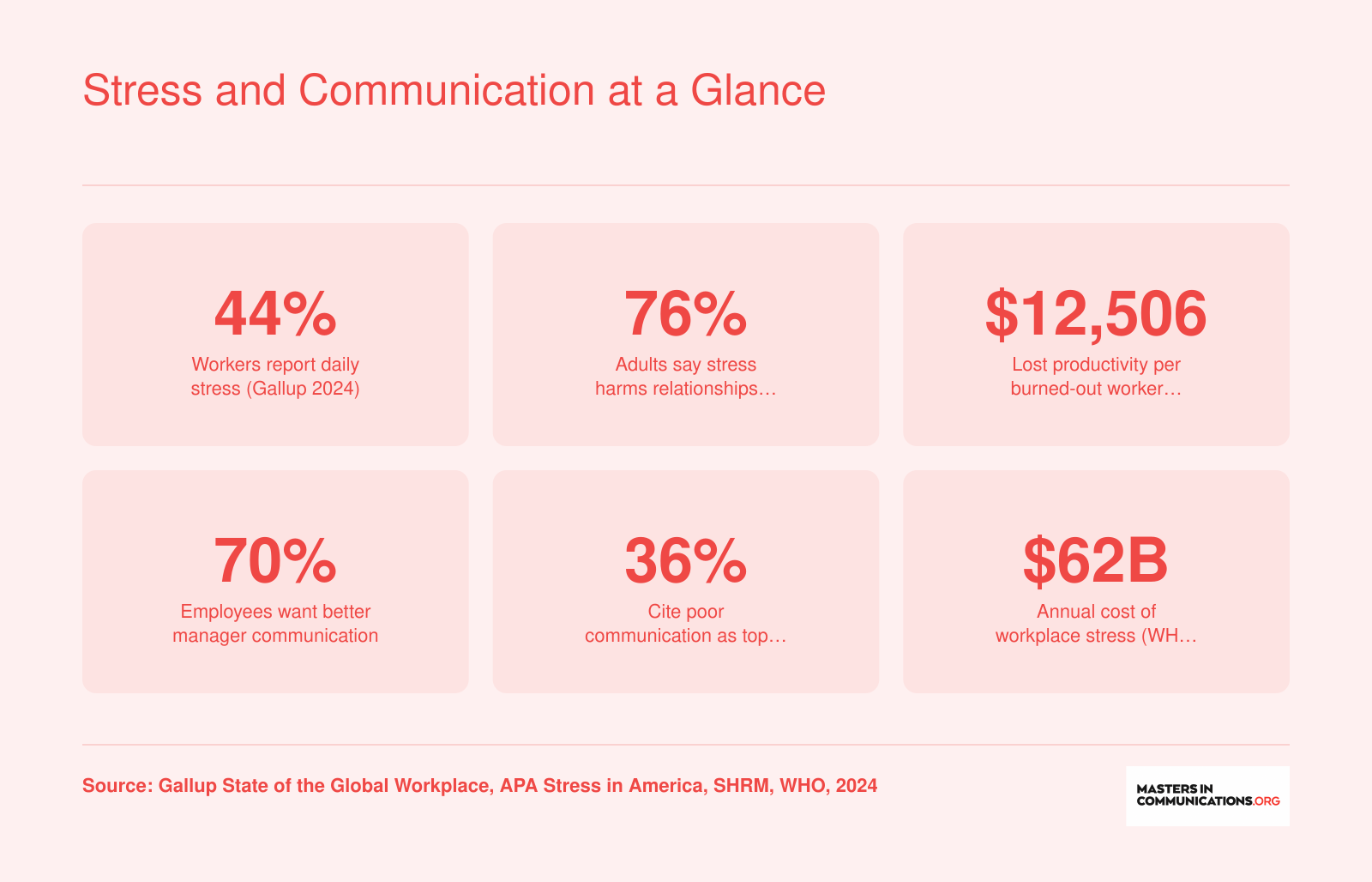
Stress and Communication at a Glance
Workplace stress and poor communication are deeply intertwined, each amplifying the other. These figures highlight the scale of the problem and why strengthening communication skills is one of the most effective strategies for reducing stress at work.
Signs of Communication Breakdown Due to Stress
Think of this table as a personal diagnostic tool, not a judgment list. Each red flag below reflects a natural stress response, and recognizing it is the first step toward managing it. If you notice three or more of these signs showing up consistently in your conversations, that is a reliable signal to start applying the evidence-based frameworks covered later in this guide.
| Red Flag | Category | What It Looks Like | Underlying Stress Mechanism |
|---|---|---|---|
| Interrupting others | Verbal | Cutting people off mid-sentence, finishing their thoughts for them, or jumping in before they pause | When the brain's threat-detection system is activated, the prefrontal cortex loses some capacity for patience. The urgency to resolve perceived danger makes waiting feel intolerable, so you rush to speak. |
| Raised voice or sharp tone | Verbal | Speaking louder than the situation calls for, snapping at minor questions, or using a clipped, tense cadence | Elevated cortisol and adrenaline increase physiological arousal, which often translates directly into vocal intensity. You may not even realize your volume has shifted. |
| Sarcasm or dismissive language | Verbal | Responding with biting humor, saying 'whatever,' or using exaggerated statements like 'Oh, that's just perfect' | Sarcasm serves as a protective mechanism, creating emotional distance when vulnerability feels too risky. It lets you express frustration without directly naming it. |
| Eye-rolling or grimacing | Nonverbal | Visible facial expressions of contempt or frustration, often involuntary, during someone else's point | Stress reduces your ability to regulate micro-expressions. Contempt signals leak out because the emotional brain is reacting faster than the conscious mind can filter. |
| Crossed arms or turned-away posture | Nonverbal | Physically closing off your body, angling away from the speaker, or creating barriers with objects like a laptop | The body mirrors the mind's desire to self-protect. Closed posture is a nonverbal attempt to shield yourself from additional emotional input. |
| Avoiding eye contact | Nonverbal | Looking at your phone, scanning the room, or fixating on a spot on the wall instead of engaging visually | Sustained eye contact requires cognitive resources that stress depletes. Avoidance also reduces the emotional load of reading another person's reactions. |
| Catastrophizing | Cognitive | Using phrases like 'This always happens' or 'Nothing ever works,' framing a single setback as a permanent pattern | Under chronic stress, the amygdala amplifies threat signals and the brain defaults to worst-case forecasting. Nuance becomes harder to access. |
| Mind-reading or assuming intent | Cognitive | Believing you know what someone meant ('She said that on purpose to undermine me') without checking | Stress narrows cognitive bandwidth, making it easier to project your own fears onto others. Verifying intent requires energy the stressed brain is trying to conserve. |
| Black-and-white framing | Cognitive | Viewing situations as all good or all bad, with no middle ground ('Either you support me or you don't') | Cortisol impairs the prefrontal cortex's ability to hold complexity. Binary thinking is a mental shortcut the brain uses when nuanced processing feels too demanding. |
| Withdrawal or stonewalling | Behavioral | Going silent, leaving the room, refusing to engage, or giving one-word answers during important discussions | When stress reaches a tipping point (sometimes called 'flooding'), the nervous system shifts into a freeze response. Withdrawal is the body's attempt to prevent total overwhelm. |
| Over-explaining or defending | Behavioral | Launching into long justifications, repeating yourself, or providing excessive context nobody asked for | Stress triggers a need to feel understood, which can spiral into verbal over-compensation. The more threatened you feel, the harder you work to control the narrative. |
| Passive-aggression | Behavioral | Agreeing outwardly but dragging your feet, 'forgetting' tasks, or using backhanded compliments | When direct confrontation feels unsafe, stress drives expression underground. Passive-aggression lets you communicate displeasure while avoiding the vulnerability of honest conflict. |
Questions to Ask Yourself
How Stress and Tiredness Impair Listening and Speaking
After roughly 24 hours without sleep, cognitive performance drops to a level comparable to a blood-alcohol concentration of 0.10, which exceeds the legal driving limit in every U.S. state.1 That statistic, drawn from sleep-science research cited by the CDC and the Sleep Foundation, should reframe how you think about sending that late-night email or powering through a difficult conversation after a sleepless night. The effects on communication are real, measurable, and compounding.
Acute Stress vs. Chronic Stress: Two Different Threats
Acute stress and chronic stress sabotage your communication in distinct ways. A sudden spike in pressure, such as a confrontation in a meeting or an unexpected deadline, narrows your attentional focus and triggers reactivity. Ironically, short bursts of acute stress can temporarily sharpen simple verbal performance, helping you deliver a rapid status update under fire.3 But that same narrowing makes you less able to read the room, pick up on emotional nuance, or choose words carefully.
Chronic stress is a slower poison. Over weeks and months, sustained pressure erodes memory, attention, and emotion regulation.3 Empathy frays. Patience shortens. You lose the cognitive bandwidth needed to decode tone of voice or pick up on the subtleties of body language. When fatigue joins the picture (and it almost always does), the damage deepens further, because chronic fatigue produces persistent decrements in the exact skills interactive communication demands most.2
How Fatigue Degrades Listening
A well-rested brain processes speech on multiple levels simultaneously: literal meaning, emotional subtext, tonal cues, facial expressions. A fatigued brain defaults to surface-level processing. Listening comprehension drops. Emotional decoding suffers.4 Tone-of-voice interpretation becomes unreliable, and research from the University of California has found that sleep-deprived individuals are more likely to project negative intent onto neutral statements.4 You hear a colleague say "Can we talk about the deadline?" and your tired brain reads it as an accusation rather than a straightforward question. Building stronger effective listening skills can help counteract this tendency, but even practiced listeners lose ground when exhaustion takes hold.
Word-finding difficulty also increases under fatigue. You may reach for one word and say another, introducing confusion that the listener then has to untangle.1 This is especially problematic in high-stakes workplace exchanges where precision matters.
The Stress-Sleep-Communication Loop
These factors do not operate in isolation. Stress causes poor sleep. Poor sleep degrades communication. Degraded communication generates new interpersonal friction, which amplifies stress, which further disrupts sleep. Naming this cycle is the first step to breaking it: once you recognize the stress-sleep-communication loop, you can intervene at any point in the chain instead of blaming yourself or others for the fallout. If workplace tension is a recurring trigger, learning how to prevent conflict in the workplace can help you interrupt the cycle before it escalates.
Three Micro-Strategies for the Exhausted Communicator
You will not always be able to get a full night of rest before an important conversation. When fatigue is unavoidable, these techniques help limit the damage:
- Pause before responding: Build in a deliberate two-to-three-second gap before you reply. This short buffer gives your prefrontal cortex a fighting chance to override the reactive impulse that fatigue amplifies.
- Schedule for peak alertness: Whenever possible, move sensitive conversations to the window when you are most alert, typically mid-morning for most adults. Avoid late-afternoon or post-lunch slots for discussions that require empathy, negotiation, or complex problem-solving.
- Use the "headline first" technique: State the single most important point at the very beginning of your message. This reduces cognitive load for both speaker and listener, lowering the chance that fatigue causes either party to miss the core takeaway buried inside a longer explanation.
None of these strategies replace adequate rest, but they act as guardrails when rest is not on the table. The goal is to protect your relationships and your professional credibility during the moments when your brain is working against you.
Evidence-Based Communication Frameworks for Stressful Situations
Research consistently shows that specific communication frameworks reduce stress, improve clarity, and prevent the breakdowns that occur when pressure mounts. These frameworks are not abstract theories: they are backed by peer-reviewed studies and endorsed by major professional organizations. Below are three evidence-based approaches that anyone can apply in stressful personal or professional situations.
Nonviolent Communication (NVC) in High-Stress Contexts
Developed by psychologist Marshall Rosenberg, Nonviolent Communication centers on expressing observations, feelings, needs, and requests without blame or judgment. Peer-reviewed studies in journals such as the Journal of Interpersonal Communication and the Journal of Social Psychology have found that NVC training significantly reduces conflict escalation and increases empathetic engagement. In workplace settings, a study in the Journal of Organizational Behavior demonstrated that teams using NVC reported lower stress during high-stakes negotiations. The Center for Nonviolent Communication also highlights research showing that NVC skills bolster emotional regulation and resilience, making it a powerful tool for de-escalating tense interactions.
The SBAR Framework for Crisis Communication
Originally designed for healthcare handoffs, SBAR (Situation, Background, Assessment, Recommendation) provides a structured way to convey critical information quickly. The Joint Commission endorses SBAR as a key tool to reduce communication errors, and the Institute for Healthcare Improvement (IHI) reports that its implementation decreases adverse events and the stress linked to miscommunication. By breaking down complex messages into four simple steps, SBAR lowers the cognitive load of both speaker and listener. This structured clarity is especially valuable during emergencies when stress impairs thinking, a dynamic explored in campus crisis communication best practices. The framework has since been adopted in aviation, emergency management, and corporate environments where rapid, precise communication is essential.
Active Listening as a Stress-Reduction Strategy
Active listening goes beyond hearing words: it involves full concentration, reflection, and validation of the speaker's message. Research from the American Psychological Association shows that feeling heard lowers cortisol levels and psychological distress. A meta-analysis in the International Journal of Listening confirmed that active listening training significantly improves communication satisfaction and reduces perceived stress. In conflict situations, active listening de-escalates tension by signaling genuine attention to the other person's concerns, which quiets the brain's stress response. Learning how to become a better communicator often starts with strengthening this skill. Many stress management programs now incorporate active listening exercises, recognizing that the quality of our attention directly shapes our physiological and emotional stress levels.
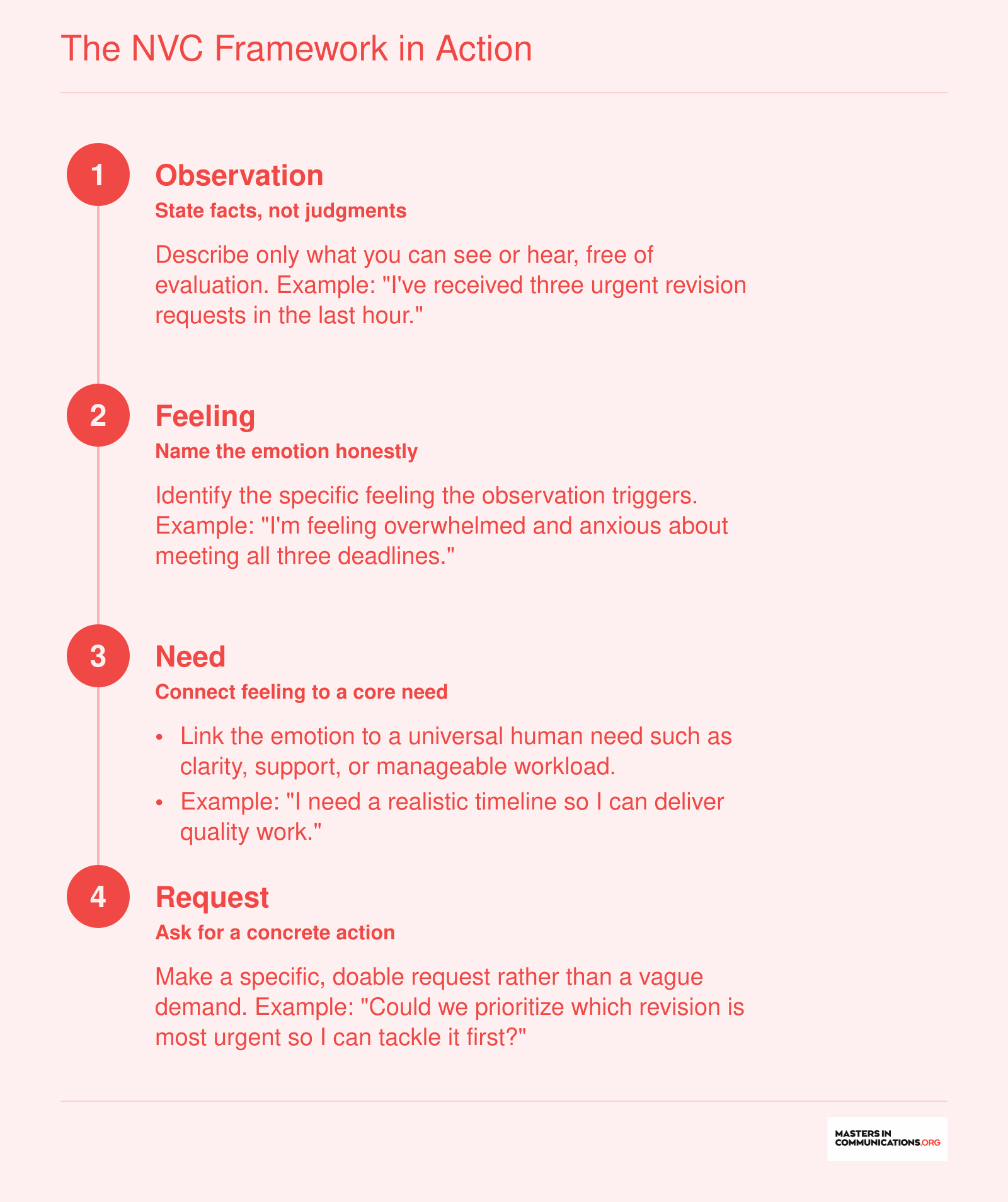
The NVC Framework in Action
Nonviolent Communication (NVC), developed by Marshall Rosenberg, gives you a repeatable structure for expressing yourself clearly even when stress is running high. Walk through these four steps the next time tension spikes at work or at home.
Communicating About Stress in the Workplace: Scripts and Strategies
Thirteen percent of U.S. employees disclosed mental health or stress concerns to a manager in 2025, according to NAMI's Workplace Mental Health Poll, despite 83 percent reporting work-related stress.12 The gap signals both acute need and widespread reluctance. Fear drives that silence: 42 percent worry about career consequences, and 50 percent fear judgment.1 Yet transparent communication about workload stress consistently correlates with better retention and productivity outcomes. Organizations that implement strong wellbeing strategies reduce turnover by 11 percent, and every dollar invested in mental health returns four dollars in productivity gains.32 Structured, solution-focused conversations about stress are a professional skill, not a liability, and the script below offers a tested framework.
Talking to Your Boss: A Sample Script
Open with impact on work quality, not personal complaints. Frame stress as a performance variable you want to manage collaboratively. Here is a full example:
"I wanted to talk about the workload on Project X. I've noticed my response times slipping, and I'm not delivering the quality I aim for. Over the past three weeks, I've been handling Project X, the Q2 compliance audit, and two client escalations simultaneously. I want to deliver strong results on X, and I'd like your input on which of these other commitments we can reschedule or delegate so I can give it the focus it needs. Can we look at the timeline together?"
This structure names the problem, quantifies it with specifics, and proposes collaboration rather than demanding relief. You present yourself as someone solving a performance challenge, which managers value. Framing stress in terms of shared goals also helps with conflict and communication by keeping the conversation productive rather than adversarial.
Peer-to-Peer Stress Communication
Flagging overwhelm to a teammate requires equal care. Avoid guilt-shifting or vague crisis language. Instead, tie the request to shared goals:
"I want to deliver quality on the client presentation, and I need help prioritizing the data analysis and the slide deck to do that. Can we divide them, or should we loop in another team member?"
This phrasing acknowledges the teammate's own workload implicitly, centers the shared deliverable, and offers two paths forward. It does not ask them to absorb your stress; it invites problem-solving.
Addressing the Fear Factor
The fear is real. Fifty percent of employees worry about judgment, and 43 percent fear career consequences for using mental health services.13 But the alternative, silent burnout, carries measurably higher costs. Twenty-five percent of employees considered quitting due to mental health in 2025, and 7 percent actually did.1 Transparent communication, by contrast, builds trust. Employees who receive workplace mental health training report 17 percentage points less productivity loss and 10 percentage points less fear of judgment than those without it.1 Managers trained in wellbeing conversations typically respond with support, not punishment, especially when the employee presents a solution-oriented approach. These are exactly the kind of soft skills for employment that distinguish high-performing professionals.
Timing and Channel
Timing matters. Do not initiate this conversation during a crisis, in an open workspace, or via instant message. Request a private, scheduled meeting: "I'd like 20 minutes to discuss workload priorities. Does Thursday afternoon work?" After the conversation, follow up in writing with agreed action items. A brief email ("Thanks for the conversation today. To confirm, we'll push the audit deadline to X and I'll focus on Project Y this week") creates shared accountability and a record of the manager's support. This documentation protects both parties and ensures follow-through.
Managing Stress Through Communication in Relationships
Stress does not stay contained inside one person; it spreads through every relationship it touches, and the way you communicate under pressure largely determines whether your closest connections become a source of relief or an additional burden.
The Demand-Withdraw Pattern
When stress escalates inside a relationship, partners frequently fall into what researchers call the demand-withdraw pattern. One person presses harder, asking questions, making accusations, or seeking resolution, while the other goes quiet, disengages, or physically leaves the room. Neither person is villainous; both are reacting to overwhelm. But the cycle feeds itself. The more one partner pursues, the more the other retreats, and the more the other retreats, the more urgency the pursuing partner feels. Naming the pattern out loud, calmly and without blame, is often enough to interrupt it: "I think we're doing that thing where I keep pushing and you keep pulling back. Can we both take a breath?"
Repair Phrases That Actually Work
Gottman Institute research consistently shows that repair attempts, small verbal gestures that de-escalate tension, are among the strongest predictors of relationship health. Having a few ready before a conflict starts makes them easier to use when stress narrows your thinking. Try:
- "I'm not angry at you, I'm overwhelmed. Can we pause and restart?"
- "I need about 10 minutes before I can talk about this productively."
- "I want to understand your side. I just need a moment to calm down first."
- "This isn't about blame. I'm struggling, and I need us to figure it out together."
The Soft Startup Technique
How a difficult conversation opens almost always predicts how it ends. Gottman's soft startup principle means leading with your own feelings and a specific request rather than an attack on the other person. Compare these two openers on the same issue:
Harsh: "You never help around the house and I'm exhausted because of it."
Soft: "I've been running on empty lately, and I'd really appreciate help with dinner on Wednesdays."
The second version carries the same underlying frustration but removes contempt and criticism, the two communication behaviors most correlated with relationship deterioration. The listener is far more likely to hear the request rather than defend against an accusation. Building stronger communication skills for personal relationships can make techniques like these feel more natural over time.
Communicating Across Generations
Family dynamics add extra layers of complexity. A stressed parent snapping at a child during homework time teaches the child that stress equals hostility, which shapes how that child will eventually handle pressure themselves. One reset phrase helps here too: "I'm sorry I was short with you. I was frustrated about something else, and that wasn't fair to you."
Adult children navigating difficult conversations with aging parents face a different challenge. When the topic is health, finances, or living arrangements, the parent may feel their autonomy is being questioned. Factors like hearing loss impact on communication can further complicate these exchanges. Opening with acknowledgment, something like "I know you've always handled things yourself, and I respect that. I'm bringing this up because I care about you, not because I think you can't manage," changes the emotional temperature before the harder content arrives.
Communication Across Different Channels Under Stress
Not all communication channels carry the same weight when you are under pressure, and choosing the wrong one during a stressful moment can turn a small friction point into a full breakdown.
Why Channel Choice Matters More When You Are Stressed
Albert Mehrabian's often-cited research suggests that the vast majority of emotional meaning in a message comes from tone of voice and mastering body language rather than the words themselves. Researchers routinely note that his original studies had narrow conditions and should not be applied universally, but the underlying principle holds: strip away vocal tone and facial expression, and your reader is largely guessing at your emotional state. When stress is already distorting how you choose words, that guesswork becomes genuinely risky.
Digital communication removes most of those cues. Research examining tone ambiguity in written workplace messages consistently finds that email and chat messages are misread at surprisingly high rates, with recipients frequently interpreting a neutral message as negative.1 A 2025 digital communications outlook from Smarsh noted that text-based channels remain a leading source of workplace misunderstanding, particularly during high-pressure periods.2
A Channel-by-Channel Breakdown
Four channels dominate most professional and personal communication today. Here is how each performs under stress:
- Email: Tone misinterpretation risk is high; emotional bandwidth is low.1 Best reserved for simple, non-urgent information where clarity can be achieved through careful drafting and a re-read before sending.
- Chat or instant messaging (Slack, Teams): Also carries high misinterpretation risk and low emotional bandwidth. Notification overload in these platforms compounds stress directly. Research from SAGE Publications links constant chat alerts to elevated fear-of-missing-out and digital fatigue.3 Use chat for quick factual questions or urgent updates, not nuanced conversations.
- Voice calls: Tone misinterpretation risk drops significantly because vocal cues are restored. Emotional bandwidth is high.2 A phone call is often the fastest way to defuse a brewing email chain that has started to feel tense.
- Video calls: Lowest misinterpretation risk and highest emotional bandwidth among digital options. Stanford research on video conferencing fatigue, published through Frontiers, documents real cognitive load costs from sustained video calls, so they are not always the right default.4 Reserve them for sensitive discussions, team bonding, or anything that genuinely needs faces in the frame.
When to Switch Channels
The practical rule is straightforward: if a text-based exchange has required more than two clarifying messages, or if you notice an edge creeping into the tone, move to voice or video. The same applies in reverse for video call fatigue. A short phone call often accomplishes what a thirty-minute video meeting was trying to do.
When you are tired or stressed, drafting an email or Slack message and waiting ten minutes before sending is a low-effort way to catch the tone problems your stressed brain did not notice on the first pass. Paying attention to communication etiquette in these moments is not a soft skill; it is one of the most practical stress-management tools available in a workplace that runs almost entirely on screens.
When to Seek Professional Help for Stress and Communication Problems
Everyone snaps at a colleague after a sleepless night or goes quiet during a difficult conversation. That kind of friction is normal. The question worth asking is whether the pattern persists, spreads, or starts to feel outside your control.
Recognizing When the Pattern Has Become a Problem
Occasional communication missteps under pressure are one thing. It is time to consider professional support when you notice any of the following lasting more than a few weeks or showing up across multiple relationships:
- Persistent withdrawal: Consistently shutting down or avoiding conversations rather than engaging, even in low-stakes situations.
- Explosive reactions: Anger responses that feel disproportionate and leave lasting damage to relationships at home or at work.
- Pervasive breakdown: Difficulty communicating clearly not just with one person but across friendships, family, and professional settings simultaneously.
- Co-occurring symptoms: Communication struggles that travel alongside anxiety, hypervigilance, intrusive thoughts, or other signs of trauma or burnout.
When these patterns cluster together, the communication issue is usually a signal, not the root cause. Treating the signal alone rarely produces lasting change. In some cases, the struggle may overlap with broader communication difficulties that benefit from specialized assessment.
Therapeutic Approaches Worth Knowing
Several evidence-based options address the intersection of stress and communication directly. Cognitive behavioral therapy helps people identify the distorted thought patterns that trigger defensive or avoidant communication, then practice replacing them with more grounded responses. For couples or close partners experiencing chronic communication breakdown, emotionally focused therapy and the Gottman method both offer structured frameworks for rebuilding connection and reducing reactivity. For professionals whose communication struggles are largely workplace-specific, executive coaching can address patterns like conflict avoidance, poor boundary-setting under pressure, or difficulty speaking up to leadership.
The right fit depends on where the friction is loudest and how deep it runs.
Building Toward Specialization
For professionals who want to move beyond managing their own stress and communication challenges and into helping others navigate them, formal education opens additional doors. A Master's in Health Communication, for example, builds expertise in the ways stress, illness, and institutional pressure affect how people give and receive information. That background is increasingly valuable in healthcare, public health, and organizational consulting, and you can explore a range of careers with a masters in communication in those fields.
Reframing What Asking for Help Means
Seeking support for communication under stress is not an admission that something is broken. Athletes work with coaches not because they are failing but because sustained performance requires outside perspective and deliberate practice. The same logic applies here. Reaching out to a therapist, coach, or communication specialist is one of the more concrete skill-building moves available to you, and the earlier you do it, the more leverage you get.
Frequently Asked Questions About Communication and Stress
Below are answers to the questions professionals ask most often about the connection between communication and stress. Each response draws on the neuroscience, frameworks, and workplace strategies discussed throughout this guide.
- How can communication help with stress?
- Verbalizing what you feel activates the prefrontal cortex and dampens the amygdala's fight-or-flight response, a process neuroscientists call affect labeling. Structured approaches like Nonviolent Communication (NVC) channel that effect into concrete steps: observing facts, naming feelings, identifying needs, and making clear requests. Over time, these habits lower cortisol levels and build a sense of control, making stress more manageable rather than overwhelming.
- How does stress affect communication in the workplace?
- When cortisol floods the brain, blood flow shifts away from the prefrontal cortex toward survival-oriented regions. The result is shorter attention spans, reactive language, and difficulty reading social cues. Teams under chronic stress often see more misinterpreted emails, missed deadlines from unclear instructions, and a rise in passive-aggressive exchanges. Research consistently links high workplace stress to lower collaboration quality and higher turnover.
- What are the first signs that stress is hurting your communication?
- Early red flags include increased interrupting, difficulty finding the right word, a tendency to default to 'yes' or 'no' answers, and noticeable withdrawal from meetings or casual conversations. You may also catch yourself rereading messages multiple times without absorbing them, or sending replies that are unusually terse. Physically, a clenched jaw or shallow breathing during conversations signals that stress is already reshaping how you interact.
- How do you talk to your boss about stress at work without risking your career?
- Frame the conversation around performance and solutions, not complaints. Use a script grounded in NVC: state the specific situation ('My current project load has increased by 40 percent this quarter'), name its impact on outcomes ('Response times to clients have slipped'), and propose a concrete adjustment ('Could we reprioritize deliverables or shift one project?'). Requesting a private, scheduled meeting and arriving with data shows professionalism rather than vulnerability.
- What communication skills help most in high-stress situations?
- Active listening tops the list because it slows reactive impulses and ensures you respond to what was actually said. Paraphrasing, or reflecting someone's point back in your own words, reduces misunderstandings on the spot. 'I' statements ('I feel overwhelmed when deadlines shift without notice') prevent blame spirals. Finally, strategic pausing, even five seconds of silence before replying, gives your prefrontal cortex time to re-engage and produce a thoughtful response.
- How does tiredness make communication worse?
- Sleep deprivation impairs the same prefrontal functions that stress targets: working memory, emotional regulation, and cognitive flexibility. Studies show that after 17 to 19 hours without sleep, cognitive performance drops to levels comparable to a blood alcohol concentration of 0.05 percent. In practice, fatigued communicators miss nuance, default to blunt or irritable language, and struggle to sustain attention during longer conversations. The combination of tiredness and stress compounds these effects dramatically.