
What you’ll learn in this article…
- Graduate communication tuition often runs $30,000 to $120,000, and the realistic salary bump rarely offsets that cost within a decade.
- About 40 percent of U.S. master's students leave without finishing, carrying debt but no credential.
- Industry certifications like the APR cost under $500 and can match a master's degree in hiring weight at many employers.
- Overqualification frequently blocks master's holders from entry and mid level roles where most communication jobs exist.
Can a master's in communication actually pay for itself before the debt drags down your career? Tuition at private universities can push graduate borrowing past $70,000, while the Bureau of Labor Statistics national median for public relations specialists, a common target role, sits at just $62,800. Yet enrollment keeps climbing, even as underemployment in communication fields remains stubbornly high.
For some professionals, the degree is a genuine springboard. But for many, the financial math and opportunity costs simply do not add up. In a profession where a strong portfolio and measurable results often outweigh a second diploma, the numbers on tuition, forgone earnings, and the real salary floor deserve a hard pause before any application is submitted.
The True Cost: Tuition, Debt, and Opportunity Cost
The decision to pursue a master's in communication ultimately comes down to a blunt financial question: will the degree pay for itself before the debt becomes a drag on your career and life goals? For many prospective students, the honest answer is less encouraging than graduate program brochures suggest.
Tuition Ranges Vary Widely, but the Bill Adds Up
Public universities typically charge between $20,000 and $40,000 in total tuition for a communication master's, while private institutions can push that figure to $50,000 or well beyond $70,000 for name-brand programs. Online master's in communication programs occasionally come in lower, sometimes in the $15,000 to $30,000 range, but fees for technology, course materials, and campus-visit residencies can close the gap quickly. Once you factor in books, software subscriptions, and incidentals, most students should budget 10 to 15 percent above the sticker price.
Graduate Debt Loads in Communication and Related Fields
Federal data shows the median debt for all master's degree borrowers sits near $38,566, with the average climbing to roughly $47,906.1 Communication and humanities-adjacent disciplines tend to land higher. Borrowers completing master's programs in behavioral sciences carry a median debt of about $59,596, while those in arts, entertainment, and media management finish around $42,906. Students in audiovisual communications technologies average close to $48,828.2 These figures place most communication-oriented graduates squarely in the $40,000 to $60,000 debt window, a range that shapes monthly budgets for years.1
On a standard 10-year repayment plan at current federal interest rates (which have hovered near 7 percent for graduate Direct Unsubsidized Loans in recent years), a $40,000 balance translates to roughly $400 to $500 per month.1 Push that balance to $60,000 and the payment climbs proportionally. Even income-driven repayment plans, which lower monthly obligations, extend the repayment window to 20 or 25 years and rack up substantially more interest over the life of the loan.
The Opportunity Cost Nobody Mentions in the Brochure
Tuition and debt are only half the equation. A full-time communication master's program takes 1.5 to 2 years to complete. If you are a mid-career communications professional earning between $50,000 and $65,000 annually, stepping away from the workforce means forgoing $75,000 to $130,000 in pre-tax earnings. That is money that would have gone toward retirement contributions, emergency savings, or paying down existing debt.
Even part-time and online students who keep working often reduce their hours or pass on promotions and lateral moves that require bandwidth they no longer have. The compounding effect of missed raises, delayed title changes, and paused networking activity is harder to quantify, but recruiters and hiring managers consistently value recent, progressive job experience. Two years of stagnation on a resume can cost you the very momentum the degree was supposed to create.
A Realistic Debt Scenario
Consider a working professional who borrows $50,000 for a two-year program at a mid-tier private university. On a standard repayment plan, monthly payments land around $580. If that graduate returns to or enters a communications role paying $55,000 (roughly $42,000 after taxes in most states), nearly 17 percent of take-home pay goes straight to loan payments. That monthly squeeze persists for a full decade, during which the borrower will have repaid close to $69,000 once interest is included. Add in the $100,000-plus in lost earnings during the program, and the total cost of the degree easily crosses $170,000. Recouping that sum through incremental salary gains of a few thousand dollars per year can take well over a decade, if the salary bump materializes at all.
Before signing a promissory note, run these numbers with your own salary, your target program's actual cost of attendance, and a realistic post-graduation income. The math should work on paper before it has to work in real life.
What Communication Professionals Actually Earn
Before investing in a master's in communication, it helps to see what professionals in related roles actually take home. The table below uses national median salary data from the Bureau of Labor Statistics. Note that these figures reflect all workers in each occupation regardless of education level, so a master's degree does not automatically place you at or above the median.
| Occupation | National Median Salary | 25th Percentile | 75th Percentile | Total Employment |
|---|---|---|---|---|
| Public Relations Managers | $138,520 | $102,300 | $198,000 | 76,060 |
| Fundraising Managers | $123,480 | $92,880 | $166,420 | 36,920 |
| Communications Teachers, Postsecondary | $77,800 | $60,060 | $103,230 | 29,260 |
| Fundraisers | $66,490 | $52,590 | $85,280 | 105,930 |
| Broadcast Announcers and Radio Disc Jockeys | $45,680 | $33,280 | $72,080 | 23,880 |
Communication Master's ROI: Does the Math Actually Work?
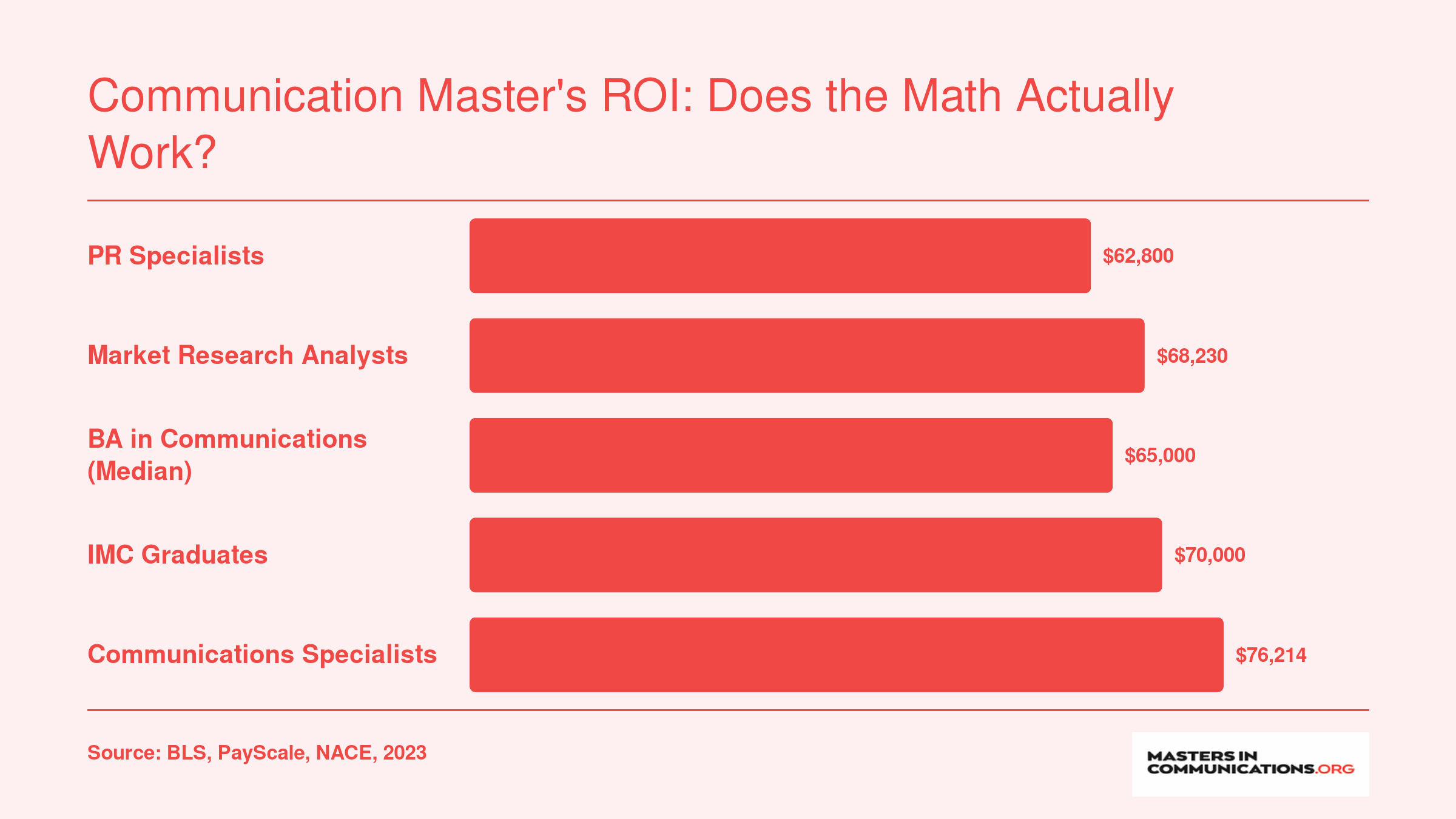
When you stack up the total cost of a master's degree (tuition plus two years of foregone salary) against the realistic salary bump, the numbers often disappoint. Many communication roles pay similarly whether you hold a bachelor's or a master's, and the premium rarely justifies $60,000 or more in combined costs. The chart below compares typical annual earnings for common communication roles, most of which do not require or meaningfully reward a graduate degree.
No Guarantee of Career Advancement or Higher Pay
A master's degree in communication does not automatically translate into promotions, raises, or a corner office. In most corners of the communication industry, hiring managers prize a strong portfolio, measurable results, and demonstrable judgment over a second diploma. That uncomfortable truth deserves a closer look before you sign a tuition check.
What Hiring Managers Actually Value
In public relations, corporate communications, content strategy, social media, and journalism, the work speaks louder than the credential. A campaign that moved metrics, a feature that earned syndication, a crisis statement that protected a brand: these are the artifacts that win interviews. A graduate seminar on media theory rarely shows up on a creative brief. Talk to recruiters at agencies or in-house comms teams and you will hear the same refrain: send writing samples, case studies, and a tight reel. A master's may help you clear an initial resume screen at a large, credential-heavy employer, but it seldom substitutes for proof you can do the job.
Underemployment and Regret Signals
The outcome data, while imperfect, is sobering. In recent surveys, roughly 64% of communications graduates and 87% of journalism graduates said they would choose a different major if given the chance, compared to 37 to 40% across all bachelor's holders. Humanities graduates broadly report degree-to-job mismatch rates near 38%, meaningfully higher than the roughly 25% reported by non-humanities peers. These figures cover undergraduates more than master's holders specifically, so treat them as directional rather than precise. Still, the pattern is hard to ignore: many people in communications-adjacent fields end up in roles that did not require their degree at all.
Where ROI Is Weakest, and Where It Might Hold
Not all communication subfields carry the same payoff. Media studies, mass communication theory, and cultural studies tracks tend to deliver the thinnest financial return, since employers in industry rarely price those credentials into salary bands. The clearer exceptions are academic and research pathways: a master's is typically a prerequisite for community college teaching and a stepping stone toward a PhD and tenure-track work. Health communication, strategic communication with a quantitative analytics focus, and instructional design can also justify the investment when paired with relevant work experience.
Credential Inflation Erodes the Signal
As more professionals earn master's degrees, the signaling value of any single diploma weakens. In a field where output quality is easy to demonstrate through a portfolio, that erosion bites harder than it does in credential-gated professions like law or accounting. The degree becomes table stakes at best, and invisible at worst.
Questions to Ask Yourself
The Overqualification and Job-Mismatch Problem
A master's in communication can create an unexpected barrier: appearing overqualified for the positions you're actually likely to land. Many graduates discover that the credential meant to open doors instead closes them, particularly at the entry- and mid-level roles that make up the bulk of available openings.
When More Education Means Fewer Callbacks
Hiring managers often view advanced degrees as signals of inflated salary expectations or quick turnover risk. If a job posting calls for two to three years of experience and a bachelor's degree, a candidate holding a master's may be screened out automatically, either by applicant tracking systems or by recruiters who assume the candidate will leave as soon as a better opportunity appears. This dynamic is especially pronounced in corporate communication departments, where budgets are fixed and roles are standardized. The result is fewer interview invitations for the majority of available positions, which remain squarely in the entry- to mid-level range.
Saturation in Popular Niches
Popular communication specializations face intense competition. Social media management, content strategy, and public relations attract floods of credentialed candidates, yet employer demand for master's-level hires in these areas remains modest. The Bureau of Labor Statistics projects approximately 27,600 annual openings for public relations specialists over the 2024 to 2034 period, with 5 percent growth (faster than the 3.1 percent national average).1 Across all media and communication occupations, about 104,800 openings are expected annually, but growth in the broader category is slower than average.2 Meanwhile, thousands of communication master's degrees are conferred each year, creating a supply that can outpace the subset of roles specifically seeking advanced credentials. The mismatch between degree production and specialized demand means many graduates end up competing for the same generalist roles as bachelor's holders. Exploring the full landscape of careers with a masters in communication can help you gauge where advanced credentials actually move the needle.
Experience Trumps Credentials
Most employers filter candidates by years of relevant, hands-on experience rather than degree level. A two-year master's program spent largely in seminars and research projects does not substitute for client-facing work, campaign execution, or platform management. In fact, time in graduate school can widen the resume gap, leaving you with less practical experience than peers who spent those same years building portfolios, managing accounts, and earning references. When a hiring manager weighs a candidate with four years of agency experience against one with a fresh master's and two years of pre-grad work, the former often wins. Developing strong soft skills for employment during those working years can matter more than any diploma.
The Bottom Line on Fit
Overqualification is not about being too skilled. It is about a credential mismatch in a field where most openings are designed for practitioners, not theorists, and where the pipeline of degree holders consistently exceeds the pipeline of roles that require or reward graduate training.
Certifications and Alternatives to a Master's in Communication
Five years of qualifying public relations experience plus $385 to $495 in fees can earn you the Accreditation in Public Relations credential, a designation that many agencies and corporate communications departments treat as equivalent to graduate coursework when evaluating candidates for director-level roles.1 That price tag represents roughly one to two percent of what a typical master's program costs, and the preparation timeline of three to twelve months fits around a full-time job without requiring you to pause your career or relocate.1
Credential Stacking: Building a Portfolio Without a Thesis
Rather than betting two years and five figures on a single degree, many communication professionals assemble a portfolio of targeted certifications that signal specific, marketable competencies. Consider the alternatives that hiring managers actually search for on LinkedIn and in applicant tracking systems:
- APR (Accreditation in Public Relations): Requires five years of PR experience; costs $385 to $495 depending on PRSA membership status; recognized across agencies, nonprofits, and corporate communications teams as evidence of strategic expertise. Some employers grant it graduate-credit equivalence for internal promotion rubrics.1
- SCMP (Strategic Communication Management Professional): Aimed at senior practitioners; validates enterprise-level strategy and measurement skills; often pursued by those targeting C-suite or VP communications roles.
- HubSpot Inbound Marketing Certification: Free; completable in a weekend; demonstrates content strategy and lead-generation fluency that digital marketing teams value.
- Google Analytics Certification: Also free; proves you can translate campaign performance into actionable data, a skill set many communication master's programs gloss over.
- PMP or CAPM (Project Management Institute): Costs range from a few hundred to roughly $550 for exams plus prep materials; signals you can run cross-functional campaigns on time and on budget, a differentiator for agency and in-house leadership tracks.
Why Employers Sometimes Prefer Credentials Over Degrees
Certifications solve a problem graduate degrees often cannot: they prove you can do a specific thing right now. A master's transcript shows coursework in theory and research methods; an APR or PMP credential shows you passed a rigorous, practitioner-designed exam that tests current industry standards. For roles where execution speed and measurable results matter more than academic pedigree, employers may weight these credentials equally or even higher.
Combining Credentials With a Bachelor's Degree
A bachelor's in communication plus two or three stacked certifications can outperform a master's on many job descriptions, especially for roles emphasizing digital analytics, media buying, or campaign management. The combination signals both foundational knowledge and specialized, verifiable skills, often at a fraction of the cost and time investment. Staying current matters too; keeping up with latest trends in communication helps ensure your credential portfolio reflects what the market actually demands. If your goal is career advancement rather than academic research, mapping out a certification path may deliver faster ROI than enrolling in a graduate program you are not certain you need.
Even in STEM fields, roughly one in three master's students never finish their degree, according to Council of Graduate Schools completion research. Communication and humanities programs often see comparable or higher attrition. Before enrolling, check IPEDS data and your target university's institutional research pages for program-specific completion rates.
What Happens if You Don't Finish the Program?
Roughly 40 percent of students who begin a master's program in the United States leave before earning the degree, and the consequences for communication students are no different from those in any other field: you carry the debt without the credential.
The Financial Trap of Incomplete Graduate Work
Federal student loans enter repayment six months after you drop below half-time enrollment, regardless of whether you finished the program. If you borrowed $25,000 over two or three semesters and then stepped away, you still owe that balance plus accruing interest. Unlike undergraduate Pell Grants, there is no federal forgiveness mechanism tied to non-completion. You are left with monthly payments that can stretch over a decade or more, and no degree to justify the investment on your resume or in a salary negotiation.
Private loans can be even less forgiving, sometimes lacking income-driven repayment options entirely. The math that already looked questionable for a completed communication master's degree becomes plainly negative when you subtract the credential from the equation.
How Employers Read an Unfinished Degree
Listing "some graduate coursework" on a resume is a gamble. Some hiring managers interpret it neutrally, but many view it as a red flag suggesting a pattern of incomplete follow-through. In fields like public relations, corporate communications, or media management, where reliability and project completion are core competencies, that perception can quietly move your application to the bottom of the pile. An incomplete graduate stint rarely functions as a positive differentiator the way a finished degree might.
Partial Credits Rarely Transfer
Graduate credit policies are notoriously institution-specific. Most universities cap the number of transfer credits they accept at the master's level, often limiting it to six or nine semester hours. Elective-heavy communication coursework may not map onto another program's requirements at all. The result is that courses you paid for and completed can become academic dead weight, unrecognized by a new school or any professional certification body. In some cases, candidates who never pursued a graduate degree at all, opting instead for a bachelor's in communication, find themselves in a stronger position than those who started and stopped a master's program.
Finding an Exit Ramp Before It Is Too Late
If you are already enrolled and questioning whether to continue, do not simply vanish from the program. Take these steps first:
- Ask about a certificate exit ramp. Some programs allow students who complete a defined cluster of courses (often 12 to 15 credits) to leave with a graduate certificate rather than nothing.
- Request a credit audit. Talk to an advisor at one or two alternative programs to see how many of your completed hours could transfer toward a different master's or a standalone certificate.
- Negotiate a leave of absence. A formal leave preserves your enrollment status and can buy time to reassess without triggering loan repayment or burning bridges with faculty.
- Weigh the remaining cost against the credential's value. If you are two courses away from finishing, the marginal cost of completion may be far less painful than walking away with debt and no diploma.
Dropping out is sometimes the right decision, especially when the program is a poor fit or when personal circumstances change. But doing it without exploring every off-ramp first turns a difficult situation into a genuinely costly one.
Workload, Mental Health, and Work-Life Balance Risks
Mental health has moved from a footnote to a central concern in graduate education conversations, with universities now reporting record counseling demand from working adult learners. Yet most communication master's programs still pitch themselves on flexibility without honestly accounting for what 18 to 24 months of sustained academic effort does to a person already holding down a career and a household.
The Real Weekly Time Commitment
Plan for 15 to 25 hours per week of coursework on top of your full-time job. That figure includes assigned readings (often 100+ pages per class per week in theory-heavy courses), discussion board posts, written assignments, group project coordination across time zones, and recorded lectures. A standard two-course semester load translates to roughly the equivalent of a second part-time job. If you currently work 45 to 50 hours weekly, you are looking at 60 to 75 hour weeks for the duration of the program, with weekends absorbed by writing.
Burnout and Cohort Rigidity
Burnout risk climbs sharply for students balancing a program with caregiving responsibilities or demanding client-facing work. Cohort-based programs, while pedagogically strong, lock you into a fixed pace: miss a semester for a family emergency or a work crisis, and you may wait a full year to rejoin. Self-paced programs solve this but introduce a different problem, namely the isolation and motivation drop that comes without peers moving alongside you. Even online masters in communication management programs, which emphasize scheduling flexibility, rarely eliminate these pressures entirely.
The Capstone Bottleneck
Most communication master's programs culminate in a thesis, applied research project, or portfolio capstone. This is where attrition spikes. Students who coasted through coursework hit a wall when asked to produce 40 to 80 pages of original research while still working full time. Faculty advisor availability is uneven, revision cycles drag, and the final semester becomes a months-long high-stress sprint. Institutions have begun treating this as a crisis communication for student mental health issue, but solutions remain uneven.
The Hidden Relationship Cost
Program marketing rarely mentions what spouses, partners, and children actually experience: missed dinners, canceled weekends, a parent visibly stressed for two years straight. Couples counselors see this pattern often. Before enrolling, have an honest conversation with the people who share your home about what they are signing up for too.
Who Should Not Pursue a Communication Master's Degree
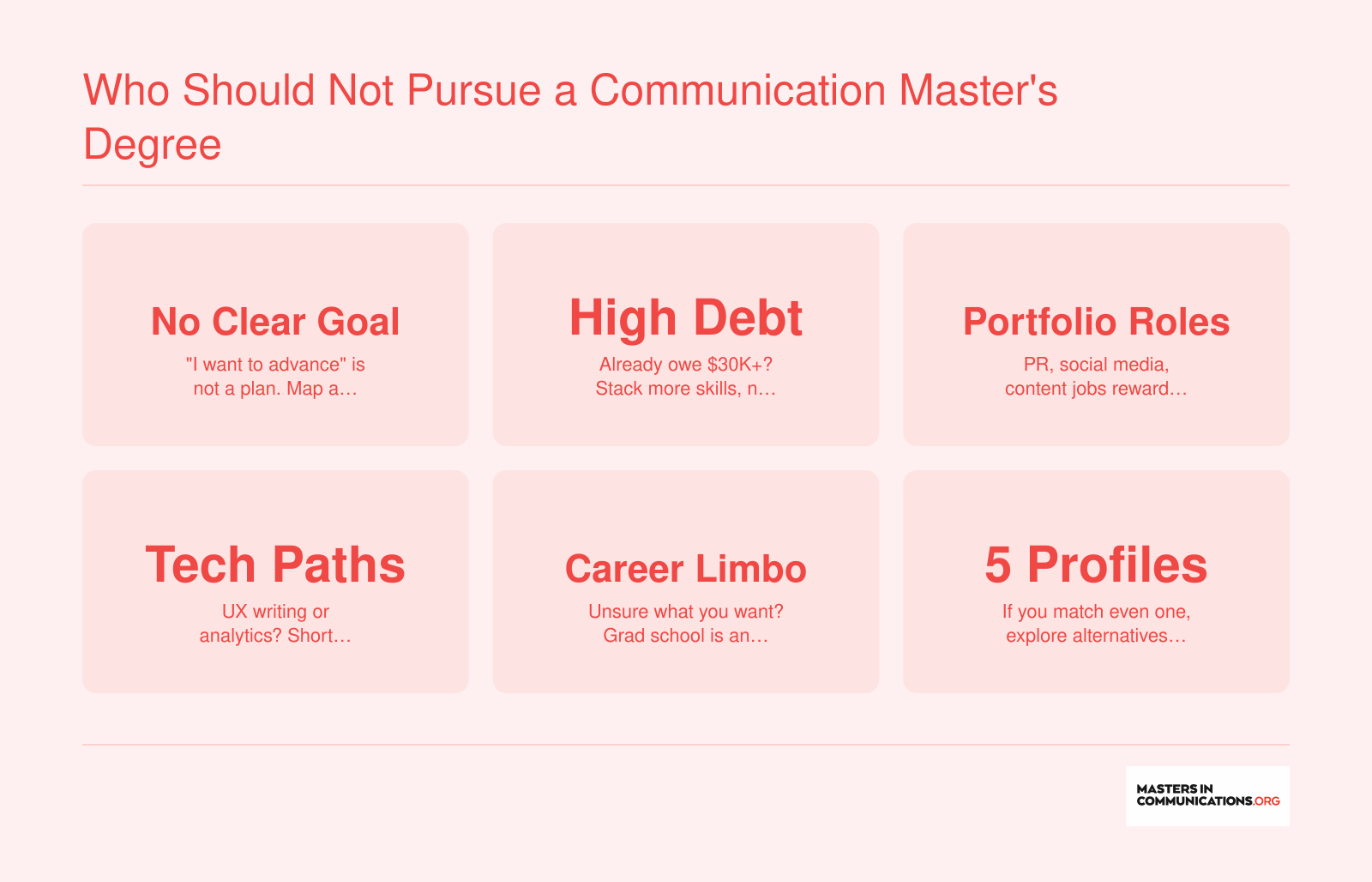
A master's in communication is not the right fit for everyone. If you recognize yourself in any of these profiles, pause before applying. Each one includes a smarter next step than enrolling in a graduate program you may not need.
Frequently Asked Questions About a Master's in Communication
Before committing two or more years and tens of thousands of dollars to a communication master's program, it helps to get straight answers to the questions most prospective students ask. The responses below draw on the data and analysis covered throughout this article.
- Is it worth it to get a master's degree in communications?
- It depends entirely on your career goals, current salary, and how you plan to finance the degree. For many working professionals, the national median pay for communication roles does not rise enough after a master's to offset tuition and lost earnings during enrollment. If your employer will not subsidize tuition and your target role does not require a graduate credential, the return on investment may be negative. Run the numbers with your own salary data before applying.
- Is a master's in communication necessary for a career in PR or corporate comms?
- In most cases, no. The majority of PR specialists and corporate communications managers hold only a bachelor's degree. Employers in these fields tend to prioritize a strong portfolio, relevant internships, and measurable campaign results over graduate coursework. Industry certifications like the APR (Accredited in Public Relations) can signal advanced expertise without the time commitment or cost of a full master's program.
- How much debt will I take on for a master's in communication?
- Total costs vary widely, but many programs run between $30,000 and $120,000 when you factor in tuition, fees, and living expenses. Graduate students frequently rely on federal loans, and interest accrues while you are enrolled. If your post-degree salary increase is modest, repayment can stretch well over a decade. Always compare net price estimates across schools and look for assistantship or employer tuition reimbursement options before borrowing.
- Why do some employers look down on communications majors?
- Some hiring managers view communication degrees as less technically rigorous than fields like data science, finance, or engineering. The perception, fair or not, is that the curriculum covers broad theory rather than hard, measurable skills. You can counter this bias by building a portfolio of real campaign metrics, learning analytics tools, and earning industry certifications that demonstrate specialized competence beyond what a transcript alone conveys.
- What are the job prospects after a communication master's degree?
- The Bureau of Labor Statistics projects steady but not explosive growth for many communication occupations through the late 2020s. Roles in public relations, media management, and organizational communication exist, yet competition is stiff because the field attracts a large number of graduates relative to open positions. A master's alone will not guarantee a role; hiring increasingly hinges on demonstrated digital skills, leadership experience, and a measurable track record.
- Can certifications replace a master's in communication for career advancement?
- For many professionals, yes. Credentials such as the APR, HubSpot Content Marketing Certification, Google Analytics certification, and project management certificates (PMP or CAPM) can sharpen your skill set at a fraction of the cost and time. Pairing targeted certifications with on-the-job results often impresses employers more than a graduate degree, especially when the role you want does not list a master's as a requirement.
A master's in communication is a real financial commitment, often $30,000 or more in tuition, that the salary data for most communication roles does not reliably justify. When you add the overqualification trap, where mid-level employers pass on candidates they expect will leave or demand more, and the faster, cheaper alternatives like industry certifications and portfolio-building that hiring managers increasingly respect, the case for the degree gets thin fast.
Pursue it only if a specific role you genuinely want gatekeeps on the credential (think academia or certain federal communications positions), your employer covers a meaningful share of the cost, and you are entering the program with little existing debt. For professionals who still want to sharpen their edge without enrolling in a graduate program, learning how to become a better communicator through deliberate practice often delivers more immediate results. If those three conditions are not all true at once, your time and money will almost certainly go further somewhere else.